Magneto-responsive soft films constitute a fascinating class of smart materials and devices capable of performing various tasks, such as micromanipulation or transport, noninvasive surgery, and sensing. These components are fabricated by incorporating magnetic materials into flexible substrates. In this context, arranging magnetic particles into elongated chains exhibiting shape anisotropy has shown great potential. Here, we introduce a novel technique for fabricating magnetically responsive films using continuous single-step production and self-assembly of magnetic nanoparticles from a carrier gas at atmospheric pressure into anisotropic magnetic structures directly onto flexible polymer layers. We show that the resulting magnetic soft films exhibit significant residual magnetization and a large response to external magnetic fields. Furthermore, we investigate the magnetic properties of the nanoparticle assemblies and show that interparticle interactions play a critical role in determining the final magnetic properties of the nanostructures. Moreover, we provide experimental evidence that fusing the nanoparticles via post-annealing results in a transition from magnetostatic to exchange interactions with an ≈50% increase in the coercivity.
Nanochains (NCs) made up of a one-dimensional arrangement of magnetic nanoparticles (NPs) exhibit anisotropic properties with potential for various applications. Herein, using a novel self-assembly method we directly integrate single NCs onto desired substrates including devices. We present a nanoscopic analysis of magnetization reversal in 1D linear NP arrays by combining x-ray microscopy, magnetoresistance (MR), and micromagnetic simulations. Imaging the local magnetization along individual NCs by scanning transmission x-ray microscopy and x-ray magnetic circular dichroism under varyingin situmagnetic fields shows that each structure undergoes distinct non-homogeneous magnetization reversal processes. The experimental observations are complemented by micromagnetic simulations, revealing that morphological inhomogeneities critically influence the reversal process where regions with parallel chains or larger multi-domain particles act as nucleation centers for the magnetization switching and smaller particles provide pinning sites for the domain propagation. Magnetotransport through single NCs reveals distinct MR behavior that is correlated with the unique magnetization reversal processes dictated by the morphology of the structures. This study provides new insights into the complex magnetization reversal mechanism inherent to one-dimensional particle assemblies and the effective parameters that govern the process.
Magnetic one-dimensional structures are attractive nanomaterials due to the variety of potential applications they can provide. The fabrication of bimetallic 1D structures further expands the capabilities of such structures by tailoring the magnetic properties. Here, a single-step template-free method is presented for the fabrication of 1D FeCo alloy nanochains. In this approach, charged single-crystalline FeCo nanoparticles are first generated by the co-ablation of pure Fe and Co electrodes under a carrier gas at ambient pressures and attracted to a substrate using an electric field. When reaching the surface, the particles are self-assembled into parallel nanochains along the direction of an applied magnetic field. The approach allows for monitoring the self-assembly particle by particle as they are arranged into linear 1D chains with an average length controlled by the deposited particle concentration. Magnetometry measurements revealed that arranging nanoparticles into nanochains results in a 100% increase in the remanent magnetization, indicating significant shape anisotropy. Furthermore, by combining x-ray microscopy and micromagnetic simulations, we have studied the local magnetization configuration along the nanochains. Our findings show that variations in magnetocrystalline anisotropy along the structure play a crucial role in the formation of magnetic domains.
The direct integration of 1D magnetic nanostructures into electronic circuits is crucial for realizing their great potential as components in magnetic storage, logical devices, and spintronic applications. Here, we present a novel template-free technique for producing magnetic nanochains and nanowires using directed self-assembly of gas-phase-generated metallic nanoparticles. The 1D nanostructures can be self-assembled along most substrate surfaces and can be freely suspended over micrometer distances, allowing for direct incorporation into different device architectures. The latter is demonstrated by a one-step integration of nanochains onto a pre-patterned Si chip and the fabrication of devices exhibiting magnetoresistance. Moreover, fusing the nanochains into nanowires by post-annealing significantly enhances the magnetic properties, with a 35% increase in the coercivity. Using magnetometry, X-ray microscopy, and micromagnetic simulations, we demonstrate how variations in the orientation of the magnetocrystalline anisotropy and the presence of larger multi-domain particles along the nanochains play a key role in the domain formation and magnetization reversal. Furthermore, it is shown that the increased coercivity in the nanowires can be attributed to the formation of a uniform magnetocrystalline anisotropy along the wires and the onset of exchange interactions.
Here we study the influence of particle size on the formation of antiferromagnetic FexO subdomains and the emergence of exchange bias in novel ferrimagnetic Cr-substituted Fe3O4 nanoparticles generated using an aerosol technique based on spark ablation. Cooling in an applied magnetic field across the Neel temperature of the FexO subdomains results in significant shifts in the hysteresis loops, which decrease in magnitude with the particle diameter for the two large systems (D approximate to 20 nm & D approximate to 40 nm), whereas only minor exchange fields are observed for the smallest system (D approximate to 10 nm). The reduced exchange bias is attributed to the metastable FexO's lower volume fraction and size due to a facile transformation into the thermodynamically stable (Fe,Cr)3O4 phase with decreasing particle diameter.
Spark ablation is a versatile technique for producing pure size-selected nanoparticles. The carrier gas used in spark ablation affects the nanoparticles' generation, crystalline structure, and chemical composition. The comprehension of this phenomenon can contribute to the design of nanoparticles with tailored properties. In this paper, we evaluate the effects of reducing (95%N2 + 5%H2), inert (N2), and oxidative (air) carrier gases in a spark ablation setup with Co–Ni alloyed electrodes. The agglomerates' particle size distribution, morphology, structure, and composition were highly dependent on the carrier gas, especially its relative oxygen content. The agglomerates were then sintered into compacted particles. Three different crystalline structures and chemical compositions were observed with X-ray diffraction and confirmed with transmission electron microscopy for the compacted particles. For 95%N2 + 5%H2 and air, single-phase (Co,Ni) and (Co,Ni)O particles were identified, respectively, whereas for N2, two-phase (Co,Ni) and (Co,Ni)O particles were obtained. This work opens up new possibilities of tuning the structure and composition, i.e., distribution of metallic and oxide phases, of the produced particles and thus tailor their properties for specific applications by simply changing the carrier gas.
Realization of stable spin states in surface-supported magnetic molecules is crucial for their applications in molecular spintronics, memory storage or quantum information processing. In this work, we studied the surface magnetism of dimetallo-azafullerene Tb2@C79N, showing a broad magnetic hysteresis in a bulk form. Surprisingly, monolayers of Tb2@C79N exhibited a completely different behavior, with the prevalence of a ground state with antiferromagnetic coupling at low magnetic field and a metamagnetic transition in the magnetic field of 2.5-4 T. Monolayers of Tb2@C79N were deposited onto Cu(111) and Au(111) by evaporation in ultra-high vacuum conditions, and their topography and electronic structure were characterized by scanning tunneling microscopy and spectroscopy (STM/STS). X-ray photoelectron spectroscopy (XPS), in combination with DFT studies, revealed that the nitrogen atom of the azafullerene cage tends to avoid metallic surfaces. Magnetic properties of the (sub)monolayers were then studied by X-ray magnetic circular dichroism (XMCD) at the Tb-M4,5 absorption edge. While in bulk powder samples Tb2@C79N behaves as a single-molecule magnet with ferromagnetically coupled magnetic moments and blocking of magnetization at 28 K, its monolayers exhibited a different ground state with antiferromagnetic coupling of Tb magnetic moments. To understand if this unexpected behavior is caused by a strong hybridization of fullerenes with metallic substrates, XMCD measurements were also performed for Tb2@C79N adsorbed on h-BN|Rh(111) and MgO|Ag(100). The co-existence of two forms of Tb2@C79N was found on these substrates as well, but magnetization curves showed narrow magnetic hysteresis detectable up to 25 K. The non-magnetic state of Tb2@C79N in monolayers is assigned to anionic Tb2@C79N- species with doubly-occupied Tb-Tb bonding orbital and antiferromagnetic coupling of the Tb moments. A charge transfer from the substrate or trapping of secondary electrons are discussed as a plausible origin of these species.
Here we study the influence of particle size on the formation of antiferromagnetic FexO subdomains and the emergence of exchange bias in novel ferrimagnetic Cr-substituted Fe3O4 nanoparticles generated using an aerosol technique based on spark ablation. Cooling in an applied magnetic field across the Néel temperature of the FexO subdomains results in significant shifts in the hysteresis loops, which decrease in magnitude with the particle diameter for the two large systems (D≈20nm&D≈40nm), whereas only minor exchange fields are observed for the smallest system (D≈10nm). The reduced exchange bias is attributed to the metastable FexO's lower volume fraction and size due to a facile transformation into the thermodynamically stable (Fe,Cr)3O4 phase with decreasing particle diameter.
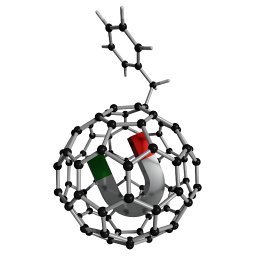
Endohedral fullerenes are perfect nanolaboratories for the study of magnetism. The substitution of a diamagnetic scandium atom in Dy2ScN@C-80 with gadolinium decreases the stability of a given magnetization and demonstrates Gd to act as a single atom catalyst that accelerates the reaching of thermal equilibrium. X-ray magnetic circular dichroism at the M-4,M-5 edges of Gd and Dy shows that Gd affects the ground state. The Gd magnetic moment follows the sum of the external and the dipolar magnetic field of the two Dy ions and compared to Dy2ScN@C-80 a lower exchange barrier is found between the ferromagnetic and the antiferromagnetic Dy configuration. The Arrhenius equilibration barrier as obtained from superconducting quantum interference device magnetometry is more than one order of magnitude larger, though a much smaller prefactor imposes the faster equilibration in Dy2GdN@C-80. This sheds light on the importance of angular momentum balance and symmetry in magnetic relaxation.
Here we present a structural and magnetic characterization of a novel bimagnetic nanoparticle composed of a 40 nm Cr-substituted magnetite phase with 4 nm FeO subdomains exhibiting large exchange bias.
A key parameter for the low-temperature magnetic coupling of in dinuclear lanthanide single-molecule magnets (SMMs) is the barrier U-FA resulting from the exchange and dipole interactions between the two 4 f moments. Here we extend the pseudospin model previously used to describe the ground state of dinuclear endofullerenes to account for variations in the orientation of the single-ion anisotropy axes and apply it to the two SMMs Dy2ScN@C-80 and Dy2TiC@C-80. While x-ray magnetic circular dichroism (XMCD) indicates the same J(z) = 15/2 Dy ground state in both molecules, the Dy-Dy coupling strength and the stability of magnetization is distinct. We demonstrate that both the magnitude of the barrier U-FA and the angle between the two 4 f moments are determined directly from precise temperature-dependent magnetization data to an accuracy better than 1 degrees. The experimentally found angles between the 4 f moments are in excellent agreement with calculated angles between the quantization axes of the two Dy ions. Theory indicates a larger deviation of the orientation of the Dy magnetic moments from the Dy bond axes to the central ion in Dy2TiC@C-80. This may explain the lower stability of the magnetization in Dy2TiC@C-80, although it exhibits a similar to 49% stronger exchange coupling than in Dy2ScN@C-80.
Directed self-assembly of nanoparticles (NPs) is a promising strategy for bottom-up fabrication of nanostructured materials with tailored composition and morphology. Here, we present a simple and highly flexible method where charged magnetic aerosolized (i.e. suspended in a gas) NPs with tunable size and composition are self-assembled into nanostructures using combined electric and magnetic fields. Size-selected Co, Ni, and Fe NPs have been generated by spark ablation, and self-assembled into different structures, ranging from one-dimensional nanochains to macroscopic three-dimensional networks. By comparing the resulting structures with simulations, we can conclude that the magnetization of the NPs governs the self-assembly through interparticle magnetic dipole-dipole interactions. We also show how the orientation of the external magnetic field directs the self-assembly into differently aligned nano- and macroscopic structures. These results demonstrate how aerosol deposition in a combined electric and magnetic field can be used for directed bottom-up self-assembly of nanostructures with specialized composition and morphology.
gamma-CoV2O6 is a quasi-one-dimensional spin-3/2 magnet that possesses two distinct magnetic orders at low temperatures with propagation vectors k(1) = (1/2, 0, 0) and k(2) = (1/4 + delta h, delta k, - 1/4 + delta l), respectively. Here we use muon spin relaxation and rotation to reveal the thermodynamics of the magnetic phase separation in this compound. In the paramagnetic (PM) region, short-range correlated spin clusters emerge at T-m similar or equal to 29 K at the partial expense of the PM volume. Upon further cooling, we show that these emergent clusters become spatially coherent and account for the k(2) phase below T-N2 = 7.5 K, while the remaining PM spins are driven into the k(1) state at T-N1 = 6.6 K. These results stress magnetic microphase inhomogeneity as a thermodynamic precursor for the ground-state phase separation in weakly coupled spin-3/2 chains.
Self-assembly of nanoparticles into vertical structures or larger ensembles can be a powerful method to achieve a strong collective behavior while still obtaining many of the same properties of the individual nanoparticles. In this study, we achieve directed self-assembly of magnetic nanoparticles into nanochains when depositing in a combined magnetic and electric field (M-ESP). We show that the Co nanoparticles are spontaneously magnetized in the aerosol phase, and that the role of the external magnetic field is mainly to guide the deposition in a certain direction.Lastly, we will present chain formation of mixed materials. Here, we combine a strong magnetic material, with other elements to achieve the same chain structure, but with a desired surface functionalization. Nanoparticle chains can therefore be formed with different functionalities, depending on the mixing material. This opens up for further combination to tune the functionalization of the nanoparticle chain structure. (Less)
Self-assembly of nanoparticles into vertical structures or larger ensembles can be a powerful method to achieve a strong collective behavior while still obtaining many of the same properties of the individual nanoparticles. In this study, we achieve directed self-assembly of magnetic nanoparticles into nanochains when depositing in a combined magnetic and electric field (M-ESP). We show that the Co nanoparticles are spontaneously magnetized in the aerosol phase, and that the role of the external magnetic field is mainly to guide the deposition in a certain direction.Lastly, we will present chain formation of mixed materials. Here, we combine a strong magnetic material, with other elements to achieve the same chain structure, but with a desired surface functionalization. Nanoparticle chains can therefore be formed with different functionalities, depending on the mixing material. This opens up for further combination to tune the functionalization of the nanoparticle chain structure. (Less)
Magnetic hysteresis is a direct manifestation of nonequilibrium physics that has to be understood if a system is to be used for information storage and processing. The dilanthanide endofullerene Tb2ScN@C-80 is shown to be a single-molecule magnet with a remanence time on the order of 100 s at 400 mK. Three different temperature-dependent relaxation barriers are discerned. The lowest 1 K barrier is assigned to intermolecular dipole-dipole interaction, the 10 K barrier to intramolecular exchange and dipolar coupling, and the 50 K barrier to molecular vibrations as was observed for Dy2ScN@C-80. The 4 orders of magnitude difference in the prefactor between the Tb and the Dy compound in the decay process across the 10 K barrier is assigned to the lack of Kramers protection in Tb3+. The sub-Kelvin hysteresis follows changes in the magnetization at level crossings of the four possible Tb-2 ground-state configurations. Comparison to a hysteresis model, with magnetic relaxation at level crossings only, reveals cooperative action between nearby molecules.
Endohedral fullerenes are perfect nanolaboratories for the study of magnetism. The substitution of a diamagnetic scandium atom in Dy2ScN@C80 with gadolinium decreases the stability of a given magnetization and demonstrates Gd to act as a single atom catalyst that accelerates the reaching of thermal equilibrium. X-ray magnetic circular dichroism at the M4,5 edges of Gd and Dy shows that the Gd magnetic moment follows the sum of the external and the dipolar magnetic field of the two Dy ions and compared to Dy2ScN@C80 a lower exchange barrier is found between the ferromagnetic and the antiferromagnetic Dy configuration. The Arrhenius equilibration barrier as obtained from superconducting quantum interference device magnetometry is more than one order of magnitude larger, though a much smaller prefactor imposes faster equilibration in Dy2GdN@C80. This sheds light on the importance of the angular momentum balance in magnetic relaxation.
Endohedral fullerenes, such as Dy2ScN@C-80, are single-molecule magnets with long relaxation times of their magnetization. An open and anisotropic 4f electron shell in the lanthanides (here Dy) imposes a magnetic moment that maintains its orientation at liquid-helium temperatures for macroscopic times. If these molecules shall be used as single-bit information storage elements or for quantum operations, the orientation of the endohedral units and the orientation of the magnetic moments has to be controlled. X-ray absorption spectroscopy (XAS) and magnetic circular dichroism (XMCD)-with variation of the angle of x-ray incidence-allows for the detection of these two structural elements. We present XMCD data of Dy2ScN@C-80 on an h-BN/Rh(111) nanomesh that display at 2 K a large hysteresis with a coercive field of 0.4 T. The angular dependence of the XAS data at the Dy M-5 edge indicates partial ordering of the endohedral units. In order to quantify anisotropic orientation we introduce the "deviation" D as an operational quantity that measures differences between two spectra.
Magnetic nanoparticles have shown great potential for use in drug delivery and bioimaging applications and are prospective building blocks in future high-performing permanent magnets. Today, magnetic nanoparticles are most often produced in batches by chemical methods resulting in the risk of chemical impurities and production of vast amounts of chemical waste. Aerosol generation methods on the other hand, particularly spark ablation, are promising for future generation of magnetic nanoparticles since they are simple, fast, continuous, scalable, provide good control of size and composition, and offer the possibility to form alloys of material combinations not miscible on the macroscopic scale. High controllability is of utmost importance when generating magnetic nanoparticles since small deviations in size can significantly alter the magnetic coercivity. Also, the composition of the particles is of high significance since the magnetic properties can be completely transformed by changes in elemental composition or the oxidation state of the particle.In this work, we present the successful generation of monodisperse bimetallic FeCr and FeMn nanoparticles by spark ablation, and the results from the thorough characterization of individual particles with aerosol instruments, transmission electron microscopy, and synchrotron-based X-ray photoelectron spectroscopy. We demonstrate how the carrier gas can be used to dictate the oxidation and how to alternate between self-passivated and completely oxidized nanoparticles. We also show how the produced particles can be deposited to yield a low surface concentration which is critical for minimizing interparticle interactions during magnetic measurements. Finally, as a proof of concept, measurements using a magnetometer equipped with a SQUID on samples with different particle coverages are presented. (Less)
 Edvin Lundgren合作论文数Division of Synchrotron Radiation Research, Department of Physics, Faculty of Science, Lund University;Centre for Nanoscience, Lund University25
 Alexey A. Popov合作论文数Department of Nanoscale Chemistry, Leibniz Institute for Solid State and Materials Research Dresden24
 Thomas Greber合作论文数Univ Zurich, Inst Phys, CH-8057 Zurich, Switzerland22
 Maria E Messing合作论文数Solid State Physics;Lund University;Solid State Physics, Lund University21
 Aram Kostanyan合作论文数Univ Zurich, Phys Inst, Winterthurerstr 190, CH-8057 Zurich, Switzerland19Johan Gustafson合作论文数Lund University17
 Jan Dreiser合作论文数Institute of Quantum Electronics17J.N. Andersen合作论文数16Andrea Resta合作论文数Institute of Physics, Lund University14
 Bernd Büchner合作论文数Institute of Complex Materials, Leibniz Institute for Solid State and Materials Research Dresden;Institute of Solid State Research, Leibniz Institute for Solid State and Materials Research Dresden;TU Dresden12
 Anders Mikkelsen合作论文数Department of Physics, Faculty of Science, Lund University;Centre for Nanoscience, Lund University12Claudiu Bulbucan合作论文数11
 Calle Preger合作论文数MAX IV Laboratory, Lund University11Olivier Balmes合作论文数11
 Knut Deppert合作论文数Division of Solid State Physics, Department of Physics, Faculty of Engineering, Lund University10Christin Schlesier合作论文数9
 Matthias Muntwiler合作论文数9Blomberg Sara合作论文数Division of Synchrotron Radiation Research and Division of Combustion Physics, Lund University8
 Richard Van Rijn合作论文数8
 Shangfeng Yang (杨上峰)合作论文数Department of Materials Science and Engineering, University of Science and Technology of China7
 Cinthia Piamonteze合作论文数Laboratory for Condensed Matter, Center for Photon Science, Paul Scherrer Institute7
 Joost W.M. Frenken合作论文数Advanced Research Center for Nanolithography, University of Amsterdam7Florian Mittendorfer合作论文数7M. Schmid合作论文数6
 Mehran Sedrpooshan合作论文数6
 Pau Ternero合作论文数6
 Lukas Spree合作论文数Leibniz Inst Solid State & Mat Res IFW Dresden, Helmholtzstr 20, D-01069 Dresden, Germany6
 Fupin Liu (刘富品)合作论文数Hefei National Laboratory for Physical Sciences at Microscale, University of Science and Technology of China %%#USTC%%#6
 Georg Kresse合作论文数Faculty of Physics, University of Vienna6
 Stanislav Avdoshenko合作论文数Leibniz Institute for Solid State and Materials Research6
 Bengt O Meuller合作论文数5
 Hendrik Bluhm合作论文数Department of Inorganic Chemistry, Fritz Haber Institute of the Max Planck Society5Xavier Torrelles合作论文数5
 Fabian Fritz合作论文数4Martin Josefsson合作论文数4
 Qingming Deng合作论文数Institute of Solid State Research, Leibniz-Institut für Festkörper- und Werkstoffforschung Dresden;Institute of Solid State Research, Leibniz-Institut für Festkörper- und Werkstoffforschung Dresden4
 Lothar Dunsch合作论文数Leibniz-Institut Für Festkörper- Und Werkstoffforschung Dresden4
 Denis Krylov合作论文数IBS Center for Quantum Nanoscience, Ewha Womans University4Roberto Felici合作论文数Dipartimento di Fisica4
 Michael Grass合作论文数Lawrence Berkeley National Laboratory, Lawrence Berkeley Natl. Laboratory4
 C. J. Weststrate合作论文数3
 Katrin Junghans合作论文数3
 Michał Studniarek合作论文数3Didier Wermeille合作论文数3Vasilii Dubrovin合作论文数Leibniz Inst Solid State & Mat Res Dresden3
 Stefano Rusponi合作论文数Institute of Physics, School of Basic Sciences, Federal Institute of Technology in Lausanne3
 Harald Brune合作论文数Laboratoire de Nanostructures Superficielles, Ecole Polytechnique Federale de Lausanne3Stania Roland合作论文数3
 N. M. Martin合作论文数Division of Synchrotron Radiation Research, Lund University3




