The accuracy of robotic forward kinematics is commonly improved by calibration. However, most calibration methods only take deterministic errors, such as inaccurate geometry and unknown stiffnesses, into account and neglect errors with stochastic characteristics, including joint friction, gear backlash and component wear. In order to incorporate these effects, this paper presents a calibration procedure for a probabilistic forward kinematics model which identifies both systematic errors and error sources whose combined effects are modeled as distributions within a kinematic chain. Additionally, we present a method for using the identified distributions to enhance task-relevant accuracy by minimizing the end-effector uncertainty resulting from such distributions in a task-specific way. Finally, this idea is demonstrated in an experiment with a research rover tasked with picking up a payload box from a lander. Here, we show that end-effector error in task-relevant directions can be reduced by 40% by choosing low-uncertainty over high-uncertainty configurations.
The automation of warehouse operations is crucial for improving productivity and reducing human exposure to hazardous environments. One operation frequently performed in warehouses is bin-packing where items need to be placed into containers, either for delivery to a customer, or for temporary storage in the warehouse. Whilst prior bin-packing works have largely been focused on packing items into empty containers and have adopted collision-free strategies, it is often the case that containers will already be partially filled with items, often in suboptimal arrangements due to transportation about a warehouse. This paper presents a contact-aware packing approach that exploits purposeful interactions with previously placed objects to create free space and enable successful placement of new items. This is achieved by using a contact-based multi-object trajectory optimizer within a model predictive controller, integrated with a physics-aware perception system that estimates object poses even during inevitable occlusions, and a method that suggests physically-feasible locations to place the object inside the container.
Handling raw products in supermarkets is still nowadays a typically manual task. First steps toward automation of these actions are being taken, typically for large production volumes with tailored solutions in well controlled environment. This paper presents a parallel mechanism robotic gripper capable of gripping by scooping and caging deformable fresh-produce like fish and meat as part of an automated logistic delivery chain with high mix low volume. The design motivation has been derived from human pick and place strategies to achieve flexible and robust capabilities in an unstructured environment. The gripper is designed using a variable stiffness actuator, to provide the delicacy required to handle the products without damaging them. Human experiments also provide input to a grasp planning framework to pick the best suited grasp strategy and position for a given object in a given surrounding. Finally, extensive testing of the gripper and grasping framework in lab and industrial conditions demonstrate its suitability for production in the real world setting.
Requirements engineering remains a fundamental yet time-consuming activity for aerospace and other complex systems, where large project documents define mission- and safety-critical specifications. Traditional approaches are challenged by the scale, heterogeneity, and ambiguity of such documents, making it difficult to ensure traceability, consistency, and completeness. This paper introduces a human-in-the-loop requirements analysis pipeline that automates requirement extraction, classification, and verification for aerospace project documentation. The tool employs a hybrid architecture: a document-agnostic, Large Language Model (LLM)assisted parser induces Regular expressions (regex)-based rules to extract requirement blocks into a normalized database, while subsequent analysis pipelines evaluate the requirements from complementary perspectives. The structural pipeline identifies redundancy, traceability gaps, and document coverage issues; the semantic/logic pipeline leverages LLMs to assess ambiguity, conflicts, and requirement clarity. A human-in-the-loop review process validates and refines outputs for reliability in aerospace contexts. While the system is designed for on-premises execution to satisfy exportcontrol and privacy constraints, our experiments were conducted with cloud-hosted LLMs pending local deployment. An initial evaluation on a synthetic European Cooperation for Space Standardization (ECSS)-style corpus representative of spacecraft project documents demonstrates the feasibility of the approach, with strong performance in structured extraction and classification, and clear insights into current limitations of semantic reasoning. Across 225 requirements, leading models achieve Balanced Accuracy (BAcc) of 0.70-0.80 and we have 3% parse errors. The architecture provides a foundation for integration with formal modeling workflows and future verification tasks.
Performing complex manipulation tasks in dynamic environments requires efficient Task and Motion Planning (TAMP) approaches that combine high-level symbolic plans with low-level motion control. Advances in Large Language Models (LLMs), such as GPT-4, are transforming task planning by offering natural language as an intuitive and flexible way to describe tasks, generate symbolic plans, and reason. However, the effectiveness of LLM-based TAMP approaches is limited due to static and template-based prompting, which limits adaptability to dynamic environments and complex task contexts. To address these limitations, this work proposes a novel Onto-LLM-TAMP framework that employs knowledge-based reasoning to refine and expand user prompts with task-contextual reasoning and knowledge-based environment state descriptions. Integrating domain-specific knowledge into the prompt ensures semantically accurate and context-aware task plans. The proposed framework demonstrates its effectiveness by resolving semantic errors in symbolic plan generation, such as maintaining logical temporal goal ordering in scenarios involving hierarchical object placement. The proposed framework is validated through both simulation and real-world scenarios, demonstrating significant improvements over the baseline approach in terms of adaptability to dynamic environments and the generation of semantically correct task plans. Videos and code can be found here: https://muhayyuddin.github.io/llm-tamp/.
Generating robust and reactive manipulation strategies that can adapt to changing context information is a challenging task in robotics. Over the years, Learning from Demonstration (LfD) has emerged as an intuitive and effective solution for generating reactive policies, particularly by following dynamical-system(DS)-based approaches. However, most state-of-the-art DS-based approaches focus on addressing the robustness limitations, overlooking the modulation of policies in response to the environment. As a result, they tend to be inflexible with respect to parameterization by task-dependent variables. In this work, we build on existing work on policy fusion and uncertainty quantification to propose a context-adaptive policy framework that combines task-parameterized, robust and reactive manipulation. For this, we use LfD to acquire a policy that is conditioned on the robot state and low-dimensional task-dependent parameters reflecting the environment. We combine the learned policy with additional uncertainty-aware policies using a Mixture of Experts (MoE) formulation to improve its out-of-distribution (OOD) robustness and convergence behavior. The approach is evaluated on the LASA handwriting dataset and on a real 7-DoF robot in three scenarios: force-conditioned grasping, manipulation of deformable food items and object-centric grasping.
“What can your humanoid robot do?” is probably the most commonly asked question that we, as roboticists, have to answer when interacting with the general public. Often, the question is framed in the familiar household or office setting, with implied expectations of robust locomotion on uneven and cluttered terrain, and compliant interaction with people, objects, and the environment. Moreover, the question implies the existence within the humanoid robot of a set of embodied loco-manipulation skills implemented by a motion planner, skills that are retrievable when given the corresponding commands. In this article, we formulate an answer to this question in the form of an efficient, modular, and extensible motion planner. We demonstrate its use with three challenging scenarios, designed to highlight both the robot’s safe operation and its precise movement in unstructured environments. Additionally, we discuss key techniques derived from our experience in the practical implementation of torque-controlled humanoid robots.
Future space missions will require the ability to manipulate satellites for repairing, refueling, and de-orbiting. This makes orbital and planetary space robotic arms a critical technology. Space robotic arms are designed to operate in zero gravity, but are tested on Earth. However, many space robotic arms are non-gravity-bearing and require a gravity support system. For this reason, the Institute of Robotics and Mechatronics at the German Aerospace Center (DLR) and the University of Duisburg-Essen have developed the Motion Suspension System (MSS), a space robot test facility. It is based on a cable-driven parallel robot that allows the space robot arm to operate on ground in the full three-dimensional workspace. To support the robot arm at arbitrary angles, the coupling interface between the MSS and the space robot arm is equipped with two passive joints with angle sensors. Their values are necessary to reconstruct the direction of the applied force, which is used for controller feedback and dynamics analysis of the space robot. As the joints are affected by friction, the measured angle might differ from the real one. This study proposes a experiment-based method to identify the friction. It reveals that the two joints are affected by viscous and static friction (stiction). However, the friction's influence on the performance of the MSS is minor in comparison to other error sources, such as controller and calibration errors. This finding contributes to a more detailed knowledge about the accuracy of the MSS which is important for using it as a verification and validation device for advanced non-gravity-bearing space robot arms.
Uncertainties in contact dynamics and object geometry remain significant barriers to robust robotic manipulation. Caging helps mitigate these uncertainties by constraining an object's mobility without requiring precise contact modeling. Existing caging research often treats morphology and policy optimization as separate problems, overlooking their synergy. In this paper, we introduce CageCoOpt, a hierarchical framework that jointly optimizes manipulator morphology and control policy for robust caging-based manipulation. The framework employs reinforcement learning for policy optimization at the lower level and multi-task Bayesian optimization for morphology optimization at the upper level. We incorporate a caging metric into both optimization levels to encourage caging configurations and thereby improve manipulation robustness. The evaluation consists of four manipulation tasks and demonstrates that co-optimizing morphology and policy improves task performance under uncertainties, establishing caging-guided co-optimization as a viable approach for robust manipulation.
Robotic joints in space behave in a different way as they do on ground. Although ground testing in thermal and vacuum chambers offers an insight into the behavior of the joints under simulated space conditions, long-term experiments under real conditions provide a more valuable insight into the expected behavior. The German Aerospace Center (DLR) carried out the Robotics Component Verification on the ISS (ROKVISS) experiment from 2005 until 2011, where a two joint robotic arm was mounted outside the International Space Station (ISS) exposed to temperatures between -20 C to +40 C. In this work, we retrieve the original experimental data and use viscous -Coulomb friction models for both joints in order to quantify the temperature dependence of each parameter. Our new analysis shows that for the evaluated data most of the friction can be modeled with static and viscous friction, which are both proportional to temperature. For load-dependent Coulomb friction both the temperature influence and the contribution to the total friction are small. We further present estimated friction model parameters over temperature with confidence bounds, quantifying the differences in joint friction for both joints.
Future space missions, including satellite life extension, orbital asset inspection, and deorbiting, rely heavily on space robotic manipulators. However, testing these robots on Earth presents significant challenges, as they are designed to operate in zero gravity but must be tested under 1 g conditions. Since the joints of most space manipulators cannot support their own weight under Earth gravity, mechanical support systems are required to reduce the gravitational joint loads. The Institute of Robotics and Mechatronics at the German Aerospace Center (DLR) and the University of Duisburg-Essen have developed the Motion Suspension System (MSS) - a cabledriven parallel robot that enables ground-based testing of space robotic manipulators in a fully three-dimensional workspace. This paper presents a quantitative assessment of force reconstruction accuracy, for ground-truth validation of the MSS. Using optical motion capture, we achieved sub-degree accuracy in measuring suspension force direction, identifying systematic errors and improving system performance by 15.6%. This study is crucial to validate the MSS as a qualification platform for space robotic manipulators.
Advancements in material science, manufacturing and sensor technologies, Artificial Intelligence, and the Internet of Things have paved the way for fabricating new parts using additive manufacturing in microgravity conditions. NASA has successfully demonstrated 3D printing onboard the International Space Station (ISS), though at a minor scale. Nevertheless, the parts built onboard the ISS were returned to Earth for further testing and verification. The logistics of bi-directional transportation of raw materials from Earth to ISS and 3D-printed parts from ISS back to Earth is complex, expensive, and slow. Harnessing materials from space to establish in-orbit manufacturing as a sustainable process is both technically and economically challenging. The potential to reuse, repurpose or recycle space debris is not well studied, though there is an increasing momentum in Active Debris Removal (ADR) missions. Unlike the standard research or review paper, this is a visionary paper in which the authors explicitly address the intersection between space debris removal and in-space manufacturing. This paper defines a pathway towards implementing an operational in-orbit manufacturing and debris removal model. For the first time, the authors introduce the application of Cloud-Based Design and Manufacturing (CBDM) for in-space manufacturing in this paper. The paper aims to define a roadmap towards implementing a space operational model for in-orbit manufacturing and debris removal. Future enabling technologies that will leverage the advances in robotics, automation, and Space 5.0-based solutions to create a new environmentally friendly and economically profitable orbital ecosystem are presented. The authors analyze the pros and cons of robotic ADR, upcycling and recycling space debris for on-demand manufacturing in orbit and present a systematic approach to implementing in-orbit manufacturing as a new frontier. Recommendations are made to establish an imminent Earth-independent space logistics and supply chain system for operating an orbital factory or warehouse that will help realize a suite of in-orbit manufacturing, maintenance, and assembly missions.
Performing complex manipulation tasks in dynamic environments requires efficient Task and Motion Planning (TAMP) approaches that combine high-level symbolic plans with low-level motion control. Advances in Large Language Models (LLMs), such as GPT-4, are transforming task planning by offering natural language as an intuitive and flexible way to describe tasks, generate symbolic plans, and reason. However, the effectiveness of LLM-based TAMP approaches is limited due to static and template-based prompting, which limits adaptability to dynamic environments and complex task contexts. To address these limitations, this work proposes a novel Onto-LLM-TAMP framework that employs knowledge-based reasoning to refine and expand user prompts with task-contextual reasoning and knowledge-based environment state descriptions. Integrating domain-specific knowledge into the prompt ensures semantically accurate and context-aware task plans. The proposed framework demonstrates its effectiveness by resolving semantic errors in symbolic plan generation, such as maintaining logical temporal goal ordering in scenarios involving hierarchical object placement. The proposed framework is validated through both simulation and real-world scenarios, demonstrating significant improvements over the baseline approach in terms of adaptability to dynamic environments and the generation of semantically correct task plans.
Orbital services are becoming increasingly important. One of the fundamental engineering challenges to enable such services is to provide mechanical, data, power, thermal, and fluid connectivity for activities such as capture, repairing, upgrading, refueling, life extension, or deorbiting of space assets. This paper provides an overview of the elements used for connectivity, generically referred to as a "standard interface". An overview of interfaces defined for applications in grabbing, mechanical docking, fluid transfer for refueling, and multi-purpose interfaces is provided. A comparative analysis of the interfaces using mechanical criteria and performance characteristics helps to identify the current status and future challenges in this domain.
Future space applications require the assembly of large structures in orbit. This can only be achieved by using autonomous robotic systems able to handle repetitive tasks with heavy and large parts in such challenging environment. This paper provides an overview of a system designed to perform autonomous assembly of segmented mirror tiles, as a proof of feasibility for assembling large structures in space using robotic technologies. We describe the hardware components of the system, and present the software layer, including assembly planning, and skill engine. An experimental evaluation of the assembly process is carried out, thus showing the performance achieved with the system.
Orbital and planetary space robotic arms play a critical role in future space exploration. They are mounted on satellites, landers, and rovers. On satellites, orbital robotic arms can extend the operational life of target satellites, facilitate the inspection of orbital assets, and assist in the deorbiting process. However, ensuring a reliable performance of the robotic arm requires thorough on-ground verification and validation. Although designed for zero- or low-gravity conditions, space robotic arms face a challenge when tested in Earth’s gravity. The limited torque provided by the robot’s joints hinders its ability to perform effective movements on ground. To address this challenge, the Institute of Robotics and Mechatronics at the German Aerospace Center (DLR) and the University of Duisburg-Essen have developed the Motion Suspension System (MSS), a cable-driven parallel robot that mechanically supports robotic arms and enables them to operate on ground in a full three-dimensional workspace. For its use as a qualification device for orbital robotic arms, a sensitivity analysis of the sensor errors is crucial. This study focuses on the impact of angle and force sensor errors on the overall performance of the MSS. Hereby, the study uses analytical computation validated by experimental results.
Autonomous and reliable robotic grasping is a desirable functionality in robotic manipulation and is still an open problem. Standardized benchmarks are important tools for evaluating and comparing robotic grasping and manipulation systems among different research groups and also for sharing with the community the best practices to learn from errors. An ideal benchmarking protocol should encompass the different aspects underpinning grasp execution, including the mechatronic design of grippers, planning, perception, and control to give information on each aspect and the overall problem. This article gives an overview of the benchmarks, datasets, and competitions that have been proposed and adopted in the last few years and presents a novel benchmark with protocols for different tasks that evaluate both the single components of the system and the system as a whole, introducing an evaluation metric that allows for a fair comparison in highly cluttered scenes taking into account the difficulty of the clutter. A website dedicated to the benchmark containing information on the different tasks, maintaining the leaderboards, and serving as a contact point for the community is also provided.
 Christian Ott合作论文数Automation and Control Institute, Technische Universität Wien23
 Christoph Borst合作论文数Center for Visual and Decision Informatics, University of Louisiana at Lafayette21
 Bernd Henze合作论文数20
 Raúl Suárez合作论文数18
 Werner Friedl合作论文数Institute of Electrical;Graz University of Technology;Institute of Electrical, Graz University of Technology17
 Gerhard Grunwald合作论文数17
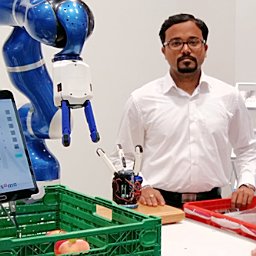 Ashok Meenakshi Sundaram合作论文数electric power research institute15
 Korbinian Nottensteiner合作论文数German Aerospace Center14
 Ismael Rodríguez合作论文数German Aerospace Center (DLR), Institute of Robotics and Mechatronics,Weßling;German Aerospace Center (DLR), Institute of Robotics and Mechatronics,Weßling,Germany,8223413
 Alin Albu-Schäffer合作论文数Institut für Robotik und Mechatronik, Deutsches Zentrum für Luft- und Raumfahrt;School of Computation, Information and Technology, Technical University Munich;Department of Computer Science, Technical University Munich12
 Diego Alexander Garzon-Alvarado合作论文数Departamento de Ingeniería Mecánica y Mecatrónica, Universidad Nacional de Colombia;Institute of Advanced Transdisciplinary Studies, Federal University of Minas Gerais;Biomimetics Laboratory, Biotechnology Institute, National University of Colombia12
 Oliver Porges合作论文数11
 Marco De Stefano合作论文数German Aerospace Center (DLR)10
 Katharina Hertkorn合作论文数Neatleaf GmbH10Manfred Schedl合作论文数10
 Daniel Leidner合作论文数Robotics and Mechatronics Center, RMC German Aerospace Center DLR9
 Jan Rosell合作论文数Institute of Industrial and Control Engineering (IOC-UPC), Barcelona, Spain9
 Andreas Stemmer合作论文数9
 Peter Lehner合作论文数Institute of Robotics and, DLR German Aerospace Center8Pierre Letier合作论文数8
 Alexander Werner合作论文数7
 Tobias Bruckmann合作论文数University Duisburg-Essen Chair of Mechatronics Germany7
 Johannes Englsberger合作论文数Institut für Robotik und Mechatronik, Deutsches Zentrum für Luft- und Raumfahrt7
 Florian Schmidt合作论文数RWTH Aachen University7Jean-Pascal Lutze合作论文数6
 Kensuke Harada (原田研介)合作论文数Harada Lab., Department of Systems Innovation, Graduate School of Engineering Science, Osaka University;Robotic Manipulation Group, Osaka University;Daifuku Logistics Automation Tech Collaborate Research Institute, Osaka University;National Institute of Advanced Industrial Science and Technology6
 Ferdinand Elhardt合作论文数5Anna Sesselmann合作论文数German Aerosp Ctr DLR, Inst Robot & Mechatron, D-82234 Wessling, Germany5
 Martin Stelzer合作论文数German Aerosp Ctr DLR, Inst Robot & Mechatron, D-82234 Wessling, Germany5
 Mathieu Deremetz合作论文数Irstea Technologies and Information Support System Research Unit 9 avenue Blaise Pascal CS 20085 63178 Aubière France5
 Yu Sun合作论文数Department of Computer Science and Engineering, College of Engineering, University of South Florida;Robot Perception and Action Lab, University of South Florida5
 Gerd Hirzinger合作论文数Institut fur Robotik und Mechatronik, Deutsches Zentrum fur Luft- und Raumfahrt5Markus Grebenstein合作论文数Institute of Robotics and Mechatronics, Deutsches Zentrum für Luft und Raumfahrt5
 Claudio Castellini合作论文数University of Genova5Vincent Bissonnette合作论文数4
 Theodoros Stouraitis合作论文数RoboPhren;DeepSea Technologies4
 Hrishik Mishra合作论文数Institute of Robotics and Mechatronics, German Aerospace Center4
 Alexander Dietrich合作论文数Institute of Robotics and Mechatronics, German Aerospace Center4
 Bernhard Brunner合作论文数Institute of Robotics and Mechatronics4Jeremi Gancet合作论文数Space Applicat Serv4
 Alexander Beyer合作论文数4Franziska Zacharias合作论文数4
 Salvatore D'Avella合作论文数Mechanical Intelligence Institute, School of Advanced Studies, Scuola Superiore Sant'Anna3
 Joe Falco合作论文数3Ana Elvira H. Martin合作论文数Technical University of Munich,Institute for Cognitive Systems3
 Timo Bachmann合作论文数Institute of Robotics and Mechatronics, German Aerospace Center (DLR), Wessling, Germany3
 George Mesesan合作论文数Institute of Robotics and Mechatronics, German Aerospace Center (DLR), Wessling, Germany3Mathilde Connan合作论文数German Aerosp Ctr DLR, Inst Robot Id Mechatron3
 Rustam Stolkin合作论文数School of Metallurgy and Materials, College of Engineering and Physical Sciences, University of Birmingham3




