Hurricanes Irma and Maria had a devastating effect on communities all around Puerto Rico and highlighted the lack of resilience of the island's power system. After months without electric service, and being left with unreliable service years later, community leaders are looking for alternatives to fulfill their energy needs. Three microgrid design alternatives for a rural community that consider centralized and decentralized diesel generation, energy storage, and photovoltaic (PV) generation are evaluated in this paper. Design basis threats and performance metrics are defined with community feedback and requirements. The Microgrid Design Toolkit (MDT) was used to run multi-objective optimization, including cost, performance, and sizing optimization. The trade-off space of solutions for the three alternatives is presented in the form of a Pareto frontier. Optimization results for the centralized alternative slightly favor diesel and big storage. However, for less aggregated alternatives, the optimization algorithm favors solar generation leading to higher renewable penetration.
This work details a project to design reliable, resilient, and cost - effective networked microgrids considering grid constraints and resilience metrics focus ed on Puerto Rico distribution feeder locations with long outages after Hurricane Maria. The project consisted primarily of modeling and simulation tasks that ac complished the following objectives: 1. Selected 10 distribution feeder models in vulnerable areas. The sample feeders are geographically distributed across Puerto Rico an d vary in length to capture the wide variety of feeders on the island. 2. Determined the optimal location and sizing of distributed energy resources (DERs) on the identified distribution feeders. The system s considered as part of the microgrid solution s were solar photovoltaic (PV), battery energy storage systems (BESS) and distributed fossil fuel generation (D F F G). 3. Estimated the cost - benefit of the proposed DER portfolios. 4. Provided a set of final recommendations that inform de cision making on how to do targeted planning analysis for microgrids that can supply energy to critical infrastructures.
In response to major system disruptions, policymakers have prioritized enhancing the resilience of the financial services and energy sectors, with a particular focus on banking and electricity regulation. In both sectors, ‘regulating for resilience’ requires bridging system-level policy goals and institution-level policy instruments as well as tailoring institutional requirements to firms’ idiosyncratic risk profiles. Stress testing has enabled financial regulators to partially overcome these analytical and governance challenges, resulting in better capitalized and managed banks, increased attentiveness to systemic risk, and a more resilient financial system. Recognizing the opportunity for translation across sectors and disciplines, this article develops a novel methodology and an actionable policy framework for embedding stress testing in electric utility investment strategies and regulatory processes. It demonstrates how stress testing could enhance the resilience and sustainability of the U.S. electric grid and explores opportunities for regulatory coordination in multi-sector analyses of climate-related risk and resilience.
As part of the project ? Designing Resilient Communities (DRC) : A Consequence - Based Approach for Grid Investment , ? funded by the United States (US) Department of Energy?s (DOE) Grid Modernization Laboratory Consortium (GMLC), Sandia National Labora tories (Sandia) is partnering with a variety of government , industry, and university participants to develop and test a framework for community resilience planning focused on modernization of the electric grid. This report provides a summary of the section of the project focused on h ardware demonstration of ?resilience nodes? concept . Acknowledgements ? SAG members ? P roject partners ? Project team/management ? P roject sponsors ? O ther stakeholders
The purpose of this segmentation strategy is to market tailored offerings to specific segments, thereby improving customer satisfaction while reducing marketing costs. In the fourth and final phase of the project, the segmentation model will be tested by using actual sales data and by collecting new customer preference data. Once this phase is completed, residential program offerings can be developed or modified to best suit the targeted segment.
The rapid increase in penetration of distributed energy resources on the electric power distribution system has created a need for more comprehensive interconnection modeling and impact analysis. Unlike conventional scenario-based studies, quasi-static time-series (QSTS) simulations can realistically model time-dependent voltage controllers and the diversity of potential impacts that can occur at different times of year. However, to accurately model a distribution system with all its controllable devices, a yearlong simulation at 1-second resolution is often required, which could take conventional computers a computational time of 10 to 120 hours when an actual unbalanced distribution feeder is modeled. This computational burden is a clear limitation to the adoption of QSTS simulations in interconnection studies and for determining optimal control solutions for utility operations. The solutions we developed include accurate and computationally efficient QSTS methods that could be implemented in existing open-source and commercial software used by utilities and the development of methods to create high-resolution proxy data sets. This project demonstrated multiple pathways for speeding up the QSTS computation using new and innovative methods for advanced time-series analysis, faster power flow solvers, parallel processing of power flow solutions and circuit reduction. The target performance level for this project was achieved with year-long high-resolution time series solutions run in less than 5 minutes within an acceptable error.
Synapse Energy Economics has conducted structured interviews to better characterize the current landscape of resilience planning within and across jurisdictions. Synapse interviewed representatives of a diverse group of communities and their electric utilities. The resulting case studies span geographies and utility regulatory structures and represent a range of threats. They also vary in terms of population density and size. This report summarizes our approach and the findings gleaned from these conversations. All the communities and utilities we interviewed see increased interest in and commitment of resources for energy-related resilience. The risks and consequences these communities and utilities faced in the past, face now, and will face in the future drove them to improve engagement, advance processes, further decision-making, and in many cases invest in projects. While no process used by communities and utilities was the same, the different processes used by communities and utilities allowed each one to make progress in its own way. Several approaches are emerging that can provide good models for other communities and utilities with an interest in improving resilience.
a clean energy microgrid deployment pilot that integrates a 50 kWAC PV array, a 109 kW / 174 kWh battery system, switchgear to safely isolate from the regional power system, and communicating controllers for HVAC and refrigeration. The project will be commissioned in May 2020 and is sited at a critical infrastructure site in rural Northern California – in this case a gasoline station with convenience store. Our experience and results shed light on capabilities of integrated microgrids to provide value to customers during blue sky conditions and resilience during black sky days with high fire risk, and what opportunities and barriers exist for scaling these integrated microgrid systems in the near term. We use a simulation model to estimate how EE and flexibility can extend the run time of solar and storage, improving the reliability of power at critical sites.
In 2019, Sandia National Laboratories contracted Synapse Energy Economics (Synapse) to research the integration of community and electric utility resilience investment planning as part of the Designing Resilient Communities: A Consequence-Based Approach for Grid Investment (DRC) project. Synapse produced a series of reports to explore the challenges and opportunities in several key areas, including benefit-cost analysis, performance metrics, microgrids, and regulatory mechanisms to promote investments in electric system resilience. This report focuses on regulatory mechanisms to improve resilience. Regulatory mechanisms that improve resilience are approaches that electric utility regulators can use to align utility, customer, and third-party investments with regulatory, ratepayer, community, and other important stakeholder interests and priorities for resilience. Cost-of-service regulation may fail to provide utilities with adequate guidance or incentives regarding community priorities for infrastructure hardening and disaster recovery. The application of other types of regulatory mechanisms to resilience investments can help. This report: characterizes regulatory objective as they apply to resilience; identifies several regulatory mechanisms that are used or can be adapted to improve the resilience of the electric system--including performance-based regulation, integrated planning, tariffs and programs to leverage private investment, alternative lines of business for utilities, enhanced cost recovery, and securitization; provides a case study of each regulatory mechanism; summarizes findings across the case studies; and suggests how these regulatory mechanisms might be improved and applied to resilience moving forward. In this report, we assess the effectiveness of a range of utility regulatory mechanisms at evaluating and prioritizing utility investments in grid resilience. First, we characterize regulatory objectives which underly all regulatory mechanisms. We then describe seven types of regulatory mechanisms that can be used to improve resilience--including performance-based regulation, integrated planning, tariffs and programs to leverage private investment, alternative lines of business for utilities, enhanced cost recovery, and securitization--and provide a case study for each one. We summarize our findings on the extent to which these regulatory mechanisms have supported resilience to date. We conclude with suggestions on how these regulatory mechanisms might be improved and applied to resilience moving forward.
Natural disasters are increasingly impacting the power availability to communities around the world causing long term blackouts. Rural and remote communities are at a greater risk of suffering longer blackouts due to being lower priority or more difficult to power during the energy restoration efforts. The communities impacted by long term blackouts tend to be economically disadvantaged and remote. Fuel pipelines are unavailable and fuel delivery is interrupted as resources are diverted to higher population areas; this makes the installation of PV plus storage very attractive. This is especially true in the tropics where the solar resource is abundant and the limiting factors, also discussed here, are of a different nature. Utilities may not have a complete picture of the restoration of power across time, this is where previous work done by NASA comes in by providing a time series of the recovery process using nighttime satellite imagery. This work proposes a methodology regarding microgrid planning and critical asset clustering using GIS, census, and the nighttime imagery provided by NASA. The work presents a workflow as well as the decision criteria involved. The aftermath of Hurricane María in Puerto Rico is presented as the test case, with a more detailed example based in the town of Jayuya.
Understanding the impact of distributed photovoltaic (PV) resources on various elements of the distribution feeder is imperative for their cost effective integration. A year-long quasi-static time series (QSTS) simulation at 1-second granularity is often necessary to fully study these impacts. However, the significant computational burden associated with running QSTS simulations is a major challenge to their adoption. In this paper, we propose a fast scalable QSTS simulation algorithm that is based on a linear sensitivity model for estimating voltage-related PV impact metrics of a three-phase unbalanced, nonradial distribution system with various discrete step control elements including tap changing transformers and capacitor banks. The algorithm relies on computing voltage sensitivities while taking into account all the effects of discrete controllable elements in the circuit. Consequently, the proposed sensitivity model can accurately estimate the state of controllers at each time step and the number of control actions throughout the year. For the test case of a real distribution feeder with 2969 buses (5469 nodes), 6 load/PV time series power profiles, and 9 voltage regulating elements including controller delays, the proposed algorithm demonstrates a dramatic time reduction, more than 180 times faster than traditional QSTS techniques.
Hurricanes Irma and Maria devastated the United States Virgin Islands (USVI), and emphasized the importance of electric grid resiliency. Increased integration of photovoltaics (PV) and other distributed energy resources (DERs) such as storage represent an opportunity to reduce dependency on fossil fuel deliveries and distribution networks with single points of failure, and to increase energy resiliency through local generation and storage of power. However, there are technical challenges including voltage fluctuations and balancing load and generation which must be addressed when integrating PV. In this paper, we provide background on the USVI electric system, discuss the opportunity for PV, and present some technical analysis related to PV integration.
The method for creating synthetic high-frequency solar simulations with unique profiles for each interconnection point on a distribution system feeder using low-frequency input data is presented, including recent improvements which have made it more accurate at matching measured irradiance statistics. These synthetic cloud fields can then be implemented into distribution grid simulations to model irradiance profiles for locations across the feeder. Without unique PV inputs at each interconnection point, the number of voltage regulator tap change operations is significantly overestimated.
The rapidly growing penetration levels of distributed photovoltaic (PV) systems requires more comprehensive studies to understand their impact on distribution feeders. IEEE P.1547 highlights the need for Quasi-Static Time Series (QSTS) simulation in conducting distribution impact studies for distributed resource interconnection. Unlike conventional scenario-based simulation, the time series simulation can realistically assess time-dependent impacts such as the operation of various controllable elements (e.g. voltage regulating tap changers) or impacts of power fluctuations. However, QSTS simulations are still not widely used in the industry because of the computational burden associated with running yearlong simulations at a 1-s granularity, which is needed to capture device controller effects responding to PV variability. This paper presents a novel algorithm that reduces the number of times that the non-linear 3-phase unbalanced AC power flow must be solved by storing and reassigning power flow solutions as it progresses through the simulation. Each unique power flow solution is defined by a set of factors affecting the solution that can easily be queried. We demonstrate a computational time reduction of 98.9% for a yearlong simulation at 1-s resolution with minimal errors for metrics including: number of tap changes, capacitor actions, highest and lowest voltage on the feeder, line losses, and ANSI voltage violations. The key contribution of this work is the formulation of an algorithm capable of: (i) drastically reducing the computational time of QSTS simulations, (ii) accurately modeling distribution system voltage-control elements with hysteresis, and (iii) efficiently compressing result time series data for post-simulation analysis.
Quasi-static time-series (QSTS) simulation provides an accurate method to determine the impact that new PV interconnections including control strategies would have on a distribution feeder. However, the QSTS computational time currently makes it impractical for use by the industry. A vector quantization approach [1- 2] leverages similarities in power flow solutions to avoid re-computing identical power flows resulting in significant time reduction. While previous work arbitrarily quantized similar power flow scenarios, this paper proposes a novel circuit-specific quantization algorithm to balance speed and accuracy. This sensitivity-based method effectively quantizes the power flow scenarios prior to running the quantized QSTS simulation. The results show vast computational time reduction while maintaining specified bounds for the error.
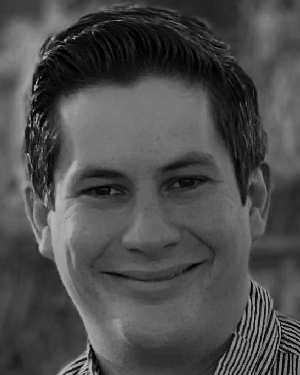 Matthew J. Reno合作论文数60
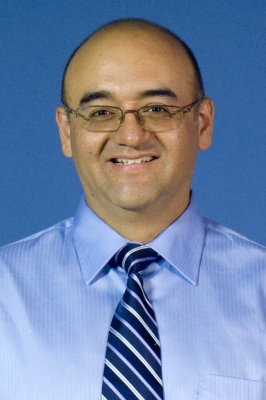 Santiago Grijalva合作论文数School of Electrical and Computer Engineering, College of Engineering, Georgia Institute of Technology29
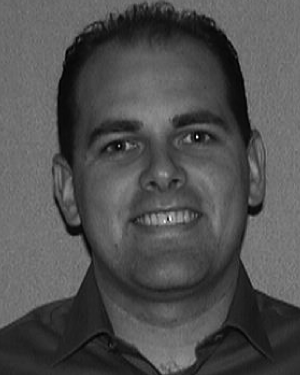 Matthew Lave合作论文数Dept. of Mechanical & Aerospace Eng., University of California, San Diego20
 Jimmy E Quiroz合作论文数15
 John Seuss合作论文数11
 Jeremiah Deboever合作论文数Electric Power Research Institute (EPRI), Palo Alto, CA7
 Coogan, Kyle合作论文数School of Electrical and Computer Engineering, Georgia Institute of Technology;c;School of Electrical and Computer Engineering, Georgia Institute of Technology7
 Jouni Peppanen合作论文数Sch. of Electr. & Comput. Eng., Georgia Inst. of Technol.;c;Sch. of Electr. & Comput. Eng., Georgia Inst. of Technol.7
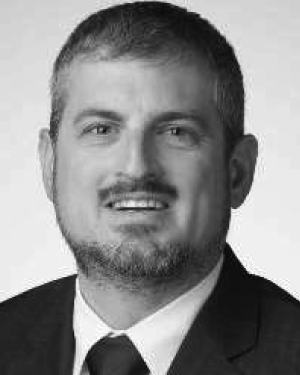 Barry A. Mather合作论文数Colorado Power Electronics Center;ECEE Department;University of Colorado;Colorado Power Electronics Center, University of Colorado7
 Robert Fredric Jeffers合作论文数Sandia National Laboratories, Albuquerque, NM, USA6Brooke Garcia合作论文数5Smith, J.W.合作论文数5
 Xiaochen Zhang合作论文数Sch. of Electr. & Comput. Eng., Georgia Inst. of Technol.;c;Sch. of Electr. & Comput. Eng., Georgia Inst. of Technol.5
 Logan Blakely合作论文数Electric Power Systems Research, Sandia National Laboratories4
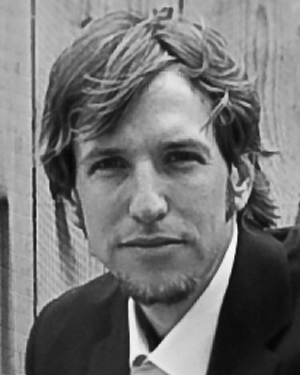 Matthew Rylander合作论文数4Ben Havumaki合作论文数3Mercy DeMenno合作论文数3Melissa Whited合作论文数3Ellis, A.合作论文数3
 Michael Coddington合作论文数3Alice Napoleon合作论文数3Jennifer Kallay合作论文数3
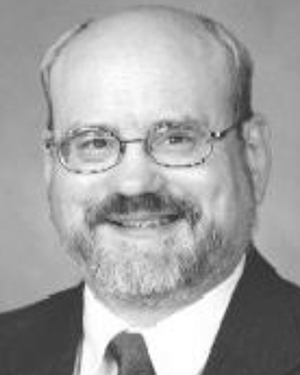 Roger C. Dugan合作论文数Electric Power Research Institute3Tim Woolf合作论文数2
 Erick E. Aponte-Bezares合作论文数2
 Rachid Darbali-Zamora合作论文数Sandia National Laboratories, Albuquerque, NM2Katherine A. Jones合作论文数2
 Kyri Baker合作论文数Department of Electrical, Computer and Energy Engineering, College of Engineering and Applied Science, University of Colorado Boulder;Department of Civil, Environmental and Architectural Engineering, College of Engineering and Applied Science, University of Colorado Boulder;Google DeepMind2
 Jay Johnson合作论文数Sandia Nat. Labs.;c;Sandia Nat. Labs.2Efraín O'Neill-Carrillo合作论文数University of Puerto Rico-Mayagüez2
 Francis Therrien合作论文数2Cesar Silva Monroy合作论文数1Amanda Wachtel合作论文数1Marc Belletete合作论文数1Peter Gotseff合作论文数1Mercy B. DeMenno合作论文数1Lindsey Rogers合作论文数1
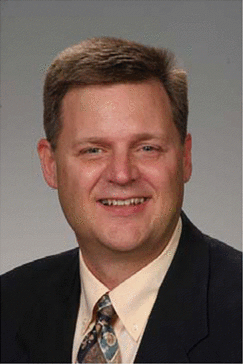 Ross Guttromson合作论文数1Melvin Lugo-Alvarez合作论文数1
 Javier Hernandez-Alvidrez合作论文数Sandia Natl Labs1
 Qinmiao Li (李钦淼)合作论文数1
 Brian J. Pierre合作论文数Sandia National Laboratories, Albuquerque, NM, USA1
 Muhammad Umer Qureshi合作论文数Georgia Inst Technol1
 jens c boemer合作论文数1Karina Munoz-Ramos合作论文数Systems Engineering, Sandia National Laboratories1
 Xiangqi Zhu合作论文数North Carolina State Univ, Elect & Comp Engn Dept, FREEDM Syst Ctr, Raleigh, NC 27695 USA1Huijuan Li合作论文数1
 Joseph A. Azzolini合作论文数Sandia National Laboratories1




