Raptors have been successfully used to disperse and often control flocks of pest birds. However, the question that has not been resolved is, “If the raptor kills a small number of the target flock, does this improve the efficiency of control?” This mini-review examines the few research reports that have been published that can shed light on this question.
Governance and regulation of the use of live animals in research and teaching is examined in Australia, Malaysia, Indonesia, the Philippines, Singapore, Thailand, China, Japan and India. A comparison of the systems in different countries will enable the determination of best practice and fit-for-purpose regulation. The most comprehensive government regulation of animal welfare in institutions covers a broad range of animals and institutions are required to have an Institutional Animal Care and Use Committee, whose membership is specified in guidelines or regulations. The work of the Committees is rigorously overseen by government and facilities that use live animals are audited externally. All countries examined have legislation governing the use of live animals in research, although only Australia and Malaysia have a fully equivalent mandated oversight of teaching. Teaching that uses live animals is partly covered in the Philippines, Japan, Singapore and Thailand This paper thus aims to review the regulation of animal use in different Asian jurisdictions in order to determine best practices that are appropriate to those settings. The most comprehensive oversight is provided in Australia and Malaysia that essentially use the same regulatory framework.
The Frontier Solid State Power Amplifier (SSPA), developed at the Johns Hopkins University Applied Physics Laboratory (JHU/APL) to support NASA's Interstellar Mapping and Acceleration Probe (IMAP) mission, is scheduled to launch in 2025. In order to provide reliable communications within a cost, schedule, and mass constrained mission, an SSPA was selected. The SSPA can operate over the International Telecommunication Union (ITU) Near Earth and Deep Space downlink frequency band of 8400–8500 MHz and provides a minimum of 10 W of RF output power, with a nominal efficiency of 31.5%, and a mass of less than 1.1kg. The SSPA consists of two standalone boxes, an RF Amplifier Box and a Power Converter Unit (PCU), connected via an interbox harness. The RF Amplifier box design utilizes three single-string hybrid amplifiers, an isolator, DC bias circuitry, and thermistor-based gain control. The hybrid amplifiers were designed using commercially available GaN transistors that have successfully been screened for the harsh space environment. The transistor is impedance matched at the input and output using microstrip transmission lines and thin-film resistors on alumina substrates, and sealed in a hermetic package. The PCU is a buck-boost converter, which provides 30 V and -5 V secondary voltages from a primary voltage ranging from 22 V to 35 V, while maintaining proper turn on and turn off voltage sequencing. The Engineering Model (EM) SSPA assembly was subjected to a 3-axis sine and random vibration followed by thermal vacuum testing from -25°C to +55°C. The design methodology, analyses, such as thermal, structural, and multipactor, along with a comparison of pre and post environmental testing are presented.
Birds are considered to be pests when they damage infrastructure and crops as well as being a health risk and a social nuisance. Here we detail some case studies where we used trained raptors to disperse populations of pest Long-billed Cacatua tenuirostris and Little Corellas C. sanguinea , Sulphur-crested Cockatoos C. galerita and Silver Gulls Chroicocephalus novaehollandiae in Victoria. We describe the situations where the technique works best and compare it with other methods of managing pest birds. Using raptors to disperse pest birds seems to be a cost-effective management tool only when the target area is small, the period over which damage occurs is limited, and when the damage caused by the pest species is costly.
Maremma guardian dogs have been protecting Little Penguins Eudyptula minor from canid predation at Middle Island, Warrnambool, since 2006. Foxes had preyed heavily on the penguins contributing to a population crash - from over 500 arrivals in the 1999-2000 breeding season, to less than 10 some five years later. Our monitoring of arrivals indicates numbers have grown to over 100 penguins. The successful use of guardian dogs to protect native wildlife and the strong community participation and support for the program constitutes what has become known as the 'Warrnambool Method' for wildlife conservation management.
Deep space missions often require a rugged, high efficiency, low mass X-Band power amplifier to return science data back to Earth. A high efficiency 25 W GaN solid state power amplifier (SSPA) prototype was developed for NASA's Europa Lander mission concept. The SSPA design consists of three amplifier stages each designed using a die-level GaN on SiC high electron mobility transistor (HEMT). The first two stages are single string amplifiers and the final output stage consists of two stages in a quadrature combined configuration, to provide both soft-redundancy and improved heat spreading, which increases reliability. The design also uses a low-loss isolator on the output to ensure that any changes in the SSPA's load impedance (i.e: the antenna) is minimized, thereby reducing any degradations to the two main requirements of the SSPA, output power and efficiency. Also, an efficient DC-DC converter that converts the Spacecraft Bus voltage (22 V to 36 V) to a regulated 32 V is designed. Each function block in the SSPA is measured individually and the overall cascaded performance is calculated based on these measurements. The final performance of the SSPA results in an output power 25 W, at a box efficiency of 37.5%. This is an improvement from traditional GaAs SSPAs that have previously flown and an improvement from recent published GaN SSPA results. [1].
Review(s) of: Australia's Amazing Kangaroos: Their conservation, unique biology and coexistence with humans, by Ken Richardson, Publisher CSIRO publishing, Collingwood, 2012, 240 pages, paperback, ISBN: 9780643097391, RRP $ 49.95.
Koalas were introduced into Framlingham Forest, south-west Victoria, in 1971 and the population grew rapidly. By the 1990s the forest was suffering severe defoliation and many trees preferred by Koalas had been over-browsed. In 1998/99 around 1100 Koalas were captured, the males sterilised and animals translocated to other suitable habitats in western Victoria. Some habitat restoration was subsequently undertaken. In 2007 a deliberately lit fire destroyed most eucalypt foliage and many Koalas were killed or burned and removed by wildlife carers and DSE staff . A survey in 2011 found only two Koalas in the area. A Koala management plan for Framlingham Forest has been prepared. (Th e Victorian Naturalist 130 (1) 2013, 37-40).
Ecological Management & RestorationVolume 10, Issue 1 p. 58-60 Impact of saltmarsh disturbance on seed quality of Sarcocornia (Sarcocornia quinqueflora), a food plant of an endangered Australian parrot Julie Mondon, Julie MondonSearch for more papers by this authorKate Morrison, Kate MorrisonSearch for more papers by this authorRobert Wallis, Robert WallisSearch for more papers by this author Julie Mondon, Julie MondonSearch for more papers by this authorKate Morrison, Kate MorrisonSearch for more papers by this authorRobert Wallis, Robert WallisSearch for more papers by this author First published: 21 April 2009 https://doi.org/10.1111/j.1442-8903.2009.00439.xCitations: 5Read the full textAboutPDF ToolsRequest permissionExport citationAdd to favoritesTrack citation ShareShare Give accessShare full text accessShare full-text accessPlease review our Terms and Conditions of Use and check box below to share full-text version of article.I have read and accept the Wiley Online Library Terms and Conditions of UseShareable LinkUse the link below to share a full-text version of this article with your friends and colleagues. Learn more.Copy URL Share a linkShare onEmailFacebookTwitterLinkedInRedditWechat References Davy A. J. (2003) Responses of Salt Marshes to Change. Available from URL: http://www.icef.eawag.ch/abstracts/davy.pdf. Viewed 12/12/2008. Google Scholar Department of Environment and Heritage (2005) Orange-Bellied Parrot Recovery Plan. Commonwealth Australia, Canberra, ACT. Google Scholar Loyn R. H., Lane B. A., Chandler C. and Carr G. W. (1986) Ecology of Orange-Bellied Parrots Neophema chrysogaster at their main remnant wintering site. Emu 86(4), 195–206. 10.1071/MU9860195 Web of Science®Google Scholar Wilson P. G. (1980) A revision of the Australian species of Salicornieae (Chenopodiaceae). Nuytsia 3(1), 3–154. Web of Science®Google Scholar Citing Literature Volume10, Issue1April 2009Pages 58-60 ReferencesRelatedInformation
Development of positive attitudes towards the environment is an important element in environmental education. We investigated whether students at Deakin University who took the first year level unit SQE112 ‘Ecology and the Environment’ developed any changes in attitudes to nature. Students completed a questionnaire before and after completing the unit of study. The questions provided information on six categories of attitudes towards wildlife. We found students who had taken SQE112 developed significantly more positive attitudes to wildlife in four of these categories (biocorrect, exploitation, natural stewardship and pest rights) but not in the categories controlled breeding and animal rights. In contrast, a control group of year one students showed no significant changes in attitudes to nature. Students who studied SQE112 had higher attitude scores initially than the control group, suggesting they were more positively disposed to the environment and chose a course which reflected this greater interest in environment. There were no significant differences in attitude change for students enrolled in SQE112 at metropolitan and regional campuses, although regionally based students initially had much lower scores on the exploitation scale. Our results are very similar to those found for USA students.
Throughout the six years till 2005 Little Penguins Eudyptula minor at Middle Island, Warrnambool, have been subjected to intense fox predation. The population of the Little Penguin at Middle Island is now dangerously low, with a reduction from 342 active burrows in 1999 to the current 52 active burrows, and from 502 to 4 Little Penguins arriving at the colony after dusk. Such a reduction in numbers requires urgent management measures in order for the colony to survive.
The study of community engagement offers many different perspectives, which often are derived from local context and culture. Substantial variations are found when one travels to different countries and especially when one becomes immersed in various cultures, organizations, social issues, settings, and Population groups. This chapter is an edited transcript of a conversation about international perspectives, with representatives from Australia, Canada, South Africa, the United Kingdom, and the United States, that took place as a plenary discussion at the Sixth International Service-Learning Research Conference in 2006.
Extensive land clearing in western Victoria has lead to land degradation, loss of natural habitat and poor water quality. Tree planting has been used to combat these problems and improve biodiversity, but whether these programs are meeting their nature conservation objectives is equivocal. Here we examined the presence of birds and mammals in 12 revegetated sites of different ages and habitat complexity and four remnant habitat sites. We found remnant sites had the greatest abundance in species richness of both birds and mammals, and that use of revegetated sites increased as the sites aged and became more structurally complex.
In Little Penguins Eudyptula minor there are no reliable plumage or body size differences that can be used visually to distinguish the sex of individuals. However, sexual dimorphism of morphometric measures has been noted, with males always being a little larger than females. In this study, differences between E. minor sexes at eight colonies in south-eastern Australia were determined statistically via discriminant function analysis (DFA) and through the utilization of DNA-based techniques developed for non-ratite birds. The DFA correctly determined gender in 91.1% of cases and molecular methods were 100% accurate. Our DFA success rate of classification is similar to that previously published for Little Penguins in Victoria. In this study statistically significant differences in mean bill depths and lengths were found between Little Penguin colonies at St Kilda, Phillip Island and Gabo Island, compared to colonies at Kangaroo Island, Granite Island, Middle Island and London Bridge. As birds in eastern populations (St Kilda, Phillip Island, Gabo Island) exhibit statistically significantly smaller beaks (bill depth and bill length), separate discriminant functions were investigated for each phenotypically distinct geo-spatial cohort. Interestingly, cluster analysis for bill length identified three groups: western (Kangaroo Island and Granite Island), eastern (St Kilda, Phillip Island and Middle Island) and the London Bridge Little Penguin colony, which constituted a separate group. We conclude that while there is a slight increase in DF power for colonies west of Cape Otway and for some specific colonies, colony-specific DFA is not required to identify the sex of Little Penguins in south-eastern Australia.
This study investigates the diet of six breeding pairs of powerful owls in the Yarra Valley Corridor in Victoria, Australia, and compares prey consumption with prey availability. The six sites represent a continuum of habitats, ranging from urban Melbourne, through the urban fringe interface to a more forested landscape. We found that powerful owls in the Yarra Valley Corridor are reliant almost exclusively on arboreal marsupial prey as their preferred diet, with 99% of their overall diet comprising four arboreal marsupial species. These four species (the common ringtail possum, common brushtail possum, sugar glider and greater glider) were also the most abundant species observed while spotlighting; however, their abundance varied along the continuum. There was a strong positive relationship with the presence of these species in the diet and their site-specific availability, indicating that the powerful owl is a generalist hunter, preying on the most available prey at a given site and in a given season. This study suggests that food resources are high in these disturbed urban fringe sites and it is unlikely that food availability in urban environments will limit the potential survival of urban powerful owls.
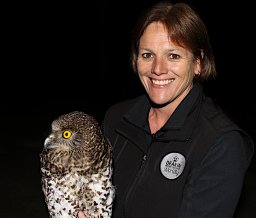 Raylene Cooke合作论文数School of Life and Environmental Sciences, Deakin University10
 Wallis Anne合作论文数8
 Alan Webster合作论文数4Overeem R合作论文数3
 Fiona Hogan合作论文数Cancer Research Institute and Department of Chemistry and Biochemistry, Arizona State University3victor g hurley合作论文数2John Lehtonen合作论文数2
 Sheng Cheng合作论文数2
 Avinash Sharma合作论文数Applied Physics Laboratory (JHU/APL),, The Johns Hopkins University2A Webster合作论文数2
 John G. White合作论文数Anatomy and Molecular Biology,University of Wisconsin2Anne Morton合作论文数1
 Neil Dalal合作论文数1CL KLEINKE合作论文数1
 Daniel Matlin合作论文数1Margo Fryer合作论文数1Glen Jameson合作论文数1
 Justin R. Dennison合作论文数1
 Sheldon, C.合作论文数1
 Sharon Ling合作论文数1L.C. Kelly合作论文数1Kate Morrison合作论文数1Gm Maynes合作论文数1
 Scott Salzman合作论文数Marshfield Clinic Research Foundation1
 Julie Mondon合作论文数1




