The universal property for the Bénabou bicategory of distributors (although we call them "modules") presented here is somewhat implicitly spread over a series of papers and yet, to my knowledge, does not appear in print. The inclusion of a bicategory into the bicategory -Mod of -enriched categories and modules between them does have a completion property with respect to freely adjoining lax colimits (collages); see . Here we are interested in the universal property of the construction of -Mod from -Cat. What we have in mind is an objective version of the notion of homological functor used by André Joyal in 1985.
In the context of enriched category theory, we give necessary and sufficient conditions for a module morphism α:M →𝒞(F,Z) to exhibit a functor Z:𝒜→𝒞 as an absolute M-weighted colimit of a functor F:ℬ→𝒞 . We also review, with short proofs, the various criteria for the weight M itself to be absolute, in the sense that any M-weighted colimit is absolute. Finally, we prove that any absolute M-weighted colimit can be viewed as a colimit weighted by an absolute weight M' .
The first word in the title is intended in a sense suggested by Lawvere and Schanuel whereby finite sets are objective natural numbers. At the objective level, the axioms defining abstract Mackey and Tambara functors are categorically familiar. The first step was taken by Harald Lindner in 1976 when he recognized that Mackey functors, defined as pairs of functors, were equivalently single functors with domain a category of spans. In 1993, Tambara recognized that TNR-functors (that is, functors designed to have abstract trace, norm and restriction operations, and now called Tambara functors) were equivalently certain functors out of a category of polynomials. We define objective Mackey and objective Tambara functors as parametrized categories that have local finite products and satisfy some parametrized completeness and cocompleteness restriction. However, we can replace the original parametrizing base for objective Mackey functors by a bicategory of spans while the replacement for objective Tambara functors is a bicategory obtained by iterating the span construction; these iterated spans are polynomials. There is an objective Mackey functor of ordinary Mackey functors. We show that there is a distributive law relating objective Mackey functors to objective Tambara functors analogous to the distributive law relating abelian groups to commutative rings. We remark on hom enrichment matters involving the 2-category $\textrm{Cat}_{+}$ of categories admitting finite coproducts and functors preserving them, both as a closed base and as a skew-closed base.
The goal is to show how a 1978 paper of Richard Wood on monoidal comonads and exponentiation relates to more recent publications such as Pastro et alia [30] and Brugui & eacute;res et alia [7]. In the process, we mildly extend the ideas to procomonads in a magmal setting and suggest it also works for algebras for any club in the sense of Max Kelly [18, 19].
This work results from a study of Nicholas Kuhn's paper entitled "Generic representation theory of finite fields in nondescribing characteristic". Our goal is to abstract the categorical structure required to obtain an equivalence between functor categories $[\mathscr{F},\mathscr{V}]$ and $[\mathscr{G},\mathscr{V}]$ where $\mathscr{G}$ is the core groupoid of the category $\mathscr{F}$ and $\mathscr{V}$ is a category of modules over a commutative ring.
We denote the monoidal bicategory of two-sided modules (also called profunctors, bimodules and distributors) between categories by Mod; ; the tensor product is cartesian product of categories. For a groupoid G , we study the monoidal centre ZPs (G , Mod(op)) of the monoidal bicategory Ps (G , Mod(op)) of pseudofunctors and pseudo- natural transformations; the tensor product is pointwise. Alexei Davydov defined the full centre of a monoid in a monoidal category. We define a higher dimensional version: the full monoidal centre of a monoidale (= pseudomonoid) in a monoidal bicategory M , and it is a braided monoidale in the monoidal centre ZM of M Each fibration pi : H -> G between groupoids provides an example of a full monoidal centre of a monoidale in Ps (G , Mod(op)). For a group G, we explain how the G-graded categorical structures, as considered by Turaev and Virelizier in order to construct topological invariants, fit into this monoidal bicategory context. We see that their structures are monoidales in the monoidal centre of the monoidal bicategory of k-linear categories on which G acts.
For our concepts of change of base and comonadicity, we work in the general context of the tricategory Catenwhose objects are bicategories V and whose morphisms are categories enriched on two sides. For example, for any monoidal comonad G on a cocomplete closed monoidal category C, the forgetful functor U: C-G. -> C is comonadic when regarded as a morphism in Caten between one-object bicategories. Other examples are provided including that obtained from any comonoidal C-enriched category. We show that the forgetful pseudofunctor U: VG -> V from the bicategory of Eilenberg-Moore coalgebras for a comonad G on V in Cateninduces a change of base pseudofunctor (U) over tilde: V-G-Mod -> V-Modwhich is comonadic in a bigger version of Caten. We should emphasise that the right adjoints to U and (U) over tilde generally do not have right adjoint lax functors, confirming our need to work with two-sided enrichments. We define Hopfness for such a comonad G and prove that having that property implies U creates left (Kan) extensions in the bicategory VG. We provide conditions under which Hopfness carries over from Gto the comonad (G) over tilde = (U) over tilde omicron (R) over tilde generated by the adjunction (U) over tilde (SIC) (R) over tilde. This has implications for characterizing the absolute colimit completion of VG-categories. A motivating example was the monoidal category of differential graded abelian groups obtained as the category of coalgebras for a Hopf monoid in the category of abelian groups. Examples include some involving base bicategories V = Spn(E) of spans in an ordinary category Ewith pullbacks. (c) 2023 Elsevier B.V. All rights reserved.
We go back to the roots of enriched category theory and study categories enriched in chain complexes; that is, we deal with differential graded categories (DG-categories for short). In particular, we recall weighted colimits and provide examples. We solve the 50 year old question of how to characterize Cauchy complete DG-categories in terms of existence of some specific finite absolute colimits. As well as the interactions between absolute weighted colimits, we also examine the total complex of a chain complex in a DG-category as a non-absolute weighted colimit.
The main result concerns a bicategorical factorization system on the bi-category Cat of categories and functors. Each functor A ->(f) B factors up to isomorphism as A ->(j) E ->(p) B where j is what we call an ultimate functor and p is what we call a groupoid fibration. Every right adjoint functor is ultimate. Functors whose ultimate factor is a right adjoint are shown to have bearing on the theory of polynomial functors.
The main result concerns a bicategorical factorization system on the bicategory $\mathrm{Cat}$ of categories and functors. Each functor $A\xra{f} B$ factors up to isomorphism as $A\xra{j}E\xra{p}B$ where $j$ is what we call an ultimate functor and $p$ is what we call a groupoid fibration. Every right adjoint functor is ultimate. Functors whose ultimate factor is a right adjoint are shown to have bearing on the theory of polynomial functors.
The construction of a category of spans can be made in some categories $\CC$ which do not have pullbacks in the traditional sense. The PROP for monoids is a good example of such a $\CC$. The 2012 book concerning homological algebra by Marco Grandis gives the proof of associativity of relations in a Puppe-exact category based on a 1967 paper of M.S. Calenko. The proof here is a restructuring of that proof in the spirit of the first sentence of this Abstract. We observe that these relations are spans of EM-spans and that EM-spans admit fake pullbacks so that spans of EM-spans compose. Our setting is more general than Puppe-exact categories.
Given a monoidal category $\mathscr{C}$ with an object $J$, we construct a monoidal category $\mathscr{C}[J^{\vee}]$ by freely adjoining a right dual $J^{\vee}$ to $J$. We show that the canonical strong monoidal functor $\Omega : \mathscr{C}\to \mathscr{C}[J^{\vee}]$ provides the unit for a biadjunction with the forgetful 2-functor from the 2-category of monoidal categories with a distinguished dual pair to the 2-category of monoidal categories with a distinguished object. We show that $\Omega : \mathscr{C}\to \mathscr{C}[J^{\vee}]$ is fully faithful and provide coend formulas for homs of the form $\mathscr{C}[J^{\vee}](U,\Omega A)$ and $\mathscr{C}[J^{\vee}](\Omega A,U)$ for $A\in \mathscr{C}$ and $U\in \mathscr{C}[J^{\vee}]$. If $\mathbb{N}$ denotes the free strict monoidal category on a single generating object $1$ then $\mathbb{N}[1^{\vee}]$ is the free monoidal category $\mathrm{Dpr}$ containing a dual pair $- \dashv +$ of objects. As we have the monoidal pseudopushout $\mathscr{C}[J^{\vee}] \simeq \mathrm{Dpr} +_{\mathbb{N}} \mathscr{C}$, it is of interest to have an explicit model of $\mathrm{Dpr}$: we provide both geometric and combinatorial models. We show that the (algebraist's) simplicial category $\Delta$ is a monoidal full subcategory of $\mathrm{Dpr}$ and explain the relationship with the free 2-category $\mathrm{Adj}$ containing an adjunction. We describe a generalization of $\mathrm{Dpr}$ which includes, for example, a combinatorial model $\mathrm{Dseq}$ for the free monoidal category containing a duality sequence $X_0\dashv X_1\dashv X_2 \dashv \dots$ of objects. Actually, $\mathrm{Dpr}$ is a monoidal full subcategory of $\mathrm{Dseq}$.
Let $G$ be a group and $k$ be a commutative ring. Our aim is to ameliorate the $G$-graded categorical structures considered by Turaev and Virelizier by fitting them into the monoidal bicategory context. We explain how these structures are monoidales in the monoidal centre of the monoidal bicategory of $k$-linear categories on which $G$ acts. This provides a useful example of a higher version of Davydov's full centre of an algebra.
We make several corrections and improvements to the published paper “Combinatorial categorical equivalences of Dold–Kan type”, mostly relating to the standing assumptions of the paper. In particular we have had to add one new assumption, but have been able to remove another.
The paper defines polynomials in a bicategory $\mathscr{M}$. Polynomials in bicategories $\mathrm{Spn}\mathscr{C} \ $ of spans in a finitely complete category $\mathscr{C} \ $ agree with polynomials in $\mathscr{C} \ $ as defined by Nicola Gambino and Joachim Kock, and by Mark Weber. When $\mathscr{M}$ is \textit{calibrated}, we obtain another bicategory $\mathrm{Poly}\mathscr{M}$. We see that polynomials in $\mathscr{M}$ have representations as pseudofunctors $\mathscr{M}^{\mathrm{op}}\to \mathrm{Cat}$. Calibrations are produced for the bicategory of relations in a regular category and for the bicategory of two-sided modules (distributors) between categories thereby providing new examples of bicategories of "polynomials".
This is an account of some work of Markus Rost and his students Dominik Boos and Susanne Maurer. We adapt it to the braided monoidal setting.
In the original publication of the article, Eq. (3.24) was published incorrectly. The corrected equation is given in this correction article. The original article has been corrected.
We make various observations on infinitary addition in the context of the series monoids introduced in our previous paper on real sets. In particular, we explore additional conditions on such monoids suggested by Tarski’s Arithmetic of Cardinal Algebras, and present a monad-theoretic construction that generalizes our construction of paradoxical real numbers.
In the category of abelian groups, Pareigis constructed a Hopf ring whose comodules are differential graded abelian groups. We show that this Hopf ring can be obtained by combining grading and differential Hopf rings using semidirect product in fairly general symmetric monoidal additive categories.
Distributive laws between two monads in a 2-category K, as defined by Jon Reek in the case K = Cat, were pointed out by the author to be monads in a 2-category Mnd K of monads. Steve Lack and the author defined wreaths to he monads in a 2-category EM K of monads with different 2-cells from MndK.Mixed distributive laws were also considered by Jon Beck, Mike Barr and, later, various others; they are comonads in MndK. Actually, as pointed out by John Power and Hiroshi Watanabe, there are a number of dual possibilities for mixed distributive laws.It is natural then to consider mixed wreaths as we do in this article: they are comonads in EMK. There are also mixed opwreaths: comonads in the Kleisli construction completion KIK of K. The main example studied here arises from a twisted coaction of a bimonoid on a monoid. A wreath determines a monad structure 011 the composite of the two endomorphisms involved; this monad is called the wreath product. For mixed wreaths, corresponding to this wreath product, is a convolution operation analogous to the convolution monoid structure on the set of morphisms from a comonoid to a monoid. In fact, wreath convolution is composition in a Kleisli-like construction. Walter Moreira's Heisenberg product of linear endomorphisms on a Hopf algebra, is an example of such convolution, actually involving merely a mixed distributive Monoidality of the Kleisli-like construction is also discussed.
 Stephen Lack合作论文数School of Computing and Mathematics, University of Western Sydney18Brian Day合作论文数14
 George Janelidze合作论文数Mathematics Institute, Georgian Academy of Sciences7
 Branko Nikolic合作论文数5
 Elango Panchadcharam合作论文数5Craig Pastro合作论文数4
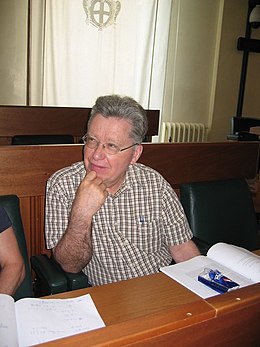 André Joyal合作论文数Universite du Quebec a Montreal4A. Carboni合作论文数4Richard Garner合作论文数3John Power合作论文数School of Computing, Macquarie University3
 Eduardo Julio Dubuc合作论文数Departamento de Matematicas Ciudad Universitaria, Universidad de Buenos Aires3
 Dominic Verity合作论文数Department of Mathematics, Macquarie University3Walter Tholen合作论文数Department of Mathematics and Statistics;York University;Department of Mathematics and Statistics, York University2Graeme Kelly合作论文数2R. J. Wood合作论文数Department of Zoology;University of Manchester;Department of Zoology, University of Manchester2A Joyal合作论文数2Thomas Booker合作论文数2Robert F. C. Walters合作论文数Department of Science of Culture;Politics and Information2H. Thompson合作论文数1A Howe合作论文数1B. Catharine Craven合作论文数1Michael K. Murray合作论文数1J Rubinstein合作论文数1G Ivanov合作论文数1A Mclntosh合作论文数1J Hempel合作论文数1Alan Andrew合作论文数1R Bartnik合作论文数1Brailey Sims合作论文数1Robert Anderssen合作论文数1K. L. McAvaney合作论文数1
 Peter N Dodds合作论文数1Dolan, J.E.合作论文数1David S. Elliott合作论文数1Manfred B. Wischnewsky合作论文数1B.E. Odgers合作论文数1Elizabeth Billington合作论文数1
 Audrey Der合作论文数1Giacomo Tendas合作论文数Corresponding author.1
 Ross Moore合作论文数1Michael Johnson合作论文数1
 Anna Labella合作论文数Department of Computer Science, Sapienza University of Rome1
 Nalini Joshi合作论文数School of Mathematics and Statistics, Faculty of Science, The University of Sydney1Kevin Coulembier合作论文数School of Mathematics and Statistics, Faculty of Science, The University of Sydney1Donovan P J合作论文数1
 Brett Hughes合作论文数The Prince Charles Hospital;Royal Brisbane and Women’s Hospital1Weber Nicholas合作论文数1R. Gordon合作论文数1Neumann Bernhard合作论文数1




