This paper presents new recommendations for the discrete sampling of a mobile radio with non-line-of-sight Rayleigh fading and a Jakes power spectrum. The results are derived from a new analytical result for the variance of the local-mean voltage using discrete, spatial sampling with uniform spacing. The variance presented here accounts for the correlation between the samples and significantly changes the number of samples that are required to estimate the local mean voltage with a 1 dB spreading factor.
This paper examines the estimation of the local mean voltage of a radio signal in a Rayleigh fast-fading environment. We focus on the statistical uncertainties of local voltage averages obtained by both integrating the voltage envelope of a specified spatial interval and averaging over a set of discrete spatial samples. We derive new analytical expressions of the variances of both discrete and continuous averaging for selected spatial intervals. We also give recommendations for averaging intervals and sample spacing to achieve a ±1 dB spreading factor. We provide important new results for the variance of discrete averaging with new insight gained on separations required for uncorrelated samples. One significant finding of this work is that criteria in the published literature are incorrect and underestimate the variance. We support these findings with an experimental validation of our variance expressions using laboratory fading simulator measurements and sample statistics.
Channel sounders are used to measure channel characteristics for radio systems. There are several types of channel sounders used today: continuous-wave (CW), direct pulse, frequency domain using a vector network analyzer (VNA), correlation-based, and swept-time delay cross-correlator. Each of these has unique advantages and disadvantages. CW systems have a larger dynamic range than other systems with a signal that can propagate further into the environment. As the audio sampling rates allow smaller file sizes than other systems, data collection can be continuous and last for several hours. This article discusses a CW-channel sounder system, which has been used to make numerous propagation loss measurements in various cities in the United States of America. Such propagation measurements should be accurate, reproducible, and free of artifacts or biases. This article shows how to set up the measurement, how to validate and verify that the system is making reliable measurements, and finally, it shows results from some of the measurement campaigns such as repeatability measurements, clutter loss measurements (where clutter loss is defined as the excess loss from free-space transmission loss), and reciprocity measurements.
Local oscillator LRM Line-reflect-match calibration method Mean-squared error associated with SSD Mean-squared error associated with
In situ measurements of radio frequency (RF) spectrum activity provide insight into the physics of radio frequency wave propagation and validate existing and new spectrum propagation models. Both of these parameters are essential to supporting and preserving interference-free spectrum sharing, as spectrum use continues to increase. It is vital that such propagation measurements are accurate, reproducible, and free of artifacts and bias. Characterizing the gains and losses of components used in these measurements is vital to their accuracy. A vector network analyzer (VNA) is a well-established, highly accurate, and versatile piece of equipment that measures both magnitude and phase of signals, if properly calibrated. This article details the best practices for calibrating a VNA. Once calibrated, it can be used to accurately measure components of a correctly configured propagation measurement (or channel sounding) system or can be used as a measurement system itself.
Propagation models are used to inform scientists and engineers on how radio propagation through an environment will affect the radio signal received on the other end of the link. Many propagation models have been developed: some are curve-fitting models, some are based on the physics of the propagation path. Some models have been developed that incorporate the presence of vegetation and man-made structures (clutter) to more closely approximate measured data. However, no model thus far predicts path loss in all environments (urban, suburban, rural, forested, etc.). This paper introduces various propagation models and compares them to measured data. In the end, we present another predictive model that includes objects within the first Fresnel zone as a predictor for a more inclusive propagation model.
We present path gain results at 3,500 MHz from a mobile channel measurement campaign that was carried out at the ITS Table Mountain Field Site. The purpose of this effort was to validate measurements obtained from a prototype sliding correlator channel sounder that is currently under development at ITS. The validation framework we developed consists of two parts: 1) a CW channel sounder to provide a highly accurate reference, and 2) a series of static paths and a mobile route over which to compare path gain results from the two systems. We obtained excellent agreement in measured path gains between the sliding correlator and the CW systems.
This paper discusses a mobile propagation measurement in Los Angeles, CA and compares these measurements to the output from the Irregular Terrain Model (ITM). Propagation measurements are currently being used at the Institute for Telecommunication Sciences (ITS) to improve and validate the ITM propagation model. In this paper, these measurements are compared to the predicted terrain attenuation losses from ITM as a function of four different terrain databases. We began using ITM to calculate clutter losses (i.e. attenuation due to vegetation and man-made structures) by subtracting the ITM prediction from the measured data. As with any model, the estimation of clutter losses changes as the prediction from ITM changes based on the terrain database; therefore, it is important to understand why these changes occur. This paper briefly discusses the measurement system, the results from this campaign, and the output from ITM as a function of four different terrain databases of various horizontal resolutions.
We describe an advanced mobile channel sounder system that has been under development by engineers at NTIA's Institute for Telecommunication Sciences since 2010. We provide a description of the channel sounder and the key system components. We then highlight the flexibility and power of this system by showing a variety of measured and processed radio propagation results obtained using this system. This system has been deployed in numerous outdoor and indoor propagation measurement campaigns. This system has also been used for both in-building and building penetration measurements.
We describe an advanced mobile channel sounder system that has been under development by engineers at NTIA's Institute for Telecommunication Sciences since 2010. We provide a description of the channel sounder and the key system components. We then highlight the flexibility and power of this system by showing a variety of measured and processed radio propagation results obtained using this system. This system has been deployed in numerous outdoor and indoor propagation measurement campaigns. This system has also been used for both in-building and building penetration measurements.
This paper discusses mobile propagation measurement campaigns in San Diego, CA; Denver, CO; and Washington, D.C. These measurements were made to inform possible clutter models in the 1755-1780 MHz band. This band was recently auctioned and will now be the first spectrum sharing band opened to both broadband wireless carriers and federal agencies. Clutter in this case is defined as the excess loss due to attenuation from buildings and vegetation, above either free-space path losses or terrain attenuation. Attenuation due to terrain was modelled using the irregular terrain model (ITM).
We provide detailed descriptions of recent radiated emissions measurements conducted by the National Telecommunications and Information Administration (NTIA) Institute for Telecommunication Sciences (NTIA/ITS) in Boulder, Colorado. ITS engineers performed a comprehensive series of radiated emission measurements on the Shore-Line Monitoring System (SLiMS). The SLiMS system is currently being developed by Time-Domain Acquisition Holdings® (TDC) under the sponsorship of the Naval Facilities Engineering Command (NAVFAC). The measurement results demonstrate both low emission levels, consistent with existing U.S. electromagnetic compatibility requirements and a low potential for causing interference to incumbent systems. A high level of precision is required to perform the characterization.
We describe a prototype propagation measurement system based on a combination of a spectrum analyzer and a vector signal analyzer. The system is designed to measure the characteristics of a narrowband mobile radio channel. We present results from a commercially-available fading simulator and fixed-to-mobile measurements performed in Boulder, Colorado. The results obtained look promising and the system demonstrates excellent measurement fidelity.
Characterizing the effects that out-of-band interference has on the performance of an S-band marine radar receiver's IF output normally requires non-linear network analysis. We have developed a non-linear network analyzer from commonly available laboratory instruments. Our automated system operates over a broad range of interferer frequencies and power levels. It enables the collection of the data required for an extensive analysis of a radar receiver's AM-AM and AM-PM performance in the presence of interference. With this data, engineers can begin to make recommendations on protecting these radars from potential interference.
This paper describes how commercially-available EMC biconical antennas can be used to perform high-resolution propagation measurements. A measurement procedure and signal processing sequence is described that greatly improves the range resolution and fidelity of transmission measurements using a pair of biconical antennas. Measurement results are provided for a number of different scenarios both indoors and outdoors. Direct comparisons are also provided with the Numerical Electromagnetics Code (NEC). The results obtained so far look quite promising and demonstrate the viability of the approach.
We report on measurements that characterize multipath conditions that affect broadband wireless communications in building penetration scenarios. Measurements carried out in various large structures quantify both radio-signal attenuation and distortion (multipath) in the radio propagation channel. Our study includes measurements of the complex, wideband channel transfer function and bandpass measurements of a 20 MHz-wide, digitally modulated signal. From these, we derive the more compact metrics of time delay spread, total received power and error vector magnitude that summarize channel characteristics with a single number. We describe the experimental set-up and the measurement results for data collected in representative structures. Finally, we discuss how the combination of propagation metrics may be used to classify different propagation channel types appropriate for public-safety applications.
In this work, we verify experimentally the consistency of EVM across modulation types of orthogonal frequency-division multiplexed (OFDM) wireless local-area network (WLAN) signals in two dedicated laboratory setups. We compared EVMs obtained for different modulation types in both an idealized distortion-free and a realistic multipath environment. Our goal is to study the effect of signal impairments on the constellation diagram through EVM, although other figures of merit, such as bit-error rate (BER) or energy-per-bit to spectral-noise density (EbN0), could be studied as well.
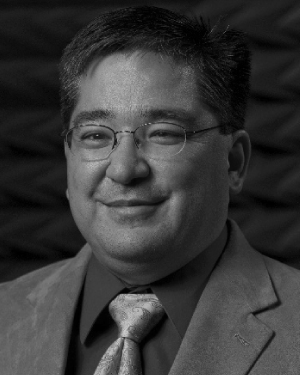 David Novotny合作论文数40
 Chriss A. Grosvenor合作论文数24
 Galen Koepke合作论文数15
 Dennis Camell合作论文数14Hammerschmidt, C.合作论文数10
 Kate A. Remley合作论文数National Institute of Standards and Technology9
 Christopher L. Holloway合作论文数RF Technology Division, Communications Technology Laboratory, National Institute of Standards and Technology9Claude M. Weil合作论文数8Ondrejka, A.合作论文数5
 John M Ladbury合作论文数5Canales, N.合作论文数5Nicholas DeMinco合作论文数4Seturnino Canales合作论文数4n canales合作论文数4Arthur R Ondrejka合作论文数4Claude M Weil合作论文数4Mark A. Mcfarland合作论文数4Doug Martin合作论文数3Michael D. McKinley合作论文数3Savio Tran合作论文数3Mike Chang合作论文数3Irena Stange合作论文数3Carey, R.L.合作论文数3Ewan, J.D.合作论文数3McKenna, P.合作论文数3Yencer, S.合作论文数3Hibbard, D.合作论文数3John J. Lemmon合作论文数3
 Michael D. Janezic合作论文数3Riddle, B.F.合作论文数2george hough合作论文数2Sanders, G.A.合作论文数2
 William Young合作论文数2Janalee Graham合作论文数2Antonakakis, E.合作论文数2Cavcey, K.合作论文数2David a Hill合作论文数2
 Ronald Delyser合作论文数Electrical Engineering;University of Denver;Electrical Engineering, University of Denver2Frank H. Sanders合作论文数2peter r franchi合作论文数1F. X. Canning合作论文数1JS Ju合作论文数1Hale, P.D.合作论文数1T. L. Roach合作论文数1keith d masterson合作论文数1
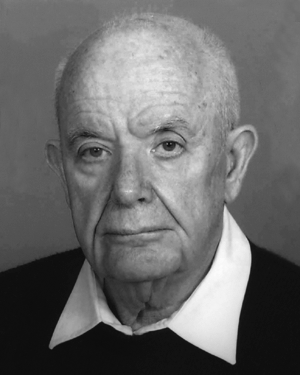 Jg Fikioris合作论文数1Amanda Koepke合作论文数1




