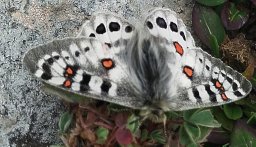
This study presents the first photographic evidence of Flos asoka (de Nicéville, [1884]) in Uttar Pradesh, India, marking a recent confirmation of its presence in the region. Through a detailed analysis of the newly captured photograph, the taxonomic identity of Flos asoka is verified, establishing its presence in Uttar Pradesh. Despite the absence of photographic evidence in previous literature and articles, this recent photograph serves as conclusive proof of the species' occurrence in Uttar Pradesh. Additionally, ecological insights derived from the study provide a deeper understanding of the ecology and natural environment of Flos asoka in the region. This finding represents a significant contribution to the knowledge of the distribution and ecology of Flos asoka and highlights the importance of photographic documentation in species presence and distribution research.
The Nymphalidae family of butterflies represents a captivating mosaic of species, not only captivating in their appearance but also serving as vital indicators of ecosystem health and biodiversity. In this study, we present an updated checklist of the Nymphalidae species inhabiting Uttar Pradesh State, India, encompassing atotal of 58 species. Notably, we report four previously unrecorded species in the Uttar Pradesh region: Charaxes bharata C. and R. Felder; Charaxes agrarius Swinhoe; Athyma perius Linnaeus and Athyma inara Westwood. This study illustrates the importance of continued monitoring and conservation efforts to safeguard the rich biodiversity of butterflies in Uttar Pradesh and beyond.
Uttar Pradesh, located in northern India, hosts a diverse array of ecosystems that sustain numerous butterfly species, including the visually striking Lycaenidae butterflies. This research presents a comprehensive checklist documenting the presence of Lycaenidae species in Uttar Pradesh, shedding light on their distribution. The checklist comprises sixty-one species, with recent surveys uncovering the presence of previously unrecorded species such as Spalgis epius Westwood, Tarucus nara Kollar, Azanus jesous Guérin-Méneville, Freyeria putli Kollar, and Remelana jangala Horsfield. These new records contribute significantly to our understanding of the butterfly fauna in Uttar Pradesh, emphasizing the importance of ongoing research and monitoring efforts for conservation and management purposes.
This study documents the first occurrence of Petelia distracta (Walker, 1860) in Uttar Pradesh, India. Additionally, it reports the unprecedented behavior of these moths engaging in nocturnal puddling on cow dung and wet old leaf. The observations contribute to the understanding of puddling behavior in Geometridae for the first time in India, offering new insights into the ecological interactions and resource utilization strategies of nocturnal Lepidoptera.
This study presents the first photographic evidence of Flos asoka (de Nicéville, [1884]) in Uttar Pradesh, India, marking a recent confirmation of its presence in the region. Through a detailed analysis of the newly captured photograph, the taxonomic identity of Flos asoka is verified, establishing its presence in Uttar Pradesh. Despite the absence of photographic evidence in previous literature and articles, this recent photograph serves as conclusive proof of the species' occurrence in Uttar Pradesh. Additionally, ecological insights derived from the study provide a deeper understanding of the ecology and natural environment of Flos asoka in the region. This finding represents a significant contribution to the knowledge of the distribution and ecology of Flos asoka and highlights the importance of photographic documentation in species presence and distribution research.
This study presents the documentation of four previously unreported Hesperiidae (Rhopalocera) species within the state of Uttar Pradesh, India. The species recorded include Tagiades litigiosa Möschler, 1878, Coladenia indrani (Moore, [1866]), Hyarotis adrastus (Stoll, [1780]), and Telicota colon (Fabricius, 1775), all of which were observed and photographed on 23.x.2023 within the confines of Pilibhit Tiger Reserve, Uttar Pradesh, India. The documentation of these species marks the first recorded specimens of their presence within this particular region, expanding the known biodiversity of Hesperiidae in Uttar Pradesh. With these additions, the total count of hesperiid species within the Rhopalocera list for Uttar Pradesh now stands at 31.
The present study adds a new record of Nymphalidae i.e., Phaedyma columella ophiana (Moore, 1872) for the state of Uttar Pradesh, India.
The present study added two new records of Lycaenidae for the State of Uttar Pradesh, India. Both species, Rapala pheretima petosiris (Hewitson, [1863]) and Flos adriana (de Nicéville, [1884]) are new for the Uttar Pradesh.
The paper deals with the avifauna of Suheldev, also called Suhelwa, Wildlife Sanctuary, Uttar Pradesh, based on a study carried out from November 2013 to November 2014. The primary focus of the study was to make an inventory of the birds of the Sanctuary with special reference to ascertaining the status of threatened species of the area. A total of 298 bird species were recorded during the study, including 3 Critically Endangered, 3 Endangered, 7 Vulnerable, and 16 Near Threatened species.
To understand the biosonar click characteristics of Ganges river dolphins (adults, young adults, and calves) in a wild environment along with periodic visual observations, an ongoing program for long-term in situ monitoring has been carried out using a passive acoustic monitoring (PAM) system. During monitoring phase 4 (2012), migrating Ganges river dolphin groups with small calves were visually observed, and click trains having a short interclick interval (ICI: from 6 to 12 ms) were concurrently found from the acoustic data corresponding to the period. Click trains having a short ICI have also been observed in other small-toothed whales during foraging and socializing activities (called buzz) (Thoms, Moss, & Vater, 2004; Simard & Mann, 2008). For analysis of the short ICI click trains produced by the Ganges river dolphins, an advanced technique that automatically detects and discriminates a “short ICI click train” from other click sequences during the selected periods of data recorded by a PAM system was developed. For a robust algorithm, a smaller mean ICI caused by overlapping click trains from multiple dolphins that fulfill the range of ICI values that may get incorrectly labeled as “short ICI click train” was considered to judiciously detect a reliable click train. By applying the selected parameters and ICI values (default or given), the performance of the proposed technique was demonstrated using sample data. The results showed the reliability of the technique for the extraction of a variety of short ICI click trains from other click trains.
There is a realization that managed forests and other natural areas in the landscape matrix can and must make significant contributions to biodiversity conservation. Often, however, there are no consistent baseline vegetation or wildlife data for assessing the status of biodiversity elements across protected and managed areas for conservation planning, nor is there a rapid and efficient means to acquire those data. We used a unified vegetation classification and simple animal sampling design to describe the patterns of abundance of selected mammals as indicator, or characteristic, species in different vegetation types and protected areas vs. managed forest units in the Terai Conservation Area (TCA) in northern Uttar Pradesh state, India. We quantified the relative abundance of 15 mammals of conservation concern from dung counts in vegetation sampling plots within 122 sample patches in 13 vegetation types and 4 management units. Assemblages of species differed both among vegetation types and among management units. Species assemblages in the two protected areas differed strongly from those in two managed forests. Grasslands in protected areas were the most species diverse among vegetation types and had several indicator species. Protected forests were dominated by chital (Axis axis) and nilgai (Boselaphus tragocamelus) in a second species group. A third species group in open grasslands and savannas in managed forests was characterized by cattle (Bos taurus) and Indian hare (Lepus nigricollis). Protected areas clearly are the core conservation area of the TCA for their relatively high habitat value and species diversity, and their protected status minimizes human disturbance. Impacts of human use are high in managed forests, indicating their compromised value for biodiversity conservation. Our simple assessment methodology gives managers a simple way to assess the status of important mammals across landscape conservation units.
 Ratindra Pandey合作论文数8
 Taslima Sheikh合作论文数Baba Ghulam Shah Badshah Univ8vivek sheel sagar合作论文数1Harish Kumar合作论文数1
 Hari Singh合作论文数1Kojima, J.合作论文数1Sugimatsu, H.合作论文数1Mathur Pradeep K合作论文数1Behera Sandeep合作论文数1
 John F. Lehmkuhl合作论文数United States Department of Agriculture Forest Service1Asad R. Rahmani合作论文数1
 Anshuman Tripathi合作论文数1
 Tamaki Ura (浦環)合作论文数Institute of Industrial Science, University of Tokyo1
 Rajendar Bahl合作论文数1




