We know the fossil record is incomplete, but just how much biodiversity does it miss? We produce the first geographically controlled estimate by comparing the geographic ranges of 34,266 modern tetrapods with a map of the world's sedimentary basins. By modeling which tetrapods live within sedimentary basins, we produce a first-order estimate of what might be found in the fossil record of the future. In this record, nearly 30% of tetrapod species have almost no chance of fossilizing, and more stringent criteria for fossilization exclude far more diversity. This geographically structured fossil record preserves disparate patterns of taxonomic and phylogenetic diversity in different tetrapod groups and underpreserves projected extinctions. For the globally threatened amphibians, the magnitude of the extinction of all endangered species would be underestimated by 66-98% in our future record. These results raise profound questions about the structure of the fossil record. Is it capable of recording major origination and extinction events on land? Have swaths of terrestrial diversity gone unrecorded based on geography alone? There are chapters of Earth history that paleontologists can never hope to know, but what is missing, and why?
Objectives The aim of this study is to introduce and systematically assess a new assemblage of colobine fossils (n = 360) recovered from Late Pleistocene (ca. 100,000 years ago) sediments in the Middle Awash research area, Afar Rift, Ethiopia. Materials and Methods We describe the colobine fossils relative to extant colobine taxa and Middle Pleistocene fossil samples from "Andalee" and Asbole, Ethiopia using linear dental, cranial, and postcranial metrics, as well as qualitative features. We also document the ontogenetic and sex profiles of this sample. Results Based on morphological affinities to extant and fossil Colobus, we refer these 360 individuals to Colobus cf. guereza. The majority of the individuals (76%) fall into young- and middle-adult age categories. Females are slightly better represented than males, although the majority of individuals (84%) could not be assigned to sex. Discussion Details of the last half million years of Colobus morphological evolution have remained obscured by a sparse fossil record. The newly recovered, prepared, and curated fossils described herein add significantly to the record of this group. Several morphologies seen in these new fossils fall between the Asbole Colobus sample and extant Colobus guereza, suggesting an ancestral-descendant phyletic relationship among the three time-successive samples. The populational variation documented among these samples indicates that the distinctive pattern of sexual dimorphism observed in C. guereza had evolved by 100 ka.
The geological record of marine animal biodiversity reflects the interplay between changing rates of speciation versus extinction. Compared to mass extinctions, background extinctions have received little attention. To disentangle the different contributions of global climate state, continental configuration, and atmospheric oxygen concentration (pO2) to variations in background extinction rates, we drive an animal physiological model with the environmental outputs from an Earth system model across intervals spanning the past 541 million years. We find that climate and continental configuration combined to make extinction susceptibility an order of magnitude higher during the Early Paleozoic than during the rest of the Phanerozoic, consistent with extinction rates derived from paleontological databases. The high extinction susceptibility arises in the model from the limited geographical range of marine organisms. It stands even when assuming present-day pO2, suggesting that increasing oxygenation through the Paleozoic is not necessary to explain why extinction rates apparently declined with time.
Objectives The goals of this study were to describe and interpret two new fossil assemblages of cercopithecin monkeys (n = 328), one from the Faro Daba beds (ca. 100,000 years) and the other one from the Chai Baro beds (>158,000 years old), in the Afar Rift of Ethiopia. Materials and Methods We describe the two assemblages and compare them to extant cercopithecin species and the smaller fossil assemblage from Asbole, Ethiopia (ca. 600 ka). We use a population-based approach to the taxonomy given the unusually large number of specimens. Craniodental and postcranial anatomy are presented. Evidence of locomotor habitus is described and evaluated in a framework of hybridization and postcranial plasticity. Results We attribute all cercopithecin specimens from both beds to cf. Chlorocebus and conclude that the Faro Daba and Chai Baro assemblages likely sample single species at each time horizon. Subtle differences between the two assemblages, mostly in postcranial morphology, are insufficient to justify separation at the species level. Discussion The large sample sizes and unique preservational aspects of these two assemblages open a new window into the recent evolution of guenons. Our data indicate that these fossil populations may be ancestral to the cercopithecins currently living in the Afar region of Ethiopia.
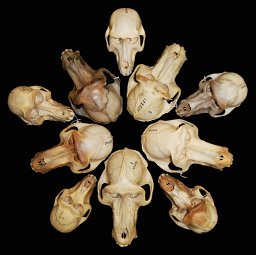
OBJECTIVES The aim of this study is to assess a new assemblage of papionin fossils (n = 143) recovered from later Pleistocene sediments in the Middle Awash study area in the Afar Rift of Ethiopia. MATERIALS AND METHODS We collected metric and qualitative data to compare the craniodental and postcranial anatomy of the papionin fossils with subspecies of modern Papio hamadryas and with Plio-Pleistocene African papionins. We also estimated sex and ontogenetic age. RESULTS The new fossils fit well within the range of morphological variation observed for extant P. hamadryas, overlapping most closely in dental size and proportions with the P. h. cynocephalus individuals in our extant samples, and well within the ranges of P. h. anubis and P. h. hamadryas. The considerable overlap in craniodental anatomy with multiple subspecies precludes subspecific diagnosis. We therefore referred 143 individuals to P. hamadryas ssp. The majority of the individuals assessed for ontogenetic age fell into middle- and old-adult age categories based on the degree of dental wear. Males (26%) were better represented than females (12%) among individuals preserving the canine-premolar honing complex. DISCUSSION These new near-modern P. hamadryas fossils provide a window into population-level variation in the later Pleistocene. Our findings echo previous suggestions from genomic studies that the papionin family tree may have included a ghost population and provide a basis for future testing of hypotheses regarding hybridization in the recent evolutionary history of this taxon.
We used image analysis software (ImageJ) to measure femoral shaft obliquity in 76 humans, 57 forest chimpanzees, and four dry-habitat (Semliki) chimpanzees. We found that dry-habitat chimpanzee femora were intermediate between forest chimpanzees and humans and significantly different from each (χ2 = 6.21, p = 0.013; χ2 = 11.11, p = 0.001). We further compared human femoral obliquity with the published values of six australopiths. Mean bicondylar angles were found to be 10.9° for humans, −0.3° for forest chimpanzees, 4.2° for Semliki chimpanzees, and 12.0° for australopiths (midsex average = 11.4°). Contrary to expectation, australopith bicondylar angles were not significantly greater than those of humans (χ2 = 0.67, p = 0.41). Human females had significantly greater angles than males (Kruskal-Wallis analysis, p = 0.002). Femoral obliquity among dry-habitat chimpanzees is consistent with the hypothesis that bipedalism evolved as a dry-habitat foraging strategy.
Studying offshore slow‐slip events (SSEs) along subduction zone interfaces is important for constraining the overall slip budget and potential for seismic slip and the relationship with large megathrust earthquakes. Models using only onshore data increasingly lack model resolution the further from the shore the SSE occurs. In this study, we combine data from the Hikurangi Ocean Bottom Investigation of Tremor and Slow Slip seafloor absolute pressure gauge (APG) network with daily position time series from New Zealand's GeoNet to create time‐dependent models of slip during the 2014 Gisborne, New Zealand SSE using the Network Inversion Filter. We compare models assuming heterogeneous versus homogenous elastic properties to explore their influence on our models. The time‐dependent results show that slip uncertainties under the APGs drop by about 23%. We also find that the peak value of slip increases with heterogeneous elastic properties as compared to homogenous models. The inclusion of the offshore APG data in our models places more slip near the trench and detects a more defined migration of slip, especially in the heterogeneous model. These differences are important for interpreting the relationship between the SSE and associated tremor, which occurs after the peak SSE slip rate. Additionally, we use a static “potency bounding” technique in order to gauge the range of models that can fit the data. This analysis demonstrates that the inclusion of offshore data helps to substantially narrow the range of plausible slip models.
 Marianne F. Brasil合作论文数Human Evolut Res Ctr, Univ Calif Berkeley7
 Leslea J. Hlusko合作论文数Department of Integrative Biology, University of California, Berkeley;National Center for Research on Human Evolution7
 Monson Tesla A合作论文数Department of Integrative Biology, University of California7
 Catherine E Taylor合作论文数6Seth Finnegan合作论文数Department of Integrative Biology, University of California, Berkeley4
 Erin Schuster合作论文数3
 Alexandre Pohl合作论文数Univ Calif Riverside, Dept Earth & Planetary Sci, Riverside, CA 92521 USA3
 Charles E. Mitchell合作论文数State University of New York, University at Buffalo3
 Laura M. Wallace合作论文数GNS Science, NZ; Institute of Geophysics, Jackson School of Geosciences, University of Texas3N. M. Bartlow合作论文数2
 Richard Stockey合作论文数Stanford Univ, Dept Geol Sci, Stanford, CA 94305 USA2Arnaud Brayard合作论文数1Isaac Krone合作论文数1
 Katherine M Magoulick合作论文数1Xu Dai合作论文数China Univ Geosci, Sch Earth Sci, State Key Lab Biogeol & Environm Geol, Wuhan 430074, Peoples R China1
 Dominik Hülse合作论文数Max Planck Inst Meteorol, Hamburg, Germany1
 Christopher A Schmitt合作论文数Center for Neurobehavioral Genetics, University of California Los Angeles;Department of Anthropology, New York University;University of California Los Angeles, New York University1
 Andy Ridgwell合作论文数Department of Earth and Planetary Sciences, University of California, Riverside;University of Bristol1
 Charles A Williams合作论文数1Noel M. Bartlow合作论文数1
 Kristian J Carlson合作论文数1
 Erin E. Saupe合作论文数Department of Earth Sciences, University of Oxford1Guillaume Le Hir合作论文数1
 Kevin D. Hunt合作论文数Department of Anthropology;Indiana University;Department of Anthropology, Indiana University1




