Linear time-varying (LTV) systems model radar scenes where each reflector/target applies a delay, Doppler shift and complex amplitude scaling to a transmitted waveform. The receiver processes the received signal using the transmitted signal as a reference. The self-ambiguity function of the transmitted signal captures the cross-correlation of delay and Doppler shifts of the transmitted waveform. It acts as a blur that limits resolution, at the receiver, of the delay and Doppler shifts of targets in close proximity. This paper considers resolution of multiple targets and compares performance of traditional chirp waveforms with the Zak-OTFS waveform. The self-ambiguity function of a chirp is a line in the delay-Doppler domain, whereas the self-ambiguity function of the Zak-OTFS waveform is a lattice. The advantage of lattices over lines is better localization, and we show lattices provide superior noise-free estimation of the range and velocity of multiple targets. When the delay spread of the radar scene is less than the delay period of the Zak-OTFS modulation, and the Doppler spread is less than the Doppler period, we describe how to localize targets by calculating cross-ambiguities in the delay-Doppler domain. We show that the signal processing complexity of our approach is superior to the traditional approach of computing cross-ambiguities in the continuous time / frequency domain.
4G/5G wireless standards ustransfer domain ise orthogonal frequency division multiplexing (OFDM) which is robust to frequency selectivity. Equalization is possible with a single tap filter, and low-complexity equalization makes OFDM an attractive physical layer. However, the performance of OFDM degrades with mobility. Zak-transform based orthogonal time frequency space (Zak-OTFS) modulation has been shown to be robust to doubly selective channels. The received signal in Zak-OTFS is a superposition of many attenuated copies since the doubly selective channel introduces delay and Doppler shifts and are more difficult to equalize since they are subject to interference along both delay and Doppler axes. In this paper, we propose a low-complexity method of equalizing Zak-OTFS in the frequency domain (FD). We derive the FD system model and show that it is unitarily equivalent to the DD system model. We show that the channel matrix in the FD is banded, making it possible to apply conjugate gradient methods to reduce the complexity of equalization. We show that complexity of FD equalization is linear in the dimension of a Zak-OTFS frame while naive MMSE equalization incurs cubic complexity. Through numerical simulations we show that FD equalization of Zak-OTFS achieves similar performance as equalization in DD domain.
We communicate over wireless channels by first estimating and then equalizing the effective channel. In Zak-OTFS (orthogonal time frequency space) modulation the carrier waveform is a pulse in the delay-Doppler (DD) domain, formally a quasi-periodic localized function with specific periods along delay and Doppler. When the channel delay spread is less than the delay period, and the channel Doppler spread is less than the Doppler period, the response to a single Zak-OTFS carrier provides an image of the scattering environment and can be used to predict the effective channel at all other carriers. This makes DD domain channel estimation straightforward, and there is no loss in spectral efficiency since it is possible to design data and pilot signals that are mutually unbiased. However, equalization in the DD domain has high complexity 𝒪(M^3N^3) where M, N are respectively the number of delay and Doppler bins in an OTFS frame, and MN is the number of information symbols. We demonstrate that equalization in the frequency domain (FD) reduces complexity to only 𝒪(M^2 N^2) by taking advantage of the banded structure of the effective FD channel. We also derive a low-complexity method to reconstruct the effective FD channel from the estimated DD domain effective channel.
We consider the design of a modern uplink for supporting machine-type communication and the confluence of sensing, communication, and distributed learning. We demonstrate that grant-free multiple access is possible even in the presence of highly time-varying channels and high delay spread. Our approach is built on enhancing the 2 -step random access procedure of the 5GNR standard. This 2 -step procedure uses Zadoff-Chu (ZC) sequences as preambles that point to radio resources which are then used to upload data. ZC sequences are processed in the delay-Doppler (DD) domain rather than the time domain. We demonstrate that it is possible to detect multiple preambles in the presence of mobility and delay spread using a receiver with no knowledge of the channel other than the worst case delay and Doppler spreads. Our approach depends on the mathematical properties of ZC sequences in the DD domain. We derive a closed form expression for ZC pilots in the DD domain, we characterize the possible self-ambiguity functions, and we determine the magnitude of the possible cross-ambiguity functions. These mathematical properties combine with Zak-OTFS modulation to enable detection of multiple pilots through solution of a compressed sensing problem. The columns of the compressed sensing matrix are the translates of individual ZC pilots in delay and Doppler. We show that columns in the design matrix satisfy a coherence property that makes it possible to detect multiple preambles in a single Zak-OTFS subframe using One-Step Thresholding, which is an algorithm with low complexity.
Zak-OTFS is a modulation scheme where signals are formed in the delay–Doppler (DD) domain, converted to the time domain (DD) for transmission and reception, then returned to the DD domain for processing. We describe how to use the same architecture for radar sensing. The intended delay resolution is 1/B where B is the radar bandwidth, and the intended Doppler resolution is 1/T where T is the transmission time. We form a radar waveform in the DD domain, illuminate the scattering environment, match filter the return, and then correlate with delay and Doppler shifts of the transmitted waveform. This produces an image of the scattering environment, and the radar ambiguity function expresses the blurriness of this image. The possible delay and Doppler shifts generate the continuous Heisenberg–Weyl group which has been widely studied in the theory of radar. We describe how to approach the problem of waveform design, not from the perspective of this continuous group, but from the perspective of a discrete group of delay and Doppler shifts, where the discretization is determined by the intended delay and Doppler resolution of the radar. We describe how to approach the problem of shaping the ambiguity surface through symplectic transformations that normalize our discrete Heisenberg–Weyl group. The complexity of traditional continuous radar signal processing is 𝒪 (B^2T^2 ) . We describe how to reduce this complexity to 𝒪 (BTlog T ) by choosing the radar waveform to be a common eigenvector of a maximal commutative subgroup of our discrete Heisenberg–Weyl group. The theory of symplectic transformations also enables defining libraries of optimal radar waveforms with small peak-to-average power ratios.
When the delay period of the Zak-OTFS carrier is greater than the delay spread of the channel, and the Doppler period of the carrier is greater than the Doppler spread of the channel, the effective channel filter taps can simply be read off from the response to a single pilot carrier waveform. The input-output (I/O) relation can then be reconstructed for a sampled system that operates under finite duration and bandwidth constraints. We introduce a framework for pilot design in the delay-Doppler (DD) domain which makes it possible to support users with very different delay-Doppler characteristics when it is not possible to choose a single delay and Doppler period to support all users. The method is to interleave single pilots in the DD domain, and to choose the pilot spacing so that the I/O relation can be reconstructed by solving a small linear system of equations.
We consider the issue of high peak-to-average-power ratio (PAPR) of Orthogonal time frequency space (OTFS) modulated signals. This paper proposes a low-complexity novel iterative PAPR reduction method which achieves a PAPR reduction of roughly 5 dB when compared to a OTFS modulated signal without any PAPR compensation. Simulations reveal that the PAPR achieved by the proposed method is significantly better than that achieved by other state-of-art methods. Simulations also reveal that the error rate performance of OTFS based systems with the proposed PAPR reduction is similar to that achieved with the other state-of-art methods.
Wireless users with different characteristics will be expected to share spectrum in next generation communication networks. One of the great strengths of wireless networks based on Orthogonal Frequency Division Multiplexing (OFDM) is the ease with which different non-overlapping time-frequency (TF) resources can be allocated to different users by simply shifting each user's signal in time and frequency. However, a significant weaknesses of OFDM is the inflexibility of sub-carrier spacing. Since OFDM does not allow users to have different sub-carrier spacing, a single user subject to inter-carrier interference causes carrier spacing to increase for all users. Zak-OTFS is an alternative delay-Doppler (DD) domain modulation scheme, where, in contrast to OFDM, the Input-Output (I/O) relation is predictable. We match the strength of OFDM by designing a novel DD domain method of shaping the transmitted Zak-OTFS pulse on the uplink that enables flexible non-overlapping TF resource allocation. The base station (BS) receives a superposition of uplink signals and applies individual matched filters to obtain the data specific to individual users. We develop theoretical measures of interference between users, and present numerical simulations for a vehicular channel model representative of next generation propagation environments. We demonstrate single-user performance in a multiuser Zak-OTFS uplink system without needing to provision guard bands between TF resources allocated to different users. These performance results demonstrate that the benefits of a predictable Zak-OTFS waveform can be realized within an architecture for uplink communication.
In Zak-OTFS (orthogonal time frequency space) modulation the carrier waveform is a pulse in the delay-Doppler (DD) domain, formally a quasi-periodic localized function with specific periods along delay and Doppler. When the channel delay spread is less than the delay period, and the channel Doppler spread is less than the Doppler period, the response to a single Zak-OTFS carrier provides an image of the scattering environment and can be used to predict the effective channel at all other carriers. The image of the scattering environment changes slowly, making it possible to employ precoding at the transmitter. Precoding techniques were developed more than thirty years ago for wireline modem channels (V.34 standard) defined by linear convolution where a pulse in the time domain (TD) is used to probe the one-dimensional partial response channel. The action of a doubly spread channel on Zak-OTFS modulation determines a two-dimensional partial response channel defined by twisted convolution, and we develop a novel precoding technique for this channel. The proposed precoder leads to separate equalization of each DD carrier which has significantly lower complexity than joint equalization of all carriers. Further, the effective precoded channel results in non-interfering DD carriers which significantly reduces the overhead of guard carriers separating data and pilot carriers, which improves the spectral efficiency significantly.
Across the world, there is growing interest in new waveforms, Zak-OTFS in particular, and over-the-air implementations are starting to appear. The choice between OFDM and Zak-OTFS is not so much a choice between waveforms as it is an architectural choice between preventing inter-carrier interference (ICI) and embracing ICI. In OFDM, once the Input-Output (I/O) relation is known, equalization is relatively simple, at least when there is no ICI. However, in the presence of ICI the I/O relation is non-predictable and its acquisition is non-trivial. In contrast, equalization is more involved in Zak-OTFS due to inter-symbol-interference (ISI), however the I/O relation is predictable and its acquisition is simple. {Zak-OTFS exhibits superior performance in doubly-spread 6G use cases with high delay/Doppler channel spreads (i.e., high mobility and/or large cells), but architectural choice is governed by the typical use case, today and in the future. What is typical depends to some degree on geography, since large delay spread is a characteristic of large cells which are the rule rather than the exception in many important wireless markets.} This paper provides a comprehensive performance comparison of cyclic prefix OFDM (CP-OFDM) and Zak-OTFS across the full range of 6G propagation environments. The performance results provide insights into the fundamental architectural choice.
Zak-Orthogonal Time Frequency Space (Zak-OTFS) modulation has been shown to achieve significantly better performance compared to the standardized Cyclic-Prefix Orthogonal Frequency Division Multiplexing (CP-OFDM), in high delay/Doppler spread scenarios envisaged in next generation communication systems. Zak-OTFS carriers are quasi-periodic pulses in the delay-Doppler (DD) domain, characterized by two parameters, (i) the pulse period along the delay axis (“delay period") (Doppler period is related to the delay period), and (ii) the pulse shaping filter. An important practical challenge is enabling support for Zak-OTFS modulation in existing CP-OFDM based modems. In this paper we show that Zak-OTFS modulation with pulse shaping constrained to sinc filtering (filter bandwidth equal to the communication bandwidth B) followed by time-windowing with a rectangular window of duration (T + T_cp) (T is the symbol duration and T_cp is the CP duration), can be implemented as a low-complexity precoder over standard CP-OFDM. We also show that the Zak-OTFS de-modulator with matched filtering constrained to sinc filtering (filter bandwidth B) followed by rectangular time windowing over duration T can be implemented as a low-complexity post-processing of the CP-OFDM de-modulator output. This proposed “Zak-OTFS over CP-OFDM" architecture enables us to harness the benefits of Zak-OTFS in existing network infrastructure. We also show that the proposed Zak-OTFS over CP-OFDM is a family of modulations, with CP-OFDM being a special case when the delay period takes its minimum possible value equal to the inverse bandwidth, i.e., Zak-OTFS over CP-OFDM with minimum delay period.
The Zak-OTFS input/output (I/O) relation is predictable and non-fading when the delay and Doppler periods are greater than the effective channel delay and Doppler spreads, a condition which we refer to as the crystallization condition. The filter taps can simply be read off from the response to a single Zak-OTFS pilot pulsone, and the I/O relation can be reconstructed for a sampled system that operates under finite duration and bandwidth constraints. In previous work we had measured BER performance of a baseline system where we used separate Zak-OTFS subframes for sensing and data transmission. In this Letter we demonstrate how to use turbo signal processing to match BER performance of this baseline system when we integrate sensing and communication within the same Zak-OTFS subframe. The turbo decoder alternates between channel sensing using a noise-like waveform (spread pulsone) and recovery of data transmitted using point pulsones.
The Zak-OTFS input/output (I/O) relation is predictable and non-fading when the delay and Doppler periods are greater than the effective channel delay and Doppler spreads, a condition which we refer to as the crystallization condition. When the crystallization condition is satisfied, we describe how to integrate sensing and communication within a single Zak-OTFS subframe by transmitting a pilot in the center of the subframe and surrounding the pilot with a pilot region and guard band to mitigate interference between data symbols and pilot. At the receiver we first read off the effective channel taps within the pilot region, and then use the estimated channel taps to recover the data from the symbols received outside the pilot region. We introduce a framework for filter design in the delay-Doppler (DD) domain where the symplectic Fourier transform connects aliasing in the DD domain (predictability of the I/O relation) with time/bandwidth expansion. The choice of pulse shaping filter determines the fraction of pilot energy that lies outside the pilot region and the degradation in BER performance that results from the interference to data symbols. We demonstrate that Gaussian filters in the DD domain provide significant improvements in BER performance over the sinc and root raised cosine filters considered in previous work. We also demonstrate that, by limiting DD domain aliasing, Gaussian filters extend the region where the crystallization condition is satisfied. The Gaussian filters considered in this paper are a particular case of factorizable pulse shaping filters in the DD domain, and this family of filters may be of independent interest.
Much of the engineering behind current wireless systems has focused on designing an efficient and high-throughput downlink to support human-centric communication such as video streaming and internet browsing. This paper looks ahead to design of the uplink, anticipating the emergence of machine-type communication (MTC) and the confluence of sensing, communication, and distributed learning. We demonstrate that grant-free multiple access is possible even in the presence of highly time-varying channels. Our approach provides a pathway to standards adoption, since it is built on enhancing the 2-step random access procedure which is already part of the 5GNR standard. This 2-step procedure uses Zadoff-Chu (ZC) sequences as preambles that point to radio resources which are then used to upload data. We also use ZC sequences as preambles / pilots, but we process signals in the Delay-Doppler (DD) domain rather than the time-domain. We demonstrate that it is possible to detect multiple preambles in the presence of mobility and delay spread using a receiver with no knowledge of the channel other than the worst case delay and Doppler spreads. Our approach depends on the mathematical properties of ZC sequences in the DD domain. We derive a closed form expression for ZC pilots in the DD domain, we characterize the possible self-ambiguity functions, and we determine the magnitude of the possible cross-ambiguity functions. These mathematical properties enable detection of multiple pilots through solution of a compressed sensing problem. The columns of the compressed sensing matrix are the translates of individual ZC pilots in delay and Doppler. We show that columns in the design matrix satisfy a coherence property that makes it possible to detect multiple preambles in a single Zak-OTFS subframe using One-Step Thresholding (OST), which is an algorithm with low complexity.
The Zak-OTFS input/output (I/O) relation is predictable and non-fading when the delay and Doppler periods are greater than the effective channel delay and Doppler spreads, a condition which we refer to as the crystallization condition. The filter taps can simply be read off from the response to a single Zak-OTFS point (impulse) pulsone waveform, and the I/O relation can be reconstructed for a sampled system that operates under finite duration and bandwidth constraints. Predictability opens up the possibility of a model-free mode of operation. The time-domain realization of a Zak-OTFS point pulsone is a pulse train modulated by a tone, hence the name, pulsone. The Peak-to-Average Power Ratio (PAPR) of a pulsone is about $15$ dB, and we describe a general method for constructing a spread pulsone for which the time-domain realization has a PAPR of about 6dB. We construct the spread pulsone by applying a type of discrete spreading filter to a Zak-OTFS point pulsone. The self-ambiguity function of the point pulsone is supported on the period lattice ${\Lambda}_{p}$, and by applying a discrete chirp filter, we obtain a spread pulsone with a self-ambiguity function that is supported on a rotated lattice ${\Lambda^*}$. We show that if the channel satisfies the crystallization conditions with respect to ${\Lambda^*}$ then the effective DD domain filter taps can simply be read off from the cross-ambiguity between the channel response to the spread pulsone and the transmitted spread pulsone. If, in addition, the channel satisfies the crystallization conditions with respect to the period lattice ${\Lambda}_{p}$, then in an OTFS frame consisting of a spread pilot pulsone and point data pulsones, after cancelling the received signal corresponding to the spread pulsone, we can recover the channel response to any data pulsone.
Orthogonal Time Frequency Space (OTFS) is a framework for communications and active sensing that processes signals in the delay-Doppler (DD) domain. It is informed by 6G propagation environments, where Doppler spreads measured in kHz make it more and more difficult to estimate channels, and the standard model-dependent approach to wireless communication is starting to break down. We consider Zak-OTFS where inverse Zak transform converts information symbols mounted on DD domain pulses to the time domain for transmission. Zak-OTFS modulation is parameterized by a delay period tau(p) and a Doppler period nu(p), where the product tau(p)nu(p) = 1. When the channel spread is less than the delay period, and the Doppler spread is less than the Doppler period, the Zak-OTFS input-output relation can be predicted from the response to a single pilot symbol. The highly reliable channel estimates concentrate around the pilot location, and we configure low-density parity-check (LDPC) codes that take advantage of this prior information about reliability. It is advantageous to allocate information symbols to more reliable bins in the DD domain. We report simulation results for a Veh-A channel model where it is not possible to resolve all the paths, showing that LDPC coding extends the range of Doppler spreads for which reliable model-free communication is possible. We show that LDPC coding reduces sensitivity to the choice of transmit filter, making bandwidth expansion less necessary. Finally, we compare BER performance of Zak-OTFS to that of a multicarrier approximation (MC-OTFS), showing LDPC coding amplifies the gains previously reported for uncoded transmission.
The recently proposed Orthogonal Time Frequency Space (OTFS) modulation has been shown to be robust to mobility induced Doppler spread in next generation communication systems. Due to dense network deployment, next generation communication systems are expected to experience significant co-channel interference. Therefore, there is a need to study the robustness of OTFS modulation in the presence of co-channel interference. In this paper, we study the impact of sinusoidal co-channel continuous wave (CW) interference on the spectral efficiency (SE) of an Orthogonal Time Frequency Space (OTFS) modulation based communication system. In OTFS modulation, information symbols are embedded in the delay-Doppler (DD) domain. Analysis of the DD domain representation of the received CW interference shows that the interference received along a particular channel path is localized in a Doppler domain interval having width approximately twice the Doppler domain resolution (i.e., inverse of the OTFS frame time-duration). With fine Doppler domain resolution, the CW interference is localized to a small portion of the Doppler domain and is expected to interfere only with a small fraction of all information symbols. This observation is supported through simulations, where it is confirmed that the degradation in the OTFS SE performance is small when the Doppler domain resolution is fine.
In our first paper [2] we explained why the Zak-OTFS input-output (I/O) relation is predictable and non-fading when the delay and Doppler periods are greater than the effective channel delay and Doppler spreads, a condition which we refer to as the crystallization condition. We argued that a communication system should operate within the crystalline regime. It is well known that it is possible to identify a linear time varying (LTV) channel if and only if it is under-spread. The crystallization condition is more restrictive than the under-spread condition, so identification is always possible. In the crystalline regime, we show that Zak-OTFS pilot sequences minimize the complexity of identifying the effective DD domain channel filter. We demonstrate that the filter taps can simply be read off from the response to a single Zak-OTFS pilot. In general, we provide an explicit formula for reconstructing the Zak-OTFS I/O relation from a finite number of received pilot symbols in the delay-Doppler (DD) domain. This reconstruction formula makes it possible to study predictability of the Zak-OTFS I/O relation for a sampled system that operates under finite duration and bandwidth constraints. We analyze reconstruction accuracy for different choices of the delay and Doppler periods, and of the pulse shaping filter. Reconstruction accuracy is high when the crystallization condition is satisfied, implying that it is possible to learn directly the I/O relation without needing to estimate the underlying channel. This opens up the possibility of a model-free mode of operation, which is especially useful when a traditional model-dependent mode of operation (reliant on estimation of the underlying physical channel) is out of reach (for example, when the channel comprises of unresolvable paths, or exhibits a continuous delay-Doppler profile such as in presence of acceleration). Our study clarifies the
We propose a low-complexity channel estimation method for Orthogonal Time Frequency Space (OTFS) modulation based systems. Two important aspects of OTFS modulation, namely, (i) fine delay-Doppler (DD) resolution which results in path separation and, (ii) the separability of the effective DD domain channel gain expression into delay domain and Doppler domain terms, are used to propose an iterative channel estimation method which s eparately estimates the delay, Doppler shift and the channel gain for each channel path. The proposed estimation does not require matrix inversion and therefore has lower complexity when compared to other known methods. The proposed method is shown to achieve a normalized mean square estimation error (NMSE) performance better than other methods.
 Ananthanarayanan Chockalingam合作论文数Department of Electrical and Communication Engineering, Indian Institute of Science45
 Robert Calderbank合作论文数Pierre R. Lamond Department of Electrical & Computer Engineering, Pratt School of Engineering, Duke University;Trinity College of Arts & Sciences, Duke University17
 B. Sundar Rajan合作论文数Department of Electrical Communication Engineering, Indian Institute of Science17
 Erik G. Larsson合作论文数Division for Communication Systems, Department of Electrical Engineering, Linköping University14
 Ronny Hadani合作论文数Department of Mathematics, College of Natural Sciences, University of Texas at Austin13
 Sudarshan Mukherjee合作论文数13
 Ranjan K. Mallik合作论文数Department of Electrical Engineering, Indian Institute of Technology Delhi10
 Yi Hong合作论文数Department of Electrical and Computer Systems Engineering, Faculty of Engineering, Monash University8
 Emanuele Viterbo合作论文数Department of Electrical and Computer Systems Engineering, Faculty of Engineering, Monash University8
 Venkatesh Khammammetti合作论文数Department of Electrical Engineering, Indian Institute of Technology Delhi6
 Soumya P. Dash合作论文数Department of Electrical Engineering, Indian Institute of Technology-Delhi, Hauz Khas, New Delhi, India6
 Imran Ali Khan合作论文数Chinese Academy of Sciences6
 Antonios Pitarokoilis合作论文数School of Electrical Engineering and ACCESS Linnaeus Center, KTH Royal Institute of Technology5
 Rachit Mahendra合作论文数Indian Institute of Technology Delhi4
 Jinu Jayachandran合作论文数Department of Electronics and Communication Engineering, Amrita School of Engineering4
 Naveen K. Yanduru合作论文数4
 Amit Agarwal合作论文数3Muhammad Ubadah合作论文数3
 Beyza Dabak合作论文数Department of Electrical and Computer Engineering, Duke University3Suresh Chandrasekaran合作论文数indian institute of science3
 Nagaraja Srinidhi合作论文数Center for Devices and Radiological Health, U.S. Food and Drug Administration3
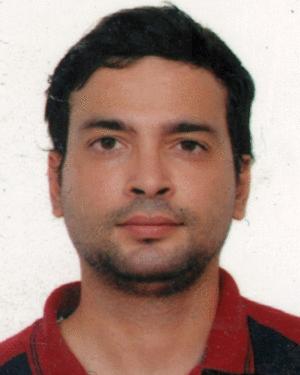 Brijesh Chander Pandey合作论文数2
 Alok Sinha合作论文数Bharti School of Telecommunication Technology and Management, Indian Institute of Technology Delhi (IIT Delhi2
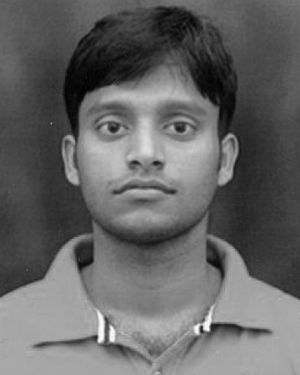 kamal biswas合作论文数Indian Institute of Technology Delhi2
 Krishna Narayanan合作论文数Department of Electrical and Computer Engineering, College of Engineering, Texas A&M University2
 K. Vishnu Vardhan合作论文数Cisco Syst. (India) Private Ltd.2Naveen Yanduru合作论文数2
 E. Viterbo合作论文数Dipartimento di Elettronica2
 Thomas Marzetta合作论文数Electrical and Computer Engineering Department, Tandon School of Engineering, New York University2
 Patchava Raviteja合作论文数Qualcomm2Yanduru, N.K.合作论文数1indra bhushan合作论文数1
 Anton Monk合作论文数1
 Ross D. Murch (穆樂思)合作论文数Department of Electronic & Computer Engineering, School of Engineering, Hong Kong University of Science and Technology;Institute of Advanced Study, Hong Kong University of Science and Technology1
 Giuseppe Caire合作论文数Electrical Engineering and Computer Science Department, Technical University of Berlin1Ramesh Annavajjala合作论文数MERL Research1Shlomo Rakib合作论文数1
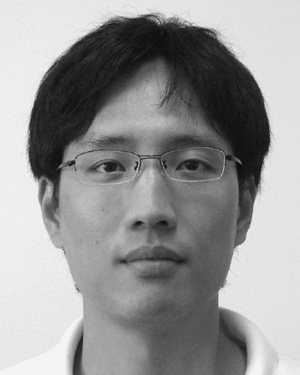 Hong Yi合作论文数1
 Ahmed Zaki合作论文数University of Calgary1
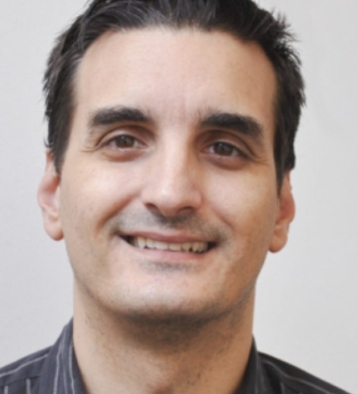 Konstantinos Pelechrinis合作论文数Department of Informatics and Networked Systems, School of Computing and Information, University of Pittsburgh;Dallas Mavericks1
 Chih-Lin I (易芝玲)合作论文数China Mobile Research Institute1
 Somsubhra Barik合作论文数1
 Sneha Kasera合作论文数John and Marcia Price College of Engineering, University of Utah;Kahlert School of Computing, University of Utah1
 Mérouane Debbah合作论文数Digital Future Institute, Khalifa University;CentraleSupélec1Ioannis Broustis合作论文数Department of Computer Science and Engineering,;University of California1Srikanth V. Krishnamurhty合作论文数1
 Ece Gelal合作论文数Dept . of Computer Science and Engineering;University of California;Dept . of Computer Science and Engineering, University of California , Riverside1




