The dream of universal access to high-quality, personalized educational content that is available both synchronously and asynchronously remains unrealized. For more than four decades, it has been said that information technology would be a key enabling technology for making this dream a reality by providing the ability to produce compelling and individualized content, the means for delivering it, and effective feedback and assessment mechanisms. Although IT has certainly had some impact, it has become a cliché to note that education is the last field to take systematic advantage of IT. There have been some notable successes of innovative software (e.g., the graphing calculator, the Geometer's Sketchpad, and the World Wide Web as an information-storage and -delivery vehicle), but we continue to teach-and students continue to learn-in ways that are virtually unchanged since the invention of the blackboard.
In experimental hypertext fiction workshops at Brown University, undergraduate writers work with programmers to create interactive literary experiences in immersive virtual reality. To involve the writer more directly in the process of implementation, we have created CaveWriting 2006 , a spatial hypertext authoring system. Authors can manipulate a graphical front-end to position text, multimedia, and 3D models within virtual space, apply special effects, and create hyperlinks which initiate theatrical events. The result can be previewed at any time inside a desktop window. Moreover, the system's features can be extended in C++, allowing programmers and writers to collaborate directly and work simultaneously.
Molecules are inherently three-dimensional (3D) objects that are represented by chemists on paper and classroom blackboards by a system of two-dimensional (2D) notations. ChemPad, a new Tablet PC application with a pedagogical focus, generates 3D molecular structures from hand drawn digital ink rather than from traditional molecule construction interfaces. Leveraging the gestural power of Fluid Inking [Zeleznik et al. ], ChemPad allows chemists to input molecules in a quick and natural fashion to generate models viewable by the open-source JMol1 molecule viewer. This capability gives ChemPad pedagogical value as shown by our user study of a hundred organic chemistry students who had difficulty with 3D chemistry thinking and used ChemPad to overcome that hurdle.
"Cave Writing" is a nationally recognized interdisciplinary workshop course offered annually at Brown University. In this sketch we describe significant educational improvements enabled by improved technology in our VR platform. These include: (a) faster development and more support for iterative design; (b) greater involvement by students from different disciplinary backgrounds in full breadth of project development, increasing cross-disciplinary learning; and (c) diverse media rendered at high performance (e.g., high quality animated text, embedded video, and more devices) that facilitate creation of literary experiences specific to the bodily presence and physical space of the Cave.
This paper reports on early progress with the use of immersive virtual reality technology for trauma surgery training. We discuss our technical goals and the application area, and then describe our work to date. The need to create a system that can be used by overworked, highly time-constrained surgeons and surgical trainees has affected many of our decisions, from the type of displays used to the focus on time navigation (to let trainees experience important moments and skip well-understood ones) to the use of easilylearned traditional 2D interfaces (vs. more demanding innovative 3D interfaces) for some of the interaction methods. This three-year research project, which is just entering its second year, is supported by a National Science Foundation Information Technology Research grant for collaborative research between groups at Brown University and the University of North Carolina at Chapel Hill.
This paper reports on early progress with the use of immersive virtual reality technology for trauma surgery training. We discuss our technical goals and the application area, and then describe our work to date. The need to create a system that can be used by overworked, highly time-constrained surgeons and surgical trainees has affected many of our decisions, from the type of displays used to the focus on time navigation (to let trainees experience important moments and skip well-understood ones) to the use of easily-learned traditional 2D interfaces (vs. more demanding innovative 3D interfaces) for some of the interaction methods. This three-year research project, which is just entering its second year, is supported by a National Science Foundation Information Technology Research grant for collaborative research between groups at Brown University and the University of North Carolina at Chapel Hill.
We present an overview of multi-year eorts aimed at developing technology to support natural telepresence over time for o-line surgical training, and over space for on-line or "live" remote consultation. Our goal is to capture and display high-fidelity, 3D graphical reconstructions of the ac- tual time-varying events, allowing observers to change their (stereo) viewpoints naturally, by walking around, leaning forward/backward, rotating their head, etc. We describe the processes we use in our early prototypes, and present some experimental results.
 Andries van Dam合作论文数Department of Computer Science, Brown University6
 Ruigang Yang (杨睿刚)合作论文数Global Institute of Future Technology, Shanghai Jiao Tong University5
 G. Welch合作论文数University of North Carolina at Chapel Hill
Department of Computer Science5
G. Welch合作论文数University of North Carolina at Chapel Hill
Department of Computer Science5 Kok Lim Low合作论文数Department of Computer Science, School of Computing, National University of Singapore3
 Henry Fuchs合作论文数Department of Computer Science, College of Arts and Sciences, The University of North Carolina at Chapel Hill3
 Bruce Cairns合作论文数Department of Microbiology and Immunology, School of Medicine, The University of North Carolina at Chapel Hil3
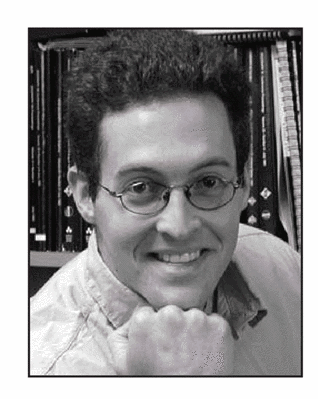 Jesse Funaro合作论文数3
 Herman Towles合作论文数Applied Research Associates3
 Andrei State合作论文数University of North Carolina at Chapel Hill;Department of Computer Science2
 Nicholas Musurca合作论文数2
 Adrian Ilie合作论文数University of North Carolina at Chapel Hill Computer Science Department2Daniel Russo合作论文数Columbia University2Rosemary Michelle Simpson合作论文数Department of Computer Science, Brown University2
 Loring Holden合作论文数Technic Inc.2Damon Baker合作论文数1Ilya Kreymer合作论文数1
 B. Danette Allen合作论文数1Hua Yang合作论文数Department of Computer Science, University of North Carolina at Chapel Hill1
 Ketan Mayer-Patel合作论文数Department of Computer Science, College of Arts and Sciences, The University of North Carolina at Chapel Hill1A. State合作论文数University of North Carolina at Chapel Hill;Department of Computer Science1Dana Tenneson合作论文数1
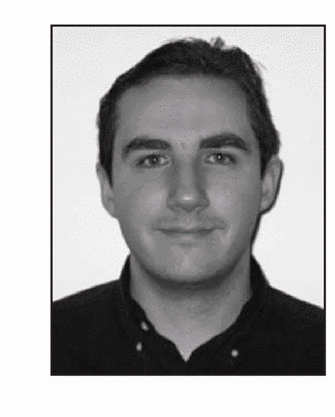 Dan Russo合作论文数1
 Morgan McGuire合作论文数Brainard Strategy1
 Robert Coover合作论文数Literary Arts Department, Brown University1Shawn Greenlee合作论文数Brown University1
 Anselmo Lastra合作论文数Department of Computer Science1
 Noah Wardrip-Fruin合作论文数University of California, Santa Cruz1Anne Morgan Spalter合作论文数Brown University, Department of Computer Science, (2004-present)
A· Visual Computing Researcher, Brown University, Department of Computer Science, (2004-present)1
Noah Wardrip-Fruin合作论文数University of California, Santa Cruz1Anne Morgan Spalter合作论文数Brown University, Department of Computer Science, (2004-present)
A· Visual Computing Researcher, Brown University, Department of Computer Science, (2004-present)1 Diane Sonnenwald合作论文数School of Information and Communication Studies, University College Dublin1Eugene B. Freid合作论文数1Andy Van Dam合作论文数1Dmitri K. Lemmerman合作论文数1




