Space debris mitigation requirements in-place today define thresholds for the probability of accidental on-orbit break-up and, sometimes, cumulative collision probability over the residual orbital lifetime of a spacecraft. For both cases, the postulated probability limit is set to 1/1000. The caveat of having fixed design target values is that their justification has to be revisited from time to time. This is especially true when previous assumptions and initial considerations are not applicable anymore. In fact, the recent years have revealed several new trends and tendencies in the way space launches and operations are nowadays performed. These developments were not considered in long-term space debris environment models which underlie current space debris mitigation requirements. This ranges from multi-spacecraft launches and the increase in smaller spacecraft (mini, micro satellites and CubeSats) to introduction of large constellations to pursuing active debris removal concepts. These behavioural changes have been analysed in long-term space debris environment simulations in the recent past. The paper taps into the results and the scenario descriptions of over 400 simulation setups either conducted by partners in joint simulation campaigns or at ESOC/Space Debris Office directly. It derives best estimates for collision rates and explosion rates originating from the various different simulation scenarios. The findings are presented in multidimensional views linking important simulation parameters such as the post mission disposal rate, constellation and active debris removal rate to the overall growth in the number of space (debris) objects at the end of the simulation period. Besides the direct application for challenging the design guideline values for collision and explosion rate, this en-ables us to further exploit the many long-term simulation results performed over several years. The analysis helps to gain further inside in the effectiveness of certain debris mitigation strategies. It can be used to identify gaps in the previous simulation scenario setups, which can be closed in future simulation campaigns and is a pre-requisite for training a surrogate model of the space debris environment. Moreover, we demonstrate how these simulations and aggregated results can be used to calibrate the values obtained from estimators for the space environment capacity and hence future is implied by sustainable be-haviour.
This is the first of two companion papers that investigate the operations of distributed satellite systems. This first article presents a survey of conventional methods of operations of spacecraft constellations, investigates its scalability for growing number of spacecraft, and identifies operational paradigm shifts. The second article focuses on the classification of distributed satellite systems and evaluates commercial tools for automated spacecraft operations. The trend of using distributed space systems such as satellite constellation instead of monolithic systems has been growing in the last decade. Recently, a variety of large satellite constellations were announced and the production of some has started. Several of these announced constellations feature more than 1000 satellites. While the "mass production" of satellites is feasible and has already started, there are no effective solutions existing for the "mass operations" of satellites. In some instances, conventional spacecraft operations involve manual control by skilled human operators, following at least a 4-eyes principle. Even when operators batch multiple telecommands together, the scheduling process is still challenging for growing spacecraft numbers. This approach is not (linearly) scalable to large satellite constellations: new operational methods need to be established and the automation level of the constellation increased. To motivate the research activities in this framework and pave the way for automated management of large distributed satellite systems, this paper gives an overview of some conventional methods of spacecraft operations. From this description, the weakness areas in terms of scalability are deduced, identifying potential bottlenecks for the operations of such systems. Following, based on three use case studies, the operational paradigm shifts related to the operation of large distributed satellite systems are identified. (C) 2020 COSPAR. Published by Elsevier Ltd. All rights reserved.
Recent developments have seen a trend towards larger constellations of spacecraft, with some proposals featuring constellations of more than 10.000 satellites. While similar concepts for large constellations already existed in the past, traditional satellite deployments hardly ever feature groups of more than 100 satellites. This trend towards considerably larger satellite numbers originates from non-traditional design and operations of spacecraft by non-traditional space companies. The evolution in the space sector, precipitated by new players, is often referred to as "Space 4.0" or "New Space". It necessitates a rethinking of the way satellites and satellite constellations are planned, designed, and operated. New operational paradigms are needed to enable automatic, optimal task definition, and scheduling in a holistic approach. This is the second of two companion papers that investigate the operations of distributed satellite systems. This second article investigates the classification of distributed satellite systems and evaluates commercial tools for automated spacecraft operations, whereas the first article performed a survey of conventional and "new space"operations of spacecraft constellations. Classification metrics for constellations are derived and evaluated with respect to their informative value concerning the operation, the automation, and the scalability of the constellation. The proposed classification system is applied to the Dove and RapidEye constellation and allows for a comparison between the presented automation approaches. Commercial tools for automated spacecraft operations are evaluated for several mission task elements, such as orbit control, orbit maintenance, and collision avoidance. Subsequently, the trends, benefits, and standardization needs for operational automation are identified. (C) 2020 COSPAR. Published by Elsevier Ltd. All rights reserved.
ESA's Space Debris Office (SDO) provides operational collision avoidance support to internal ESA missions as well as external partners. The support covers missions in low-Earth orbit and highly eccentric ones, but also special cases such as a conjunction analyses for Earth flybys of interplanetary missions. This diversity of missions often requires the development of custom solutions to account for operational reality. An example custom analysis was needed when large acquisition manoeuvres are performed and lead to increased state uncertainties and ultimately a collision probability dilution. A new metric is presented, which overcomes the limitation of the traditional collision probability by allowing a position shift. The method and its limitation in the operational context are discussed. The overall processing chain is currently upgraded and modernized in order to cope with expected future data loads and to be able to ingest conjunction warnings from multiple surveillance data providers. The chain includes conjunction event detection, collision risk assessment and visualization, orbit and covariance propagation, process control and data handling. This paper will outline the new developments, present results from custom analyses such as the new metric, as well as provide the most recent statistics on conjunction events.
The ReDSHIFT H2020 European project has shown, among other findings, that passive disposal procedures can benefit from the exploitation of dynamical perturbations. One key aspect of the project was a study on the dynamical disposal of spacecraft at the end-of-life by exploiting natural perturbations and identifying stable and unstable regions in the phase space, where the objects could be moved to exploit either long term "graveyards" or, possibly and preferentially, faster escape routes (the so-called "de-orbiting highways"). In particular, for the Low Earth Orbit (LEO) region, a natural eccentricity growth can be leveraged in order to reenter to the Earth's atmosphere at a lower Delta v-budget. The numerical cartography of the region has been proven from a theoretical perspective, on the basis of a frequency analysis focused on solar radiation pressure and lunisolar perturbations and on dynamical systems theory tools. In this work, we summarize the whole study concerning the dynamics that characterizes the LEO region in the long-term, by giving a comprehensive picture of the theoretical findings together with their possible exploitation for the debris mitigation. The efficiency of the "de-orbiting highways" is tested and validated with a "thought experiment" by means of long-term propagation of a population of objects stemming from a specific traffic launch. It is shown how the de-orbiting corridors could be very effective in removing the majority of objects from the high LEO region at the end-of-life, thus contributing to the stabilization of the space debris environment, in particular for high-allude spacecraft.
We consider a central challenge that is mission critical for the successful operation of large-scale satellite constellations in Low-Earth Orbit: How can we coordinate the short-term download operations for the enormous amounts of generated data, based on wireless line-of-sight connections to a limited number of stationary ground station? These issues are critical for the future growth of space systems, with multiple commercial space operators competing for downloading their commercial data in a timely fashion, relying on the services of a scarce set of ground stations that is subject to numerous strong constraints, so it cannot simply be expanded. We present a distributed auction-based scheduling approach for maximizing the value of the downloaded data. Our method allows competing satellite operators to bid for contact times and has a fair and transparent price estimation based on the competition. On its own, it can also be used with a simple bidding strategy to obtain good schedules; this is demonstrated on benchmark simulation with up to 1080 satellites. As a consequence, we are able to achieve values rates of 74% of available data, compared to 28% for standard greedy strategies.
The ReDSHIFT (Revolutionary Design of Spacecraft through Holistic Integration of Future Technologies) project was concluded on March 31, 2019. The 3-year project involved 13 European partners and was aimed at studying, implementing and testing novel solutions for space debris mitigation. The focus was on passive means to reduce the impact of Space Debris by prevention, mitigation and protection. One key aspect of the project was a study on the dynamical disposal of spacecraft at the end-of-life by exploiting natural perturbations and identifying stable and unstable regions in the phase space, where the objects could be moved to exploit either long term “graveyards” or, possibly and preferentially, faster escape routes (the so called “de-orbiting highways”). In this work the efficiency of the “de-orbiting highways” is tested and validated with a “thought experiment” by means of long term propagation of a population of objects stemming from a specific traffic launch. It is shown how the de-orbiting corridors could be very effective in removing the majority of objects from the high LEO region at the end-of-life, thus contributing to the stabilization of the space debris environment.
The ReDSHIFT (Revolutionary Design of Spacecraft through Holistic Integration of Future Technologies) project has been approved by the European Community in the framework of the H2020 Protec 2015 call, focused on passive means to reduce the impact of Space Debris by prevention, mitigation and protection. The main innovative aspects of the project concern a synergy between theoretical and experimental aspects, such as: long term simulations, astrodynamics, passive de-orbiting devices, 3D printing, design for demise, hypervelocity impact testing, legal and normative issues. After more than two years of work, the project is approaching its end. The main expected output are almost complete. The rst complete dynamical mapping of the whole space, from LEO up to the geostationary orbit, was performed, looking for de-orbiting highways , i.e., preferential escape routes to speed up the disposal of spacecraft at the end-of-life, both with and without the use of area augmentation devices. The rst prototypes of 3D-printed spacecraft (and of speci c spacecraft parts) were produced and extensively tested. A number of innovative Design for Demise tests were performed both on 3D-printed samples and on traditional space hardware. Hypervelocity and radiation tests were completed on a number of 3D-printed samples to understand their suitability for the prototype spacecraft. A software tool, encompassing the main project ndings and allowing a preliminary design and de nition of a debris compliant mission (in terms of de-orbiting strategy, shielding, demising, etc.), is now completed and will soon be made publicly available on the website of the project. The legal and normative implications of the project's ndings (e.g., their potential impact on the current mitigation guidelines) is being explored. The paper presents an overview of the ReDSHIFT results obtained so far, in an e ort to highlight the holistic approach of the project covering di erent aspects of the space debris mitigation eld. IAC-18,A6,4,6,x45666 Page 1 of 11 69 International Astronautical Congress (IAC), Bremen, Germany, 1-5 October 2018. Copyright c ©2018 by Alessandro Rossi. Published by the IAF, with permission and released to the IAF to publish in all forms.
Introduction Collaboration is a key factor for successful development of spacecraft. It is a broad term and has many meanings because exchange of information is needed all along the development life cycle. A successful design directly depends on sharing necessary information with others and, on the other hand, comprehending and using relevant information as input for your own work. Modeling and simulation is extensively used in spacecraft design and appears in many different varieties throughout the whole development life cycle. It covers a wide range, from simple orbit simulations based on analytical equations to high-fidelity and multidomain simulations using distributed high-performance computers. In today’s large-scale, complex projects, traditional engineering approaches reach...
The H2020 ReDSHIFT project aims at finding passive means to mitigate the proliferation of space debris. This goal is pursued by a twofold research activity based on theoretical astrodynamics, computer simulations and the analysis of legal aspects of space debris, coupled with an experimental activity on advanced additive manufacturing (3D printing) applied to the production of a novel small satellite. Several different aspects related to the design and production of a debris compliant spacecraft are treated, including shielding, area augmentation devices for deorbiting (solar and drag sails) and design for demise. A strong testing activity, mainly based on design for demise wind tunnel experiments and hypervelocity impacts is performed as well. The main results obtained so far in the project are outlined.
The growth of orbital space debris is both a consequence of and a potential hindrance to space activities. The risks posed by space debris propagation in the most used orbital regions highlight the need to adequately address the challenges posed to the sustainability in outer space. The preservation of the access to and usability of outer space in the long-term requires that action is taken which has to be the result of both mitigation and remediation measures for existing and future space missions. As the enforcement of such technical measures will depend on adequate regulation, they need to be approached also from a legal perspective. The deficiencies in law for space debris remediation mechanisms originate from the fact that although technical concepts have been developed, the legal framework for space activities does not impose any legal obligations for debris removal and on-orbit servicing. Nevertheless, an overview of the relevant legal framework shows that there is a legal basis for the protection of the outer space environment which can, as has already been the case with space debris mitigation guidelines, be substantiated in more concrete terms by the formulation of voluntary, non-binding instruments and included in national legislation.
This paper presents the results of a numerical evaluation of the natural lifetime reduction in low Earth orbit, due to dynamical perturbations. The study considers two values for the area-to-mass ratio, a nominal ratio which resembles a typical value of spacecraft in orbit today, and an enhanced ratio which covers the surface augmentation. The results were obtained with two orbit propagators, one of a semi analytical nature and the second one using non-averaged equations of motion. The simulations for both propagators were set up similarly to allow comparison. They both use the solar radiation pressure and the secular terms of the geopotential (J(2), J(4) and J(6)). The atmospheric drag was turned on and off in both propagators to alternatively study the eccentricity build up and the residual lifetime. The non-averaging case also covers a validation with the full 6 x 6 geopotential. The results confirm the findings in previous publications, that is, the possibility for de-orbiting from altitudes above the residual atmosphere if a solar sail is deployed at the end-of-life, due to the combined effect of solar radiation pressure and the oblateness of the Earth. At near polar inclinations, shadowing effects can be exploited to the same end. The results obtained with the full, non-averaging propagator revealed additional de-orbiting corridors associated with solar radiation pressure which were not found by previous work on space debris mitigation. The results of both tools are compared for specific initial conditions. For nominal values of area-to-mass ratio, instead, it is confirmed that this resonance effect is negligible. The paper then puts the findings in the perspective of the current satellite catalogue. It identifies space missions which are currently close to a resonance corridor and shows the orbit evolution within the resonances with a significantly shorter residual orbital lifetime. The paper finishes with a discussion on the exploitation of these effects with regards to the long-term simulation of the space debris environment and a flux and collision probability comparison. (C) 2019 COSPAR. Published by Elsevier Ltd.
According to the model-based systems engineering paradigm, all engineers contribute to a single centralized data model of the system. The German Aerospace Center (DLR) develops a software tool Virtual Satellite which enables the engineers to store, exchange and alter their corresponding subsystem data on base of a distributed system model and thus contribute to the overall mission design during concurrent engineering (CE) sessions. Each engineer has their own scope of responsibilities, e.g. satellite trajectory, communication, or thermal analysis. Tracking implications of design changes on the whole system and feasibility aspects of the design is not trivial. Having an automated feasibility checking mechanism as a part of CE which would run iteratively after each design change provides a useful feedback mechanism for engineers and for the spacecraft client. For the purpose of mission feasibility checking a domain specific language (DSL) has been implemented using the Xtext Java framework. The extended parametric data model defined in the DSL serves as an executable representation of the spacecraft mission. The idea to use such an executable model to create a preliminary mission plan and hence confirm missions feasibility during conceptual study has already been introduced by Schaus et al. at the DLR. However, the vector of values of system variables was assumed to be equivalent with the currently active component, implying that component activities are mutually exclusive. This led to over-constraining of the execution model. Our work argues that concurrency considerations are critical from the earliest design phases. Since satellite is coupled with its environment and concurrency is an intrinsic property of the physical nature, considering concurrency allows for more realistic mission plans. The contributions of this paper are the introduction of concurrency considerations at the early space mission design phases and the use of timed automata tool (UPPAAL) for the mission feasibility check during concurrent engineering sessions. As a result, with almost no overhead, the planned mission can be analyzed in a more realistic way. Furthermore, the run-times of the feasibility check amount to 10-100 milliseconds or less, which is also a significant improvement with respect to the previous work. This allows for more precision and fine granular modeling, and is a promising basis for model refinements in the consecutive mission design phases.
 Andreas Gerndt合作论文数19
 Philipp Fischer合作论文数NVIDIA12
 Daniel Ludtke合作论文数Technische Universitat Berlin11
 Enrico Stoll合作论文数Institute of Astronautics (LRT), Technische Unversität München10
 Elisa Maria Alessi合作论文数Dpt. Matemàtica Aplicada i Anàlisi Gran Via 585, Universitat de Barcelona7
 Giulia Schettino合作论文数IFAC CNR6
 Ioannis Gkolias合作论文数5
 Andy Braukhane合作论文数5
 Ian Holbrough合作论文数4Benjamin Grzesik合作论文数4
 Despoina K. Skoulidou合作论文数Department of Physics, Aristotle University of Thessaloniki4James Beck合作论文数4
 Alessandro Rossi合作论文数IFAC-CNR4
 Kleomenis Tsiganis合作论文数Department of Physics;Aristotle University of Thessaloniki;Department of Physics, Aristotle University of Thessaloniki4Kattia Flores Pozo合作论文数3Mirue Choi合作论文数3Harald Konstanski合作论文数3Christian Schurig合作论文数3Federico Letterio合作论文数3
 Mohamed Khalil Ben-Larbi合作论文数Corresponding author.3
 Camilla Colombo合作论文数Department of Aerospace Science and Technology, Politecnico di Milano3
 Dominik Krupke合作论文数Braunschweig University of Technology3
 Sándor Fekete合作论文数Abteilung Algorithmik, Institut für Betriebssysteme und Rechnerverbund, Carl-Friedrich-Gauß-Fakultät, Technische Universität Braunschweig3
 Andreas Haas合作论文数Google3
 Dominik Quantius合作论文数3
 Olaf Maibaum合作论文数2Thorn Schleutker合作论文数2Tom Haylok合作论文数2Rada Popova合作论文数2Florio Dalla Vedova合作论文数2Stijn Lemmens合作论文数European Space Agency - European Space Operations Centre (ESA/ESOC), Robert-Bosch-Straße 5, 64293 Darmstadt, Germany2
 Francesca Letizia合作论文数ESOC2
 FRANCESCONI ALESSANDRO合作论文数Universita degli Studi di Padova2
 Marco Lisi合作论文数2
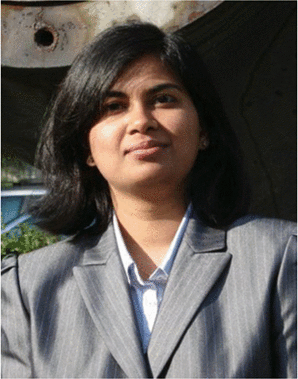 Meenakshi Deshmukh合作论文数2Scott J.I. Walker合作论文数2Andrea D'Ambrogio合作论文数University of Roma2Daniele Gianni合作论文数European Space Agency2Quirin Funke合作论文数1pierluigi de simone合作论文数1
 Andre Horstmann合作论文数1Jonas Dippel合作论文数1
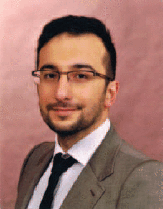 Jafar Akhundov合作论文数1Frazer McLean合作论文数1
 Silvia Sanvido合作论文数1Michael Perk合作论文数Department of Computer Science, TU Braunschweig1Jan Siminski合作论文数Space Debris Office1
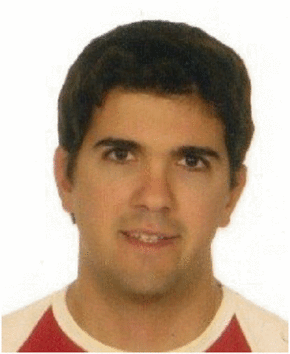 Benjamin Bastida Virgili合作论文数1
 Jonas Radtke合作论文数1




