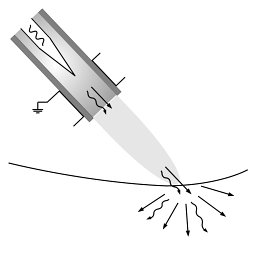
Hydroponic growth of food plants in greenhouses is of rapidly increasing importance to assure future autonomy of food supply, especially in harsher climate zones. Greenhouse culture yields are drastically reduced by pathogenic microorganisms that cause root rot in plants. In Canada, the fungus Pythium ultimum, which can survive harsh winter conditions, has a particularly large impact on food production. In this work, we present cold physical plasma treatment of liquids with a gliding arc plasma as a novel approach for combating pythium growth in liquid media. This study is based on exploring air or other N2 + O2 mixtures as a parameter to identify which plasma treatment is best suited for its anti-fungal activity in different media. If sourced from renewable energy and water, the proposed treatment is intrinsically sustainable. 3 media conditions are explored: first distilled water, to identify the production of highly reactive oxygen species (ROS) and reactive nitrogen species (RNS). Second, an inoculated distilled water is used in conjunction with an ELISA assay as a quick response indicator. Third, a Sabouroud 2 % dextrose broth, is used as a culture media in which oomycetes are grown subsequent to plasma treatment, and hyphal mass is compared between untreated and treated samples. Extracting a subset of 80+ chemical reactions from the available literature and databases, a reaction scheme is proposed accounting for liquid-vapor equilibria (through Henry's coefficients) and reaction rate analysis. The most promising plasma treatment condition was found to be using a 95 % N2: 5 % O2 gas mixture with a treatment time of 30 min, reducing hyphal mass growth from 1.8 g to 0.4 g over 1 week in Sabouroud broth. The pythium degradation process was observed through scanning electron microscopy (SEM) analysis, showing that Sporangium or oogonia containing structures that terminate the pythium's hyphae have been broken and significantly reduced after plasma treatment.
3D printing is a robust technique that can fabricate customized tissue-engineered scaffolds for bone regeneration. Eggshell (ES) contains bone-like compounds, which makes this biowaste an interesting material for bone tissue engineering. Here, we fabricated 3D printed scaffolds using polycaprolactone (PCL) and ES powder and investigated the effect of ES concentration on the printability, mechanical properties, and morphology of the scaffolds. It was found that ES significantly alters the surface topography of the 3D printed PCL/ES structures from smooth at 10 wt.
We report on a methodology for measuring the energy dissipated per AC high voltage cycle in a cold atmospheric pressure plasma jet (CAPJet). This method is adapted from research by Nisol et al. on plasma polymerization of hexamethyldisiloxane (HMDSO) organosilicon vapor in a large area planar dielectric barrier discharge (DBD) reactor. Here too, we measured ΔEg, the energy difference with and without small HMDSO vapor concentrations in the argon carrier gas flow. From ΔEg we then derived Em, the energy per molecule, and compared values with those of Nisol. Good agreements were found, including in film structures determined from attenuated total reflectance (ATR) Fourier transform infrared (FTIR) spectra, thus suggesting that realistic Em values can be successfully obtained also for the CAPJet case.
Aging (or "hydrophobic recovery") of plasma-modified polymer surfaces has been known and documented in the literature over several decades; to the best of our knowledge, the present study appears to be the first in which this is done for two vastly different rough surface structures: (i) electrospun nanofibrous (NF) mats, and (ii) flat films (FF), for three polymers of well-documented interest in biotechnological applications: poly(lactic acid); poly(urethane); and poly(caprolactone). Two different plasma treatments are applied: low-pressure (LP) radio-frequency (rf) glow discharges in flows of O-2 and NH3 under mild power conditions. Measured time-dependent surface compositions (from X-ray photoelectron spectroscopy survey spectra) and water contact angles (WCA) were found to tend toward asymptotic limiting values after ca. 30 days of storage in clean air, as previously reported by these and other authors. An entirely novel aspect of this work is to examine and compare time-dependent WCA behaviors of NF and FF samples in terms of Wenzel (W) and Cassie-Baxter (C-B) model behaviors, including possible transitions from C-B to W and their interpretation.
Metastatic cancers can be highly heterogeneous, show large patient variability and are typically hard to treat due to chemoresistance. Personalized therapies are therefore needed to suppress tumor growth and enhance patient's quality of life. Identifying appropriate patient-specific therapies remains a challenge though, due mainly to non-physiological in vitro culture systems. Therefore, more complex and physiological in vitro human cancer microenvironment tools could drastically aid in development of new therapies. We developed a plasma-modified, electro-spun 3D scaffold (PP-3D-S) that can mimic the human cancer microenvironment for customized-cancer therapeutic screening. The PP-3D-S was characterized for optimal plasma-modifying treatment and scaffolds morphology including fiber diameter and pore size. PP-3D-S was then seeded with human fibroblasts to mimic a stromal tissue layer; cell adhesion on plasma-modified poly (lactic acid), PLA, electrospun mats vastly exceeded that on untreated controls. The cell-seeded scaffolds were then overlaid with alginate/gelatin-based hydrogel embedded with MDA-MB231 human breast cancer cells, representing a tumor-tissue interface. Among three different plasma treatments, we found that NH3 plasma promoted the most tumor cell migration to the scaffold surfaces after 7 days of culture. For all treated and non-treated mats, we observed a significant difference in tumor cell migration between small-sized and either medium- or large-sized scaffolds. In addition, we found that the PP-3D-S was highly comparable to the standard Matrigel® migration assays in two different sets of doxorubicin screening experiments, where 75% reduction in migration was achieved with 0.5 μM doxorubicin for both systems. Taken together, our data indicate that PP-3D-S is an effective, low-cost, and easy-to-use alternate 3D tumor migration model which may be suitable as a physiological drug screening tool for personalized medicine against metastatic cancers.
Water scarcity threatens more and more people in the world. Moisture adsorption from the atmosphere represents a promising avenue to provide fresh water. Nanoporous sponges ("NPSs"), new carbon-based sorbents synthesized from the pyrolysis of resorcinol-formaldehyde resin, can achieve comparable performance to metal organic framework-based systems, but at a significantly lower cost. Oxygen and nitrogen functionalities can be added to the NPS surface, through oxidation and addition of phenanthroline to the initial reagent mixture, respectively. The resulting NPS sorbents have high specific surface areas of 347 to 527 m(2).g(-1) and an average capillary-condensation-compatible pore size of 1.5 nm. When oxidized, the NPS can capture up to 0.28 g of water per gram of adsorbent at a relative pressure of 0.90 (0.14 g.g(-1) at P/P-sat = 0.40) and maintain this adsorption capacity over multiple adsorption/desorption cycles. Scaled-up synthesis of the NPS was performed and tested in an experimental water capture setup, showing good agreement between small- and larger-scale adsorption properties. Water adsorption isotherms fitted with the theoretical model proposed by Do and Do demonstrate that hydroxyl functionalities are of key importance to NPS behavior.
A versatile pilot-scale reactor has been designed in such a way that it can be readily converted from a dielectric barrier discharge "PECVD" operating mode into a photoinitiated "PICVD" one; in the latter, low-pressure mercury (Hg) lamps replace the high-voltage glow discharge plasma. Both processes operate at ambient temperature and atmospheric pressure, 100 kPa, using acetylene (C2H2) monomer. In both sets of experiments, it was found that efficient gas-to-solid conversion can occur in the form of a nanoparticulate amorphous hydrocarbon polymer-like material. It was found that in the PICVD case, great care was required to exclude even traces of O-2 contamination, because it not only reduced the growth rate of solid, but the latter then became highly oxidized ([O] similar to 50 at.%) and water-soluble. [GRAPHICS]
The electrical discharge characteristics of a large-area experimental dielectric barrier discharge in argon-hexamethyldisiloxane mixtures containing up to about 1,600 ppm of the monomer is analysed by means of electrical measurements and numerical modelling. A time-dependent, spatially one-dimensional fluid model is employed, taking into account the spatial variation of the discharge plasma between the two plane-parallel dielectrics covering the electrodes. Reasonable agreement between electrical measurements and modelling results is generally found for the gap voltages and discharge currents. Remaining differences between the measured and calculated electrical energy dissipated in the plasma per period are discussed.
The method we have developed for understanding energetic exchanges between precursor molecules and argon (Ar) carrier gas in a dielectric barrier discharge (DBD) has much-proven merit. The present article focuses on hydrofluoromethanes, CH x F y . The precursors (‰ concentrations) were mixed with Ar in a 20 kHz, 8 kV (peak-to-peak) DBD. For each compound, E m , the energy absorbed per molecule, was plotted as a function of precursor flow rate. Besides the determination of E m , we have used optical emission spectroscopy as a diagnostic of the plasma physicochemistry. The influence of chemical structure has been investigated by depositing thin plasma polymer coatings; we have measured their deposition rates and water contact angles, which have been correlated with E m values and X-ray photoelectron spectroscopy measurements.
The method developed for fundamental understanding of energetic exchanges between monomer molecules and argon carrier gas in a dielectric barrier discharge (DBD) has previously proven merit. In this seventh article related to this methodology, research has been extended to a new family of precursors: anhydrides . Monomers (typically ‰) were mixed with 10 slm of Ar in a 20 kHz, 8 kV (peak-to-peak) DBD corresponding to an energy per cycle of 1600 μJ for pure Ar. For each of the investigated monomers E m , the energy absorbed per molecule was plotted as a function of precursor flow rate. The influence of chemical structure (C/O ratio, unsaturation) has been investigated and compared with previous data for other types of precursors. Thin plasma polymer coatings were deposited; in addition to measuring deposition rates, we also present relationships between E m values, spectro-ellipsometric and FTIR measurements.
Since the earliest days of this field there has been an interest in correlating the structure of plasma polymer (PP) coatings with deposition parameters, most particularly with energy input per monomer molecule, Em. Both of our laboratories have developed methods for measuring Em (or somewhat equivalent, the apparent activation energy, Ea) in low- (LP) and atmospheric-pressure (AP) electrical discharge plasmas. We recently proposed a new parameter, energy conversion efficiency (ECE), which for the first time permits direct comparison of LP and AP experiments. Here, we report the case of small hydrocarbons, namely acetylene, ethylene and methane. "Critical" Em (or Ea) values that demarcate ECE regimes separating different reaction mechanisms are found to agree remarkably well, and to correlate with specific reaction mechanisms, including dissociation, recombination, gas-phase oligomerization, and surface processes.
Two dielectric barrier discharge (DBD) reactors, one small, the other about 40 times larger, associated equipment, and a dedicated MATLAB code have been used to carry out precise determinations of electrical energy, E-g, dissipated per discharge cycle of the applied a.c. voltage, V-a. In the smaller reactor, this was done over the frequency range 5 <= f <= 50 kHz and using twin pairs of several different insulating materials (2.54-cm-diameter disks) with relative permittivities between 2.1 <= kappa'(die) <= 9.5 as dielectric barriers in DBDs for four different gases: He, Ne, Ar, and N-2. In the large reactor, f was restricted to 20 kHz in Ar and He; this latter system primarily serves for plasma polymerization experiments in which organic "monomers" are admixed with the flow of Ar as carrier gas. We report the method for exactly evaluating E-g, and then present and compare values measured under different conditions. To the extent possible, these are compared between the small and large reactors, and with results published in the literature. The reliability of the method is confirmed, for example, by reproducing published breakdown fields of the gases examined, and by several other original results.
We report experiments in which reactive oxygen species (ROS) from a 20 kHz HV discharge in Ar/O2 (90/10) gas mixture at atmospheric pressure were directly bubbled into highly concentrated aqueous suspensions of cyanobacteria Dolichospermum, green algae Scenedesmus and BMAA toxin, simulating extreme algal blooms. It has been found that even quite short treatment durations, up to 6 min, could greatly reduce the numbers of viable cells and completely destroy the BMAA toxin. Perhaps even more important, “plasma‐activated water” (PAW) was found to continue its effectiveness after 24 h, even 4 days after terminating the discharge.
It has come to the authors’ attention that Figure 1 in the article by B. Nisol et al. ( https://doi.org/10.1002/ppap.201500161 , published in Plasma Process. Polym. 2016, 13, 557) displayed an erroneous result. An error occurred in the Matlab ® code while carrying out the transfer of the energy measurement methodology to a larger DBD reactor. This erratum is published to correct this.
We have studied “PEG-like” plasma-deposited coatings of poly(ethylene glycol), some of which prevent protein adsorption and cellular adhesion. This enables inhibition of possible inflammatory reactions or rejection of an implant following its insertion into living tissue. Our approach, based on electrical measurements in atmospheric pressure Ar dielectric barrier discharges, enables precise measurements of , the energy absorbed per monomer molecule. Here, we demonstrate the importance of in preparing PEG-like coatings for biomedical applications, for example by highlighting the great importance of molecular weight of monoglyme (1G) or diglyme (2G) monomers, and by obtaining anti-fouling layers, “PP-2G,” only with the diglyme. We demonstrate resistance to protein adsorption and cell adhesion of PP-2G surfaces prepared with optimized (and ) values.
(or somewhat equivalent, E a ) in low(LP) and atmospheric-pressure (AP) discharge plasmas. In this work we propose a new parameter, the so-called energy conversion efficiency, ECE, which permits direct comparison of LP and AP experiments. This is done for the case of three model compounds, ethane, acetylene, and acrylic acid. 'Critical' energy values that demarcate ECE regimes separating different fragmentation/reaction mechanisms agree remarkably well for all three monomers examined; resulting in E m (or E a ) values are correlated with specific mechanisms, and the numerical results are convincingly supported by data from the chemical literature. Thus, the measurement of the energy conversion in LP and AP plasmas helps to control plasma polymerization processes.
In the plasma polymerization literature, there has been an interest since at least the 1970s to correlate the structure of plasma polymer (PP) deposits with plasma parameters during deposition, most particularly with the energy input per monomer molecule, (E)m. In our two laboratories, we have developed methods for measuring E-m (or somewhat equivalent, E-a) in low- (LP) and atmospheric-pressure (AP) discharge plasmas. In this article we propose a new parameter, the so-called energy conversion efficiency, ECE, which permits direct comparison of LP and AP experiments. This is done for the case of three model monomer compounds, ethane, acetylene, and acrylic acid (AAc). "Critical'' energy values that demarcate ECE regimes separating different fragmentation/reaction mechanisms agree remarkably well for all three monomers examined; resulting E-m (or E-a) values are correlated with specific mechanisms, and the numerical results are convincingly supported by data from the chemical literature.
We report dielectric barrier discharge (DBD)-based atmospheric pressure (AP) plasma polymerization (PP) experiments using argon carrier gas and a wide variety of hydrocarbon molecules as the precursors ("monomers"). As in our preceding research with other reagents, unprecedented precision and reproducibility in energy measurements is again demonstrated. Measurements based on various aliphatic and aromatic hydrocarbon compounds have yielded values of Em, the energy absorbed from the plasma by each monomer molecule. Systematic differences among families of compounds enabled us to draw several important conclusions about fragmentation and polymerization in the DBD plasma environment, observations which are in fair qualitative agreement with low-pressure radio-frequency PP data by Yasuda and Hirotsu from the 1970s.
A large research reactor for performingdielectric barrier discharge (DBD) experiments at atmospheric pressure (AP) has been used with argon (Ar) carrier gas under constant plasma conditions (f = 20 kHz, Va(f) = 8 kVp-p = 2.8 kVrms). Various permanent gases (H2, O2, N2, light hydrocarbons) and some heavier organic molecules were introduced as reactive “dopant” flows, Fd, at ‰ concentrations in the F = 10 standard liters per minute (slm) flow of argon. We have earlier perfected and reported a method for measuring Eg, the energy dissipated per cycle of the applied a.c. voltage, and ΔEg, the energy difference with and without reactive dopant in the Ar flow. The latter and Fd permit calculation of Em, the energy absorbed from the plasma by each dopant molecule. Plots of Em versus Fd and 1/Fd yield much valuable information about excitation, fragmentation, and polymerization in the DBD plasma environment. Optical emission (OES) and Fourier-transform infrared (FTIR) spectroscopies help to further enhance and complement interpretation of measured data.
 Bernard Nisol合作论文数Fac Sci Analyt & Interfacial Chem, Univ Libre Bruxelles17
 Michael R. Wertheimer合作论文数Department of Engineering Physics, Polytechnique Montreal17
 Dirk Hegemann合作论文数Plasma & Coating Group, Empa Laboratory5
 Sophie Lerouge合作论文数Groupe de Rhéophysique des Colloides, Université de Metz4
 Stephan Reuter合作论文数Ctr Innovat Competence Plasmatis3
 Ajji Abdellah合作论文数Department of Chemical Engineering, Polytechnique Montréal3
 Mansoureh Mohseni Garakani合作论文数2
 Markus M. Becker合作论文数Leibniz Inst Plasma Sci & Technol INP Greifswald2Ulrich Legrand合作论文数CREPEC, Polytech Montreal2
 Pierre Luc Girard Lauriault合作论文数Department of Chemical Engineering, McGill University2
 Jason Robert Tavares合作论文数Department of Chemical Engineering, Polytechnique Montréal2
 Hervé Gagnon合作论文数2
 Detlef Loffhagen合作论文数2
 Claus Peter Klages合作论文数Institut für Oberflächentechnik, Technische Universität Braunschweig2
 Mylene Archambault-Caron合作论文数1Alessio Aufoujal合作论文数1Pouyan Ahangar合作论文数1
 Armin Amirsadeghi合作论文数Zernike Institute for Advanced Materials, University of Groningen1
 Cedric Pattyn合作论文数CNRS, Université d'Orléans1
 Giulia Laghi合作论文数Dept Ind Engn DIN, Alma Mater Studiorum Univ Bologna1
 Saber Moradinejad合作论文数Dept Civil Mineral & Min Engn, Polytech Montreal1Ali Mousavi合作论文数University of Montreal, University of Montreal1
 Arman Jafari合作论文数Dept Chem Engn, Shiraz Univ1
 Derek Rosenzweig合作论文数Division of Orthopaedic Surgery, Department of Surgery, Faculty of Medicine and Health Sciences, McGill University1
 David Juncker合作论文数Department of Biomedical Engineering, Faculty of Medicine and Health Sciences, McGill University1
 Anne Meunier合作论文数1Généreux Mylène合作论文数1
 Matteo Gherardi合作论文数Dept Ind Engn DIN, Alma Mater Studiorum Univ Bologna1
 Arash Zamyadi合作论文数Civil, Mineral and Mining Engineering Department, École Polytechnique de Montreal1
 Kristian Waters合作论文数Department of Mining and Materials Engineering, Faculty of Engineering, McGill University1
 Jean-Luc Meunier合作论文数Xerox Research Centre1
 Richard Boudreault合作论文数Technologies Aérospatiales1Gregor Andelfinger合作论文数1
 Houman Savoji合作论文数Chemical & Petroleum Engineering Department, Sharif University of Technology1Piet van Vliet合作论文数1
 Frédéric Sirois合作论文数Department of Electrical Engineering, Polytechnique Montréal1
 Francois Reniers合作论文数Faculté des Sciences, Université Libre de Bruxelles1




