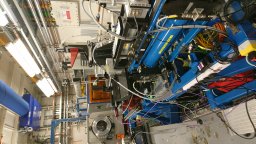
It is well known that ion implantation into metals allows lifetime increase of functional surfaces [1]. However, the technical complexity of the particle accelerators, combined with the high doses required for improvement of metal properties, reserves metal treatment by ion implantation only for finished and high added value products. The advances in both industrial vacuum [2] and particle accelerator [3] technologies lead us to consider ion implantation as a potential surface treatment for semi-finished product. As a consequence the product should undergo various thermo-mechanical treatments after the ion implantation phase. The behaviour of aluminum bulks under nitrogen irradiation needs to be studied in order to optimise the ion implantation step. In this study, we examine the superficial aluminium hardness and wear behaviour improvements under nitrogen implantation and the correlated surface morphology modifications. Implantations were performed by mean of the QUERTHOR implantor. QUERTHOR uses a miniaturized Electron Cyclotron Resonance accelerator allowing intense and multi-charged ion-beam production. N-implantation into Al-1050 sheet, allowed a superficial-hardness increase from 0.2 to 15 GPa, and a friction coefficient decrease from 1 until 0.2. These results are correlated to the microstructure of implanted aluminium as measured using XPS and grazing-incidence XRD. The implanted samples were then submitted to temperature ageing and mechanical stresses in order to evaluate the influence of the nitride layer on the bulk aluminum formability. The influence of the initial microstructure on the implanted sample behaviour is also investigated. Influence of crystallographic orientation of aluminum on implantation-induced hardening was shown. The present work allowed us to evaluate the limits of formability of implanted aluminum for various initial microstructures, which represent different formability process steps incorporating ion implantation. [1] R.J. Rodriguez, A. Sanz, A. Medrano, J.A. Garcia Lorente. Vacuum, 52 (1999) 187 [2] P. Choquet (CRPGL), D. Chaleix (Arcelor Mittal). Vacuum technologies development for flat product treatment. Journey of Plasma Technologies and Automotive Industry (AGMAT), Ecole des Mines de Saint Etienne. (2007) [3] R. Geller. Electron Cyclotron Resonance Ion Sources and ECR Plasmas. Ed. Taylor & Francis (1996)
Samples of Al-1050 and of Al-2024 aluminum alloys were implanted by means of nitrogen multicharged ion beam provided by an ECR source. Wear and corrosion tests were performed in order to qualify and quantify the surface enhancement created by implantation. The tests performed, respectively, using ball-on-disk set up and linear polarization technique, combined with SEM observations and correlated with microstructural study already published, made possible the identification of damaging mechanisms of nitrogen implanted aluminum surface. The study underlines the importance which has to be given to the implanted fluence and to the initial microstructure, if a consistent surface improvement is targeted. It is demonstrated in this work that the improvement of wear resistance is strongly linked to the intrinsic properties of the nitride protective layer and not to the initial microstructure which only affects optimum fluence. Corrosion tests reveal inverse tendency. The alloy composition is, in this case, of importance, contrarily to implanted fluencies which do not affect the results. This study also shows that if nitrogen implantation is good for surface resistance, a pit (corrosion) or a crack (wear) of implanted surface causes more damage than corrosion or wear of untreated surface. (C) 2014 Elsevier B.V. All rights reserved.
Influence of the size effects on the mechanical behavior of face-centered cubic metals was studied for complex loadings close to microforming ones. The effect of a reduction in thickness ( t ) over grain size ( d ) ratio on the mechanical behavior for high-purity nickel and copper is investigated for three different loadings by tensile and Nakazima tests (plane strain conditions and balanced biaxial expansion). Experimental results highlight a strong degradation of the mechanical properties of Cu and Ni when the t / d ratio is reduced below a critical value, independently of the strain path. However, this effect occurs if the equivalent plastic strain is larger than a critical level which is strain path dependent and related to the stress triaxiality. The current study reveals that plastic anisotropy is also affected by size effects. An excellent correlation is obtained between the t / d ratio and the thickness reduction, through the mean normal plastic anisotropy parameter which is widely used to estimate sheet formability. A size effect map based on forming limit diagrams is proposed to depict the optimal conditions of microforming.
The influence of the size effects on the forming processes for micro-sized parts is not yet well known. This work follows experimental and numerical studies of the effect of a reduction in thickness (t) over grain size (d) ratio on the mechanical properties of high purity copper. Under tensile conditions, copper exhibits softer mechanical properties if t/d < 6, in agreement with previous results concerning Al or Ni. To assess the influence of complex loadings linked to forming processes on size effects, Nakazima tests were performed with 20 mm hemispherical punch on a universal sheet metal testing machine associated to a 3D video extensometer. Our results revealed that size effects are strongly sensitive to strain paths. Depending on these latter, the deterioration of the mechanical properties shown for tension is modified.
This paper deals with the surface strengthening of aluminum alloys by means of a new process allowing multi-charged nitrogen ion implantation. X-ray photoelectron spectroscopy, grazing-incidence X-ray diffraction and atomic force microscopy were used to study microstructural changes involved by implantation. This microstructural study revealed the formation of AlN and AlONγ due to the low nitrogen concentration gradient obtained with multi-charged implantation. Nanoindentation and wear tests were performed to evaluate the mechanical properties of implanted surfaces. A significant improvement of wear resistance was observed as a consequence of the nitride protective layer formation. The observed surface hardening is attributed to both AlONγ and AlN formations and to the precipitation-induced stress.
 Eric Hug合作论文数Laboratoire CRISMAT/ENSICAEN, UMR 6508, 6 Boulevard du Maréchal Juin, 14050 Caen cedex 4, France5
 Pierre-Antoine Dubos合作论文数Corresponding author.2
 Clément Keller合作论文数Groupe de Physique des Matériaux, Université de Normandie2
 Daniel Chateigner合作论文数Institut Universitaire de Technologie, Université de Caen Normandie/Laboratoire de Cristallographie et Sciences des Matériaux, Ecole Nationale Supérieure d'Ingénieurs de Caen2
 Antoine Gueydan合作论文数1
 Mohamed Ben Bettaieb合作论文数Department ArGEnCo, University of Liège1
 Laurent Maunoury合作论文数1




