The famous Ham-Sandwich theorem states that any d point sets in ℝ^d can be simultaneously bisected by a single hyperplane. The α-Ham-Sandwich theorem gives a sufficient condition for the existence of biased cuts, i.e., hyperplanes that do not cut off half but some prescribed fraction of each point set. We give two new proofs for this theorem. The first proof is completely combinatorial and highlights a strong connection between the α-Ham-Sandwich theorem and Unique Sink Orientations of grids. The second proof uses point-hyperplane duality and the Poincaré-Miranda theorem and allows us to generalize the result to and beyond oriented matroids. For this we introduce a new concept of rainbow arrangements, generalizing colored pseudo-hyperplane arrangements. Along the way, we also show that the realizability problem for rainbow arrangements is ∃ℝ-complete, which also implies that the realizability problem for grid Unique Sink Orientations is ∃ℝ-complete.
It is well-known that the 2-Thief-Necklace-Splitting problem reduces to the discrete Ham Sandwich problem. In fact, this reduction was crucial in the proof of the $$\textsf{PPA}$$ -completeness of the Ham Sandwich problem [Filos-Ratsikas and Goldberg, STOC’19]. Recently, a variant of the Ham Sandwich problem called $$\alpha $$ -Ham Sandwich has been studied, in which the point sets are guaranteed to be well-separated [Steiger and Zhao, DCG’10]. The complexity of this search problem remains unknown, but it is known to lie in the complexity class $$\textsf{UEOPL}$$ [Chiu, Choudhary and Mulzer, ICALP’20]. We define the analogue of this well-separation condition in the necklace splitting problem — a necklace is n - separable , if every subset A of the n types of jewels can be separated from the types $$[n]\setminus A$$ by at most n separator points. Since this version of necklace splitting reduces to $$\alpha $$ -Ham Sandwich in a solution-preserving way it follows that instances of this version always have unique solutions. We furthermore provide two FPT algorithms: The first FPT algorithm solves 2-Thief-Necklace-Splitting on $$(n-1+\ell )$$ -separable necklaces with n types of jewels and m total jewels in time $$2^{O(\ell \log \ell )}+O(m^2)$$ . In particular, this shows that 2-Thief-Necklace-Splitting is polynomial-time solvable on n -separable necklaces. Thus, attempts to show hardness of $$\alpha $$ -Ham Sandwich through reduction from the 2-Thief-Necklace-Splitting problem cannot work. The second FPT algorithm tests $$(n-1+\ell )$$ -separability of a given necklace with n types of jewels in time $$2^{O(\ell ^2)}\cdot n^4$$ . In particular, n -separability can thus be tested in polynomial time, even though testing well-separation of point sets is $$\textsf{coNP}$$ -complete [Bergold et al., SWAT’22].
We prove that an epsilon-approximate fixpoint of a map f : [0, 1](d) -> [0, 1](d) can be found with O(d(2) (log 1/epsilon + log 1/1-lambda)) queries to f if f is lambda-contracting with respect to an l(p)-metric for some p is an element of [1,8) boolean OR{8}. This generalizes a recent result of Chen, Li, and Yannakakis [STOC 2024] from the l(infinity)-case to all l(p)-metrics. Previously, all query upper bounds for p is an element of [1,8) \ {2} were either exponential in d, log 1/epsilon, or log 1/1-lambda. Chen, Li, and Yannakakis also show how to ensure that all queries to f lie on a discrete grid of limited granularity in the l(infinity)-case. We provide such a rounding for the l(1)-case, placing an appropriately defined version of the l(1)-case in FPdt. To prove our results, we introduce the notion of l(p)-halfspaces and generalize the classical centerpoint theorem from discrete geometry: for any p is an element of[1,8) boolean OR {8} and any mass distribution (or point set), we prove that there exists a centerpoint c such that every l(p)-halfspace defined by c and a normal vector contains at least a 1/d+1 -fraction of the mass (or points).
MaxCut is a classical NP -complete problem and a crucial building block in many combinatorial algorithms. The famous Edwards-Erdös bound states that any connected graph on n vertices with m edges contains a cut of size at least m 2 + n - 1 4 . Crowston, Jones and Mnich [Algorithmica, 2015] showed that the MaxCut problem on simple connected graphs admits an FPT algorithm, where the parameter k is the difference between the desired cut size c and the lower bound given by the Edwards-Erdös bound. This was later improved by Etscheid and Mnich [Algorithmica, 2017] to run in parameterized linear time, i.e., f ( k ) · O ( m ) . We improve upon this result in two ways: Firstly, we extend the algorithm to work also for multigraphs (alternatively, graphs with positive integer weights). Secondly, we change the parameter; instead of the difference to the Edwards-Erdös bound, we use the difference to the Poljak-Turzík bound. The Poljak-Turzík bound states that any weighted graph G has a cut of weight at least w ( G ) 2 + w MSF ( G ) 4 , where w(G) denotes the total weight of G, and w MSF ( G ) denotes the weight of its minimum spanning forest. In connected simple graphs the two bounds are equivalent, but for multigraphs the Poljak-Turzík bound can be larger and thus yield a smaller parameter k. Our algorithm also runs in parameterized linear time, i.e., f ( k ) · O ( m + n ) .
A unique sink orientation (USO) is an orientation of the n -dimensional hypercube graph such that every non-empty face contains a unique sink. We consider the only known connected flip graph on USOs. This flip graph is based on the following theorem due to Schurr: given any n -dimensional USO and any one dimension $$i\in [n]$$ i ∈ [ n ] , the set $$E_i$$ E i of edges connecting vertices along dimension i can be decomposed into equivalence classes (so-called phases ), such that flipping the direction of any $$S\subseteq E_i$$ S ⊆ E i yields another USO if and only if S is the union of some of these phases. In this paper we provide an algorithm to compute the phases of a given USO in $$O(n\cdot 3^n)$$ O ( n · 3 n ) time, significantly improving upon the previously known $$O(n\cdot 4^n)$$ O ( n · 4 n ) trivial algorithm. We also show that the phase containing a given edge can be flipped using only poly ( n ) space additional to the space required to store the USO. We contrast this by showing that given a boolean circuit of size poly ( n ) succinctly encoding an n -dimensional USO, it is $$\textsf{PSPACE}$$ PSPACE -complete to determine whether two given edges are in the same phase. Finally, we also prove some new results on the structure of phases.
The Necklace Splitting problem is a classical problem in combinatorics that has been intensively studied both from a combinatorial and a computational point of view. It is well-known that the Necklace Splitting problem reduces to the discrete Ham Sandwich problem. This reduction was crucial in the proof of PPA-completeness of the Ham Sandwich problem. Recently, Borzechowski, Schnider and Weber [ISAAC'23] introduced a variant of Necklace Splitting that similarly reduces to the alpha-Ham Sandwich problem, which lies in the complexity class UEOPL but is not known to be complete. To make this reduction work, the input necklace is guaranteed to be n-separable. They showed that these necklaces can be fairly split in polynomial time and thus this subproblem cannot be used to prove UEOPL-hardness for a-Ham Sandwich. We consider the more general unfair necklace splitting problem on n-separable necklaces, i.e., the problem of splitting these necklaces such that each thief gets a desired fraction of each type of jewels. This more general problem is the natural necklace-splitting-type version of alpha-Ham Sandwich, and its complexity status is one of the main open questions posed by Borzechowski, Schnider and Weber. We show that the unfair splitting problem is also polynomial-time solvable, and can thus also not be used to show UEOPL-hardness for alpha-Ham Sandwich.
Various algebraic and geometric problems reduce to the sink-finding problem in unique sink orientations (USOs), which are orientations of the hypercube graph that have a unique sink in every subcube. A USO is called realizable if it can arise from applying one of these reductions. We study how realizability influences the query complexity of the sink-finding problem. To this end, we consider a specific subclass of USOs, the so-called Matoušek USOs. The Matoušek USOs are a family of USOs which are a translation of the LP-type problems used by Matoušek to show that the Sharir-Welzl algorithm for LP-type problems may require at least subexponential time [Matoušek, 1994]. Gärtner showed that the Random Facet algorithm for USO sink-finding requires at least subexponentially many vertex evaluation queries on Matoušek USOs, but at most quadratically many queries on realizable Matoušek USOs [Gärtner, 2002]. However, Gärtner did not fully characterize this realizable subset. In this paper, we fully characterize the realizable subset of the Matoušek-type USOs (the USOs isomorphic to a Matoušek USO) and also provide concrete realizations using instances of the P-Matrix Linear Complementarity Problem, basing our work on the so-called cyclic-P-matroids studied by Fukuda, Klaus, and Miyata. We further extend the results of Matoušek and Gärtner for the Random Facet algorithm to the query complexity of the sink-finding problem itself: we show that sink-finding is strictly easier on realizable Matoušek-type USOs than on all Matoušek-type USOs. We show that in the realizable case $O(\log^2 n)$ queries suffice, while in general exactly n queries are needed.
Klaus showed that the Oriented Matroid Complementarity Problem (OMCP) can be solved by a reduction to the problem of sink-finding in a unique sink orientation (USO) if the input is promised to be given by a non-degenerate extension of a P-matroid. In this paper, we investigate the effect of degeneracy on this reduction. On the one hand, this understanding of degeneracies allows us to prove a linear lower bound on the number of vertex evaluations required for sink-finding in P-matroid USOs, the set of USOs obtainable through Klaus’ reduction. On the other hand, it allows us to adjust Klaus’ reduction to also work with degenerate instances. Furthermore, we introduce a total search version of the P-Matroid Oriented Matroid Complementarity Problem (P-OMCP). Given any extension of any oriented matroid M, by reduction to a total search version of USO sink-finding we can either solve the OMCP, or provide a polynomial-time verifiable certificate that M is not a P-matroid. This places the total search version of the P-OMCP in the complexity class Unique End of Potential Line (UEOPL).
Given a set of objects O in the plane, the corresponding intersection graph is defined as follows. A vertex is created for each object and an edge joins two vertices whenever the corresponding objects intersect. We study here the case of unit segments and polylines with exactly k bends. In the recognition problem, we are given a graph and want to decide whether the graph can be represented as the intersection graph of certain geometric objects. In previous work it was shown that various recognition problems are ∃ℝ -complete, leaving unit segments and polylines as few remaining natural cases. We show that recognition for both families of objects is ∃ℝ -complete.
Schaefer's dichotomy theorem [Schaefer, STOC'78] states that a boolean constraint satisfaction problem (CSP) is polynomial-time solvable if one of six given conditions holds for every type of constraint allowed in its instances. Otherwise, it is NP-complete. In this paper, we analyze boolean CSPs in terms of their topological complexity, instead of their computational complexity. We attach a natural topological space to the set of solutions of a boolean CSP and introduce the notion of projection-universality. We prove that a boolean CSP is projection-universal if and only if it is categorized as NP-complete by Schaefer's dichotomy theorem, showing that the dichotomy translates exactly from computational to topological complexity. We show a similar dichotomy for SAT variants and homotopy-universality.
For any positive edge density $p$, a random graph in the Erd\H{o}s-Renyi $G_{n,p}$ model is connected with non-zero probability, since all edges are mutually independent. We consider random graph models in which edges that do not share endpoints are independent while incident edges may be dependent and ask: what is the minimum probability $\rho(n)$, such that for any distribution $\mathcal{G}$ (in this model) on graphs with $n$ vertices in which each potential edge has a marginal probability of being present at least $\rho(n)$, a graph drawn from $\mathcal{G}$ is connected with non-zero probability? As it turns out, the condition ``edges that do not share endpoints are independent'' needs to be clarified and the answer to the question above is sensitive to the specification. In fact, we formalize this intuitive description into a strict hierarchy of five independence conditions, which we show to have at least three different behaviors for the threshold $\rho(n)$. For each condition, we provide upper and lower bounds for $\rho(n)$. In the strongest condition, the coloring model (which includes, e.g., random geometric graphs), we show that $\rho(n)\rightarrow 2-\phi\approx 0.38$ for $n\rightarrow\infty$, proving a conjecture by Badakhshian, Falgas-Ravry, and Sharifzadeh. This separates the coloring models from the weaker independence conditions we consider, as there we prove that $\rho(n)>0.5-o(n)$. In stark contrast to the coloring model, for our weakest independence condition -- pairwise independence of non-adjacent edges -- we show that $\rho(n)$ lies within $O(1/n^2)$ of the threshold $1-2/n$ for completely arbitrary distributions.
Given a set of objects O in the plane, the corresponding intersection graph is defined as follows. A vertex is created for each object and an edge joins two vertices whenever the corresponding objects intersect. We study here the case of unit segments and polylines with exactly k bends. In the recognition problem, we are given a graph and want to decide whether the graph can be represented as the intersection graph of certain geometric objects. In previous work it was shown that various recognition problems are $\exists\mathbb{R}$-complete, leaving unit segments and polylines as few remaining natural cases. We show that recognition for both families of objects is $\exists\mathbb{R}$-complete.
As set systems, hypergraphs are omnipresent and have various representations ranging from Euler and Venn diagrams to contact representations. In a geometric representation of a hypergraph $H=(V,E)$, each vertex $v\in V$ is associated with a point $p_v\in \mathbb{R}^d$ and each hyperedge $e\in E$ is associated with a connected set $s_e\subset \mathbb{R}^d$ such that $\{p_v\mid v\in V\}\cap s_e=\{p_v\mid v\in e\}$ for all $e\in E$. We say that a given hypergraph $H$ is representable by some (infinite) family $F$ of sets in $\mathbb{R}^d$, if there exist $P\subset \mathbb{R}^d$ and $S \subseteq F$ such that $(P,S)$ is a geometric representation of $H$. For a family F, we define RECOGNITION(F) as the problem to determine if a given hypergraph is representable by F. It is known that the RECOGNITION problem is $\exists\mathbb{R}$-hard for halfspaces in $\mathbb{R}^d$. We study the families of translates of balls and ellipsoids in $\mathbb{R}^d$, as well as of other convex sets, and show that their RECOGNITION problems are also $\exists\mathbb{R}$-complete. This means that these recognition problems are equivalent to deciding whether a multivariate system of polynomial equations with integer coefficients has a real solution.
We provide polynomial-time reductions between three search problems from three distinct areas: the P-matrix linear complementarity problem (P-LCP), finding the sink of a unique sink orientation (USO), and a variant of the α-Ham Sandwich problem. For all three settings, we show that "two choices are enough", meaning that the general non-binary version of the problem can be reduced in polynomial time to the binary version. This specifically means that generalized P-LCPs are equivalent to P-LCPs, and grid USOs are equivalent to cube USOs. These results are obtained by showing that both the P-LCP and our α-Ham Sandwich variant are equivalent to a new problem we introduce, P-Lin-Bellman. This problem can be seen as a new tool for formulating problems as P-LCPs.
We study the problem of recognizing whether a given abstract simplicial complex $K$ is the $k$-skeleton of the nerve of $j$-dimensional convex sets in $\mathbb{R}^d$. We denote this problem by $R(k,j,d)$. As a main contribution, we unify the results of many previous works under this framework and show that many of these works in fact imply stronger results than explicitly stated. This allows us to settle the complexity status of $R(1,j,d)$, which is equivalent to the problem of recognizing intersection graphs of $j$-dimensional convex sets in $\mathbb{R}^d$, for any $j$ and $d$. Furthermore, we point out some trivial cases of $R(k,j,d)$, and demonstrate that $R(k,j,d)$ is ER-complete for $j\in\{d-1,d\}$ and $k\geq d$.
We consider the algorithmic problem of finding the optimal weights and biases for a two-layer fully connected neural network to fit a given set of data points, also known as empirical risk minimization. We show that the problem is $\exists\mathbb{R}$-complete. This complexity class can be defined as the set of algorithmic problems that are polynomial-time equivalent to finding real roots of a multivariate polynomial with integer coefficients. Furthermore, we show that arbitrary algebraic numbers are required as weights to be able to train some instances to optimality, even if all data points are rational. Our result already applies to fully connected instances with two inputs, two outputs, and one hidden layer of ReLU neurons. Thereby, we strengthen a result by Abrahamsen, Kleist and Miltzow [NeurIPS 2021]. A consequence of this is that a combinatorial search algorithm like the one by Arora, Basu, Mianjy and Mukherjee [ICLR 2018] is impossible for networks with more than one output dimension, unless $\text{NP} = \exists\mathbb{R}$.
Algorithms for finding the sink in Unique Sink Orientations (USOs) of the hypercube can be used to solve many algebraic and geometric problems, most importantly including the P-Matrix Linear Complementarity Problem and Linear Programming. The realizable USOs are those that arise from the reductions of these problems to the USO sink-finding problem. Finding the sink of realizable USOs is thus highly practically relevant, yet it is unknown whether realizability can be exploited algorithmically to find the sink more quickly. However, all (non-trivial) known unconditional lower bounds for sink-finding make use of USOs that are provably not realizable. This indicates that the sink-finding problem might indeed be strictly easier on realizable USOs. In this paper we show that this is true for a subclass of all USOs. We consider the class of Matou\v{s}ek-type USOs, which are a translation of Matou\v{s}ek's LP-type problems into the language of USOs. We show a query complexity gap between sink-finding in all, and sink-finding in only the realizable $n$-dimensional Matou\v{s}ek-type USOs. We provide concrete deterministic algorithms and lower bounds for both cases, and show that in the realizable case $O(log^2 n)$ vertex evaluation queries suffice, while in general exactly $n$ queries are needed. The Matou\v{s}ek-type USOs are the first USO class found to admit such a gap.
We consider the algorithmic problem of finding the optimal weights and biases for a two-layer fully connected neural network to fit a given set of data points, also known as empirical risk minimization. We show that the problem is $\exists\mathbb{R}$-complete. This complexity class can be defined as the set of algorithmic problems that are polynomial-time equivalent to finding real roots of a multivariate polynomial with integer coefficients. Furthermore, we show that arbitrary algebraic numbers are required as weights to be able to train some instances to optimality, even if all data points are rational. Our result already applies to fully connected instances with two inputs, two outputs, and one hidden layer of ReLU neurons. Thereby, we strengthen a result by Abrahamsen, Kleist and Miltzow [NeurIPS 2021]. A consequence of this is that a combinatorial search algorithm like the one by Arora, Basu, Mianjy and Mukherjee [ICLR 2018] is impossible for networks with more than one output dimension, unless $\text{NP} = \exists\mathbb{R}$.
In nearest-neighbor classification, a training set $P$ of points in $\mathbb{R}^d$ with given classification is used to classify every point in $\mathbb{R}^d$: Every point gets the same classification as its nearest neighbor in $P$. Recently, Eppstein [SOSA'22] developed an algorithm to detect the relevant training points, those points $p\in P$, such that $P$ and $P\setminus\{p\}$ induce different classifications. We investigate the problem of finding the minimum cardinality reduced training set $P'\subseteq P$ such that $P$ and $P'$ induce the same classification. We show that the set of relevant points is such a minimum cardinality reduced training set if $P$ is in general position. Furthermore, we show that finding a minimum cardinality reduced training set for possibly degenerate $P$ is in P for $d=1$, and NP-complete for $d\geq 2$.
A unique sink orientation (USO) is an orientation of the $n$-dimensional hypercube graph such that every non-empty face contains a unique sink. Schurr showed that given any $n$-dimensional USO and any dimension $i$, the set of edges $E_i$ in that dimension can be decomposed into equivalence classes (so-called phases), such that flipping the orientation of a subset $S$ of $E_i$ yields another USO if and only if $S$ is a union of a set of these phases. In this paper we prove various results on the structure of phases. Using these results, we show that all phases can be computed in $O(3^n)$ time, significantly improving upon the previously known $O(4^n)$ trivial algorithm. Furthermore, we show that given a boolean circuit of size $poly(n)$ succinctly encoding an $n$-dimensional (acyclic) USO, it is PSPACE-complete to determine whether two given edges are in the same phase. The problem is thus equally difficult as determining whether the hypercube orientation encoded by a given circuit is an acyclic USO [G\"artner and Thomas, STACS'15].
 Patrick Schnider合作论文数Dept Comp Sci, Swiss Fed Inst Technol9Michaela Borzechowski合作论文数7
 Tillmann Miltzow合作论文数Institute of Computer Science, Freie Universität Berlin6
 Daniel Bertschinger合作论文数Eraneos Switzerland4
 Christoph Hertrich合作论文数Institut für Mathematik, Goethe-Universität Frankfurt;The London School of Economics and Political Science2Kalina Petrova合作论文数2Nicolas El Maalouly合作论文数2
 Lasse Wulf合作论文数Graz University of Technology2Paul Jungeblut合作论文数Karlsruhe Institute of Technology2
 Michael Hoffmann合作论文数Institute of Theoretical Computer Science, ETH Zurich2Jonas Lill合作论文数1Sebastian Haslebacher合作论文数1Josiah Rohrer合作论文数1
 Lukas Gianinazzi合作论文数Scalable Parallel Computing Lab, Computer Science Department, ETH Zurich1Joseph Doolittle合作论文数1Spencer Gordon合作论文数Division of Engineering and Applied Science, California Institute of Technology1
 Raphael Steiner合作论文数Tech Univ Berlin, Inst Math, Berlin, Germany1
 Maciej Besta合作论文数Scalable Parallel Computing Lab, Institute of Computer Systems, Department of Computer Science, ETH Zurich1
 Linda Kleist合作论文数1Yishai Oltchik合作论文数1
 Torsten Hoefler合作论文数Scalable Parallel Computing Lab, Computer Science Department, ETH Zürich1
 Bernd Gärtner合作论文数Institute of Theoretical Computer Science, Department of Computer Science, Eidgenössische Technische Hochschule Zürich1
 John Fearnley合作论文数University of Liverpool1Robert Gerstenberger合作论文数1
 Rahul Savani合作论文数Department of Computer Science, University of Liverpool1Anders Martinsson合作论文数Uppsala1
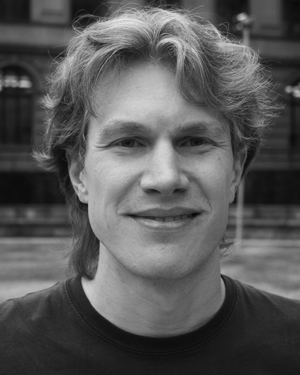 Johannes Lengler合作论文数ETH Zürich1
 Emo Welzl合作论文数Department of Computer Science, ETH Zurich;Institute of Theoretical Computer Science, ETH Zurich1
 Andrey Ivanov Ivanov合作论文数Kavetsky Institute of Experimental Pathology, Oncology and Radiobiology, The National Academy of Sciences1




