Society’s increasing demand for electrical energy, along with the increased integration of remote renewable generation has driven transmission levels to ever higher voltages in order to maintain (or improve) grid efficiency. Consequently, high voltage testing and monitoring beyond voltage levels covered by presently available metrology infrastructures are needed to secure availability and quality of supply. Calibration services for Ultra-High Voltage Direct Current (UHVDC) presently are only available up to 1000 kV. There is a need to extend the DC calibration capabilities for voltage instrument transformers up to 1200 kV and for factory component testing capabilities up to 2000 kV. Also, methods for linear extension of lightning impulse calibration, for dielectric testing of UHV grid equipment, urgently need revision. Recent research has raised questions regarding the validity of the current linearity extension methods for voltages beyond 2500 kV. Furthermore, new methods for calibration are needed for the 0.2 class HVAC voltage instrument transformers for system voltages up to 1200 kV. The current methods used for determination of the voltage dependence are very time consuming, raising the need for methods allowing faster assessment. Finally, with new HVDC transmission grids and associated components, novel methods are needed for detection, classification and localisation of partial discharge (PD) under DC stress. The industry needs methods for reliable monitoring of critical components such as cables, for both HVAC and HVDC, and gas insulated substations (GIS), and techniques for addressing new challenges introduced by HVDC technologies, such as the ability to distinguish PD signals from switching transients in converters and other sources of noise.
As part of the production of equipment for high voltage electricity grids, high voltage tests are performed to verify that the equipment can withstand the operational voltage stresses. Such ‘withstand tests’ are performed using combined and composite waves, where lightning impulse (LI) or switching impulse (SI) waves are superimposed on AC or DC. Both the technical understanding of the generation and measurement of such high voltage wave forms and the regulations in international standards are not sufficient for the current requirements. Therefore, a European metrology project with industrial partners, universities and seven European metrology institutes (NMI) is started in 2020. In three technical work packages the metrological and standardisation need will be issued. First, the relationship between impulse voltages with AC or DC measurement, and related detrimental effects due to combining wave shape tests will be reliably determined. New measurement instruments, low voltage generators and measurement evaluation software will be created. Traceable high voltage measurement systems and calibration services for composite and combined wave shapes, with a target amplitude uncertainty of less than 2 % will be developed at the NMIs. The capabilities of these NMIs will be confirmed with aid of a high voltage comparison campaign at PTB. The uncertainty of existing voltage dividers and measuring systems used in tests with composite and combined wave shapes will be accurately determined. Finally, the research results will be forwarded to the ongoing revision of the IEC 60060 series.
In this contribution, a new separation method for partial discharge signals and disturbances is introduced. In contrast to frequency rejection filter techniques like low or high-pass filters as de-noising methods, a correlation filter is used to separate the acquired signals into different signal classes. For that, a test circuit for the measurement of partial discharge signals under dc voltage was set up. Two test samples for the generation of corona and surface discharges as typical partial discharge sources were used to obtain test signals for the presented classification algorithm. Besides partial discharge signals, additional disturbances from the power supply, which was realized by the application of a half-wave rectifier, were also measured. Spectral analyses of the measured signals show the difficulties when using common frequency-rejection filter methods since the relevant spectral contents of discharge signals and disturbances are located in the same frequency range. An application of these filter methods for de-noising would influence the waveform of the partial discharge signals and impede further analyses due to a limitation respectively a loss of their relevant spectral contents. The new approach provides a separation method for different signals without an influence on the pulse shape by using a correlation filter method. Histogram analyses of the correlation coefficients show a clear differentiation of the signal classes and present thresholds for the distinction between correlated and uncorrelated events. The consistence of each single signal class is proven to ensure a high similarity of the events obtained from the same test sample. The correlation between two signal classes lead to coefficients below the determined threshold value, which indicates a comparison of events from different classes. In a last experiment, the results from the histogram analysis were implemented in a classification algorithm to separate the raw data into specific classes and presents a new approach for the grouping of unknown signals in comparison to multi-channel processing tools like the 3 Center Frequency Relation Diagram (3CFRD).
 Alf-Peter Elg合作论文数3
 Kari Lahti合作论文数3
 Johann Meisner合作论文数3
 Fernando Garnacho合作论文数3
 Backhaus, K.合作论文数IEEH, Tech. Univ. Dresden;c;IEEH, Tech. Univ. Dresden3
 Ahmet Merev合作论文数TÜBITAK National Metrology Institute3Hanane Saadeddine合作论文数2Andrea Orrea合作论文数2
 Jussi Havunen合作论文数2
 Uwe Schichler合作论文数2
 Paolo E. Roccato合作论文数Divisione Elettromagnetismo, INRiM, Strada delle Cacce, 91, 10135 Torino, Italy2
 Markus H. Zink合作论文数1
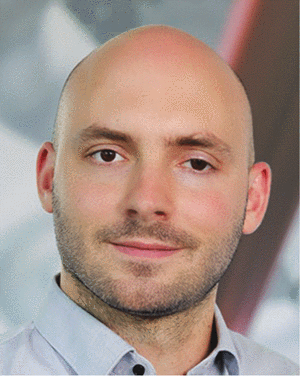 Erik Winkelmann合作论文数1
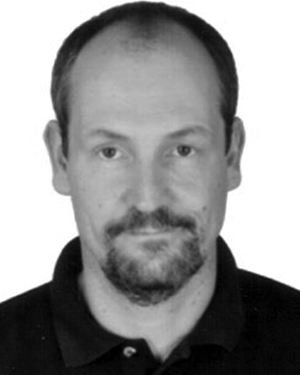 Carlos A. Platero合作论文数1
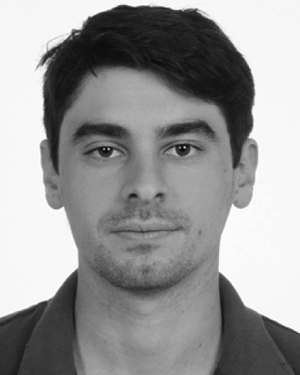 Christian Mier Escurra合作论文数1Andreas Kuechler合作论文数1
 Ernest Houtzager合作论文数1Agazar, M.合作论文数1
 Ernst Gockenbach合作论文数Schering-Institute for High Voltage Engineering and Asset, Leibniz Universität Hannover1




