With the increasing attention to deep neural network (DNN) models, attacks are also upcoming for such models. For example, an attacker may carefully construct images in specific ways (also referred to as adversarial examples) aiming to mislead the DNN models to output incorrect classification results. Similarly, many efforts are proposed to detect and mitigate adversarial examples, usually for certain dedicated attacks. In this paper, we propose a novel framework called AdvEWM based on embedding digital watermark to generate image adversarial examples for fooling DNN models. Specifically, partial main features of the watermark image are embedded into the host image almost invisibly, aiming to tamper with and damage the recognition capabilities of the DNN models. We devise an efficient mechanism to select host images and watermark images and utilize the improved discrete wavelet transform (DWT) based Patchwork watermarking algorithm with a set of valid hyperparameters to embed digital watermarks from the watermark image dataset into original images for generating image adversarial examples. The experimental results illustrate that the attack success rate on common DNN models can reach an average of 95.47% on the CIFAR-10 dataset and the highest at 98.71%. Besides, our scheme is able to generate a large number of adversarial examples efficiently, concretely, an average of 1.17 s for completing the attacks on each image on the CIFAR-10 dataset. In addition, we design a baseline experiment using the watermark images generated by Gaussian noise as the watermark image dataset that also displays the effectiveness of our scheme. Similarly, we also propose the modified discrete cosine transform (DCT) based Patchwork watermarking algorithm. To ensure repeatability and reproducibility, the source code is available on GitHub.
Cryptocurrencies are no longer just the preferred option for cybercriminal activities on darknets, due to the increasing adoption in mainstream applications. This is partly due to the transparency associated with the underpinning ledgers, where any individual can access the record of a transaction record on the public ledger. In this paper, we build a dataset comprising Bitcoin transactions between 12 July 2019 and 26 May 2021. This dataset (hereafter referred to as BABD-13) contains 13 types of Bitcoin addresses, 5 categories of indicators with 148 features, and 544,462 labeled data, which is the largest labeled Bitcoin address behavior dataset publicly available to our knowledge. We then use our proposed dataset on common machine learning models, namely: k-nearest neighbors algorithm, decision tree, random forest, multilayer perceptron, and XGBoost. The results show that the accuracy rates of these machine learning models for the multi-classification task on our proposed dataset are between 93.24% and 97.13%. We also analyze the proposed features and their relationships from the experiments, and propose a k-hop subgraph generation algorithm to extract a k-hop subgraph from the entire Bitcoin transaction graph constructed by the directed heterogeneous multigraph starting from a specific Bitcoin address node (e.g., a known transaction associated with a criminal investigation). Besides, we initially analyze the behavior patterns of different types of Bitcoin addresses according to the extracted features.
The training of state-of-the-art deep learning models generally requires significant high-quality data, including personal and sensitive data. To ensure privacy of the sensitive data used in training deep learning models, many methods have been designed by the research community. However, it has been observed that many privacy-preserving approaches for image-based deep learning model training incur significant time in the processing of images and/or have low accuracy on trained models when a large number of images is used for classification tasks. Hence, in this paper, we propose a lightweight and efficient approach to preserve image privacy while maintaining the availability of the training set. Specifically, we design the pixel block mixing algorithm for facial image classification privacy preservation in deep learning. Experimental findings show that the models trained by the mixed training set generated by the proposed algorithm maintain their availability. The comparison results of the structural similarity index measure between images in the new training set and the original training set show that our scheme preserves image privacy. Our evaluations also reveal that the data augmentation can be applied to the mixed training set to improve the training effectiveness. We also demonstrate it is computationally challenging for attackers to restore the mixed training set to the original one.
The growing acceptance and popularity of cryptocurrencies have boosted the digital financial markets, which have also increased crime risk due to their anonymity and decentralization. Appropriately monitoring decentralized cryptocurrency, particularly Bitcoin, can prevent participants from financial loss and benefit the community. Therefore, in this paper, we build the first Bitcoin address subgraph dataset called BASD-8, which contains 3,830 labeled Bitcoin address subgraphs, and we study the structural characteristics of these subgraphs, aiming at identifying eight common types of Bitcoin addresses to distinguish between normal and abnormal addresses. Three methods are utilized to exploit subgraph patterns: complex network, machine learning, and empirical analysis. Specifically, we calculate ten vital metrics of subgraphs as features to train address classifiers using basic machine learning models. Also, a graph neural network model is trained as a graph-level classifier, and the experimental results with the best f1-score of 91.35% illustrate the effectiveness of our dataset and study methods. Furthermore, we conduct a detailed empirical pattern analysis combining the subgraph structures and the definitions of each category of Bitcoin addresses.
While data sharing cross management is increasingly popular, there are challenges in such a decentralized data sharing mode, especially in terms of transaction fairness and copyright protection. However, few schemes consider both fairness and copyright protection in the current literature. In this paper, we propose a flexible and Ethereum-based scheme to facilitate copyright protection in data sharing blockchain, by using watermark based policies. This allows us to achieve properties such as preventing the re-selling of data (e.g., partial data, combined data, and leaked data). We also design five algorithms to automatically guarantee data sharing fairness and proactively protect data copyright, by using smart contracts. In other words, several new security features are introduced to existing transaction schemes, while still achieving feasible performance. The response times for each key step of smart contract in the proposed scheme is between 0.41 s and 0.91 s.
Decision-making plays an increasing important role in our digitalized society, and hence the need for trustworthy data. For example, in a traditional trading process, a trusted middle person generally helps to arbitrate any dispute between two or more parties involved in the trading. However, having such a trusted middle person can be labor-intensive, increases transaction costs, and lacks fairness during arbitration due to the subjectivity of the middle person. While we can avoid the need for a middle person using smart contract-based approaches, there are other limitations (e.g., fairness and privacy preservation) that need to be addressed. In this paper, we present a fair scheme for big data exchanging that allows buyers and sellers to autonomously and fairly complete transactions, without involving any third-party middle person. Specifically, our scheme uses smart contracts and oblivious transfer protocol, in combination with our proposed Ether cheque system. Smart contracts are used to achieve transaction fairness, autonomy and trading timing control. The oblivious transfer protocol helps us to preserve the privacy of transactions. We use Ether cheque to improve the fairness of the transaction and make the transaction more convenient. Also, our proposed approach can facilitate the identification of a cheating party.
Abstract While data sharing cross management is increasingly popular, there are challenges in such a decentralized data sharing mode, especially in terms of transaction fairness and copyright protection. However, few schemes consider both fairness and copyright protection in the current researches. In this paper, we propose a flexible and Ethereum based scheme to facilitate copyright protection in data sharing blockchain, by using watermark-based policies. This allows us to achieve properties such as preventing the re-selling of data (e.g., partial data, combined data, and leaked data). We also design five algorithms to allow us to automatically guarantee data sharing fairness and proactively protect data copyright, by using smart contracts. By design, several new security features have been introduced to existing transaction schemes while still achieving feasible performance. The response times for each key step of smart contract in the proposed scheme is as fast as 0.41 s and as slow as 0.91 s.
With the increasing attentions of deep learning models, attacks are also upcoming for such models. For example, an attacker may carefully construct images in specific ways (also referred to as adversarial examples) aiming to mislead the deep learning models to output incorrect classification results. Similarly, many efforts are proposed to detect and mitigate adversarial examples, usually for certain dedicated attacks. In this paper, we propose a novel digital watermark based method to generate adversarial examples for deep learning models. Specifically, partial main features of the watermark image are embedded into the host image invisibly, aiming to tamper and damage the recognition capabilities of the deep learning models. We devise an efficient mechanism to select host images and watermark images, and utilize the improved discrete wavelet transform (DWT) based Patchwork watermarking algorithm and the modified discrete cosine transform (DCT) based Patchwork watermarking algorithm. The experimental results showed that our scheme is able to generate a large number of adversarial examples efficiently. In addition, we find that using the extracted features of the image as the watermark images, can increase the success rate of an attack under certain conditions with minimal changes to the host image. To ensure repeatability, reproducibility, and code sharing, the source code is available on GitHub
 Yuexin Xiang合作论文数China Univ Geosci, Sch Comp Sci, Wuhan, Peoples R China8
 Kim-Kwang Raymond Choo合作论文数Department of Information Systems and Cyber Security, College of AI, Cyber and Computing, The University of Texas at San Antonio7
 Wei Ren (任伟)合作论文数School of Computer Science, China University of Geosciences, Wuhan7
 Tianqing Zhu (朱天清)合作论文数School of Computer Science, China University of Geosciences6
 Xianghan Zheng (郑相涵)合作论文数College of Computer and Data Science, Fuzhou University4
 Gautam Srivastava合作论文数1
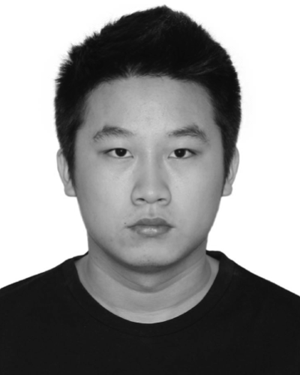 Ding Bao合作论文数1
 Qingqing Yang合作论文数1
 Yuquan Li合作论文数1
 Yulei Chen合作论文数Wuhan Univ, Sch Math & Stat, Wuhan 430072, Peoples R China1
 jie he合作论文数1
 Wenmao Liu (刘文懋)合作论文数1




