A rapid urinary iodide test was assessed in goats to validate its effectiveness in field conditions. The test provides a semiquantitative assessment of the iodine intake and could be valuable for animal population. Two hundred and forty-six dairy goats were randomized selected for this study. According to iodide content in urine, results were classified in three groups (< 10 mu g/dL, 10-30 mu g/dL, > 30 mu g/dL). These findings were in agreement with spectrophotometrical determinations and with serum iodine values. Sensibility and specificity were 89% and 78%, respectively. Data on reproducibility and interfering substances were also valuable. Given the technical simplicity, cost-effectiveness and its stability in heat environmental conditions, the rapid urinary iodide test should be considered as a valuable method for epidemiological surveys in field conditions or in development countries. (c) 2005 Elsevier B.V. All rights reserved.
In 1998, two cases of silica urolithiasis occurred in castrated male dromedaries on an intensive camel farm in the Canary Islands. The immediate attributable cause was the ingestion of large amounts of silica in the feed, estimated as 84.44 g/day. An associated cause was the low level of salt in the diet. Daily ingestion of salt from feed and water was estimated to be 21.8 g (8.6 g of sodium). Seventy-six castrated males from the same farm were divided into four groups: group A received 30 g of salt daily; group B received 40 g; group C received 60 g; and group D received no added salt in the diet (control). The animals were maintained on these dietary regimes for 2 years. No animals from groups A, B or C suffered overt urinary retention. One animal from group D had an obstructive urinary retention 10 months after the study commenced. Thus, 52 g of salt daily appears to be sufficient to prevent urinary retention in dromedaries raised in a subtropical climate.
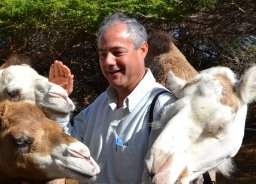 Carlos Gutierrez合作论文数Fac Vet, Univ Las Palmas Gran Canaria6
 M.C. Juste合作论文数Faculty of Veterinary Medicine, University of Las Palmas de Gran Canaria5
 Francisco Doreste合作论文数4
 Juan Alberto Corbera合作论文数Facultad de Veterinaria, Universidad de Las Palmas de Gran Canaria4
 Juan Alberto Corbera Sánchez合作论文数3Manuel Jose Morales合作论文数Service of Oncology, Hospital Universitario Nuestra Señora de Candelaria1Inmaculada Morales合作论文数1




