Dusty plasmas are ubiquitous throughout the universe, spanning laboratory and industrial plasmas, fusion devices, planetary environments, cometary comae, and interstellar media. Despite decades of research, many aspects of their behavior remain poorly understood within a unified framework. While numerous theoretical and numerical models describe specific phenomena, such as dust charging, transport, waves, and self-organization, fully predictive models across the wide range of spatial and temporal scales in both laboratory and natural systems remain elusive. Conventional plasma descriptions rely on coupled differential equations for particle densities, momenta, and energies, but their solutions are often limited by computational cost, numerical uncertainties, and incomplete knowledge of boundary conditions and transport processes. Recent advances in machine learning (ML), particularly deep neural networks, offer new opportunities to complement traditional physics-based modeling. Here we review ML and artificial intelligence (AI) approaches, termed bottom-up data-driven methods, for dusty plasma research. Central to this effort is Dust Neural nEtworks Technology (DustNET), a community-driven dataset initiative inspired by ImageNet, integrating experimental, simulation, and synthetic data to enable predictive modeling, uncertainty quantification, and multi-scale analysis. DustNET-trained models may also be deployed in real-time experimental settings under edge computing constraints. Combined with emerging multi-modal AI foundation models and autonomous agents, this framework provides a pathway toward a unified, physics-informed understanding of dusty plasmas across laboratory, industrial, space, and astrophysical environments.
From the interior of planets and supernova explosions to the high energy density plasmas in inertial confinement fusion, strong coupling governs the highly complex dynamics and structure formation of the particles within these systems. In a system known as dusty plasma, visible microparticles inserted into a low temperature plasma become charged and self-organize into structures in much the same way, allowing us to gain insight into these kinds of particle interactions. In addition to nonlocal and stochastic effects characteristic of strongly coupled plasmas, the dust-dust interaction potential can become anisotropic in the presence of external electric or magnetic fields. By tracking the motion of these particles and studying their collective behavior we can infer how changes in the background plasma and the presence of external fields causes anisotropies in the interparticle potential.
Dusty plasmas, composed of electrons, ions, neutral particles, and charged dust grains, exhibit self-organization phenomena such as string-like structures observed in microgravity experiments. The formation of these structures is influenced by ion wakes generated by streaming ions under external electric fields, as well as by time-evolving plasma inhomogeneities such as ionization waves. Existing ion wake models, such as point charge and Gaussian-based representations, often rely on configuration-specific parameters, limiting their general applicability. In this work, we present a robust and general potential model for dust and ion wake systems under PK-4-like conditions. Using a small set of coefficients determined from molecular dynamics simulations, the model captures the potential distributions for multiple interparticle distances. Its application to test cases and implementation in a small scale dust dynamics simulation demonstrates its applicability to a wide range of dust arrangements beyond string-like configurations.
Identification of the particle interaction potential is a challenging and important task in dusty plasma, colloids, and smart materials, as it allows the characterization of structure formation and helps predict phase transitions. With the advent of machine learning methods, this interaction can be extracted from particle position data, leading to a generalizable expression that is applicable in different systems. Methods such as sparse regression aim to provide a physically interpretable model that can generalize well, while avoiding unnecessary complexity due to overfitting. In this work, we present the use of the Sparse Identification of Nonlinear Dynamics with the weak formulation to learn equations of motion for noisy data from simple simulations of two dust particles interacting with a Yukawa (shielded Coulomb) potential. The application of these methods to experimental dusty plasma data is discussed, particularly in the case of simulation data and glass box experiments in RF discharge gravity environments and DC discharge microgravity environments, such as the Plasmakristall-4 (PK-4) experiment.
We report a new experimental platform developed at the DIII-D National Fusion Facility to investigate carbon ablation and spallation under extreme heat fluxes relevant to fusion plasma-facing components and high-enthalpy atmospheric entry. Carbon samples were exposed to parallel heat fluxes of $30$--$40~\mathrm{MW\,m^{-2}}$ in the scrape-off layer using two complementary approaches: stationary carbon rods inserted near the divertor strike point and slow-launch carbon pellets injected vertically into the edge and core plasma. Pellets penetrating the core experienced heat fluxes approximately an order of magnitude higher. The conditions reproduce key aspects of the shock-layer environment encountered by the Galileo probe during entry into Jupiter's atmosphere. Fast visible imaging, divertor spectroscopy, infrared thermography, CO$_2$ interferometry, and post-exposure profilometry provided measurements of ablation rates, surface recession, and temperature evolution. Measured mass-loss rates of $(1$--$3)\times10^{-2}~\mathrm{g\,cm^{-2}\,s^{-1}}$ agree with semi-empirical aerospace ablation models, while wedge-shaped rods exhibited greater ablation than cylindrical and concave samples. UEDGE-DUSTT simulations incorporating parallel plasma flows, ${\bf j}\times{\bf B}$ forces, and ablation-cloud shielding reproduce the measured pellet trajectories and ablation timescales. These results establish tokamak plasma as a high-heat-flux environment for validating carbon ablation models and studying material response and impurity dynamics in reactor-relevant divertor plasmas.
Anisotropic anomalous dust diffusion in microgravity dusty plasma is investigated using experimental data from the Plasmakristall-4 (PK-4) facility on board the International Space Station. The PK-4 experiment uses video cameras to track individual dust particles, which allows the collection of large amounts of statistical information on the dust particle positions and velocities. These statistics are used to quantify anomalous dust diffusion caused by anisotropies in the plasma-mediated dust-dust interactions in PK-4. Anisotropies are caused by an externally applied polarity-switched electric field, which modifies the ion wakefields surrounding the dust grains. Video data for nine sets of pressure-current conditions are used to recover mean squared displacement (MSD) plots after subtracting particle drift. Position and velocity histograms are fitted to Tsallis nonextensive probability distribution functions (PDFs). Both MSDs and PDFs indicate a crossover from suprathermal to L & eacute;vy diffusion in the axial direction at higher pressure conditions. In addition, increasing the pressure enhances dust thermal equilibrium, while increasing the current drives the system away from equilibrium.
This study investigates the filamentary structural states of microgravity dusty plasma using data from the Plasmakristall-4 (PK-4) facility on board the International Space Station. The dust particles in the PK-4 discharge are observed to form field-aligned filaments and nested (layered) structures in response to changes in the plasma conditions, neutral gas pressure, and externally applied electric field. This work explores the possibility that these filamentary dusty plasmas exhibit properties of liquid crystals. The structural characteristics of the dust clouds are studied for nine sets of pressure-current conditions using pair correlation functions calculated for particles (i) within individual filaments, (ii) within the central plane of the dust cloud, and (iii) within successive planes of the cloud (the 3D cloud). It is observed that, at low pressure (≈30 Pa), the entire cloud is in a weakly crystalline state with similar coupling of particles within filaments and among neighboring filaments. At high pressure (≈70 Pa), the order within filaments improves (enhanced crystalline behavior), while the degree of freedom of filaments to move with respect to each other increases (enhanced liquid behavior). Since neutral gas pressure in dusty plasma acts as inverse temperature, we argue that the structural changes observed with increasing pressure are analogous to a transition to a nematic liquid crystal state. It is further observed that the filaments exhibit alignment in nested surfaces for several pressure-current conditions, suggesting the possibility of a smectic liquid crystal state. These results are confirmed by molecular dynamics simulations of the dust and ions using the DRIAD (Dynamic Response of Ions And Dust) code.
Complex plasma, consisting of ionized gas mixed with micron-sized dust particles, exhibit unique behaviors due to the mass disparity between dust grains and other plasma components. These disparities result in non-Hamiltonian dynamics that pose significant challenges for numerical modeling. Under specific conditions, the dust grains self-organize into crystal structures, driven by ion wakefields and subject to imperfections that induce dynamic phenomena like torsions—where dust grains couple and exhibit elliptical motion within the crystal lattice.To better understand these phenomena, we developed a near real-time interactive computer model grounded in laboratory conditions, specifically replicating the environment within a GEC RF reference cell. This model addresses the challenges of stiffness in differential equations by employing an innovative point charge approach, where each point charge is dynamically influenced by all dust grains, enhancing the model's accuracy and responsiveness. The system allows for user interaction, enabling the manipulation of parameters and near real-time observation of dust behavior. Our approach balances computational efficiency with the ability to simulate complex plasma dynamics, providing a powerful tool for the study of dusty plasma crystals.
Rotating quasipaired particles (torsions) are observed within a two-dimensional monolayer crystal suspended in an argon complex plasma for discharge powers of 1-10 W and pressures of 135-155 mTorr. The inclusion of a torsion in a crystal lattice fundamentally changes the overall lattice state to a "hot crystal." A torsion increases the particle motion and kinetic energy of other particles in the crystal, with the strongest effects on neighboring particles. The apparent effective range is to the third nearest neighbor, with the kinetic energy in the first three shells of particles increasing by at least 200% over baseline values for the crystal. However, the variance of the motion of all particles in the crystal increases by more than two times over the average background kinetic fluctuations for the whole crystal. The formation of a torsion perturbs the structure and symmetry of a plasma crystal. A single torsion causes the average interparticle spacing to increase by 11% compared to the same crystal without a torsion. Particles in the first two shells surrounding a torsion also display reduced hexagonal symmetry. The combination of the perturbed lattice structure and the larger range of motion for the microparticles contribute to a higher-energy-state crystal when torsions are present.
Interacting torsions are examined within a two-dimensional monolayer crystal suspended in an argon complex plasma for 1-10 W discharge powers and pressures of 135-155 mTorr. Two torsions embedded in a lattice are shown to amplify the kinetic energy and range of motion of particles located between the torsions to nearly three times that observed in single torsion systems. It is also shown that multiple torsions can interact via amplified particle energy when separated by up to 14 interparticle distances ( Delta). The torsion separation distance also showed a positive linear trend with power and a slightly positive correlation with the pressure. This amplification of energy is possible due to the fact that multiple torsions in a lattice increase the interparticle distance of the lattice by 16% more than single torsion systems, leading to additional freedom of motion in the lattice plane. These combined findings show that multiple torsions heat the lattice differently depending on their separation from the other torsion. The midpoint particles between torsions absorb the majority of energy from the two torsions, and energy addition at the midpoint is nonlinear. The addition of more torsions to the lattice may lead to melting of the plasma crystal.
Dust grains have been used as minimally invasive probes to determine plasma parameters including the plasma density, temperature, and electric field in a plasma discharge. However, the dust grains in a plasma generate local potential disturbances due to the collection of charge and the subsequent electrostatic interactions between the dust and charged plasma particles. Dust grains in close proximity to one another exhibit interesting non-reciprocal interactions and self-organize into structures such as one-dimensional filamentary chains, two-dimensional “zigzags,” and three-dimensional helices, among others. The formation of these structures suggests that although the dust grains may be less invasive than traditional plasma probes, the disturbance to the local plasma environment introduced by dust grains is non-trivial. Commonly used analytic forms of the electric potential describing complex plasmas have failed to resolve the near-dust region, and as a result are insufficient to provide insight about the formation of complex dust structures. Here, we use an N-body simulation to compute the electric potential from ion densities near various dust grain configurations. We provide an alternative description to the standard analytic model for the electric potential of dust and ion wakes based on a Gaussian shaped cloud of ions. The electric potential obtained from simulations is used to identify minimum energy configurations for two and three dust grains. It is further demonstrated that the minimum potential region identified for N dust grains and their associated ion wakes does not predict the minimum-energy configuration of N + 1 dust grains.
The mechanical processes that convert an initially fluffy chondrule fine-grained rim (FGR) into a more compact structure remain poorly characterized. Given the presence of shocks in protoplanetary disks, we use numerical simulations to test the hypothesis that dust-laden shocks in the solar nebula contributed to FGR modification. We use the iSALE2D shock physics code to model the collision of dusty nebular shock fronts (which we term “dust clouds”) into chondrule surfaces that host a porous FGR. In our simulations, dust particles are modeled as dunite disks. The dust radii follow the Mathis–Rumpl–Nordsieck distribution of interstellar grains. Chondrules are modeled as rectangular dunite slabs. We vary the impact speed v imp , the fractional abundance f cloud of dust grains in the impacting shock, and the fractional abundance f FGR of dust grains in the pre-existing FGR. We thus compute dust temperatures and pressures resulting from the collisions, as well as the net mass accretion of dust by the FGRs. Dust temperatures increase upon impact, depending on the kinetic energy of the dust cloud and on f FGR . Dust rims with a higher f FGR heat up more than those with a lower f FGR , with possibly important implications for the composition and structure of FGRs. Maximum impact pressures increase with f cloud . Fine-grained rims can experience mass gain from the impacting cloud, but in some instances, mass is lost from the rim. We find qualitative similarities in the topography of the FGR–chondrule interface between our simulations and petrographic analyses of the Paris CM chondrite by other authors.
Dust accumulation is one of the critical issues that must be mitigated on in-situ lunar explorations because an in-situ probe is exposed to small dust particles, which are easily attached to it, during its operations. The Lunar Dust Science Definition Team is organized by the Jet Propulsion Lab/California Institute of Technology through NASA's Biological and Physical Sciences Division to define key science questions and assess dust remediation techniques. Here, we assess three electrostatic remediation technology concepts: electrostatic dust shield; surface electrostatically collecting dust, later called attractive surface; and electron beam — plasma jet inducing electrostatic dust lofting from a surface. We qualitatively investigate their maturity by defining six operational factors: Time and location; Amount of dust removal; Contamination of target surfaces; Operation duration; Installation; and Safety. In addition to these techniques, we discuss a supporting system that loads dust particles onto a test article to examine dust removal efficiency. The results show that further development increases the maturity of all the technologies. While laboratory and theoretical demonstrations reported whether each technology robustly work on the Moon, which hosts a complex, heterogeneous dust environment, we find that it is still uncertain if this is the case because none has been tested in the lunar environment. Particularly, operation duration and safety are critical to be addressed further on both laboratory and spaceflight scales.
Significant experimental and computational investigations have explored the feasibility of electrostatically-motivated dust motion on the lunar surface. The motion of lunar dust influences our understanding of the evolution of the surface and may also present a hazard to future exploration vehicles and astronauts. The possibility of a sustained exploration presence on the lunar surface opens the door to long-term experiments on the lunar surface, akin to the science facilities on the International Space Station. We have identified four measurements/observations that would significantly advance our understanding of dust-plasma interactions on the lunar surface. In this context, we provide conceptual designs for payloads to obtain these observations: a Langmuir probe, dust deposit witness plate, regolith charge measurement instrument, and cameras to look for evidence of horizon glow. These payloads could deploy independently and sequentially, or together as a suite. The proposed payloads would provide key observations that would inform future modeling efforts and direct future in situ experiments to understand the dust-plasma environment, both for planetary science and spacecraft design applications.
Oxide/oxide ceramic matrix composites have potential applications in thermal protection systems due to their ability to withstand very high temperatures while maintaining their load bearing capability and oxidation resistance. Under hypersonic flight conditions vehicle components may be exposed to temperatures above the melting points of alumina and mullite, as well as to chemically active ionized gases. Therefore, it is necessary to understand the response of these CMCs to not just thermal loads, but also the added challenges of plasma environments. In this study, alumina-mullite based oxide/oxide CMCs were exposed to an inductively generated plasma jet for 30 min at a heat flux of 24 W/cm2 in near vacuum conditions. Resulting microstructures were characterized with XRD and SEM/EDS. Silicon rich, sub-micron globules were observed on the surface of the impinged region. Also, the first 5 mu m below the surface were enriched with silicon. The back surface showed no silicon enrichment but did have a granulated surface texture in comparison to as manufactured samples. Short beam strength tests were performed as a measure of structural performance. Differences in the overall response and short beam strength were noted between the as manufactured and plasma exposed cases.
Fine-grained dust rims (FGRs) surrounding chondrules in carbonaceous chondrites encode important information about early processes in the solar nebula. Here, we investigate the effect of the nebular environment on FGR porosity, dust size distribution, and grain alignment, comparing the results for rims comprised of ellipsoidal and spherical grains. We conduct numerical simulations in which FGRs grow by collisions between dust particles and chondrules in both neutral and ionized turbulent gas. The resultant rim morphology is related to the ratio ϵ of the electrostatic potential energy at the collision point to the relative kinetic energy between colliding particles. In general, large ϵ leads to a large rim porosity, large rim grain size, and low growth rate. Dust rims comprised of ellipsoidal monomers initially grow faster in thickness than rims comprised of spherical monomers, due to their higher porosity. As the rims grow and obtain a greater electrostatic potential, repulsion becomes dominant, and this effect is reversed. Grain size coarsening toward the outer regions of the rims is observed for low- and high- ϵ regimes, and is more pronounced in the ellipsoidal case, while for the medium- ϵ regime, small monomers tend to be captured in the middle of the rims. In neutral environments, ellipsoidal grains have random orientations within the rim, while in charged environments ellipsoidal grains tend to align with maximum axial alignment for ϵ = 0.15. The characterization of these FGR features provides a means to relate laboratory measurements of chondrite samples to the formation environment of the parent bodies.
The microgravity environment of the Plasmakristall-4 experiment on the International Space Station provides a laboratory for exploring plasma-mediated interactions among charged dust grains in fully three-dimensional space. Away from the strong influence of Earth's gravity, the dust grains can levitate in the bulk of the plasma, where they have been observed to form extended filamentary structures aligned with the discharge tube axis. These structures can be used as a macroscopic analogue for other self-organizing systems, including electrorheological fluids and liquid crystals, and the success of the analogy depends on a thorough understanding of the mechanisms guiding the dust interaction potential. Here we present the results from molecular dynamics simulations of the ion flow past isolated dust chains within the dust cloud and the dust cloud macrostructure. Although dust grains are known to respond on the millisecond timescale, analysis reveals that periodic variations of plasma conditions on the microsecond timescale significantly affect dust structure formation. In addition to the expected formation of filamentary dust chains in the dust cloud macrostructure, dust grains in a large cloud are also observed to organize into ordered positions on the surface of nested cylinders, in agreement with experimental observations.
This study examines the structure and stability of filamentary dusty plasmas using data from the Plasmakristall-4 (PK-4) facility on board the International Space Station. Under the action of a polarity-switched DC electric field, the dust particles in the PK-4 discharge have been found to organize into field-aligned extended filaments, which has been compared to the filamentary state in electrorheological (ER) fluids. Here we discuss how, in addition to an ER-type structural transition, the PK-4 dusty plasmas exhibit structural states reminiscent of those observed in liquid crystals (LCs) with rod-shaped molecules. We find that dust particles within the filaments are strongly coupled in a crystalline-like structure, while the coupling of particles across filaments is liquid-like. In addition to a common orientation along a director axis (nematic behavior), the dust filaments also appear to align in large-scale nested structures, or shells (smectic behavior). Finally, these filaments are found to further arrange in hexagonal patterns within the plane orthogonal to the director axis, suggesting the possibility for smectic-B and smectic-C structural states. As the observed ER and LC features of the filamentary dusty plasma states are sensitive to variations in the PK-4 discharge conditions, we argue that these dusty plasmas can provide a controlled analogous system for the study of fundamental phenomena in soft matter, such as the origins of pattern formation and universality of phase transitions.
Two-dimensional microparticle crystals can be formed in the sheath of a gas discharge plasma. Ions from the bulk plasma are accelerated in the sheath electric field, flowing past the grains to create a positive ion wake downstream from the grains. Interaction between the ion wake and neighboring grains creates additional coupling between oscillation modes and can trigger mode-coupling instability (MCI). In order to better understand MCIs, the interaction between dust grains and ion wakes must be understood; however, the relationship between the discharge parameters and ion wake characteristics is unknown. A molecular dynamics simulation of ion dynamics and dust charging is used to self-consistently determine the dust charge and ion wake characteristics for different synthetic experimental conditions. It is found that the ion wake is strongly dependent on the background gas pressure but not affected much by the discharge power.
 Lorin Matthews合作论文数Center for Astrophysics;Baylor University;Center for Astrophysics, Baylor University297
 Reyes Jorge C合作论文数73
 Qiao Ke (柯巧)合作论文数73
 Jie Kong合作论文数63
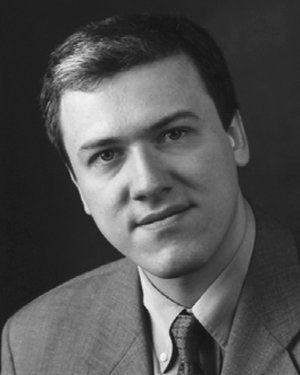 Rene Laufer合作论文数34
 Victor Land合作论文数Found. for Fundamental Res. on Matter;c;Found. for Fundamental Res. on Matter33
 Jimmy Schmoke合作论文数32Evdokiya Kostadinova合作论文数29
 Georg Herdrich合作论文数Steinbeis Transfer Centre Plasma and Space Technology;Institut für Raumfahrtsysteme, Universität Stuttgart28Mike Cook合作论文数28
 Peter Hartmann合作论文数Research Institute for Solid State Physics and Optics;Hungarian Academy of Sciences;Research Institute for Solid State Physics and Optics, Hungarian Academy of Sciences24
 Mudi Chen合作论文数23
 Michael Dropmann合作论文数23
 Angela Douglass合作论文数21
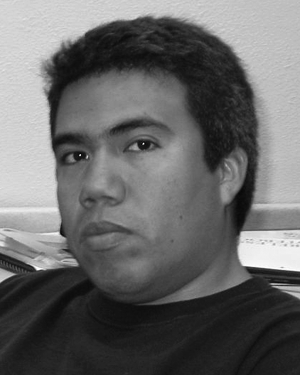 Jorge Carmona合作论文数21Dustin Sanford合作论文数17
 Constanze Liaw合作论文数17Augusto Carballido合作论文数16
 Zhuanhao Zhang合作论文数15
 Bernard Smith合作论文数15
 Zhiyue Ding合作论文数Donghua University, Donghua University15Katrina Vermillion合作论文数13Ke Qiao合作论文数13Marlene Rosenberg合作论文数Department of Electrical and Computer Engineering, University of California, San Diego11
 Brandon Harris合作论文数Washington University in St. Louis11
 Khandaker S. Ashrafi合作论文数Department of Basic Science, Primeasia University11C. Xiang合作论文数10
 Hubertus Thomas合作论文数Institute of Materials Physics in Space, Deutsches Zentrum für Luft-und Raumfahrt e.V.10Judy York合作论文数9
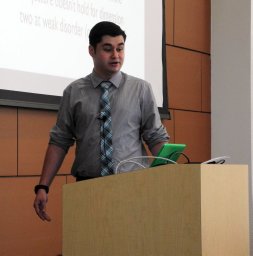 Kyle Busse合作论文数Dept Math, Rice Univ9J. Reay合作论文数8Shanna Attai合作论文数8Jorge R. Carmona合作论文数8Kerri Ranney合作论文数8Joshua L. Padgett合作论文数8W. Merle Alexander合作论文数7J. Schmoke合作论文数6
 Jonathan Perry合作论文数Dept Phys Astron & Geosci, Towson Univ6
 James Creel合作论文数Center for Astrophysics;Engineering;Baylor University;Center for Astrophysics, Baylor University6
 Oleg F. Petrov合作论文数Joint Insitute for High Temperatures, Russian Academy of Sciences6h s goad合作论文数5R. Nazzario合作论文数5Carballido A.合作论文数5Calvin Carmichael合作论文数5qianyu ma合作论文数5M. Cook合作论文数5Li Wang合作论文数5
 Razie Yousefi合作论文数5




