A convenient synthesis of 1-(2-fluorovinyl)-1,2-benziodoxol-3(1H)-ones was described. Fluorination reaction of alkynes with the reagent from o-iodobenzoic acid, mCPBA and HF·py was conducted in DCM and followed by addition of BF3·OEt2 at -65 °C. Treatment of the reaction mixture with NaHCO3 gave 1-(2fluorovinyl)benziodoxolones as stable solids. The similar fluorination reaction of alkynes using 1-hydroxy-1,2benziodoxol-3(1H)-one and HF·py also gave the same products.
A new synthetic method for [1]benzothieno[3,2- b][1]benzothiophene derivatives (BTBTs) was developed. The present method consists of iodocyclization of 1,2-bis(2-methylthiophenyl)ethynes and photolysis of 3-iodo-(2-methylthiophenyl)benzo[ b]thiophenes. With 1,2-bis(2-methylthiophenyl)ethynes treated with I2/PhI(OAc)2 in CH2Cl2 at room temperature, selective cyclization at sulfur took place to give 3-iodo-(2-methylthiophenyl)benzo[ b]thiophenes in good yields. Irradiation of the iodinated benzo[ b]thiophenes with a high-pressure Hg lamp (>290 nm) provided BTBTs in good yields. Furthermore, the present method was applied to the synthesis of bis[1]benzothieno[2,3- d;2',3'- d']benzo[1,2- b;4,5- b']dithiophene (BBTBDT).
The hypervalent iodine/HF reagent consisting of PhIO and HF·py was found to be effective for fluorination of functionalized aromatic olefins bearing synthetically important carbonyl and hydroxyl groups. Fluorination of 1,3-diphenyl-2-propen-1-one with PhIO/HF·py reagent in CH2Cl2 at room temperature gave 3,3-difluoro-1,2-diphenyl-1-propanone in high yield. Other α-aryl-α,β-unsaturated ketones underwent the fluorination to yield aryl 2,2-difluoroethyl ketone derivatives in good to high yields. Catalytic fluorination of α-aryl-α,β-unsaturated ketones using a p-TolI/HF·py/mCPBA reagent system also worked well. Moreover, the fluorination of cinnamyl alcohol derivatives by PhIO/HF·py reagent proceeded smoothly to afford 2-aryl-3,3-difluoro-1-propanols in moderate yields.
The reaction of alkynes with PhIO and Py·HF followed by treatment with BF3·OEt2 gave β-fluorovinyliodonium tetrafluoroborates in good to high yields. More conveniently, the reaction using PhI and Py·HF in the presence of m-CPBA also afforded β-fluorovinyliodonium tetrafluoroborates in good yields. These methods have the advantages that β-fluorovinyliodonium salts can be prepared without ArIF2.
The 1,4-benzdiyne equvalent, [2,5-bis(trimethylsilyl)-4-(trifyloxy)phenyl](phenyl)iodonium triflate, was prepared from sodium 2,4,5-trichlorophenoxide. The chemoselective generation of an aryne from the side of the phenyliodonio group was observed after treatment with a fluoride ion. Double cycloaddition of 1,4-benzdiyne with different arynophiles was conducted in one pot, giving bis-cycloadducts in high yields. Similarly, the 1,3-benzdiyne equivalent bearing phenyliodonio and triflate groups was prepared from sodium 2,3,6-trichlorophenoxide. The 1,3-benzdiyne equivalent also underwent the chemoselective stepwise generation of arynes and the double cycloaddition with different arynophiles. These hybrid benzdiyne equivalents provided the double cycloadducts in high yields and enabled the convenient one-pot procedure for synthesis of polycyclic aromatic compounds.
The reaction of 1,2-dibromobenzenes with chlorotrimethylsilane efficiently proceeded in the presence of Mg and LiCl in DMI under mild conditions, giving 1,2-bis(trimethylsilyl) benzenes in good to high yields. The reaction of 1,2-dibromobenzenes with chlorodimethylsilane under the same conditions afforded the corresponding 1,2-bis(dimethylsilyl)benzenes in high yields. Functional group transformations of 1,2bis(trimethylsilyl)benzene were conducted to demonstrate the synthetic utility.
The intramolecular aminofluorination of homoallylamine derivatives using a reagent system of PhI(OAc)2 and Py·HF in CH2Cl2 at room temperature for 5 h gave N-tosyl-3-fluoropyrrolidines in good to high yields. Furthermore, the catalytic aminofluorination was furnished by the reaction using p-iodotoluene as a catalyst in the presence of Py·HF as a fluorine source and mCPBA as a terminal oxidant.
Hypervalent iodine reagents have been recognized as useful and environmentally benign reagents, and widely used in organic synthesis. Among them, (difluoroiodo) arenes and Togni's reagents are stable, low toxic, and have attracted much attention as useful fluorinating reagents because they can reduce the drawbacks found in direct fluorination reactions with fluorine gas. However, most (difluoroiodo) arenes are prepared by reaction of iodosylarenes with HF reagents. For the fluorination reaction, in addition, (difluoroiodo) arenes must be activated by a HF reagent such as HF. amine complexes. Accordingly, HF is essential both for the preparation and for the activation of ArIF2 in the fluorination reaction. To avoid such tedious procedures and develop a convenient method, we envisaged one-pot fluorination reactions achieving both preparation of a (difluoroiodo) arene and its activation for fluorination. In the fluorination reaction, HF is considered to play two roles as the reagent for the generation of ArIF2 and as the activating agent for the fluorination reaction. Using a convenient fluorinating reagent composed of a hypervalent iodine compound and a HF source, we conducted the following reactions: (1) selective fluorination of carbonyl compounds such as 1,3-diketones, beta-ketoesters, beta-ketoamides, malonic esters and aromatic ketones, and (2) gem-difluorination of styrenes. The detailed results are reported.
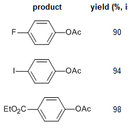
A strategy for desilylative acetoxylation of (trimethylsilyl)arenes has been developed in which (trimethylsilyl)arenes are converted into acetoxyarenes. The direct acetoxylation is performed in the presence of 5 mol % of Pd(OAc)2 and PhI(OCOCF3)2 (1.5 equiv) in AcOH at 80 °C for 17 h. The acetoxyarenes are obtained in good to high yields (67-98%). The synthetic utility is demonstrated with a one-pot transformation of (trimethylsilyl)arenes to phenols by successive acetoxylation and hydrolysis. Furthermore, desilylative acyloxylation of 2-(trimethylsilyl)naphthalene using several carboxylic acids has been conducted.
Intermolecular hydroarylation of propynoic acid and its esters with indoles proceeded efficiently in acetic acid under a catalytic system of FeCl3/3AgOTf and afforded the corresponding 3,3-bis(indol-3yl)propanoic acids and their esters in high yields. In the case of 2-methylindole, 3-indolylacrylic acid and its ethyl ester were obtained in high yields. This iron-catalyzed hydroarylation showed a high regioselectivity at the 3-position of indoles and a high utility for the synthesis of bis(indol-3-yl) compounds, which are important for biological and pharmaceutical fields.
The reaction of mesitylene with ethyl propiolate in the presence of [Pd(dppe)(OAc)(2)] in TFA at 30 degrees C for 5 h gave diethyl (2E,4Z)-4-[(2,4,6-trimethylphenyl)methylene]-2-pentenedioate selectively. Screening several bidentate phosphines Ligands showed that dppe and dppm ligands are good for the arylbutadiene formation. This reaction was applied to other electron-rich arenes and found to be effective for synthesis of arylbutadienes and extended pi-conjugated molecules. The regio- and stereoselective addition of an arene to propiolate was confirmed by NMR and single-crystal X-ray structural analyses of the products, suggesting that the arylbutadiene formation consisted of anti addition of an arene and a metal to the triple bond of ethyl propiolate, followed by syn addition to another molecule of ethyl propiolate Similarly, the reaction of various arenes with ethyl propiolate in the presence of [Pt(dppe)(OTf)(2)] catalyst gave arylbutadienes selectively. In the Pd- or Pt-catalyzed reaction of arenes with ethyl propiolate, it was found that a bidentate ligand controlled the reaction to lead the formation of arylbutadienes.
A highly effective cascade process giving 3-alkenylcoumarins is furnished by a series of reactions involving pallada-arylation of ethyl propiolate with phenols, intramolecular transesterification to 3-coumarylpalladium species, its alkyne insertion, and protonation. [Pd(OAc)2(dppe)] is an effective catalyst for the synthesis of 3-alkenylcoumarins from phenols and ethyl propiolate.
Hydroarylation of propiolic acids with various arenes in TFA proceeded efficiently in the presence of FeCl3/AgOTf catalyst system. In the case of electron-rich arenes, the iron-catalyzed hydroarylation gave cinnamic acids in moderate to high yields. The hydroarylation of phenylacetylene was observed but the catalyst was not effective under the same conditions.
目的:非ホジキンリンパ腫の再発を早期診断出来る超音波所見を検討する.対象:発症時から経過観察した完全寛解中の18例125リンパ節(寛解リンパ節)及び寛解から再発または寛解せず増悪した計5例57リンパ節(再発リンパ節)である.方法:1.寛解リンパ節の大きさを測定した.2.寛解リンパ節の領域による大きさの相違をunpaired student T-testで検討した.3.ロジスティック回帰分析を用いた症例対照研究を施行した.超音波所見の(1)から(3)には,寛解リンパ節を用い,説明変数は(1)から(8)の場合を1,その他を0とした.(1)長径,(2)横径,(3)厚み径は,平均(M)+1標準偏差値(SD)以上,(4)厚み径/長径比は0.5以上,(5)境界は全周性に明瞭,(6)周囲の筋肉と比較したエコーレベルは同等かそれ以上に低い,(7)リンパ門域は広い,(8)血流は描出あり.結果:寛解リンパ節の大きさは,上頸部群の横径及び厚み径が中頸部以下尾側の領域より有意(P<0.01)に大きかった.M+1SDの概数は横径,厚み径についてはそれぞれ上頸部では11 mm,6 mm,中頸部以下では9 mm,4 mmであった.単ロジスティック回帰分析での有意な項目のオッズ比は厚み径11.9,横径11.0,血流4.1,厚み径/長径比3.7,長径3.1,エコーレベル3.0,境界2.8であった.多重ロジスティック回帰分析による有意な項目のオッズ比は,横径6.2(P<0.001)及び厚み径4.1(P<0.01)であった.結論:再発所見として最も有用な項目は横径であり,有用な項目の組み合わせは横径と厚み径であった.
Per-O-acylated cyclodextrins with different alkyl chains were prepared in good to high yields by iodine-catalyzed acylation of all hydroxy groups of cyclodextrins with carboxylic anhydrides under solvent-free conditions.
Platinum(II)-catalyzed hydroarylation of propiolic acids was applied to thiophenes, and we found that the reaction with thiophenes predominantly afforded double thienylated products. Reaction of thiophenes with ethyl propiolate proceeded efficiently in the presence of K2PtCl4 (2 mol%) and AgOTf (8 mol%) in trifluoroacetic acid under mild conditions to give ethyl 3,3-bis(substituted thienyl)propionates in good yields. The same platinum(II)-catalyzed reaction with propiolic acid instead of the ethyl ester provided bis(substituted thienyl)propionic acids in high yields.
Iodoarylation of arylacetylenes with electron-rich arenes using a simple reagent system: I 2 and PhI(OCOPh) 2 proceeded regio- and stereoselectively to give trans adducts, 1,1-diaryl-2-iodoethenes, in good to high yields.
A new and efficient K2PtCl4/AgOTf catalyst for the hydroarylation of propiolic acid was found. The hydroarylation of propiolic acids gave predominantly (Z)-cinnamic acid derivatives in high yields. The K2PtCl4/AgOTf catalyst showed a high activity to less reactive benzene.
Hydroarylation of aryl-substituted alkynes with simple and substituted arenes was conducted in the presence of trifluoroacetic acid in dichloromethane without any metal catalysts or additives. Electron-rich arenes Coupled with aryl-substituted alkynes to give 1, 1 -diarylalkenes in good to high yields.
 Hiroshi Taniguchi合作论文数31
 Shinjiro Kobayashi合作论文数Faculty of Engineering, Kyushu University28
 yuko ohashi合作论文数24ya muraki合作论文数22
 Juzo Oyamada合作论文数21Y. Minorikawa合作论文数19K. Kobayakawa合作论文数18yukihide kamiya合作论文数12Yuzo Fujiwara合作论文数Hiroshima University12S. Matsuno合作论文数12
 Peter J. Stang合作论文数Department of Chemistry, University of Utah10K. Mitsui合作论文数9hideaki shibata合作论文数9S. Mikamo合作论文数9y teramoto合作论文数8Kazuhiro Mitsui合作论文数8Ichizo Nakamura合作论文数8Hironobu Kawasato合作论文数8T. KABASHIMA合作论文数7
 Atsushi Okada合作论文数Samsung Electronics7
 Md Delwar Hossain合作论文数Faculty of Science and Engineering, Saga University7S. Higashi合作论文数6ichiro nakamura合作论文数6
 Kazufumi Honda合作论文数Tokyo Medical University;Kobe University;Division of Chemotherapy and Clinical Research, National Cancer Center;Department of Bioregulation, Graduate School of Medicine, Nippon Medical School;Depertment of Bioregulation, Institute for Advanced Medical Sciences, Nippon Medical School6Y. Kawashima合作论文数5F. Kajino合作论文数Department of Physics, Konan University5H Inazawa合作论文数4
 Tatsuo Suda合作论文数4
 Shigenobu Shibata合作论文数Faculty of Science and Engineering, Waseda University4Sachiko Tanaka合作论文数4
 Sotaro Higashi合作论文数Izumi Neurosurgical Hospital4H. WINGERT合作论文数3Tetsuo Kuroki合作论文数3Shuji Ozaki合作论文数3s iida合作论文数3kenji mitsui合作论文数3takahiro aoki合作论文数3
 T. Suda合作论文数Nishina Ctr, RIKEN3Fumiko NAKAGAWA合作论文数3Gondo Keisuke合作论文数3Shuichi Iida合作论文数3Kenzi Hori合作论文数3Manfred Boehshar合作论文数3Teizo Yamaji合作论文数3Takuya Hashimoto (橋本拓也)合作论文数Faculty of Engineering, Tokai University;College of Humanities and Sciences, Nihon University3Shingo Miyake合作论文数3tatsuo aoki合作论文数2S. SODA合作论文数2Y Ohashi合作论文数2




