Time and frequency properties of the signal of a radar system are investigated. The structures of transmitter and receiver are described. The exponential and rational models are used in the time domain and in domain of Discrete Fourier Transform. Modulated, no modulated and noise signals are examined. Several approaches to spectral analysis are compared. Some improvements for finding eigen frequencies are proposed.
Resonance properties of the transducers of ultrasound non-destructive testing system are investigated. The system for non-contact reflective ultrasonic testing is described. The model of the ratio of polynomials is used in the frequency domain. Some improvement to combination of Levy and Gauss-Newton methods for finding natural frequency of the transducers are proposed. Several versions of rational approximation of frequency characteristics are compared.
Resonance properties of the transducers of ultrasound non-destructive testing system are investigated. Experimental system for investigating frequency characteristics of ultrasonic transducers is described. A sinusoidal model for input and output signals is used. Versions of the Prony method for frequency finding robust to noise and low-frequency interference are proposed. Several versions of the method of selective rational interpolation in the frequency domain are compared.
The system of non-contact ultrasonic testing of polymer composite materials by the shadow method system is described. Frequency dependence of the integral informative parameter is presented for different values of time points of integration. Possibility to operate simultaneously on two working frequencies is shown.
The system of contactless ultrasonic testing of polymer composite materials by the shadow method system is described. The results of testing various samples and types of detected defects are presented. The spectra of the signal and noise are calculated by discrete Fourier transforming. Frequency separation method is used for noise filtration, signal-component separation and for calculation of signal envelope.
The localization of the plane wave expansion is considered for the analysis of wave beam transformations on transversely inhomogeneous structures. To implement compact localization in the spatial domain, it is proposed to use a system of non-intersecting rectangular windows. Problems of discrete realization of local plane wave expansion are analyzed. An algorithm for the numerical implementation of the localization of the plane wave expansion based on the quasisolution search method is proposed. Its advantage over the algorithm based on the discrete Fourier transform is demonstrated. The efficiency of its use has been demonstrated by the example of analyzing the wave beam reflection from the secondary aperture with transverse inhomogeneity.
The system of non-contact ultrasonic testing of polymer composite materials by the through-transmission method system is described. Envelopes of fundamental and higher harmonics are investigated by discrete Fourier transformation. The model of ratio of polynomials is used for describing spectra of time signals. The quadrature components are found by modified Prony method. The spatial resolving power is investigated.
Propagation of electromagnetic waves in a circular waveguide with helical corrugation is examined. Bragg coupling of rotated or azimuthally symmetric modes is investigated. Coupling coefficients are obtained by the asymptotic the Krylov-Bogoliubov-Mitropolsky method. Perturbed longitudinal wavenumbers are calculated for a case of periodic perturbation.
The relationship between the eigen parameters of the periodic Bragg structure and the effective parameters of an equivalent homogeneous medium is considered. By the example of a layered dielectric structure, their relationship with the constructive parameters is examined and their dependence on frequency is analyzed. An approach which makes it possible to obtain physically consistent values of the effective permittivity and permeability of the Bragg structure is considered.
The problem of representing S-parameters of a periodic structure using the model of an equivalent homogeneous layer is considered. For correct determination of the values of the parameters for such model, it is proposed to use the transition to the time domain and inverse one using the Fourier transform. The use of the proposed approach has been examined for several types of periodic structures. The efficiency of this approach is shown for periodic structures with frequency bands of the anomalous behavior of the phase-frequency characteristic.
The approximations of Fermi-Dirac integral are examined. The exponential and combined exponential- polynomial models are investigated. The modifications of the Prony method are proposed. The errors of the different approaches are compared.
Circular waveguides with longitudinally gyrotropic and spatially oscillated filling are examined. Asymptotic solution of boundary-value problem describing a combination of Bragg reflection and Faraday rotation is derived by the Krylov-Bogoliubov-Mitropolsky method. An influence of distortions of periodicity on scattering properties is investigated. Analytical solutions and comparisons with known results are obtained for some particular cases.
The problem of representing a periodic Bragg structure by an equivalent homogeneous layer is under consideration. The relationship of the parameters of such layer and eigen parameters of the periodic structure is examined. For such relationship, the dependence upon frequency for some specific parameters of a layered dielectric structure is analyzed. An approach that makes it possible to obtain physically consistent values of the equivalent permittivity and permeability of the periodic Bragg structure is presented.
Analytical expressions for pulse signal reflected by traditional Bragg-type layered structures are obtained. The expressions for characteristic polynomial are calculated. The influence of the number of layers in the structure and contrast of permittivity on the form of pulse is studied. The analysis is done in the comparison with properties of the structure in frequency domain including behavior of zeros of frequency characteristic. The role of reverberations is revealed.
In this work we propose a modified Prony interpolation (MPI) technique for the integration of highly oscillating functions appearing in various engineering problems, like electrically large scattering or physical optics problems. We develop a quadrature for the numerical integration over a finite domain [a, b]. In domain [a, b], the integrand function is appropriately interpolated using Prony’s method, taking into account the optimal estimation of the complex exponents existing in the interpolation formula. This optimal selection is chosen by examining the principal value of the involved logarithm, and allows for improved convergence. The convergence and accuracy of the MPI method is demonstrated by comparisons with the alternative Gauss-Kronrod quadrature, which is suitable for integrating highly oscillating functions. Different numerical results are presented. Represented numerical results.
Propagation of sinc(x), Gaussian, Lorenz, and exponential time pulses in Bragg reflectors, resonators with walls in the form of Bragg reflectors is under consideration. The influence of the number of layers in elements of the structure on the form of pulse is studied. The analysis is done in the comparison with properties of the structure in frequency domain including behavior of zeros of frequency characteristic. Influence of properties of zeros and minimal-phase characteristics on negative group delay manifestation is revealed. The application of exponential approximation of time-domain signals is investigated.
The advantages of the application of fractional-rational approximation in z-plane for analysis of frequency dependences of Bragg-type layered structures are demonstrated. The algorithm on base of continued fractions is under discussion. Connection of zeros behavior and properties of phase characteristics including minimal-phase properties, presence of negative group delay was revealed. The effect of coupling for poles and zeros behavior was investigated.
The time delays of pulses reflected from periodic and non-periodic Bragg layered structures have been investigated. The specific structures such as Bragg reflectors and structures with chirp variation of thickness of the "period" have been considered. The calculation has been carried out under the conditions that carrier frequency is in the vicinity of the Bragg resonance values. The parameters of interpolating models have been found by methods Prony and continued fractions.
A new approach to determining the amplitude levels of piecewise constant signal has been proposed that is based on using its multiplicative model and solving the problem of polynomial approximation. In case of the absence of noise, the statement of polynomial approximation problem is based on the requirement of exact match of the current signal value with the amplitude value of one of its levels. In case of the presence of ordinary additive noise, the problem statement is based on the least squares criterion, while the solution of problem is presented in the analytical form. For the case of the presence of pulse-type noise, the problem statement is based on the minimum duration criterion, while the problem solution is achieved numerically by an appropriate functional minimization in unknown amplitudes of levels. The case of binary piecewise constant signal is considered in detail. The results of numerical simulation are presented for the cases, where the binary signal is distorted by ordinary additive noise with Gaussian distribution law and the pulse-type noise with the Cauchy distribution law.
The behavior of quasi-periodic and aperiodic (chirp) Bragg structures with thin lossy layers was examined. In order to determine the frequency dependence of the reflection coefficient transmission matrix method was used. A deep minimum of the reflection coefficient for any frequency is implemented by proper choice of the thickness of the last thin film and its optical distance to the substrate. The possibility of providing broadband reflection by aperiodic structures has been offered.
 Mikhail Andreev合作论文数Dnepropetrovsk Nat. Univ.;c;Dnepropetrovsk Nat. Univ.48
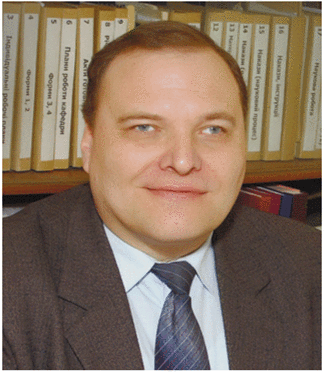 O.O. Drobakhin合作论文数Dnepropetrovsk National University48
 S.M. Vovk合作论文数Dnipropetrovs’k National University31
 V.A. Karlov合作论文数13
 Denis Sidorov合作论文数Melentiev Energy Systems Institute, Siberian Branch, Russian Academy of Sciences;Russia and Irkutsk State University12
 Oleg Antropov合作论文数11Viktor Gritsenko合作论文数6
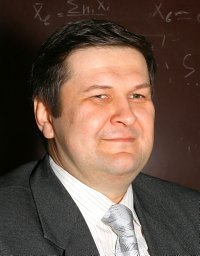 D. Yu. Saltykov合作论文数6Ivanilov, V.E.合作论文数4EL BARTASHEVSKII合作论文数4IV SLAVIN合作论文数3Sergey V. Timofeev合作论文数A.N. Nesmeyanov Institute of Organoelement Compounds, Russian Academy of Sciences2А. Д. Клименко合作论文数1AA TURCHIN合作论文数1
 Grigorios P. Zouros合作论文数School of Electrical and Computer Engineering, National Technical University of Athens;c;School of Electrical and Computer Engineering, National Technical University of Athens1V. S. Miroshnichenko合作论文数1Ye. B. Senkevich合作论文数1V. M. Dolgov合作论文数1




