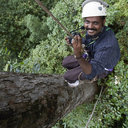
Lianas shape tropical forest species composition, structure, and dynamics. Increasing climate fluctuation and anthropogenic disturbances increase liana abundance. Despite the increasing number of liana studies in India, only a few have examined the distribution and association of hosts with lianas, or liana-host interaction networks to determine their functional significance and conservational value. Therefore, our objective was to fill the knowledge gap about the diversity, abundance, and network structure of liana-host interactions in response to logging disturbance in a wet evergreen forest of Uppangala in central Western Ghats, India. We sampled lianas >= 1 cm in diameter at 1.3 m from the base and their host trees in thirty 20 m x 20 m plots in selectively logged and unlogged forest management regimes. We evaluated liana-host tree interactions in logged and unlogged forests and retrieved community-level measures (nestedness, connectance, modularity, and network specialization index) and species-level indicators (species specialization index). Diversity and abundance of liana species were considerably greater in the selectively logged forest site. The logged forest site had compartmentalization, anti-nestedness, and network specialization, while unlogged forests were not showing any significant network structure. Most species of lianas and hosts were peripherals, but others were structurally important (connectors, module hubs, and network hubs) in the two forest sites. Forest management regimes had distinct structurally significant species. We evaluated liana-host tree interactions in logged and unlogged forests and retrieved community-level measures (nestedness, connectance, modularity, and network specialization index) and species-level indicators (species specialization index). Diversity and abundance of liana species were considerably greater in the selectively logged forest site. The logged forest site had compartmentalization, anti-nestedness, and network specialization, while unlogged forests were not showing any significant network structure.image
Selective logging disrupts forests, changing their structure and species composition. Long-term monitoring helps in identifying the factors influencing it and aids in designing management plans. We conducted a quantitative re-assessment of trees ≥ 30 cm girth at breast height in four 1 ha plots in logged and two 1 ha plots in adjacent unlogged compartments of Uppangala forest continuum in the Western Ghats, India to compare the structural and compositional changes after a decade (2010–2021). Altogether, four species disappeared and three species were newly recruited. Mean species richness and stem density of both the forest sites decreased. Logged plots showed a slight increase in basal area (2.5
Documenting the biodiversity of protected areas and reserve forests is important to researchers, academicians and forest departments in their efforts to establish policies to protect regional biodiversity. Shettihalli Wildlife Sanctuary (SWS) is an important protected area located in the central Western Ghats of Karnataka state known for its diverse flora and fauna with distinct ecological features. For the last four decades the sanctuary has witnessed the loss of forest cover, yet the vegetation in few locations is relatively undisturbed. The current inventory was undertaken during 2019–2020 to provide a checklist of woody species from SWS under-researched earlier. The list comprises 269 species of trees, lianas and shrubs distributed in 207 genera and 68 families. The most diverse families are Fabaceae, Moraceae, Rubiaceae, Rutaceae, Lauraceae, Apocynaceae, Meliaceae, Malvaceae, Phyllanthaceae, and Anacardiaceae, representing 48% of total woody flora. The sanctuary shelters 263 native and six exotic plant species. Thirty-nine species were endemic to the Western Ghats, five species to peninsular India and one species to the Western Ghats and Andaman & Nicobar Islands. Four forest types, i.e., dry deciduous, moist deciduous, semi-evergreen, and evergreen forests, are represented in the sanctuary. Of the total species, only seven occurred in all forest types, while 111 species are exclusive to a single forest type. One-hundred-and-four taxa were assessed for the International Union for Conservation of Nature & Natural Resources (IUCN) Red List. Ten species that fall under Near Threatened, Vulnerable, and Endangered categories were encountered occasionally. The baseline data generated on plant diversity will be useful in highlighting the importance of these forests for species conservation and forest management. Such data form a cornerstone for further research. For instance, to understand the effect of invasive species and human impacts on the diversity of the region.