As an aid to debugging conveniently all the new Brookhaven Fastbus modules that will be used in Experiment 749 at the AGS, an 8085 based microprocessor module has been made. A debugging program which allows the testing of modules on the bus is provided.
During this period new modules and devices will be built to be used in Experiment 749 at the A.G.S. Included will be /spl I.itilde/200 channels of A-D converters for Pb-Glass Cerenkov counters, 2000 channels of proportional wire chamber readout, cable segments, segment interconnects, a new unibus interface, and a new onsegment processor. These items and perhaps others will be ready by the end of 1981.
This paper describes a processor designed to operate at a speed compatible with fastbus. It has been used in an experiment at the AGS in Brookhaven National Laboratory. Its function was to read data from various fastbus modules and store it in a buffer where it could later be read and further processed by a slower host computer. The data was formatted so that the host computer could more easily process it. The processor also made decisions based on the validity of the data and rejected bad events. The ratio of the number of triggers to the number of accepted events was about 20 to 1.
Experiment No. 735, now being executed at the A.G.S. is implemented in FASTBUS. Briefly, this data acquisition system is designed to operate and gather data from high energy physics experiments at sub-microsecond speeds. It is a 32 bit bus system capable of operating at near-gigabit rates. The bus can be segmented with each segment operating independently when not communicating with each other. The system is based upon a very fast integrated circuit family, emitter coupled logic or ECL.
Described is a new and novel approach for cooling nuclear instrumentation modules via heat conduction. We will show the simplicity of liquid cooled crates and ease of thermal management with conduction cooled modules. While this system was developed primarily for the higher power levels expected with Fastbus electronics, it has many general applications.
During this period new modules and devices will be built to be used in Experiment 749 at the A.G.S. Included will be approx. 200 channels of A-D converters for Pb-Glass Cerenkov counters, 2000 channels of proportional wire chamber readout, cable segments, segment interconnects, a new unibus interface, and a new on-segment processor. These items and perhaps others will be ready by the end of 1981.
 S. Blatt合作论文数9L. Leipuner合作论文数9R. Larsen合作论文数9T. Rudolf合作论文数8D. Makowiecki合作论文数8W. Morse合作论文数8J. Fuhrmann合作论文数4M. Schmidt合作论文数3K. Hoffman合作论文数2M. P. Schmidt合作论文数2W. Zhaungzi合作论文数2
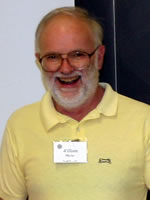 William Morse合作论文数Department of Physics, Brookhaven National Laboratory1Mp Schmidt合作论文数1M. Campbell合作论文数1W. Zhuangzi合作论文数1




