The ocean, covering 71 percent of the Earth’s surface, holds abundant resources and necessitates effective underwater exploration technologies. As a key active sensing tool, sonar plays a vital role in seabed mapping, wreck salvage, and underwater security due to its wide field of view and real-time imaging capability. However, sonar images often suffer from blurred object boundaries and severe reverberation caused by complex acoustic environments. To address these challenges, this paper proposes a Spatio-Frequency Interaction Enhancement Network (SFIENet) for sonar image object detection. Specifically, we design a High-Frequency Feature Enhancement Module (HFFEM) to sharpen object edges and introduce a cross-domain attention mechanism to fuse spatial and DCT-based frequency domain features via channel-wise weighting. Furthermore, an Adaptive Threshold Focal Loss (ATFL) is proposed to mitigate foreground-background imbalance, improving the model’s focus on target regions. To support evaluation, we construct a multi-scenario FLS dataset that includes labeled samples collected from simulated pools, coastal shallows, and inland lakes. Experimental results demonstrate that the proposed method achieves superior detection accuracy compared to state-of-the-art baselines, validating its effectiveness in complex underwater environments.
This letter proposes a lightweight parallel recurrent-convolutional scheme to improve generalization capability and recognition accuracy while maintaining low computational complexity in resource-constrained underwater acoustic channels. In this scheme, the lightweight convolutional network is used to extract time-frequency features, and the lightweight recurrent network with gated recurrent units is used to capture long-term temporal phase correlations, thereby alleviating the Doppler-induced phase rotation and inter-symbol interference in time-varying multipath underwater acoustic channels. Sea-trial data are collected during shallow-water sea trials with strictly separated training and evaluation datasets. Experimental results on ten underwater acoustic modulation types show that the proposed scheme improves recognition accuracy by 6.2% and reduces computational cost by 22.4%, while exhibiting stronger generalization capability compared with benchmark schemes.
Existing adaptive modulation and coding schemes suffer from performance degradation under time-varying underwater acoustic (UWA) channels and jamming attacks, resulting in increased video jitter and energy consumption, as well as reduced peak signal-to-noise ratio (PSNR). In this article, we first propose a reinforcement learning (RL)-based underwater video transmission scheme, which jointly optimizes the channel coding methods, subcarrier modulation order, quantization parameter, and transmit power against jamming. The direct sequence spread spectrum (DSSS) mechanism is used to reduce the jamming power in each subcarrier frequency band, which ensures that the transmitter obtains a reliable feedback message. In addition, a multi-frame statistics scheme is designed to support transmission policy selection, which mitigates the impact of channel instability by averaging the observed transmission performance and channel gain. To further enhance communication performance and robustness under large state-action spaces and dynamic channel conditions, we propose a deep RL (DRL)-based anti-jamming video transmission scheme to compress the excessive state-action space, mitigate quantization errors, and improve transmission stability. Two target networks are employed in DRL to ensure learning stability by mitigating fluctuations in Q -value and R -value updates caused by the time-varying channel. In addition, the performance bounds of transmission delay and energy consumption related to modulation order and channel coding rate are derived. Simulation and experimental results demonstrate that our schemes improve the video transmission performance by reducing transmission delay, energy consumption, and video jitter while increasing the PSNR and video quality compared with the benchmarks.
To address the insufficient rejection capability of unknown classes in open-set recognition for underwater acoustic (UWA) communication, this paper proposes a feature fusion-based modulation recognition framework. This method leverages the ability of Convolutional Neural Networks (CNNs) to extract time-frequency features and the strength of Recurrent Neural Networks (RNNs) in modeling time-series signals. As a result, the feature representation is significantly enhanced. Furthermore, an improved Class Anchor Clustering (CAC) loss is introduced to encourage tight clustering of known modulation types in the logit space, while a distance-based metric is used to reject unknown types. The experiments are conducted on the real-world pool datasets. The experimental results show that the proposed method accurately identifies known modulation types while effectively rejecting unknown ones.
In the Internet of Underwater Things, which is entirely composed of autonomous underwater vehicles (AUVs) without fixed beacons, synchronized underwater acoustic (UWA) localization systems are employed. These systems estimate the relative locations of the AUVs, enabling the formation of an optimal network topology. The localization accuracy is affected by the AUV motion, the localization and communication signal (LCS) bandwidth and duration, and the power of LCSs. In this article, a reinforcement learning (RL)-based smart AUV localization scheme is proposed first. By optimizing the localization time windows and the signal weights, the RL-based localization scheme reduces the localization time delay and energy consumption while increasing the localization accuracy without fixed anchor nodes. Furthermore, a double deep Q-network (DDQN)-based hierarchical structure localization scheme is proposed to optimize the allocation of the substrategies for the follower AUVs, aiming to reduce the localization error and the energy consumption. Computational complexity and Cram & eacute;r-Rao lower bounds (CRBs) are analyzed to evaluate the optimal localization performance. Simulation results show that the proposed schemes improve the localization accuracy, and reduce the time delay and the energy consumption compared with the benchmarks.
Litopenaeus Vannamei, a highly productive crustacean-farmed product in the world, emits specific sounds associated with its feeding behavior during predation. Despite its economic importance, there are relatively few studies on the occurrence mechanism and state classification of this marine shrimp compared with those of other organisms. This paper presents a study on the classification of the behavior status of Litopenaeus Vannamei using passive acoustic underwater signal processing technology. The study included adding emergence signals from other marine organisms to investigate differences in acoustic signals among species. Since intraspecific signals often have small differences, resulting in weak feature expression capabilities, few effective features can be extracted during the feature extraction process. These issues have always been the focus of attention. This paper proposes MRANet, a new neural network structure that utilizes a multi-scale feature extraction ResNet with attention mechanisms. The test results show that the accuracy of MRANet can reach 98.9%. These findings contribute valuable insights into the behavioral classification of Litopenaeus Vannamei, which can effectively enhance intelligent aquaculture practices.
Due to the lack of sufficient valid labeled data and severe channel fading, the recognition of various underwater acoustic (UWA) communication modulation types still faces significant challenges. In this paper, we propose a lightweight UWA communication type recognition network based on semi-supervised learning, named the SSL-LRN. In the SSL-LRN, a mean teacher–student mechanism is developed to improve learning performance by averaging the weights of multiple models, thereby improving recognition accuracy for insufficiently labeled data. The SSL-LRN employs techniques such as quantization and small convolutional kernels to reduce floating-point operations (FLOPs), enabling its deployment on underwater mobile nodes. To mitigate the performance loss caused by quantization, the SSL-LRN adopts a channel expansion module to optimize the neuron distribution. It also employs an attention mechanism to enhance the recognition robustness for frequency-selective-fading channels. Pool and lake experiments demonstrate that the framework effectively recognizes most modulation types, achieving a more than 5% increase in recognition accuracy at a 0 dB signal-to-noise ratio (SNRs) while reducing FLOPs by 84.9% compared with baseline algorithms. Even with only 10% labeled data, the performance of the SSL-LRN approaches that of the fully supervised LRN algorithm.
Beacon-aided autonomous underwater vehicle (AUV) localization supporting maritime surveillance applications in underwater acoustic sensor networks selects a fixed number of beacons with constant transmit power, and thus has degradation of localization accuracy with severe channel fading and position fluctuation of beacons. In this paper, we propose a reinforcement learning based AUV localization scheme to choose the beacons and their transmit power to improve the localization accuracy and energy efficiency based on the AUV depth, the received signal strength, the number of selected beacons and the beacon energy consumption. According to the least squares method, the AUV position is calculated based on the isogradient sound speed model and the round-trip time of the localization signals. The localization error averaged over different beacon sets is evaluated to formulate the localization policy distribution. Deep neural network is designed to estimate the expected long-term discounted utility with higher feature extraction efficiency for the underwater networks with a large number of beacons. The Cramer-Rao lower bounds of the proposed localization schemes are derived to analyze the effect of the position fluctuation of beacons on the localization accuracy. Simulation results verify the performance gain in terms of the localization accuracy and the beacon energy consumption over the benchmark.
Underwater video transmission has to ensure quality-of-service (QoS) against jamming with severe multipath effect and narrow bandwidth limitation that degrade the communication performance under variable channel state. In this paper, we propose a reinforcement learning (RL)-based QoS-aware underwater video transmission scheme to optimize the video compression ratio, modulation format and transmit power based on the state consisting of the channel gain and previous transmission performance. This scheme evaluates the risk level that indicates the probability of failing the QoS and the long-term expected utility of each transmission policy under the current state to improve the anti-jamming communication performance. We derive the performance bound of the utility and analyze its relationship with transmission policy. Simulation results illustrate that our scheme improves the QoS by reducing the frame loss rate (FLR), transmission delay and increasing spatial-spectral entropy-based quality (SSEQ) compared with the benchmark.
Compound-Protein Interaction (CPI) prediction is a crucial task in drug discovery. Modern CPI prediction models are mostly based on the attention mechanism. However, the attention scores are often inaccurate, i.e., functionally irrelevant substructures can still receive moderate attention scores, and attention scores can not distinguish compounds with similar structural topology but different pharmacological properties. We propose SPACPI to address this problem from three perspectives, i.e., (1) identifies important compound substructures by integrating auxiliary information from molecular fingerprints, (2) determines important compound atoms by learning each atom’s tolerance to different perturbation amplitudes, (3) obtains more robust model parameters by focusing on the topK important atoms. Experiments on two benchmark datasets and two label-reversal datasets show that SPACPI outperforms the state-of-the-art CPI prediction model with an average increase of 5.02
To develop an efficient and accurate lightweight underwater acoustic (UWA) modulation recognition algorithm, this study proposes an algorithm called Channel Expansion-Lightweight Recognition Network (CE-LRN). The CE-LRN sig-nificantly reduces computational complexity by adopting small convolutional kernels and quantized convolutional layer techniques, achieving deployment standards friendly to embedded devices. Additionally, a channel expansion module is introduced in the CE-LRN algorithm, which effectively improves recognition accuracy with only a slight increase in computational complexity. Compared with two recently proposed recognition algorithms, the CE-LRN greatly reduced computational complexity, with its floating-point operations (FLOPs) being only 16.9M, a reduction of over 83.4%. Experimental results demonstrated that CE-LRN has good classification performance for Multi-Frequency Shift Keying (MFSK) and Multi-Phase Shift Keying (MPSK) signals.
In mobile edge computing (MEC) systems, multiple unmanned aerial vehicles (UAVs) can be utilized as aerial servers to provide computing, communication, and storage services for edge users, called UAV-assisted MEC, which has emerged as a promising technology to improve both the computing and communication performances. Unlike existing works without considering jamming attacks, we investigate a multi-UAV-assisted-MEC scenario under multiple malicious jammers and then propose a resource management approach with the objective of minimizing both the system energy consumption and latency. Due to the time-varying nature of communication environments, we design a multi-agent deep reinforcement learning (MADRL)-based resource management approach to dynamically adjust the CPU frequency, communication bandwidth, and channel access selection of UAVs to enhance the system performance against jamming attacks. On this basis, in order to enhance the algorithm learning efficiency, we propose a multi-agent twin-delayed deep deterministic policy algorithm in combination with the prioritized experience replay mechanism (PER-MATD3) to effectively search for the joint resource management strategy under high-dimensional state and action spaces, where the time-varying channel state information and imperfect attack behavior information are also effectively trained to improve the learning capacity and convergence speed. Simulation and experimental results verify that the proposed approach can significantly decrease the overall system latency (i.e., computing and communication latency) and energy consumption compared to other benchmark algorithms under different real-world settings.
Underwater acoustic (UWA) communication and localization systems have been used to improve the self-localization accuracy of mobile unmanned underwater vehicles (UUVs), However, poor UWA channels, sound velocity estimation errors and sound ray bending, and moving UUVs cause great difficulties in the timeliness and accuracy of multi-UUVs localization. In this paper, we apply reinforcement learning (RL) to the localization process of multi-UUVs and propose a high-precision localization scheme, named RL-GLMU. In this scheme, the localization process is achieved by modulated UWA communication in the absence of precise ocean information, and the signal weights and locations of the localization process are optimized by RL to improve the localization accuracy. Then, the learning space is discretized by topological gridding, which improves the convergence speed of the algorithm. Simulation results compared with the benchmark algorithms verify the effectiveness and robustness of the scheme, which effectively improves the localization accuracy and reduces the time delay error and localization time.
Due to the uneven characteristics of the data collected by Passive Acoustic Monitoring (PAM) and the lack of effective labels, it has been difficult to accurately identify the acoustic signals of marine mammals. Aiming at these well-known challenges, in this study, we integrate convolutional neural networks and, with the help of transfer learning strategies, construct a model specifically for dolphin sound signal recognition. The proposed network is called transfer learning-based convolutional neural network (Trans-CNN). We first construct a Pre-train Dataset containing labels based on the audio signals in the Watkins database, and an unlabeled dataset (Dolphin Dataset) for transfer learning. Next, these datasets are applied on the Trans-CNN model. The experimental results show that for the recognition tasks of 12 different dolphin sounds, Trans-CNN has achieved an average accuracy of 90%, which is more than 15% higher than the traditional recognition method.
Many crucial underwater tasks are performed based on the precise positions of target nodes in underwater acoustic sensor networks (UASNs). However, due to significant signal attenuation and long propagation latency in acoustic communication, it is challenging to achieve accurate and energy-efficient underwater localization. In this paper, we propose an autonomous underwater vehicles (AUVs) localization scheme to determine the selection and transmit power of beacons based on range measurements between AUVs and mobile beacons using the two-ray travel time of localization signals. Then, a safe reinforcement learning algorithm is proposed to select the AUV localization policy based on the AUV depth, the previous number of selected beacons and received signal strengths. Performance analysis in terms of computational complexity and Cramer-Rao lower bound is provided. Simulation results based on the isogradient sound speed model show that the proposed scheme achieves higher localization accuracy, lower energy consumption and higher utility compared with the benchmark.
Unmanned Underwater Vehicles (UUVs) are widely used in scenarios such as underwater resource exploration and underwater tactical surveillance. In order to improve mission efficiency and completion rate, it is necessary to enhance the positioning accuracy of UUVs. However, due to the influence of long transmission delay of underwater acoustic signals, bending of sound lines, change of sound velocity and ocean current movement, there are still many challenges to accurately locate UUV in motion. In this paper, we propose a deep reinforcement learning based accurate UUV localization (DRLAUL) algorithm. DR-LAUL algorithm is capable of recognizing received signals even in the presence of non-line-of-sight paths. It prioritizes line-of-sight signals for localization and compensates for the propagation delay of localization signals, enhancing distance estimation accuracy, improving localization precision, and reducing the overall system energy consumption. The simulation results show that compared to two benchmark algorithms, the DRLAUL algorithm reduces the RMSE by 66.1% and 38.1% respectively, and reduces energy consumption by 50.6% and 23.5% respectively. Furthermore, the DRLAUL algorithm achieves the best performance in different underwater environments.
Unmanned aerial vehicles (UAVs) have been increasingly employed as aerial servers in mobile edge computing (MEC) systems, providing essential computing, communication, and storage services for edge users. This UAV-assisted MEC paradigm shows great promise in enhancing both computing and communication performances. However, the presence of malicious jammers poses significant challenges to the system's reliability and efficiency. In this study, we explore the resource management problem in a multi-UAV-assisted MEC scenario under the influence of multiple malicious jammers. To mitigate the impact of jamming attacks, we propose a resource management approach with the primary objective of minimizing system energy consumption and latency while adhering to UAV energy constraints. Due to the dynamic and time-varying nature of the communication environment, we present a deep reinforcement learning (DRL)-based algorithm that dynamically adjusts the CPU frequency and communication bandwidth of the UAV to optimize the system performance even under jamming attacks. Through simulations, we demonstrate the effectiveness of the proposed algorithm in significantly reducing the overall system latency (both computational and communication latency) as well as minimizing energy consumption.
The current Internet development situation regarding the analysis of sports teaching information is very necessary and can be a way to improve the effectiveness of sports teaching in the information environment. Aiming at the defects of strong subjectivity and low discrimination accuracy of the current sports video classification results, this paper proposes an effective sports video classification method based on deep learning, which can effectively evaluate the sports assisted teaching. Specifically, the key frame features are obtained by using the similarity coefficient key frame extraction algorithm, and the sports video image classification is established through the deep learning coding model. Thus, the ability of the school to rely on the scheme proposed in this paper to improve the teaching facilities, physical education curriculum teaching materials, assessment teaching materials, management, and so on. The results show that for different types of sports videos, the overall effect of the classification of the method in the paper is significantly better than that of other current sports-assisted teaching evaluation methods, which has significantly improved the effect of sports-assisted teaching evaluation.
针对自主水下航行器(AUV)隐蔽航行需求,文中设计了一种基于捷联式惯性导航系统(SINS)和长基线(LBL)的组合导航系统,其中LBL信标按照固定顺序在不同时隙分别发送声信号,在接收到声信号后通过SINS分别计算出每个虚拟信标的位置平移量,并列出方程组解算出水声定位位置坐标.航行中可以通过LBL水声定位信息来校正SINS的导航误差,而校正后的SINS位置信息可以为LBL定位提供更精确的虚拟信标平移量.在组合导航定位过程中,通过融合节点冗余信息,进行多点LBL定位,从而提高定位精度;同时利用历史冗余节点替代缺失节点,保证正常量测更新.通过MATLAB仿真对组合导航系统进行验证,结果表明,基于SINS和LBL的AUV组合导航系统能在AUV隐蔽状态下,充分抑制纯惯导误差,提高导航定位精度,节省系统能量.在利用冗余信息之后,系统的导航精度、可靠性和容错性都得到进一步提高.
Blind modulation recognition is one of the most important component of the intelligent communication. Recent years, supervised learning is proved to be an effective way to solve this problem. But in time space varying underwater acoustic (UWA) channels, high quality labeled data is very difficult to obtain. To solve this problem, we put forward a semi-supervised learning-based blind modulation recognition scheme SSLUWA for UWA signals. This scheme linearly interpolates the unlabeled signal as fake label, and trains it by interpolation consistency. It can test the knowledge learned from the labeled signals by the accuracy of training on unlabeled signals, to improve the recognition accuracy when the labeled signals are insufficient. In order to verify the performance of SSLUMA, extensive pool and simulation experiments have been conducted. The results show that, compared with 100% label samples, the recognition accuracy of the SSLUWA decreases slightly at low SNR when the label samples are only 10%.
 En Cheng (程恩)合作论文数School of Informatics, Xiamen University25
 Liang Xiao (肖亮)合作论文数Department of Communication Engineering, School of Informatics, Xiamen University17
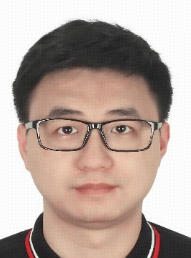 Keyu Chen (陈柯宇)合作论文数School of Informatics, Xiamen University15
 Fei Yuan (袁飞)合作论文数Department of Information and Communication Engineering, School of Informatics, Xiamen University;Key Laboratory of Underwater Acoustic Communication and Marine Information Technology Ministry of Education, Xiamen University11
 Xialin Jiang合作论文数Xiamen University, Xiamen, China9
 Haixin Sun (孙海信)合作论文数School of Informatics, Xiamen University8
 Deqing Wang (王德清)合作论文数School of Informatics, Xiamen University7
 Xiaoyi Hu (胡晓毅)合作论文数School of Electronic Science and Engineering, Xiamen University6Xudong You合作论文数5Zehong Xu合作论文数5Yuchen Yue合作论文数4
 Helin Yang (杨和林)合作论文数Department of Information and Communication Engineering, School of Informatics, Xiamen University4Jing-jing Cai合作论文数4Hao-qian Huang合作论文数4
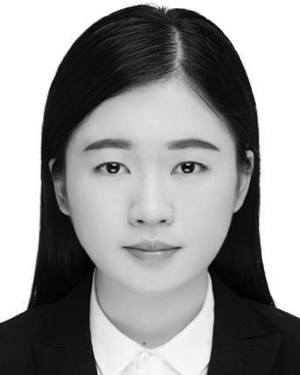 Donghua Jiang合作论文数Xiamen Univ, Dept Commun Engn, Xiamen 361005, Peoples R China4
 Chunxian Gao (高春仙)合作论文数Department of Information and Communication Engineering, School of Informatics, Xiamen University4
 Zefang Lv (吕泽芳)合作论文数Institute of Space Internet, College of Future Information Technology, Fudan University3
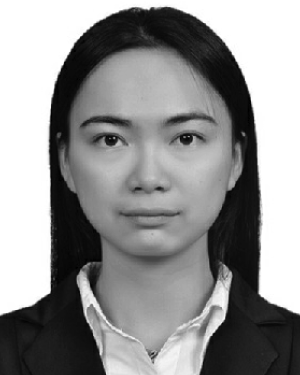 Jiamin Lin合作论文数3
 Yongjun Xie合作论文数3
 Yating Lin合作论文数3
 Yifeng Zhao (赵毅峰)合作论文数School of Informatics, Xiamen University3Shaoxuan Li合作论文数2Chuhuan Liu合作论文数2
 Ziling Shao合作论文数2Ruiheng Liao合作论文数2Qian Ding合作论文数2Xiaoyue Wan合作论文数2Jincheng Tao (陶金成)合作论文数2
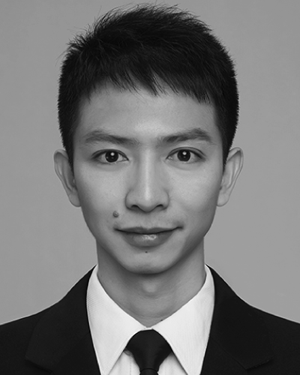 Rongxin Zhang合作论文数Xiamen University, China2Ming LIAN (连明)合作论文数2
 Zehui Xiong合作论文数School of Electronics, Electrical Engineering and Computer Science, Queen's University Belfast2MaoChun Wei (魏茂春)合作论文数2
 Ye Chen合作论文数2
 Jing Han (韩晶)合作论文数School of Marine Science and Technology, Northwestern Polytechnical University2Maode Ma合作论文数2
 Yuliang Tang (唐余亮)合作论文数Xiamen University2Wenhui Liu合作论文数2Liqing Ye合作论文数1Haoyu Chen合作论文数1Tuhao Li合作论文数1Ziyao Pan合作论文数1Yifan Chen合作论文数1
 Wenhui Hua合作论文数1Shengnan ZHANG (张胜楠)合作论文数1Chen Yilong合作论文数1Yong-xiu Zhang合作论文数1Jian Feng合作论文数1
 Jinwang Yi合作论文数1




