To address the challenges in evaluating spaceborne calibration network performance, this paper proposes an optimality-driven assessment methodology. Initially, an evaluation framework is established, focusing on three core metrics: the maximum number of calibratable events, the average duration per calibration event, and the uniformity of network calibration. Subsequently, metric data for multiple constellation configurations are derived using an integrated STK/MATLAB simulation environment. The optimal solution set is identified through Pareto non-dominated sorting and crowding distance analysis. A quantitative assessment model is then developed, correlating individual constellation metrics with overall performance via linear fitting and dynamic weight adjustment strategies. Finally, simulation experiments utilizing the Gaofen-3 and Haiyang-2 satellite series as calibration targets validate the methodology's effectiveness, providing both theoretical foundations and data support for constellation design and optimization.
Constrained by the physical geometry of microphone arrays, acoustic beamforming faces limitations in its operational frequency range and scanning scale. Non-synchronous measurements (NSM) offer a viable solution by moving an array to construct a virtual large dense array. Our team, in a previous study , proposed a tensor completion method based on the Tensor Nuclear Norm (TNN), which addresses the frequency selection problem by reconstructing the Cross-Spectral Tensor (CST) of broadband signals . However, the TNN , as a convex surrogate for tensor rank, has a limitation: it assigns equal weight to all singular values, which restricts its performance under low signal-to-noise ratio (SNR) conditions. As an extension and improvement of that work , this paper proposes a novel approach: a non-synchronous measurements method for broadband multiple-sound-source localization based on Laplacian-enhanced low-rank tensor completion. This method utilizes the Laplace function as a superior non-convex surrogate, enabling it to automatically assign weights based on singular value importance, thereby achieving a more robust recovery of the low-rank tensor structure. Simulations and experimental studies demonstrate that, compared to TNN and other methods, the proposed L-TNN algorithm produces sound maps with lower side-lobes and higher accuracy, especially under challenging conditions of low SNR and sparse measurements.
Target classification is a fundamental task in radar systems, and its performance critically depends on the quantization precision of the signal. While high-precision quantization (e.g. 16-bit) is well established, 1-bit quantization offers distinct advantages by enabling direct sampling at high frequencies and eliminating complex intermediate stages. However, its extreme quantization leads to significant information loss. Although higher sampling rates can compensate for this loss, such oversampling is impractical at the high frequencies targeted for direct sampling. To achieve high-accuracy classification directly from 1-bit radar data under the same sampling rate, this paper proposes a novel two-stage deep learning framework, CF-Net. First, we introduce a self-supervised pre-training strategy based on a dual-branch U-Net architecture. This network learns to restore high-fidelity 16-bit images from their 1-bit counterparts via a cross-feature reconstruction task, forcing the 1-bit encoder to learn robust features despite extreme quantization. Subsequently, this pre-trained encoder is repurposed and fine-tuned for the downstream multi-class target classification task. Experiments on two radar target datasets demonstrate that CF-Net can effectively extract discriminative features from 1-bit imagery, achieving comparable and even superior accuracy to some 16-bit methods without oversampling.
Synthetic Aperture Radar (SAR) has the ability of all-weather, day-and-night operation, high-resolution imaging, and strong penetration capabilities in target imaging. This facilitates its applications in target reconnaissance. In this way, it poses a lot of threat to the protection of important targets. Nowadays, much attention has been attracted by how to work against SAR and decrease its imaging ability. This is not only vital for enhancing the survivability of military targets but also for bolstering electronic warfare and information security capabilities. Whereas most of the existing literature focuses on how to jam SAR. Much less work considers the target concealing problem. In this paper, an effective way to conceal targets to resist SAR reconnaissance is discussed. A phase modulation method is proposed to cancel the imagery of the real target to conceal it in the SAR imagery. Specifically, the method is represented analytically first. Then, the effect of target concealing is shown to depict the effectiveness. This method can be used to promote the safety of important targets.
Optimum performance of co-existing radar and communication (CRC) system is a challenging task when target and user exist within a crowded area where path-loss is dominant. Inspired by the application of intelligent reflecting surface (IRS) in reconstructing the wireless transmission environment, this paper investigates deploying IRS to the CRC system to pursue performance improvement. Particularly, we consider an IRS-assisted CRC system where the IRS not only provides an indirect communication path but inevitably introduces additional interfering paths. Our goal is to maximize the radar signal-to-interference-plus noise ratio (SINR) by jointly optimizing the transmit beamform and the phase of IRS while satisfying the user SINR, the total transmit power at the radar and base station, the restriction of IRS phaseshift. An efficient alternative optimization algorithm combining the second-order cone programming and semidefinite programming optimization methods is exploited to solve the complicated non-convex unit-norm problem. Simulation results reveal the advantages of deploying IRS in the CRC system and the effectiveness of our proposed algorithm.
Adaptive schemes in physical layer security, designed to dynamically respond to the evolving conditions of wireless channels, play a crucial role in fortifying the security of wireless communication systems. We offer a thorough analysis of the current state of research on adaptive schemes in physical layer security, introducing a novel taxonomy to categorize and understand these schemes more effectively. A detailed comparison is drawn between the insights provided in this survey and those from the literature, highlighting the unique contributions of our work. We delve into the contributions and challenges associated with various adaptive schemes, providing valuable lessons and summaries to guide further research. The future research directions of the adaptive scheme are discussed in Part 2 of the Appendix, aiming to address the current and emerging demands of wireless communication systems. Through this survey, we aim to enrich the discourse on adaptive schemes in physical layer security, paving the way for advanced research and development in enhancing the security of wireless networks.
Structural pruning has been widely studied for its effectiveness in compressing neural networks. However, existing methods often neglect the interconnections among parameters. To address this limitation, this paper proposes a structural pruning framework termed Optimal Brain Connection. First, we introduce the Jacobian Criterion, a first-order metric for evaluating the saliency of structural parameters. Unlike existing first-order methods that assess parameters in isolation, our criterion explicitly captures both intra-component interactions and inter-layer dependencies. Second, we propose the Equivalent Pruning mechanism, which utilizes autoencoders to retain the contributions of all original connection–including pruned ones–during fine-tuning. Experimental results demonstrate that the Jacobian Criterion outperforms several popular metrics in preserving model performance, while the Equivalent Pruning mechanism effectively mitigates performance degradation after fine-tuning. Code: https://github.com/ShaowuChen/Optimal_Brain_Connection
This paper tackles a notable security loophole in tag-based Physical-Layer Authentication (PLA) when faced with cooperative attacks, highlighting its significance due to two main reasons. First, while attackers may only observe the tag amid noise, they can reduce the noise effect through multiple observations. Furthermore, several cooperative attackers can orchestrate more sophisticated attacks, achieving goals beyond the reach of a single attacker. In this paper, we propose an enhanced PLA scheme, designated as the Enhanced Detection of Cooperative Attacks (EDCA) scheme, to counter these cooperative threats. The basic idea of the EDCA scheme involves utilizing a unique noise characteristic induced by replayed signals to identify and thwart cooperative attacks, preventing attackers from accumulating multiple observations of the same tag. We theoretically analyze the proposed scheme over fading channels and derive closed-form expressions for its performance. Implementation and rigorous evaluation of the EDCA scheme are carried out to compare its performance with prior schemes. Simulation results confirm the alignment of theoretical predictions with empirical outcomes. The proposed scheme not only can effectively detect cooperative attacks but also provide a better detection performance.
In recent years, two competitive time series classification models, namely, ROCKET and MINIROCKET, have garnered considerable attention due to their low training cost and high accuracy. However, they rely on a large number of random 1-D convolutional kernels to comprehensively capture features, which is incompatible with resource-constrained devices. Despite the development of heuristic algorithms designed to recognize and prune redundant kernels, the inherent time-consuming nature of evolutionary algorithms hinders efficient evaluation. To efficiently prune models, this paper eliminates feature groups contributing minimally to the classifier, thereby discarding the associated random kernels without direct evaluation. To this end, we incorporate both group-level (I 2 , 1-norm) and element-level (I 2-norm) regularizations to the classifier, formulating the pruning challenge as a group elastic net classification problem. An ADMM-based algorithm is initially introduced to solve the problem, but it is computationally intensive. Building on the ADMM-based algorithm, we then propose our core algorithm, POCKET, which significantly speeds up the process by dividing the task into two sequential stages. In Stage 1, POCKET utilizes dynamically varying penalties to efficiently achieve group sparsity within the classifier, removing features associated with zero weights and their corresponding kernels. In Stage 2, the remaining kernels and features are used to refit a I 2-regularized classifier for enhanced performance. Experimental results on diverse time series datasets show that POCKET prunes up to 60% of kernels without a significant reduction in accuracy and performs 11 x faster than its counterparts. Our code is publicly available at https://github.com/ShaowuChen/POCKET.
Due to the complexity of layout spaces in constructions, the arrangement of pipelines is a laborious task. However, the majority of existing pipeline layout algorithms, which are based on objective weighting, primarily focus on single pipeline layout. Moreover, in practical engineering scenarios, branched pipelines outnumber single pipelines by a considerable margin. Therefore, this paper proposes a method based on an improved A* algorithm and the NSGA-II algorithm to solve the problem of branched pipeline layout. First, mathematical models of layout space and optimization algorithms are established, and optimization objectives are defined. Second, the key technologies of the algorithm are detailed, including the improved A* algorithm, two different genetic crossover strategies, and a strategy for preserving population diversity, aimed at enhancing the algorithm's optimization capability. Third, a method to optimize the overall overlap of branch pipelines is proposed. Finally, the effectiveness and efficiency of this method are verified through experiments.
Radar target detection technology has been widely used in many fields. In some application scenarios, such as security screening at a high-traffic airport, we need a flexible and real-time contraband detection system to ensure the safety of passengers. However, the object detection system based on deep learning usually has the problem of a large number of parameters, which will seriously affect its real-time performance if it is deployed on a small mobile platform. In this article, we will use model compression technology to lightweight the object detection model and deploy it into an embedded system for airport security screening. Firstly, we use a millimeter-wave radar device to collect datasets, and train a common single-stage target detection model SSD. Then we made some lightweight modifications to the model to reduce memory and computing power when deployed on an embedded mobile platform. Finally, we deploy the modified lightweight model combined with PaddleLite framework on the C5MB platform, and use the FPGA resources of the platform to accelerate inference. Experiments show that the detection speed of the proposed deployment method can reach 243.88ms/frame, which is 8.04 times faster than that directly deployed on the ARM platform, and the detection accuracy index mAP reaches 84.6%.
To address the challenges of physical geometric constraints of microphone arrays and the lack of a prior information about the operating frequencies of target signals, we propose a novel method for broadband multiple-sound-source localization: a non-synchronous measurements method for broadband multiple-sound-source localization based on Laplacian-enhanced low-rank tensor completion. Our method thoroughly analyzes the tensor data structure of broadband signals and introduces a multiplier-optimized alternating direction method. Through extensive simulation studies, our approach has achieved remarkable results. We validate the outstanding performance of the Laplacian-enhanced algorithm, demonstrating its ability to generate highly accurate sound maps, capturing five distinct speech signal sources. Compared to other methods, our approach provides a more comprehensive global view. This technological advancement brings substantial hope for the precise localization of multiple broadband sound sources in critical applications, offering significant potential for future applications.
Filter pruning has attracted increasing attention in recent years for its capacity in compressing and accelerating convolutional neural networks. Various data-independent criteria, including norm-based and relationship-based ones, were proposed to prune the most unimportant filters. However, these state-of-the-art criteria fail to fully consider the dissimilarity of filters, and thus might lead to performance degradation. In this paper, we first analyze the limitation of relationship-based criteria with examples, and then introduce a new data-independent criterion, Weighted Hybrid Criterion (WHC), to tackle the problems of both norm-based and relationship-based criteria. By taking the magnitude of each filter and the linear dependence between filters into consideration, WHC can robustly recognize the most redundant filters, which can be safely pruned without introducing severe performance degradation to networks. Extensive pruning experiments in a simple one-shot manner demonstrate the effectiveness of the proposed WHC. In particular, WHC can prune ResNet-50 on ImageNet with more than 42% of floating point operations reduced without any performance loss in top-5 accuracy.
Nonsynchronous measurement (NSM) is able to improve the spatial resolution of beamforming and localization accuracy at the cost of longer recording time. This trade-off can be tolerated in various applications of sound source localization (SSL), such as machine fault diagnosis. Therefore, the NSM is a promising localization technique. For stationary acoustic field, the state-of-the-art NSM methods can well localize the stationary sources. However, when the sound sources are nonstationary, these conventional NSM algorithms fail to work effectively. In this work, we propose deep-learning-aided NSM (DL-NSM) to address the nonstationary source localization. Similar to the conventional NSM methods, the DL-NSM utilizes the diagonal blocks of an incomplete covariance matrix of the NSM to determine the nondiagonal elements of this matrix but differs in the fact that the DL-NSM can achieve the approximation to the covariance matrix of the corresponding synchronous measurement (SM). In the corresponding SM, a prototype array with a larger size and denser array elements is utilized to localize the sound sources, i.e., the covariance matrix of the corresponding SM can give the correlations of all array elements. This nonlinear approximation of the covariance matrix in the proposed DL-NSM can be learned by the proper training procedure. Therefore, the correlations of the NSM could be recovered, and the array aperture might be expanded, providing high-resolution localization. The simulation and experiment validate the superiority of the proposed DL-NSM.
Deep convolutional neural networks (CNNs) with a large number of parameters require intensive computational resources, and thus are hard to be deployed in resource-constrained platforms. Decomposition-based methods, therefore, have been utilized to compress CNNs in recent years. However, since the compression factor and performance are negatively correlated, the state-of-the-art works either suffer from severe performance degradation or have relatively low compression factors. To overcome this problem, we propose to compress CNNs and alleviate performance degradation via joint matrix decomposition, which is different from existing works that compressed layers separately. The idea is inspired by the fact that there are lots of repeated modules in CNNs. By projecting weights with the same structures into the same subspace, networks can be jointly compressed with larger ranks. In particular, three joint matrix decomposition schemes are developed, and the corresponding optimization approaches based on Singular Value Decomposition are proposed. Extensive experiments are conducted across three challenging compact CNNs for different benchmark data sets to demonstrate the superior performance of our proposed algorithms. As a result, our methods can compress the size of ResNet-34 by 22× with slighter accuracy degradation compared with several state-of-the-art methods.
With the increase of demand in the flexibility and rapidity in different industry areas, unmanned systems are implemented under various circumstances for the convenience they bring. However, the mobility restricts the system size and power consumption. In this case, much attention has been attracted by one-bit quantization for its simplification in signal acquiring and processing. Whereas, most of existing literature focus on how to reap information from one-bit data. Much less work explains the reason why the information can be achieved from the coarsely quantized data. In this paper, the process of one-bit quantization is analytically analyzed in detailed in a mathematical angle of view, where the quantization noise resulting from the nonlinear effect is analyzed. Specifically, the one-bit quantized data is decomposed mathematically, and the components are analyzed to show the existence of the requisite signal in the quantized signal. This offers a theoretical explanation of the effectiveness of one-bit quantization.
In compressed sensing, a measurement matrix phi having low coherence with sparse dictionary 41can achieve better signal reconstruction performance. To improve the signal reconstruction performance, this paper proposes two joint optimization algorithms for the Gaussian random measurement matrix to minimize the coherence between the measurement matrix phi and the sparse dictionary 41. First, a joint optimization algorithm is proposed that can simultaneously reduce the average mutual coherence mu g and the mutual coherence mu based on an alternating projection strategy. Then, to further decrease the coherence between phi and 41, an improved shrinkage method based on K-order cumulative coherence mu K is proposed. Furthermore, another joint optimization algorithm is proposed by fusing this improved shrinkage method, which can simultaneously decrease the average mutual coherence mu g and the K-order cumulative coherence mu K . Simulation results show that the two proposed joint optimization algorithms outperform existing algorithms in reducing coherence and improving reconstruction performance. (c) 2023 Published by Elsevier B.V.
3D object detection based on LiDAR point cloud is one of the key techniques for autonomous driving applications. However, it is not easy to extract effective features from complicated point cloud data and keep a balance between accuracy and speed, because the density of the point cloud data changes over time, usually showing different structures in spatial domain, such as near-dense, far-sparse and empty. In this work, we propose an Efficient Sampling Weighted Fusion encoder (SWFNet) for 3D object detection. First, an efficient point cloud sampling method is employed to select valid points for each pillar, which reduces the computational complexity and improves the detection accuracy to some extent. In addition, a pillar feature learning network, called WFNet herein, is designed to extract key point information. It uses the weighted fusion technique, a finer-grained pillar feature, including three dimensions, i.e., point, feature and pillar, can be obtained. Furthermore, by replacing the encoder part with the SWFNet in the PointPillars framework, the detection performance can be improved significantly, especially for detecting small objects. The superior performance of the proposed SWFNet has been demonstrated using the KITTI dataset, showing that the 3D mean average precision (mAP) has improved by 4.33% and the inference speed has been increased up to 115 frames per second (FPS), respectively.
In recent years., dictionary learning has attracted great interest in the field of sparse representation. To improve the sparse representation performance of signals., this paper proposes an incoherent dictionary learning algorithm based on the simulta-neous codeword optimization (SimCO) algorithm. The proposed algorithm is achieved by embedding a coherence penalty for the framework of the SimCO algorithm to avoid performance degradation caused by similar atoms appearing in the learned dictionary. Simulation results show that the proposed algorithm has a competitive sparse representation performance compared to existing algorithms.
In recent years, two competitive time series classification models, namely, ROCKET and MINIROCKET, have garnered considerable attention due to their low training cost and high accuracy. However, they require a large number of random 1-D convolutional kernels to comprehensively capture features, which is incompatible with resource-constrained devices. Despite the development of heuristic algorithms designed to recognize and prune redundant kernels, the inherent time-consuming nature of evolutionary algorithms hinders efficient evaluation. To effectively prune models, this paper removes redundant random kernels from a feature selection perspective by eliminating associating connections in the sequential classifier. Two innovative algorithms are proposed, where the first ADMM-based algorithm formulates the pruning challenge as a group elastic net classification problem, and the second core algorithm named P-ROCKET greatly accelerates the first one by bifurcating the problem into two sequential stages. Stage 1 of P-ROCKET introduces dynamically varying penalties to efficiently implement group-level regularization to delete redundant kernels, and Stage 2 employs element-level regularization on the remaining features to refit a linear classifier for better performance. Experimental results on diverse time series datasets show that P-ROCKET prunes up to 60% of kernels without a significant reduction in accuracy and performs 11 times faster than its counterparts. Our code is publicly available at https://github.com/ShaowuChen/P-ROCKET.
 Lei Huang (黄磊)合作论文数State Key Laboratory of Radio Frequency Heterogeneous Integration, College of Electronics and Information Engineering, Shenzhen University56
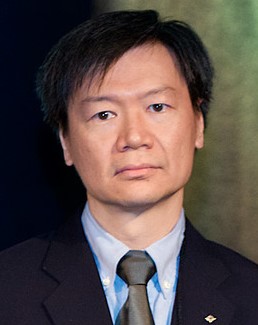 Hing Cheung So (蘇慶祥)合作论文数Department of Electrical Engineering, City University of Hong Kong22
 Shaowu Chen合作论文数College of Electronics and Information Engineering, Shenzhen University13
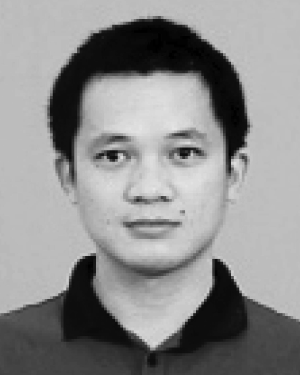 Min Huang合作论文数Shenzhen Univ, Coll Informat Engn, Shenzhen 518060, Peoples R China9
 Yuan Chen (陈媛)合作论文数School of Computer & Communication Engineering, University of Science and Technology Beijing9
 Long Chen (陈龙)合作论文数School of Mechanical Engineering, Northwestern Polytechnical University8
 Guitong Chen合作论文数8
 Qiang Li (李强)合作论文数School of Mechanical, Electronic and Control Engineering, Beijing Jiaotong University8
 Jingxin Xu合作论文数5
 Jihong Zhang (张基宏)合作论文数Institute of Multi-Dimensional Signal Processing, Shenzhen University5
 Peichang Zhang (张沛昌)合作论文数College of Information Engineering,Shenzhen University5
 Junhao Huang合作论文数Guangdong Key Lab Intelligent Informat Proc, Shenzhen Univ4
 Shiqi Liu (刘仕奇)合作论文数State Key Laboratory of Radio Frequency Heterogeneous Integration, College of Electronics and Information Engineering, Shenzhen University4
 Bo Zhao (赵博)合作论文数College of Electronics and Information Engineering, Shenzhen University4
 Deepu John合作论文数Univ Coll Dublin, Sch Elect & Elect Engn, Dublin, Ireland3
 Xin Lin合作论文数School of Electronic and Information Engineering, South China University of Technology3
 Wing-Kwong (Ricky) Chan (陳榮光)合作论文数Department of Computer Science, College of Engineering, City University of Hong Kong3Shu Fang合作论文数2Sheng‐Jie Jin合作论文数2Huochao Tan合作论文数2Liangtao Duan合作论文数2
 Qingyuan Wang合作论文数School of Electrical & Electronic Engineering, University College Dublin;SFI Centre for Research Training in Machine Learning, University College Dublin2Yingying Huang合作论文数2
 Jiajia Wang合作论文数2
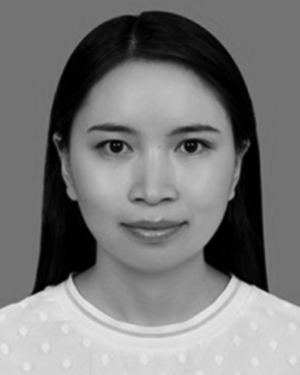 Maoxin Tian合作论文数2
 Xiaoang Liu (刘晓昂)合作论文数School of Mechanical Engineering, Hebei University of Technology2
 Weimin Bao (包为民)合作论文数College of Engineering, Peking University;School of Aerospace Science and Technology, Xidian University2
 Wei Liu合作论文数Department of Electrical and Electronic Engineering, Faculty of Engineering, The Hong Kong Polytechnic University2
 Quanzhong Li (李全忠)合作论文数School of Computer Science and Engineering, Sun Yat-sen University2
 Ning Xie (谢宁)合作论文数College of Electronics and Information Engineering, Shenzhen University2Frankie Kit Wing Chan合作论文数2
 Long-Ting Huang (黄龙庭)合作论文数School of Information Engineering, Wuhan University of Technology2Yicong Chen合作论文数1Yufeng Cai合作论文数1Yu Li合作论文数1Jinquan Liang合作论文数1Xuhua Li合作论文数1
 Lin Lan-Xin (林兰馨)合作论文数1Yi Wan合作论文数1
 Xiao Peng Li (李晓鹏)合作论文数College of Electronics and Information Engineering, Shenzhen University1
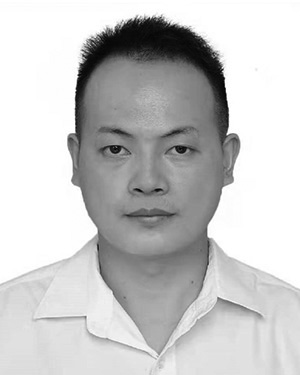 Qijun Deng合作论文数1
 Zheng-Ming Jiang合作论文数1
 Xinzhu Chen (陈新竹)合作论文数College of Electronics and Information Engineering, Shenzhen University1
 Bing Li (李冰)合作论文数School of Electrical Engineering, Southwest Jiaotong University1
 Yang Xin合作论文数School of Medicine, Shenzhen University1
 Liang Yu (余亮)合作论文数Northwestern Polytechnical University1
 Dusit (Tao) Niyato合作论文数College of Computing and Data Science, Nanyang Technological University;School of Physical and Mathematical Sciences, Nanyang Technological University;School of Computer Science and Engineering, Nanyang Technological University1
 Peng Zhang (张鹏)合作论文数Guangdong Key Laboratory of Intelligent Information Processing, College of Electronics and Information Engineering, Shenzhen University1




