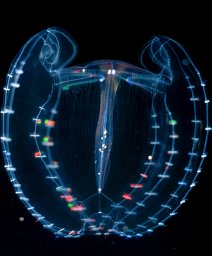
Hydrostatic pressure increases with depth in the ocean, but little is known about the molecular bases of biological pressure tolerance. We describe a mode of pressure adaptation in comb jellies (ctenophores) that also constrains these animals’ depth range. Structural analysis of deep-sea ctenophore lipids shows that they form a nonbilayer phase at pressures under which the phase is not typically stable. Lipidomics and all-atom simulations identified phospholipids with strong negative spontaneous curvature, including plasmalogens, as a hallmark of deep-adapted membranes that causes this phase behavior. Synthesis of plasmalogens enhanced pressure tolerance in Escherichia coli , whereas low-curvature lipids had the opposite effect. Imaging of ctenophore tissues indicated that the disintegration of deep-sea animals when decompressed could be driven by a phase transition in their phospholipid membranes.
The deep ocean is dark, cold, and pressurized—pressure increases by 1 bar for every 10 m depth. How does marine life adapt to this extreme environment? Given that lipid membranes are sensitive to both temperature and pressure (they are the most compressible biological material in a cell), one expects to find adaptations in the lipidomes of organisms that are specialized for life at high pressure. Here, we explore this question using the ctenophores as a model organism. Ctenophores make up a marine invertebrate phylum that is the oldest distinct lineage on the metazoan tree, and different species have adapted independently to many pressure and temperature regimes.
Life in the deep ocean and continental subsurface is estimated to make up more than half of all biomass on the planet, and must withstand the crushing pressures up to 1000 times that at the surface. Lipid membranes encapsulating cells and organelles are sensitive to their physical environments, especially pressure. To understand the mechanisms by which membrane structure adapts to high pressure environments, we have employed lipidomic and structural analyses of extracted membranes from pressure-adapted deep-sea invertebrates (ctenophores), allowing us to identify key chemical and physical signatures of depth adaptation. To validate these findings, we employed yeast and bacterial model organisms, engineered with tuned lipid biosynthesis pathways, and grown under varying pressures in the lab. This multi-scale, comparative approach has revealed lipid properties such as headgroup stoichiometry, ether vs. ester chain linkages, chain unsaturation, and chain length length provide biophysical advantages to buffer against physiologically-incompatible membrane states and preserve membrane plasticity at high pressure. Understanding lipid adaptations to pressure could allow for the identification of the mechanisms by which cells sense the global membrane environment and thereby facilitate homeoviscous, homeophasic, and homeocurvature responses.
The study of evolution and speciation in non-model systems provides us with an opportunity to expand our understanding of biodiversity in nature. Connectivity studies generally focus on species with obvious boundaries to gene flow, but in open-ocean environments, such boundaries are difficult to identify. Due to the lack of obvious boundaries, speciation and population subdivision in the pelagic environment remain largely unexplained. Comb jellies (Phylum Ctenophora) are mostly planktonic gelatinous invertebrates, many of which are considered to have freely interbreeding distributions worldwide. It is thought that the lobate ctenophore Bolinopsis infundibulum is distributed throughout cooler northern latitudes and B. vitrea warmer. Here, we examined the global population structure for species of Bolinopsis with genetic and morphological data. We found distinct evolutionary patterns within the genus, where B. infundibulum had a broad distribution from northern Pacific to Atlantic waters despite many physical barriers, while other species were geographically segregated despite few barriers. Divergent patterns of speciation within the genus suggest that oceanic currents, sea-level, and geological changes over time can act as either barriers or aids to dispersal in the pelagic environment. Further, we used population genomic data to examine evolution in the open ocean of a distinct lineage of Bolinopsis ctenophores from the North Eastern Pacific. Genetic information and morphological observations validated this as a separate species, Bolinopsis microptera, which was previously described but has recently been called B. infundibulum. We found that populations of B. microptera from California were in cytonuclear discordance, which indicates a secondary contact zone for previously isolated populations. Discordance at this scale is rare, especially in a continuous setting.
ABSTRACT Animals are known to regulate the composition of their cell membranes to maintain key biophysical properties in response to changes in temperature. For deep-sea marine organisms, high hydrostatic pressure represents an additional, yet much more poorly understood, perturbant of cell membrane structure. Previous studies in fish and marine microbes have reported correlations with temperature and depth of membrane-fluidizing lipid components, such as polyunsaturated fatty acids. Because little has been done to isolate the separate effects of temperature and pressure on the lipid pool, it is still not understood whether these two environmental factors elicit independent or overlapping biochemical adaptive responses. Here, we use the taxonomic and habitat diversity of the phylum Ctenophora to test whether distinct low-temperature and high-pressure signatures can be detected in fatty acid profiles. We measured the fatty acid composition of 105 individual ctenophores, representing 21 species, from deep and shallow Arctic, temperate, and tropical sampling locales (sea surface temperature, −2° to 28°C). In tropical and temperate regions, remotely operated submersibles (ROVs) enabled sampling down to 4000 m. We found that among specimens with body temperatures 7.5°C or colder, depth predicted fatty acid unsaturation levels. In contrast, in the upper 200 m of the water column, temperature predicted fatty acid chain lengths. Taken together, our findings suggest that lipid metabolism may be specialized with respect to multiple physical variables in diverse marine environments. Largely distinct modes of adaptation to depth and cold imply that polar marine invertebrates may not find a ready refugium from climate change in the deep.
A common way of illustrating phylogeographic results is through the use of haplotype networks. While these networks help to visualize relationships between individuals, populations, and species, evolutionary studies often only quantitatively analyze genetic diversity among haplotypes and ignore other network properties. Here, we present a new metric, haplotype network branch diversity (HBd), as an easy way to quantifiably compare haplotype network complexity. Our metric builds off the logic of combining genetic and topological diversity to estimate complexity previously used by the published metric haplotype network diversity (HNd). However, unlike HNd which uses a combination of network features to produce complexity values that cannot be defined in probabilistic terms, thereby obscuring the values' implication for a sampled population, HBd uses frequencies of haplotype classes to incorporate topological information of networks, keeping the focus on the population and providing easy-to-interpret probabilistic values for randomly sampled individuals. The goal of this study is to introduce this more intuitive metric and provide an R script that allows researchers to calculate diversity and complexity indices from haplotype networks. A group of datasets, generated manually (model dataset) and based on published data (empirical dataset), were used to illustrate the behavior of HBd and both of its terms, haplotype diversity, and a new index called branch diversity. Results followed a predicted trend in both model and empirical datasets, from low metric values in simple networks to high values in complex networks. In short, the new combined metric joins genetic and topological diversity of haplotype networks, into a single complexity value. Based on our analysis, we recommend the use of HBd, as it makes direct comparisons of network complexity straightforward and provides probabilistic values that can readily discriminate situations that are difficult to resolve with available metrics.
Since its founding, the Monterey Bay Aquarium Research Institute (MBARI) has pioneered unique capabilities for accessing the deep ocean and its inhabitants through focused peer relationships between scientists and engineers. This focus has enabled breakthroughs in our understanding of life in the sea, leading to fundamental advances in describing the biology and the ecology of open-ocean and deep-sea animals. David Packard's founding principle was the application of technological advances to studying the deep ocean, in part because he recognized the critical importance of this habitat in a global context. Among other fields, MBARI's science has benefited from applying novel methodologies in molecular biology and genetics, imaging systems, and in situ observations. These technologies have allowed MBARI's bioluminescence and biodiversity laboratory and worldwide collaborators to address centuries-old questions related to the biodiversity, behavior, and bio-optical properties of organisms living in the water column, from the surface into the deep sea. Many of the most interesting of these phenomena are in the midwater domain-the vast region of ocean between the sunlit surface waters and the deep seafloor.
Previous articleNext article No AccessGeneticsInvasion Genetics: The Baker and Stebbins Legacy. Edited by Spencer C. H. Barrett, Robert I. Colautti, Katrina M. Dlugosch, and Loren H. Rieseberg. Hoboken (New Jersey): Wiley. $85.00. xiv + 380 p. + 10 pl.; ill.; index. ISBN: 978-1-118-92216-3. 2017.Devon Pearse, Helen Holmlund, Julie Herman, Sara Grove, Jacob Winnikoff, Karen Tanner, Shelley Sianta, Nicholas Macias, and Alisa VershininaDevon PearseEcology & Evolutionary Biology, University of California, Santa Cruz, California Search for more articles by this author , Helen HolmlundEcology & Evolutionary Biology, University of California, Santa Cruz, California Search for more articles by this author , Julie HermanEcology & Evolutionary Biology, University of California, Santa Cruz, California Search for more articles by this author , Sara GroveEcology & Evolutionary Biology, University of California, Santa Cruz, California Search for more articles by this author , Jacob WinnikoffEcology & Evolutionary Biology, University of California, Santa Cruz, California Search for more articles by this author , Karen TannerEcology & Evolutionary Biology, University of California, Santa Cruz, California Search for more articles by this author , Shelley SiantaEcology & Evolutionary Biology, University of California, Santa Cruz, California Search for more articles by this author , Nicholas MaciasEcology & Evolutionary Biology, University of California, Santa Cruz, California Search for more articles by this author , and Alisa VershininaEcology & Evolutionary Biology, University of California, Santa Cruz, California Search for more articles by this author Ecology & Evolutionary Biology, University of California, Santa Cruz, CaliforniaEcology & Evolutionary Biology, University of California, Santa Cruz, CaliforniaEcology & Evolutionary Biology, University of California, Santa Cruz, CaliforniaEcology & Evolutionary Biology, University of California, Santa Cruz, CaliforniaEcology & Evolutionary Biology, University of California, Santa Cruz, CaliforniaEcology & Evolutionary Biology, University of California, Santa Cruz, CaliforniaEcology & Evolutionary Biology, University of California, Santa Cruz, CaliforniaEcology & Evolutionary Biology, University of California, Santa Cruz, CaliforniaEcology & Evolutionary Biology, University of California, Santa Cruz, CaliforniaPDFPDF PLUSFull Text Add to favoritesDownload CitationTrack CitationsPermissionsReprints Share onFacebookTwitterLinkedInRedditEmail SectionsMoreDetailsFiguresReferencesCited by The Quarterly Review of Biology Volume 92, Number 3September 2017 Published in association with Stony Brook University Article DOIhttps://doi.org/10.1086/693625 Views: 28Total views on this site For permission to reuse, please contact [email protected]PDF download Crossref reports no articles citing this article.
ABSTRACT The ability of animals to cope with environmental stress depends – in part – on past experience, yet knowledge of the factors influencing an individual's physiology in nature remains underdeveloped. We used an individual monitoring system to record body temperature and valve gaping behavior of rocky intertidal zone mussels (Mytilus californianus). Thirty individuals were selected from two mussel beds (wave-exposed and wave-protected) that differ in thermal regime. Instrumented mussels were deployed at two intertidal heights (near the lower and upper edges of the mussel zone) and in a continuously submerged tidepool. Following a 23-day monitoring period, measures of oxidative damage to DNA and lipids, antioxidant capacities (catalase activity and peroxyl radical scavenging) and tissue contents of organic osmolytes were obtained from gill tissue of each individual. Univariate and multivariate analyses indicated that inter-individual variation in cumulative thermal stress is a predominant driver of physiological variation. Thermal history over the outplant period was positively correlated with oxidative DNA damage. Thermal history was also positively correlated with tissue contents of taurine, a thermoprotectant osmolyte, and with activity of the antioxidant enzyme catalase. Origin site differences, possibly indicative of developmental plasticity, were only significant for catalase activity. Gaping behavior was positively correlated with tissue contents of two osmolytes. Overall, these results are some of the first to clearly demonstrate relationships between inter-individual variation in recent experience in the field and inter-individual physiological variation, in this case within mussel beds. Such micro-scale, environmentally mediated physiological differences should be considered in attempts to forecast biological responses to a changing environment.
To the human observer, the deep sea is as extreme an environment as Earth has to offer. Below about 200 metres, there is no light from the surface, the water can be frigid (-2 to 5°C), oxygen and food are scarce, and the pressure is staggering. Of course, to the countless species that inhabit the deep sea, these conditions are not so extreme, and in a statistical sense, they fall fairly close to average, since the deep comprises the planet's largest habitat by volume. Despite its expanse, we know little about how life persists in an environment so different from our own. Only in the last half-century has technology emerged that allows us to collect and study live deep-sea animals. Diversity, Evolution and EcoPhysiology of Ctenophores (DEEPC, deepc.org, a US NSF-supported research effort) is opening a window on biochemistry in the deep, and specifically on its relationship to high pressure. By determining structural constraints on enzyme function under pressure, we aim to inform models focusing on deep-sea animal colonization, and to find general patterns of protein adaptation with possible applications in protein engineering and biocatalysis.
Untargeted liquid chromatography-MS (LC-MS) is used to rapidly profile crude natural product (NP) extracts; however, the quantity of data produced can become difficult to manage. Molecular networking based on MS/MS data visualizes these complex data sets to aid their initial interpretation. Here, we developed an additional visualization step for the molecular networking workflow to provide relative and absolute quantitation of a specific compound in an extract. The new visualization also facilitates combination of several metabolomes into one network, and so was applied to an MS/MS data set from 20 crude extracts of cultured marine cyanobacteria. The resultant network illustrates the high chemical diversity present among marine cyanobacteria. It is also a powerful tool for locating producers of specific metabolites. In order to dereplicate and identify culture-based sources of known compounds, we added MS/MS data from 60 pure NPs and NP analogs to the 20-strain network. This dereplicated six metabolites directly and offered structural information on up to 30 more. Most notably, our visualization technique allowed us to identify and quantitatively compare several producers of the bioactive and biosynthetically intriguing lipopeptide malyngamide C. Our most prolific producer, a Panamanian strain of Okeania hirsuta (PAB10FEB10-01), was found to produce at least 0.024 mg of malyngamide C per mg biomass (2.4%, w/dw) and is now undergoing genome sequencing to access the corresponding biosynthetic machinery.
 Steven H. D. Haddock合作论文数Monterey Bay Aquarium Research Institute7
 Budin Itay合作论文数Joint BioEnergy Inst4
 Daniel Milshteyn合作论文数Chemistry and Biochemistry, University of California San Diego2
 Helen I Holmlund合作论文数Natural Science Division, Pepperdine University2
 Christianson Lynne M合作论文数2
 Schultz Darrin T合作论文数2
 Alisa Vershinina合作论文数2
 Edward Lyman合作论文数Department of Computational Biology;School of Medicine;University of Pittsburgh;School of Medicine, University of Pittsburgh2Sara Grove合作论文数2
 Shelley Sianta合作论文数2
 Erik V Thuesen合作论文数Evergreen State College2
 Claudia E. Mills合作论文数Department of Biology, University of Washington2
 Devon E. Pearse合作论文数National Marine Fisheries Service, NOAA Southwest Fisheries Science Center2Jei-Ying Chen合作论文数1Benjamin Erwin合作论文数1Philip R. Pugh合作论文数1Daniel B Wright合作论文数1Wyatt L Patry合作论文数1
 Pieter C Dorrestein合作论文数Departments of Pharmacology and Pediatrics, Skaggs School of Pharmacy and Pharmaceutical Sciences, University of California, San Diego;Collaborative Mass Spectrometry Innovation Center, University of California, San Diego;Institute for Metabolomics Medicine, University of California, San Diego1May B. Roberts合作论文数1
 Remy Gatins合作论文数Dept Marine Sci, Northeastern Univ1Casey Dunn合作论文数Molecular Cell Biology, Genetics, and Development, Biological & Biomedical Sciences, Yale University1
 Sonke Johnsen合作论文数Nicholas School of the Environment, Duke University;Department of Biology, Duke University1
 Sodt Alexander J合作论文数NICHD, NIH1Ryan Joseph F合作论文数1
 Warren R Francis合作论文数Monterey Bay Aquarium Research Institute;Department of Ocean Sciences, University of California Santa Cruz;Monterey Bay Aquarium Research Institute, University of California Santa Cruz1
 Giacomo Bernardi合作论文数Environmental Studies Department, University of California Santa Cruz;Division of Physical & Biological Sciences, Department of Ecology and Evolutionary Biology, University of California Santa Cruz1
 Gleason Lani U合作论文数Scripps Institution of Oceanography, University of California1
 Evgenia Glukhov合作论文数University of California, San Diego, University of California1
 severine Martini合作论文数Mediterranean Institute of Oceanography (MIO),, Aix Marseille Université1Powers Meghan L合作论文数1
 Edward Dennis合作论文数School of Medicine, University of California, San Diego;Revelle College, University of California, San Diego;Division of Graduate Education and Postdoctoral Affairs, University of California, San Diego1
 William Gerwick合作论文数Scripps Institution of Oceanography, UC San Diego;Skaggs School of Pharmacy, UC San Diego1
 Eric M. Garcia合作论文数Chemistry Department, Federal University of Minas Gerais1
 Christine E. Schnitzler合作论文数Department of Zoology, Oregon State University1
 Anela Choy合作论文数Integrative Oceanography Division, Scripps Institution of Oceanography, University of California, San Diego1
 George N. Somero (George Somero)合作论文数Hopkins Marine Station, Stanford Doerr School of Sustainability, Stanford University;Woods Institute for the Environment, Stanford University1
 William Wesley Dowd合作论文数K Lab;Medical Center, Duke University;Medical Center, Duke University1
 Karen J. Osborn合作论文数Monterey Bay Aquarium Research Institute1Aaron M. Armando合作论文数Department of Pharmacology, University of California–San Diego1
 Hudson Tercio Pinheiro合作论文数CCHN, Universidade Federal do Espírito Santo1
 Susan von Thun合作论文数Monterey Bay Aquarium Research Institute1
 Oswald Quehenberger合作论文数School of Health Sciences, University of California San Diego1
 Luke P. Miller合作论文数Marine Science Center, Northeastern University1
 Eva Salas合作论文数Centro de Investigación en Ciencias del Mar y Limnología, Universidad de Costa Rica1Kyra L. Schlining合作论文数Monterey Bay Aquarium Research Institute1Paul H. Yancey合作论文数1
 William E Browne合作论文数University of Chicago1
 Monique Messie合作论文数Monterey Bay Aquarium Res Inst1




