Machine learning in Big Data is getting the spotlight to retrieve useful knowledge inherent in multi-dimensional information and discover new inherent knowledge in the fields related to the storage and retrieval of massive multi-dimensional information that is newly produced. The machine learning technique can be divided into supervised and unsupervised learning according to whether there is data labeling or not. Unsupervised learning, which is a technique to classify and analyze data with no labeling, is utilized in various ways in the analysis of multi-dimensional Big Data. The present study thus proposed an altered K-means algorithm to analyze the problems with the old one and determine the number of clusters automatically. The study also proposed an approach of optimizing the number of clusters through principal component analysis, a pre-processing process, with the input data for clustering. The performance evaluation results confirm that the CVI of the proposed algorithm was superior to that of the old K-means algorithm in accuracy.
Recently, along with the 4th industrial revolution, research on IT convergence technology that is aiming for eco-friendly agriculture is under way, and smart agricultural technologies utilizing artificial intelligence techniques are being studied in various forms. In general, the status and size of the crops produced from the farms are analyzed by image processing, and they are used to classify the quality. This paper proposes a system for analyzing the pest status of mushrooms cultivated in mushroom plantations using CNN, a machine learning algorithm that is becoming popular in the image recognition field. The mushroom images are analyzed by the CNN analysis module to determine similarity with other images learned according to the similarity measurement technique based on the Euclidean technique.
A lot of people were trapped in elevators without power supply when BLACK-OUT situation occurred in 2011. The telephone network of control room connected to the elevators had problem operating poorly. In this paper we propose an ICT based elevator emergency call device prototype system and evaluate the performance of the system. The proposed system quickly responds in emergency situation to guarantee passenger safety. For the goal, firstly the system tries to connect to a control room. If it fails the system attempts to call numbers for emergency contact and a rescue team sequentially. The system is designed to quickly support emergency contact as well. Finally, the information of elevator failure is rapidly transferred to the failure process device by the proposed system.
현재 농작물의 품질과 직결되는 병해충에 관하여 농작물 재배 현장에서 바로 사용할 수 있는 모바일 전용의 응용 시스템은 부족한 실정이다. 따라서 본 논문에서는 병해충 예찰 및 기본 정보에 관해서는 충실하나 즉각적인 진단 기능이 매우 부족하고 아울러 농작물 재배 현장에서 바로 사용할 수 있는 모바일 기반의 병해충 전용 시스템의 부재를 개선하기 위해서, u-Farm을 위한 모바일 기반의 농작물 재배 현장 중심형 스마트 병해충 정보검색 시스템을 설계 및 구현한다. 제안하는 시스템은 이미지의 전문 분석에 유용한 검색 라이브러리인 루씬(Lucene) 및 JSON 데이터 구조를 기반으로 농작물 재배 현장에서 병해충의 정보를 웹뿐만 아니라, 본인이 소유한 스마트 폰을 통해 실시간으로 직접 확인할 수 있는 장점이 있다. 또한, 시스템의 확장 및 재사용성을 높이기 위해 객체지향 모델링을 기반으로 설계하였으며, 농작물의 메타 정보뿐만 아니라, 메타 정보 기반의 텍스트 및 색상 등과 같은 이미지 특징 정보를 기반으로 검색이 가능하다. 본 시스템을 통해 u-Farm 실현뿐만 아니라 농업인이나 재배 현장 관리자들이 농작물 작황, 병해충 현황 파악 및 관리를 실시간으로 진행할 수 있다. There is a shortage of mobile application systems readily applicable to the field of crop cultivation in relation to diseases and insect pests directly connected to the quality of crops. Most of system have been devoted to diseases and insect pests that would offer full predictions and basic information about diseases and insect pests currently. But for lack of the instant diagnostic functions seriously and the field of crop cultivation, we design and implement a crop cultivation field-oriented smart diseases and insect pests information retrieval system based on mobile for u-Farm. The proposed system had such advantages as providing information about diseases and insect pests in the field of crop cultivation and allowing the users to check the information with their smart-phones real-time based on the Lucene, a search library useful for the specialized analysis of images, and JSON data structure. And it was designed based on object-oriented modeling to increase its expandability and reusability. It was capable of search based on such image characteristic information as colors as well as the meta-information of crops and meta-information-based texts. The system was full of great merits including the implementation of u-Farm, the real-time check, and management of crop yields and diseases and insect pests by both the farmers and cultivation field managers.
에너지 수확 모바일 센서 망에서 센서 노드간의 듀티-사이클 동기화는 매우 중요한 의미를 갖는다. 제한된 에너지를 효율적으로 사용하여 협력해야 하기 때문에 각 노드의 듀티-사이클이 서로 유사하게 동작되어야 한다. 이때 망을 구성하는 노드 분포는 노드간의 연결뿐만 아니라 동기화에 의한 노드의 활동 시간, 그리고 망의 수명에 영향을 준다. 본 논문에서는 자기-동기화 듀티-사이클 기법을 적용한 에너지 수확 모바일 센서 망에서 망의 토폴로지를 변화시킨다. 단순 랜덤 토폴로지 망보다는 망이 담당하는 영역과 노드 밀집도에 따라서 노드의 분포를 균일하게 유지하는 알고리즘을 제시한다. 제시된 토폴로지 변환 알고리즘을 위하여 유체 흐름과 군집 분산 모델을 적용하고 에이전트 기반 모델링을 이용하여 성능분석을 시행한다. 또한 제안된 알고리즘을 자기-동기화 듀티-사이클 기반 모바일 센서 망에 적용하여 노드 간 동기화 특성이 강화되고 에너지 소비 편차의 감소를 확인한다.
본 논문에서는 기존 HubNet 기반의 참여 모의실험의 한계를 극복하기 위한 능동형 참여 모의실험 (Active Participatory Simulation; APS) 학습 구조를 제시하고, 이를 위한 고고보도용 NetLogo 확장 모듈을 자바로 개발한다. NetLogo는 복잡하게 보이는 과학현상의 이면에 존재하는 복잡계를 모델링할 수 있는 에이전트 기반 모델링 (Agent Based Modeling) 언어다. 이것과 HubNet을 이용하면 모의실험이 수행되는 동안 학생은 하나의 에이전트로서 이 실험에 참여할 수 있다. 하지만 HubNet에서는 서버만이 외부장치와 연결된다. 따라서 고고보드를 이용한 환경 데이터 및 사용자 입력을 다수의 클라이언트를 통하여 수신할 수 없어 이중초점 모델링 기반 학습이 불가능하다. 이에 클라이언트에 연결된 고고보드의 입력 정보를 TCP/IP 소켓을 이용하여 수신하고 보드를 제어하는 자바 확장 모듈을 개발한다. 또한 HubNet과 이 확장 모듈을 사용한 APS 학습 구조 모델링 방법과 이를 위한 NetLogo 프로그래밍을 소개한다. 마지막으로 다양한 APS 학습 구조에 따른 예시를 제시하고 응답처리지연 시간 관점에서 평가하여 과학분야에 활용될 수 있는 방안을 모색한다. Flooding based routing protocols are usually used to disseminate information in wireless sensor networks. Those approaches, however, require message retransmissions to all nodes and induce huge collision rate and high energy consumption. In this paper, HoGoP (Hop based Gossiping Protocol) in which all nodes consider the number of hops from sink node to them, and decide own gossiping probabilities, is introduced. A node can decide its gossiping probability according to the required average reception percentage and the number of parent nodes which is counted with the difference between its hop and neighbors' ones. Therefore the decision of gossiping probability for network topology is adaptive and this approach achieves higher message reception percentage with low message retransmission than the flooding scheme. Through simulation, we compare the proposed protocol with some previous ones and evaluate its performance in terms of average reception percentage, average forwarding percentage, and forwarding efficiency. In addition, average reception percentage is analyzed according to the application requirement.
Flooding based routing protocols are usually used to disseminate information in wireless sensor networks. Those approaches, however, require message retransmissions to all nodes and induce huge collision rate and high energy consumption. In this paper, HoGoP (Hop based Gossiping Protocol) in which all nodes consider the number of hops from sink node to them, and decide own gossiping probabilities, is introduced. A node can decide its gossiping probability according to the required average reception percentage and the number of parent nodes which is counted with the difference between its hop and neighbors' ones. Therefore the decision of gossiping probability for network topology is adaptive and this approach achieves higher message reception percentage with low message retransmission than the flooding scheme. Through simulation, we compare the proposed protocol with some previous ones and evaluate its performance in terms of average reception percentage, average forwarding percentage, and forwarding efficiency. In addition, average reception percentage is analyzed according to the application requirement.
This paper presents a new medium access control (MAC) protocol for wireless sensor networks (WSN). This new MAC is supposed to improve the energy efficiency of WSN. A lot of proposed MAC protocols are based on periodic sleep approach. A typical method is to let sensor nodes follow a schedule to listen or sleep. Usually, that schedule is initialized at the beginning of the MAC process. Few papers proposed methods to dynamically decide the sleep schedule during the MAC process. But those approaches are not aimed at adapting the traffic state. A measuring mechanism is proposed to analyze traffic state in one cluster of WSN. According to traffic state, sensor nodes change their sleep schedules. Sensor nodes can sleep a lot when network is idle, and work as normal when network is busy. This new scheme is evaluated by a simulation compared with Bit-Map-Assisted MAC protocol. Two protocols are compared in terms of energy consumption and transmission delay. Simulation result shows the proposed MAC mechanism can use energy more efficiently.
High false alarm rate and time-space cost of rule extraction and detection limit the application of machine learning in real intrusion detection system (IDS), and IDS cannot satisfy most system performance requirements simultaneously. In this paper, a Constraint-based gene expression programming rule extraction algorithm (CGREA) is proposed which guarantees the validity of rules and reduces the evolution time through grammar constraint and probability restriction. Additionally, an adaptive intrusion detection engine (AIDE) is applied to automatically renew the detected order of rules according to the performance metric. The KDD CUPpsila99 DATA is used for evaluation and results show that the rules, which are extracted by the CGREA algorithm within a few evolution generations, can not only achieve high detection rate but also detect unknown attacks. Moreover, the AIDE based on CGREA increases the attack detection rate, and adapts itself to different performance requirements with different sequences of rule detection.
In this paper, a WDM optical ring consisting of access nodes with fixed transmitter-n fixed receivers (FT—FR n ) is considered. As access nodes share a wavelength channel there is trade-off between node throughput and fairness among them. In order to abbreviate the transmission unfairness and to increase the throughput, we propose p-persistent medium access control (MAC) protocol. Each node uses the carrier sense multiple access with collision avoidance (CSMA/CA) protocol to transmit packets, and decides whether to use a local empty slot with probability p when a transferred packet based on source-stripping is dropped and emptied. Numerical prediction for the proposed MAC protocol is introduced to compute the maximum node throughput under uniform traffic condition. For more detail results, we use network simulation with self-similar traffic and introduce various results. The proposed MAC protocol gives better node throughput than non-persistent protocol and shows an improved fairness factor than 1-persistent protocol. Through simulation, we also find the reasonable probability of p-persistent protocol for a given architecture.
The general aim of this paper is to study the spatio-temporal modeling techniques which can efficiently represent multiple moving objects' in video databases. The traditional schemes only consider direction property, time interval property, and spatial relationship property for modeling moving objects' trajectories. But, our scheme also takes into account on distance property, conceptual location information, and related object information so that we may improve a retrieval accuracy to measure a similarity between two moving objects as well as them. As its application, we implement the Content- and Semantic-based Soccer Video Retrieval (CS2VR) system by using MS Visual C++ and DirectX for indexing and searching on soccer video data. The CS2VR helps users to easily extract the trajectory information of soccer ball form soccer video data semi-automatically as well as to conveniently retrieve the results acquired by sketching query trajectory with mouse button.
Optical Burst-Switched (OBS) networks usually employ one-way reservation by sending a burst control packet (BCP) with a specific offset time, before transmitting each data burst frame (BDF). Therefore, a fiber link failure may lead to loss of several BDFs as the ingress nodes sending these BDFs remain unaware of the failed link till they receive the failure indication signal (FIS). In this paper, we propose a hybrid restoration scheme, wherein we employ a novel combination of sub-path as well as path restoration schemes. In particular, the upstream node preceding the failed link employs sub-path restoration as soon as it detects the failure. Thereafter, when the source ingress node receives the FIS message, it (source ingress node) takes over the responsibility and employs path restoration. However, sub-path restoration is exercised by the upstream node only if the remaining time intervals left for the yet-to-arrive BDFs (for which BCPs have already left the upstream node) are less than a minimum time interval (called as threshold reaction time). Performance of the proposed scheme is evaluated through extensive computer simulation using OPNET. Our results indicate that the proposed restoration scheme significantly reduces burst losses due to link failure and, thus, outperforms the existing restoration schemes.
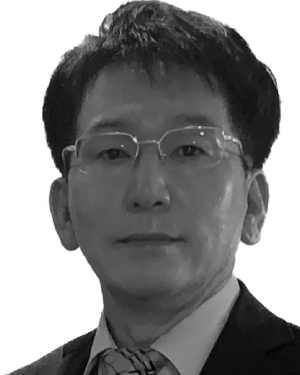 Young-Chon Kim合作论文数Department of Computer Engineering, Chonbuk National University11
 hongyu xiong合作论文数Facebook Res Menlo Pk CA USA6
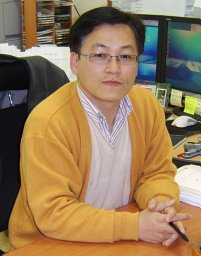 Chun-Bo Sim合作论文数6
 Se-Hoon Jung合作论文数Sch Creat Convergence, Andong Natl Univ4
 chelung park合作论文数3xue qiu合作论文数3Sun-Sik Roh合作论文数3Hae-Joung Lee合作论文数3You Kang‐Soo合作论文数2shuang wang合作论文数2Wan Tang (唐菀)合作论文数2Kyu-Yeop Song合作论文数2Yun-Ho Cha合作论文数2Se Hoon Jung合作论文数1Kyung-Jong Kim合作论文数1Hongjun Park合作论文数1Seon-Sik No合作论文数1sungkyun park合作论文数1Sang-Heon Shim合作论文数1
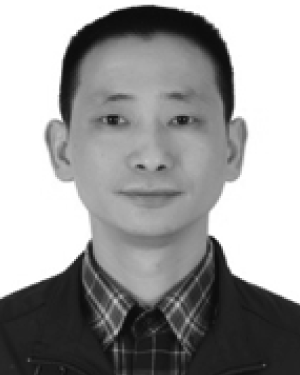 Ximin Yang合作论文数1
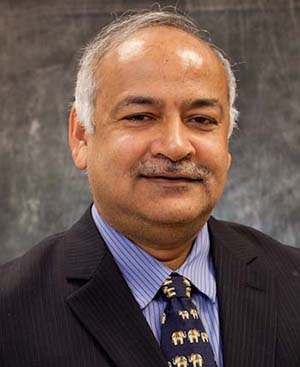 Biswanath Mukherjee合作论文数Department of Computer Science, University of California, Davis1Sang Yeol Lee合作论文数1
 Shuang Wang (王爽)合作论文数1Cao Yang合作论文数1
 Jing Zhang合作论文数1Hae-Chong Lee合作论文数1Won-Hyuk Yang合作论文数1
 DongGook Park合作论文数1
 Choon-Bo Shim合作论文数1Chang-Sun Shin合作论文数1
 Kyeong-Eun Han合作论文数1
 Debasish Datta合作论文数Department of Electronics and Electrical Communication Engineering, Indian Institute of Technology1Kyoung-Min Yoo合作论文数1




