In field seismic data, abnormal environmental noise from the acquisition environment often is unavoidable, and its characteristics are complex. Abnormal environmental noise has a strong amplitude (tens of thousands times the average seismic amplitudes) and masks the effective seismic signal. The traditional method for removing such abnormal environmental noise relies on energy scanning to identify the noise location. However, energy scanning cannot always accurately identify such noise due to the sudden energy change at the locations of first-breaks and surface waves. A deep learning method for removing abnormal environmental noise has been developed. The presence of environmental noise with large amplitude also results in an uneven energy distribution. The existing denoising networks rarely consider this situation. Based on the characteristics of environmental noise received by the nodal seismic acquisition system, a workflow for automatically generating the training data sets has been established. The network is built based on the Unet with the incorporation of a residual block. The Batchnorm layer is specifically omitted to adapt to the uneven energy distribution. Synthetic and field data testing have confirmed the effectiveness and applicability of the proposed method. The new method indicates better denoising performance and greater flexibility than the traditional method. Comparison between different networks also indicates that the new Residual Block Connected Unet is much more effective in denoising seismic data that contain abnormal environmental noise.
To analyze seismic wave field characteristics and characterize fracture (or crack) reservoirs, it is essential to build proper wave-induced fluid flow (WIFF) models of various scales. There is much research related to WIFF fractured models that are mainly suitable only for different scales of fracture (crack) medium separately, such as microscopic cracks and mesoscopic fractures. Based on previous research, it is proposed a unified multiscale (mesoscopic and microscopic) dispersion and attenuation model for the medium with fractures, cracks, pores, and fluid. The formulation uses frequency-dependent fractured (or crack) parameters expressed as the form of multiplication of fracture parameters and relaxation function. The advantage of this method is that it is convenient to build fluid porous medium with different scale fractures (or cracks) and various fracture (or crack) configurations. The numerical simulation results prove the correctness and applicability of the proposed extended WIFF dispersion and attenuation model. Based on our proposed method, the characteristics of the dispersion and attenuation of the multiscale fractured model are analyzed. The results indicate that the characteristics of velocity dispersion and wave attenuation in the medium with different scales of fractures are similar. The velocity increases with frequency and finally tends to be stable. The main difference among the different scales of models is that the frequency bands of the dispersion and attenuation occurring are different. We also discover that for multiscale fractured medium, the characteristic frequency and attenuation peaks do not necessarily correspond to each other, which makes the analysis of the dispersion and attenuation more complicated.
地下储层中存在介观尺度的裂缝是导致地震波的速度频散和能量衰减的一个重要原因.从 Galvin介观裂缝模型出发,重构其低频极限和高频极限的表达形式,将频散关系施加到裂缝模型上构建依赖频率的裂缝柔度参数,建立了一种改进的介观尺度的裂缝型岩石物理模型.基于该改进模型,利用附加柔度的组合性质,可以容易地构建更复杂的模型并进行依赖频率的地震响应特征分析.在传统的反射系数公式中引入频率参数,分析了具有不同裂缝长度、背景渗透率、流体粘度等频散敏感参数的反射界面上的频散 AVO 及地震记录响应特征.通过数值模拟得出频散敏感参数主要影响发生频散的频段,即影响岩石的特征频率;当模型的特征频率与地震波频段主频相近时,频散现象最突出,当特征频率大于地震波频段主频一个数量级时,可以忽略频散作用,此时采用传统的 Gassmann方程即可较准确地分析地震剖面的特征.基于改进模型得到的认识为地震频散特征的实际应用提供了岩石物理模型的构建方面的指导.
The quality of wavefield separation on vertical seismic profiling (VSP) data directly affects subsequent imaging and inversion processes. However, the traditional methods have various defects in separating upgoing and downgoing waves. The application of deep learning brings another train of thought to solve related problems. The traditional methods, such as f-k filtering and Radon transform, produce results with spatial aliasing and inaccurate amplitudes. The median filtering method relies on accurate first-break picking and waveform consistency. Moreover, the results of traditional methods are subject to manual intervention. To overcome these problems, a deep-learning method is developed for the automatic wavefield separation of VSP data. First, the traditional Radon transform method is used to produce training data sets. Then, to ensure amplitude preservation and suppress spatial aliasing, new input data is formed by recombining the upgoing and downgoing waves extracted by Radon transform. The developed deep-learning network is highly efficient, and its accuracy exceeds that of the traditional methods only after one epoch training. A practical workflow of wavefield separation based on deep learning is established, and it is applied to synthetic data and field distributed acoustic sensing VSP data. The results indicate that our method is superior in terms of amplitude preservation and spatial aliasing suppression. The time consumption of our method is very acceptable and can be further minimized by training the network using downsampling data.
The mechanism of dispersion and attenuation induced by fluid flow among pores and microcracks in rocks is an important research topic in geophysical domain. A generalised frequency-dependent fourth-rank tensor is proposed and derived herein by combining Sayers's discontinuity tensor formula and Gurevich's squirt flow model. Furthermore, a proposed method for establishing a cracked model with cracks embedded in a transversely isotropic (TI) background medium is developed. Based on the new formulation, we investigate the characteristics of dispersion, attenuation and azimuthal anisotropy of three commonly encountered vertical crack distributions, including aligned cracks, monoclinic cracks and cracks with partial random orientations. We validate the developed model by comparing its predictions with those of the classic anisotropic squirt flow model for an aligned crack. The numerical analyses indicate that the azimuth is independent of frequency when the maximum attenuation is observed for all three crack distributions. In a low-frequency range in the case of an anisotropic background, the attenuation of the qP-wave is inversely proportional to velocity, whereas the attenuation of the qSV-wave is proportional to velocity. In addition, the inherent anisotropy of the rock does not significantly affect the dispersion and attenuation owing to squirt flow. Finally, to investigate the applicability of the theory, we model laboratory data of a synthetic porous sandstone with aligned cracks. Overall, the models agree well with laboratory data. The complex characteristics determined through this study may be useful for the seismic characterisation of fractured reservoirs.
地震波场的方位特征对于裂缝性油气藏的地震预测方法研究有着重要的意义.为使裂缝模型更具一般性,本文基于线性滑动理论和Bond变换构造了两组任意夹角竖直裂缝模型;考虑到波场二维模拟中突出方位特征,依据弹性动力学的基本方程和Bond变换,推导出了含方位角的弹性波传播速度应力方程;使用高精度交错网格有限差分法对几种裂缝介质进行了数值模拟,并分析其波场特征的变化.模拟结果表明,在两组参数相同的任意夹角竖直裂缝模型中,裂缝内夹角各个方位的波场特征变化不明显,各向异性强度较低,裂缝外夹角各个方位的波场特征变化剧烈,裂缝正交时,各处波场特征相近;针对单组裂缝模型,分析了裂缝参数变化对波场特征的影响,总结出了三种波场形态,得出了裂缝垂直面的波场特征与裂缝法向弱度和切向弱度的相对大小有关,从裂缝垂直面到裂缝平行面的波场朝着相同的形态变化,与裂缝参数无关等认识.这些分析结果有助于进一步认识和应用裂缝介质的波场方位特征.
中国西部某地是致密油勘探重点地区,其中目的层的岩性以云质岩为主.将"甜点"的测井响应特征和地震响应特征研究透彻,在确定钻探有利区的过程中具有至关重要的作用.通过结合叠前叠后反演进行致密油甜点预测这一方法,能够准确的判断甜点的测井响应特征、地震响应特征及识别参数,也能够为我们的预测提供更多的证据.
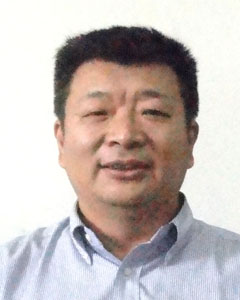 Jianguo Yan (阎建国)合作论文数Chengdu University of Technology5
 Qiaomu Qi (漆乔木)合作论文数State Key Laboratory of Oil and Gas Reservoir Geology and Exploitation, Chengdu University of Technology4
 Zhonglin Cao (曹中林)合作论文数2
 Yuyong Yang (杨宇勇)合作论文数Chengdu University of Technology2Wenlu Huang合作论文数1Yang Wanxiang (杨万祥)合作论文数1WANG Yupeng (王钰鹏)合作论文数1Qi CHEN (陈琪)合作论文数1xuechun zhang (张雪纯)合作论文数1Rubing DENG (邓儒炳)合作论文数1Xun Ling (凌勋)合作论文数1
 Dewen Lei (雷德文)合作论文数中国石油新疆油田分公司1




