Large language models (LLMs) have revolutionized automated code generation, yet the evaluation of their real-world effectiveness remains limited by static benchmarks and simplistic metrics. We present ProxyWar, a novel framework that systematically assesses code generation quality by embedding LLM-generated agents within diverse, competitive game environments. Unlike existing approaches, ProxyWar evaluates not only functional correctness but also the operational characteristics of generated programs, combining automated testing, iterative code repair, and multi-agent tournaments to provide a holistic view of program behavior. Applied to a range of state-of-the-art coders and games, our approach uncovers notable discrepancies between benchmark scores and actual performance in dynamic settings, revealing overlooked limitations and opportunities for improvement. These findings highlight the need for richer, competition-based evaluation of code generation. Looking forward, ProxyWar lays a foundation for research into LLM-driven algorithm discovery, adaptive problem solving, and the study of practical efficiency and robustness, including the potential for models to outperform hand-crafted agents. The project is available at https://github.com/xinke-wang/ProxyWar.
Approximately 3,000 of the 4,500 oracle bone script (OBS) characters remain undeciphered due to fragmentary inscriptions and sparse evidence. Current AI approaches fail to replicate expert workflows that integrate form analysis, contextual semantics, and philological reasoning. We introduce AlphaOracle, a human-workflow-inspired framework that systematizes OBS decipherment using the largest digitized corpus to date. Its multi-stage pipeline comprises: (i) rubbing parsing; (ii) radical-based morphological analysis with diachronic modeling; (iii) contextual retrieval with semantic alignment; and (iv) philological validation against classical sources. Each stage generates explicit, confidence-weighted evidence chains, culminating in interpretable reports for scholarly verification. Across multiple test characters, AlphaOracle's readings strongly agreed with expert interpretations. In a study of 86 domain specialists, it reduced analysis time by 64
In this paper, we propose DS-KWS, a two-stage framework for robust user-defined keyword spotting. It combines a CTC-based method with a streaming phoneme search module to locate candidate segments, followed by a QbyT-based method with a phoneme matcher module for verification at both the phoneme and utterance levels. To further improve performance, we introduce a dual data scaling strategy: (1) expanding the ASR corpus from 460 to 1,460 hours to strengthen the acoustic model; and (2) leveraging over 155k anchor classes to train the phoneme matcher, significantly enhancing the distinction of confusable words. Experiments on LibriPhrase show that DS-KWS significantly outperforms existing methods, achieving 6.13\% EER and 97.85\% AUC on the Hard subset. On Hey-Snips, it achieves zero-shot performance comparable to full-shot trained models, reaching 99.13\% recall at one false alarm per hour.
Fingerspelling plays a vital role in sign languages, particularly for conveying names, technical terms, and words not found in the standard lexicon. However, evaluation of two-handed fingerspelling detection and recognition is rarely addressed in existing sign language datasets—particularly for BANZSL (British, Australian, and New Zealand Sign Language), which share a common two-handed manual alphabet. To bridge this gap, we curate a large-scale dataset, dubbed BANZ-FS, focused on BANZSL fingerspelling in both controlled and real-world environments. Our dataset is compiled from three distinct sources: (1) live sign language interpretation in news broadcasts, (2) controlled laboratory recordings, and (3) diary vlogs from online platforms and social media. This composition enables BANZ-FS to capture variations in signing tempos and fluency across diverse signers and contents. Each instance in BANZ-FS is carefully annotated with multi-level alignment: video ↔ subtitles, video ↔ fingerspelled letters, and video ↔ target lexicons. In total, BANZ-FS includes over 35,000 video-aligned fingerspelling instances. Importantly, BANZ-FS highlights the unique linguistic and visual challenges posed by two-handed fingerspelling, including handshape coarticulation, self-occlusion, intra-letter variation, and rapid inter-letter transitions. We benchmark state-of-the-art models on the key tasks, including fingerspelling detection, isolated fingerspelling recognition, and fingerspelling recognition in context. Experimental results show that BANZ-FS presents substantial challenges while offering rich opportunities for BANZSL understanding and broader sign language technology. The dataset and benchmarks are available at BANZ-FS.
3D multimodal large language models (3D MLLMs) describe a 3D object as a whole but cannot address, name, or reason about its parts. Prior part-aware attempts add segmentation decoders, heavier 3D encoders, or bounding-box grammars at substantial parameter cost. We take a fundamentally different path: we reorganize the input token stream so that parts become directly addressable through the LLM's own vocabulary. Our model, 3D-PLOT-LLM, partitions the frozen point encoder's patches into K locally coherent regions and inserts, before each region's patch tokens, a learnable per-region marker and a reserved vocabulary token ; a Marker-Space Refinement (MSR) module then conditions each marker on its region's spatial statistics and adjacency neighbors. The model thus cites parts in its output and follows prompts that refer to parts by token, a capability absent from prior object-level 3D MLLMs. To probe this interface, we construct PartVerse-QA, a vocabulary-level part-QA benchmark adapted from PartVerse mesh annotations (77K training pairs and 588 held-out queries on disjoint object splits), on which 3D-PLOT-LLM reaches caption-to-slots Jaccard 0.459 and Exact-match 13.78
Recent advances in Large Language Models (LLMs) have raised new questions about their abilities in reasoning and decision-making, particularly under uncertainty. While traditional evaluation benchmarks primarily focus on text understanding or deterministic tasks, they fail to probe the complex probabilistic reasoning and strategic planning essential for real-world intelligence. To bridge this gap, we propose PokerBench, a game-theoretic evaluation framework based on Texas Hold’em poker, for systematically assessing LLMs’ capacity for probabilistic reasoning and decision making under incomplete information. Experiments with several state-of-the-art LLMs reveal significant limitations in their strategic behavior when compared with established algorithmic baselines, highlighting the challenges that current models face in game-theoretic and real-world decision scenarios. These findings emphasize the need for more comprehensive and fine-grained evaluation methods to drive progress toward robust and general AI reasoning.
Recent large pre-trained text-to-image models possess massive prior knowledge, which can generate high-quality images with a simple prompt. However, when we need to generate a personalized object with a specific attribution description, namely, an identity V*, it cannot generate images that match the desired identity. Existing personalization methods for text-to-image models have the following three problems: (1) low identity fidelity, (2) low prompt fidelity and (3) low quality. To address the above issues, we propose a dual-direction fine-tuning method that guides the large pre-trained text-to-image model to generate images corresponding to the input prompt. Specifically, we input a class label into a large pre-trained text-to-image model to generate class-generalized images and caption these images using a Bootstrapping Language–Image Pre-training (BLIP) image-captioning model, obtaining class-generalized prompts. The two fine-tuning directions are ID-strengthen and ID-weaken directions. For the ID-strengthen direction, we append up-weighted V* at the beginning of a class-generalized prompt to obtain an ID-strengthen prompt, then we use the reference images of V* and the ID-strengthen prompt to fine-tune the pre-trained model. For the ID-weaken direction, we append down-weighted V*, obtain an ID-weaken prompt, and fine-tune the pre-trained model. In addition, we propose an attentive attribution alignment strategy to align the semantic information of the weighted prompts to the class-generalized prompts. Qualitative and quantitative experiments show that our method improves identity fidelity and prompt fidelity while maintaining high visual quality.
Explainability for Large Language Model (LLM) agents is especially challenging in interactive, partially observable settings, where decisions depend on evolving beliefs and other agents. We present TriEx, a tri-view explainability framework that instruments sequential decision making with aligned artifacts: (i) structured first-person self-reasoning bound to an action, (ii) explicit second-person belief states about opponents updated over time, and (iii) third-person oracle audits grounded in environment-derived reference signals. This design turns explanations from free-form narratives into evidence-anchored objects that can be compared and checked across time and perspectives. Using imperfect-information strategic games as a controlled testbed, we show that TriEx enables scalable analysis of explanation faithfulness, belief dynamics, and evaluator reliability, revealing systematic mismatches between what agents say, what they believe, and what they do. Our results highlight explainability as an interaction-dependent property and motivate multi-view, evidence-grounded evaluation for LLM agents.
BackgroundOral microenvironmental disorders are associated with an increased risk of heart failure with preserved ejection fraction (HFpEF). Hyperspectral imaging (HSI) technology enables the detection of substances that are visually indistinguishable to the human eye, providing a noninvasive approach with extensive applications in medical diagnostics. ObjectiveThe objective of this study is to develop and validate a digital, noninvasive oral diagnostic model for patients with HFpEF using HSI combined with various machine learning algorithms. MethodsBetween April 2023 and August 2023, a total of 140 patients were recruited from Renmin Hospital of Wuhan University to serve as the training and internal testing groups for this study. Subsequently, from August 2024 to September 2024, an additional 35 patients were enrolled from Three Gorges University and Yichang Central People’s Hospital to constitute the external testing group. After preprocessing to ensure image quality, spectral and textural features were extracted from the images. We extracted 25 spectral bands from each patient image and obtained 8 corresponding texture features to evaluate the performance of 28 machine learning algorithms for their ability to distinguish control participants from participants with HFpEF. The model demonstrating the optimal performance in both internal and external testing groups was selected to construct the HFpEF diagnostic model. Hyperspectral bands significant for identifying participants with HFpEF were identified for further interpretative analysis. The Shapley Additive Explanations (SHAP) model was used to provide analytical insights into feature importance. ResultsParticipants were divided into a training group (n=105), internal testing group (n=35), and external testing group (n=35), with consistent baseline characteristics across groups. Among the 28 algorithms tested, the random forest algorithm demonstrated superior performance with an area under the receiver operating characteristic curve (AUC) of 0.884 and an accuracy of 82.9% in the internal testing group, as well as an AUC of 0.812 and an accuracy of 85.7% in the external testing group. For model interpretation, we used the top 25 features identified by the random forest algorithm. The SHAP analysis revealed discernible distinctions between control participants and participants with HFpEF, thereby validating the diagnostic model’s capacity to accurately identify participants with HFpEF. ConclusionsThis noninvasive and efficient model facilitates the identification of individuals with HFpEF, thereby promoting early detection, diagnosis, and treatment. Our research presents a clinically advanced diagnostic framework for HFpEF, validated using independent data sets and demonstrating significant potential to enhance patient care. Trial RegistrationChina Clinical Trial Registry ChiCTR2300078855; https://www.chictr.org.cn/showproj.html?proj=207133
Scoring the Optical Character Recognition (OCR) capabilities of Large Multimodal Models (LMMs) has witnessed growing interest. Existing benchmarks have highlighted the impressive performance of LMMs in text recognition; however, their abilities in certain challenging tasks, such as text localization, handwritten content extraction, and logical reasoning, remain underexplored. To bridge this gap, we introduce OCRBench v2, a large-scale bilingual text-centric benchmark with currently the most comprehensive set of tasks (4x more tasks than the previous multi-scene benchmark OCRBench), the widest coverage of scenarios (31 diverse scenarios), and thorough evaluation metrics, with 10,000 human-verified question-answering pairs and a high proportion of difficult samples. Moreover, we construct a private test set with 1,500 manually annotated images. The consistent evaluation trends observed across both public and private test sets validate the OCRBench v2's reliability. After carefully benchmarking state-of-the-art LMMs, we find that most LMMs score below 50 (100 in total) and suffer from five-type limitations, including less frequently encountered text recognition, fine-grained perception, layout perception, complex element parsing, and logical reasoning. The project website is at: https://99franklin.github.io/ocrbench_v2/
Large Vision Language Models (LVLMs) have demonstrated remarkable abilities in understanding and reasoning about both visual and textual information. However, existing evaluation methods for LVLMs, primarily based on benchmarks like Visual Question Answering and image captioning, often fail to capture the full scope of LVLMs' capabilities. These benchmarks are limited by issues such as inadequate assessment of detailed visual perception, data contamination, and a lack of focus on multi-turn reasoning. To address these challenges, we propose LVLM-Playground, a game-based evaluation framework designed to provide a comprehensive assessment of LVLMs' cognitive and reasoning skills in structured environments. LVLM-Playground uses a set of games to evaluate LVLMs on four core tasks: Perceiving, Question Answering, Rule Following, and End-to-End Playing, with each target task designed to assess specific abilities, including visual perception, reasoning, decision-making, etc. Based on this framework, we conduct extensive experiments that explore the limitations of current LVLMs, such as handling long structured outputs and perceiving detailed and dense elements. Code and data are publicly available at https://github.com/xinke-wang/LVLM-Playground.
With the rapid development of deep learning, the implementation of intricate algorithms and substantial data processing have become standard elements of deep learning projects. As a result, the code has become progressively complex as the software evolves, which is difficult to maintain and understand. Existing studies have investigated the impact of refactoring on software quality within traditional software. However, the insight of code refactoring in the context of deep learning is still unclear. This study endeavors to fill this knowledge gap by empirically examining the current state of code refactoring in deep learning realm, and practitioners' views on refactoring. We first manually analyzed the commit history of five popular and well-maintained deep learning projects (e.g., PyTorch). We mined 4,921 refactoring practices in historical commits and measured how different types and elements of refactoring operations are distributed and found that refactoring operation types' distribution in deep learning projects is different from it in traditional Java software. We then surveyed 159 practitioners about their views of code refactoring in deep learning projects and their expectations of current refactoring tools. The result of the survey showed that refactoring research and the development of related tools in the field of deep learning are crucial for improving project maintainability and code quality, and that current refactoring tools do not adequately meet the needs of practitioners. Lastly, we provided our perspective on the future advancement of refactoring tools and offered suggestions for developers' development practices.
We introduce MonkeyOCR, a document parsing model that advances the state of the art by leveraging a Structure-Recognition-Relation (SRR) triplet paradigm. This design simplifies what would otherwise be a complex multi-tool pipeline and avoids the inefficiencies of processing full pages with giant end-to-end models. In SRR, document parsing is abstracted into three fundamental questions - “Where is it?” (structure), “What is it?” (recognition), and “How is it organized?” (relation) - corresponding to structure detection, content recognition, and relation prediction. To support this paradigm, we present MonkeyDoc, a comprehensive dataset with 4.5 million bilingual instances spanning over ten document types, which addresses the limitations of existing datasets that often focus on a single task, language, or document type. Leveraging the SRR paradigm and MonkeyDoc, we trained a 3B-parameter document foundation model. We further identify parameter redundancy in this model and propose contiguous parameter degradation (CPD), enabling the construction of models from 0.6B to 1.2B parameters that run faster with acceptable performance drop. MonkeyOCR achieves state-of-the-art performance, surpassing previous open-source and closed-source methods, including Gemini 2.5-Pro. Additionally, the model can be efficiently deployed for inference on a single RTX 3090 GPU. Code and models will be released at https://github.com/Yuliang-Liu/MonkeyOCR.
Neural radiance fields (NeRF) and 3D Gaussian splatting (3DGS) have benefited the task of novel view synthesis (NVS) that is critical to real-world applications. When extreme sparsity occurs in the training views (i.e., few-shot NVS), the synthesized view images may undergo a significant quality degradation due to overfitting. Although the conventional 3DGS-based methods for few-shot NVS have reached an impressive milestone in terms of synthesis quality and efficiency, they are yet to emphasize the awareness of the scene's surface as well as the redundancy of Gaussians, which cause blurring and artifacts over complex regions in the scene. In this paper, we propose an efficient method for few-shot novel view synthesis with surface-aware Gaussian splatting (SuraGS). Specifically, we design two surface-aware strategies on surface Gaussian optimization and behind-surface Gaussian pruning. The former drives the foremost Gaussian along each ray to possess appropriate positions and orientations with respect to the scene's surface, and the latter leverages a pruning mask to explicitly remove redundant Gaussians. In addition, we design an auxiliary training strategy based on semi-supervised learning to counteract overfitting. Experiments on different datasets demonstrate that our SuraGS outperforms state-of-the-art methods for few-shot NVS in various metrics, with substantial efficiency improvements. In particular, the proposed method can reduce the number of Gaussians by up to 75% at the inference stage and GPU memory usage by up to 65% at the training stage.
Multimodal Large Language Models (MLLMs) have demonstrated strong generalization in vision-language tasks, yet their ability to understand and act within embodied environments remains underexplored. We present NavBench, a benchmark to evaluate the embodied navigation capabilities of MLLMs under zero-shot settings. NavBench consists of two components: (1) navigation comprehension, assessed through three cognitively grounded tasks including global instruction alignment, temporal progress estimation, and local observation-action reasoning, covering 3,200 question-answer pairs; and (2) step-by-step execution in 432 episodes across 72 indoor scenes, stratified by spatial, cognitive, and execution complexity. To support real-world deployment, we introduce a pipeline that converts MLLMs' outputs into robotic actions. We evaluate both proprietary and open-source models, finding that GPT-4o performs well across tasks, while lighter open-source models succeed in simpler cases. Results also show that models with higher comprehension scores tend to achieve better execution performance. Providing map-based context improves decision accuracy, especially in medium-difficulty scenarios. However, most models struggle with temporal understanding, particularly in estimating progress during navigation, which may pose a key challenge.
Efficient and accurate extraction of road networks from high-resolution satellite images is essential for urban planning, construction, and traffic management. Recently, various road datasets and advances in deep learning models have greatly enhanced road extraction techniques. However, challenges remain when trying to apply existing research to rural areas. Specifically, most public road datasets focus on urban areas and only contain a small number of rural scenes with complex backgrounds. The application of current public datasets for rural road extraction is challenging due to significant stylistic differences between urban and rural roads. In this article, a large-scale high-resolution remote sensing road dataset, termed WHU-RuR+, is proposed for rural road extraction, which contains 36,098 pairs of 1024 x 1024 high-resolution satellite images with the corresponding road annotation, covering a 6866.35 km2 of rural areas in eight countries around the world. In addition, the article comprehensively summarizes the characteristics of this dataset and comprehensively evaluates advanced deep learning methods for road extraction on the WHU-RuR + dataset. Experimental results show that this dataset not only meets the application needs of rural road mapping but also has great practical application potential. At the same time, this article analyzes the challenges faced by rural road extraction and explores future research directions. The proposed WHU-RuR + rural road dataset will be available at the following URL: http://rsidea.whu. edu.cn/WHU_RuR+_dataset.htm.
Extremely low-light text images are common in natural scenes, making scene text detection and recognition challenging. One solution is to enhance these images using low-light image enhancement methods before text extraction. However, previous methods often do not try to particularly address the significance of low-level features, which are crucial for optimal performance on downstream scene text tasks. Further research is also hindered by the lack of extremely low-light text datasets. To address these limitations, we propose a novel encoder-decoder framework with an edge-aware attention module to focus on scene text regions during enhancement. Our proposed method uses novel text detection and edge reconstruction losses to emphasize low-level scene text features, leading to successful text extraction. Additionally, we present a Supervised Deep Curve Estimation (Supervised-DCE) model to synthesize extremely low-light images based on publicly available scene text datasets such as ICDAR15 (IC15). We also labeled texts in the extremely low-light See In the Dark (SID) and ordinary LOw-Light (LOL) datasets to allow for objective assessment of extremely low-light image enhancement through scene text tasks. Extensive experiments show that our model outperforms state-of-the-art methods in terms of both image quality and scene text metrics on the widely-used LOL, SID, and synthetic IC15 datasets. Code and dataset will be released publicly at https://github.com/chunchet-ng/Text-in-the-Dark.
Large Multimodal Models (LMMs) have emerged as powerful general-purpose vision systems, yet their effectiveness compared to specialized tools remains unclear. We present a comprehensive evaluation of state-of-the-art LMMs across three paradigms: end-to-end inference, toolassisted prompting, and autonomous agent-based tool selection. Through our benchmark suite MMToolSet, we assessed leading LMMs on diverse vision tasks ranging from high-level reasoning (image-caption matching) to precise low-level operations (object counting, spatial grounding). Our findings reveal a nuanced landscape: while LMMs excel at semantic understanding tasks without external assistance, they struggle with spatial precision and systematic enumeration. Tool augmentation yields substantial improvements for these challenging tasks, reducing counting errors by up to 50% and enabling accurate object localization. However, success depends critically on model sophistication: advanced models like ChatGPT-4o demonstrate selective tool usage, invoking external assistance only when beneficial, while open-source alternatives often misapply tools, degrading performance. Notably, no model exhibits dynamic tool configuration capabilities, relying instead on default parameters even in suboptimal scenarios. These results suggest that the future of multimodal AI lies not in replacing specialized tools but in developing hybrid systems that seamlessly combine the generalization of LMMs with the precision of task-specific models. Data and code are available here https://github.com/TLink666/MMToolSet.
The benefit of transformers in large-scale 3D point cloud perception tasks, such as 3D object detection, is limited by their quadratic computation cost when modeling long-range relationships. In contrast, linear RNNs have low computational complexity and are suitable for long-range modeling. Toward this goal, we propose a simple and effective window-based framework built on Linear group RNN (i.e., perform linear RNN for grouped features) for accurate 3D object detection, called LION. The key property is to allow sufficient feature interaction in a much larger group than transformer-based methods. However, effectively applying linear group RNN to 3D object detection in highly sparse point clouds is not trivial due to its limitation in handling spatial modeling. To tackle this problem, we simply introduce a 3D spatial feature descriptor and integrate it into the linear group RNN operators to enhance their spatial features rather than blindly increasing the number of scanning orders for voxel features. To further address the challenge in highly sparse point clouds, we propose a 3D voxel generation strategy to densify foreground features thanks to linear group RNN as a natural property of auto-regressive models. Extensive experiments verify the effectiveness of the proposed components and the generalization of our LION on different linear group RNN operators including Mamba, RWKV, and RetNet. Furthermore, it is worth mentioning that our LION-Mamba achieves state-of-the-art on Waymo, nuScenes, Argoverse V2, and ONCE datasets. Last but not least, our method supports kinds of advanced linear RNN operators (e.g., RetNet, RWKV, Mamba, xLSTM and TTT) on small but popular KITTI dataset for a quick experience with our linear RNN-based framework.
Wireframe parsing aims to identify vectorized line segments as pairs of endpoints from an image. Conventional methods usually require field-specific knowledge for manual introduction of auxiliary processes or auxiliary learning tasks towards satisfactory performances. Such pipelines are, however, characterized by high complexity, insignificant efficiency, and limited space for further performance improvement. To address these issues, we propose WirePAuS, a novel Wireframe Parser with an Auxiliary-free Single-shot pipeline, which requires no auxiliary processes or auxiliary learning tasks. This is based on its capability to generate appropriate prior information from a prior-informed feature extractor, which incorporates frequency-domain and Hough-domain prior information on line segments in the backbone. Meanwhile, we devise a structurally compact pipeline that enables the parser to directly predict the focal midpoints as line objects and exploit their displacements for the corresponding endpoints. Our end-to-end trainable WirePAuS is capable to capture rich structural details during single-shot inference. Extensive experiments suggest that the proposed method reaches significantly improved performances for wireframe parsing and outperforms a series of state-of-the-art methods.
 Yuliang Liu (刘禹良)合作论文数School of Artificial Intelligence and Automation, Huazhong University of Science and Technology8
 Lianwen Jin (金连文)合作论文数Lab of Deep Learning and Vision Computing, School of Electronics and Information Engineering, South China University of Technology8
 Xiang Bai (白翔)合作论文数School of Artificial Intelligence and Automation, Huazhong University of Science and Technology;School of Software Engineering, Huazhong University of Science and Technology6
 Shengwei Han (韓勝偉)合作论文数3
 Yanfei Zhong (钟燕飞)合作论文数State Key Laboratory of Information Engineering in Surveying, Mapping and Remote Sensing, Wuhan University3
 Chunhua Shen (沈春华)合作论文数College of Computer Science and Technology, Zhejiang University3
 Yongge Liu (刘永革)合作论文数School of Computer and Information Engineering, Anyang Normal University3Haisu Guan合作论文数2
 Can Huang合作论文数2
 Chun Chet Ng合作论文数AI LENS;Stealth Startup2Jingqun Tang合作论文数NetEase2Mingxin Huang合作论文数South China University of Technology2
 Chee Seng Chan (陈志胜)合作论文数Department of Artificial Intelligence, Faculty of Computer Science and Information Technology, University of Malaya;WeBank2Che-Tsung Lin合作论文数1
 Zhi Qin Tan合作论文数King’s College London1Junao Shen (沈骏翱)合作论文数1Biao Yang合作论文数1
 Zhe Liu合作论文数School of Electronic Information and Communications, Huazhong University of Science and Technology;Baidu Vision Technology Department1Jinghua Hou合作论文数Huazhong University of Science and Technology1
 Tang Ziwei (汤梓伟)合作论文数1
 Wei Chen (陈伟)合作论文数School of Software Engineering, Huazhong University of Science and Technology1
 Chunyang Cui合作论文数1
 Jie-Long Kew合作论文数Faculty of Comp Sci. and Info. Tech., Universiti Malaya1
 Ji Zhao合作论文数1
 Tongya Zheng合作论文数These two authors contributed equally to this work.1Xiaomeng Yang合作论文数1
 Binghong Wu合作论文数1
 Dezhi Peng合作论文数South China Univ Technol1
 Hao Feng合作论文数Microsoft1
 Kai Ding合作论文数IntSig Informat Co Ltd1
 Jiaxin Zhang合作论文数School of Electronic and Information Engineering, South China University of Technology, Guangzhou 510000, China1Yipeng Sun合作论文数Baidu Inc, Beijing, Peoples R China1
 Sensen Wu (吴森森)合作论文数School of Earth Sciences, Zhejiang University1LI Zhe (李哲)合作论文数Hong Kong Polytechnic University1
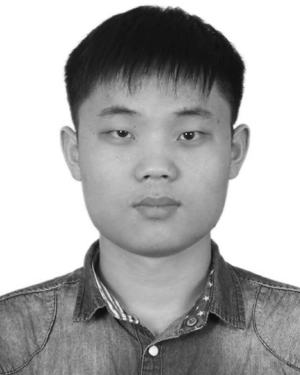 Shuaitao Zhang合作论文数1
 Qi Liu (刘淇)合作论文数School of Data Science, University of Science and Technology of China;State Key Laboratory of Cognitive Intelligence, School of Computer Science and Technology, University of Science and Technology of China;Anhui Province Key Laboratory of Big Data Analysis and Application, School of Computer Science and Technology, University of Science and Technology of China1
 Mingli Song (宋明黎)合作论文数College of Computer Science and Technology, Zhejiang University;Hangzhou City University1
 Feng Tian (田枫)合作论文数School of Computer & Information Technology, Northeast Petroleum University1
 Canjie Luo合作论文数ByteDance Inc.1
 Tong He (贺通)合作论文数Shanghai AI Lab1
 Guozhi Tang合作论文数ByteDance Inc.1
 Lixin Fan合作论文数WeBank AI, Shenzhen, China1
 Hengshuang Zhao (赵恒爽)合作论文数Division of AI & Data Science, School of Computing and Data Science, The University of Hong Kong1
 Hao Chen (陈昊)合作论文数The State Key Laboratory of Cad&cg, College of Computer Science and Technology, Zhejiang University1
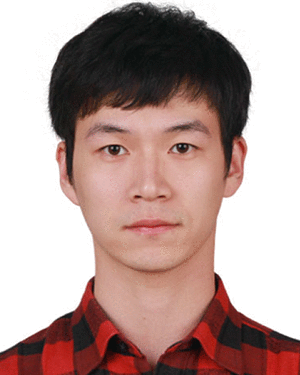 Hao Liu (刘皓)合作论文数ByteDance Inc.1
 Yaohua Yi (易尧华)合作论文数Wuhan University1
 Chun Chen (陈纯)合作论文数College of Computer Science and Technology, Zhejiang University1
 Ling Fu (付玲)合作论文数Britton Chance Center for Biomedical Photonics, Wuhan National Laboratory for Optoelectronics, Huazhong University of Science and Technology;School of Engineering Sciences, Huazhong University of Science and Technology;Key Laboratory of Biomedical Photonics of Ministry of Education, Huazhong University of Science and Technology1




