Vision Transformers (ViTs) have exhibited exceptional performance across diverse computer vision tasks, while their substantial parameter size incurs significantly increased memory and computational demands, impeding effective inference on resource-constrained devices. Quantization has emerged as a promising solution to mitigate these challenges, yet existing methods still suffer from significant accuracy loss at low-bit. We attribute this issue to the distinctive distributions of post-LayerNorm and post-GELU activations within ViTs, rendering conventional hardware-friendly quantizers ineffective, particularly in low-bit scenarios. To address this issue, we propose a novel framework called Activation-Distribution-Friendly post-training Quantization for Vision Transformers, ADFQ-ViT. Concretely, we introduce the Per-Patch Outlier-aware Quantizer to tackle irregular outliers in post-LayerNorm activations. This quantizer refines the granularity of the uniform quantizer to a per-patch level while retaining a minimal subset of values exceeding a threshold at full-precision. To handle the non-uniform distributions of post-GELU activations between positive and negative regions, we design the Shift-Log2 Quantizer, which shifts all elements to the positive region and then applies log2 quantization. Moreover, we present the Attention-score enhanced Module-wise Optimization which adjusts the parameters of each quantizer by reconstructing errors to further mitigate quantization error. Extensive experiments demonstrate ADFQ-ViT provides significant improvements over various baselines in image classification, object detection, and instance segmentation tasks at 4-bit. Specifically, when quantizing the ViT-B model to 4-bit, we achieve a 5.17% improvement in Top-1 accuracy on the ImageNet dataset. Our code is available at: https://github.com/llwx593/adfq-vit.git.
Protein language models are currently experiencing a surge in demand owing to their remarkable accuracy in protein structure prediction. Nevertheless, their applications are hindered by the significant computation and memory requirements. The existing optimization strategies primarily focus on computational efficiency while often neglecting memory optimization, thereby restricting their suitability for devices with limited resources. In this paper, we propose MEFold, a novel memory-efficient optimization framework for protein language models that enables efficient inference on resource-constrained devices. MEFold consists of Look-up Table Chunk and Fine-grained Quantization. Look-up Table Chunk reduces the memory of intermediate activations by chunk and avoids the overhead of obtaining the optimal chunk size configuration through pre-computing. For the memory of model parameters, Fine-grained Quantization, delicately controls the scope of quantization to ensure that memory reduction is achieved while preventing declines in accuracy and computational speed. Experimental results show that, compared to the original model, for protein sequences ranging from 74 to 1024 in length, our method significantly reduces the peak memory during inference from 14.7-54.2GB to 6.0-14.4GB, while minimizing the impact on inference latency. On CASP14 and CAMEO datasets, the accuracy loss compared to the original model is below 1%. Moreover, our optimization provides various memory-saving alternatives. Our code is available at https://github.com/llwx593/MEFold.
Deep learning frameworks are powerful tools to support model training. They dispatch operators by mapping them into a series of kernel functions and launching these kernel functions to specialized devices such as GPUs. However, there is little known about the performance of dispatching and mapping mechanisms in different frameworks, although these mechanisms directly affect training time. This paper presents a performance evaluation in various frameworks by examining their kernel function efficiency and operator dispatching mechanisms. We introduce two evaluation metrics, device computing time (DCT) and device occupancy ratio (DOR), based on the device’s active and idle states. To ensure comparable evaluation results, we propose a three-step verification method including hyper-parameter, model, and updating method equivalences. Due to inequivalent implementations in frameworks, we present an equivalence adjustment method based on the number of operators. Our evaluation results demonstrate the device utilization capability of five frameworks, namely PyTorch, TensorFlow 1, TensorFlow 2, MXNet, and PaddlePaddle, and reveal the potential for further optimizing the training performance of deep learning frameworks.
Recent advancements in unsupervised protein language models (ProteinLMs), like ESM-1b and ESM-2, have shown promise in different protein prediction tasks. However, these models face challenges due to their high computational demands, significant memory needs, and latency, restricting their usage on devices with limited resources. To tackle this, we explore post-training quantization (PTQ) for ProteinLMs, focusing on ESMFold, a simplified version of AlphaFold based on ESM-2 ProteinLM. Our study is the first attempt to quantize all weights and activations of ProteinLMs. We observed that the typical uniform quantization method performs poorly on ESMFold, causing a significant drop in TM-Score when using 8-bit quantization. We conducted extensive quantization experiments, uncovering unique challenges associated with ESMFold, particularly highly asymmetric activation ranges before Layer Normalization, making representation difficult using low-bit fixed-point formats. To address these challenges, we propose a new PTQ method for ProteinLMs, utilizing piecewise linear quantization for asymmetric activation values to ensure accurate approximation. We demonstrated the effectiveness of our method in protein structure prediction tasks, demonstrating that ESMFold can be accurately quantized to low-bit widths without compromising accuracy. Additionally, we applied our method to the contact prediction task, showcasing its versatility. In summary, our study introduces an innovative PTQ method for ProteinLMs, addressing specific quantization challenges and potentially leading to the development of more efficient ProteinLMs with significant implications for various protein-related applications.
For person re-identification (Re-ID) task, most of previous studies assumed that the pedestrians do not change their appearances. The works on cross-appearance Re-ID, including datasets and algorithms, are still few. Therefore, this paper contributes a cross-season appearance change Re-ID dataset, namely NKUP+, including more than 300 IDs from surveillance videos over 10 months, to support the studies of the cross-appearance Re-ID. In addition, we propose a network named M2Net, which integrates multi-modality features from the RGB images, contour images and human parsing images. By ignoring irrelevant misleading information for cross-appearance retrieval in RGB images, M2Net can learn features that are robust to appearance changes. Meanwhile, we propose a sampling strategy called RAS to contain a variety of appearances in one batch. And appearance loss and multi-appearance loss are designed to guide the network to learn both same-appearance and cross-appearance features. Finally, we evaluated our method on NKUP+/PRCC/DeepChange datasets, and the results showed that, compared with the baseline, our method renders significant improvement, leading to the state-of-the-art performance over other methods. Our dataset is available at https://github.com/nkicsl/NKUP-dataset.
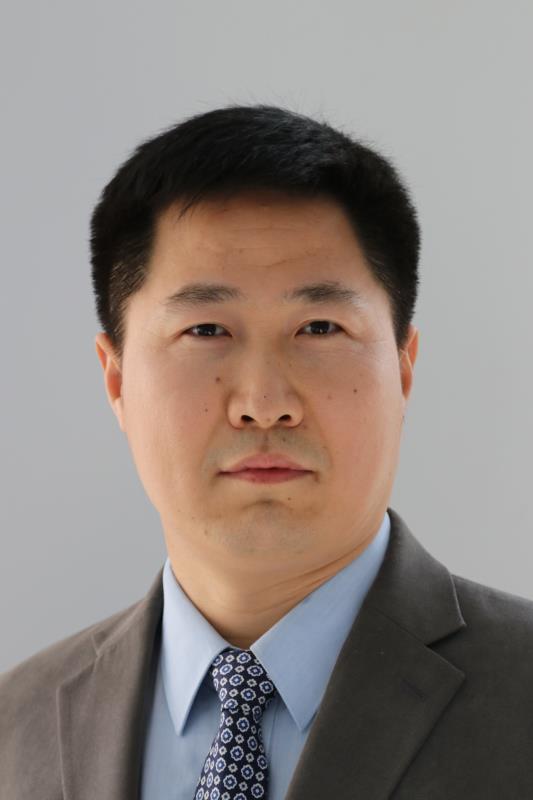 Tao Li (李涛)合作论文数College of Computer Science, Nankai University4
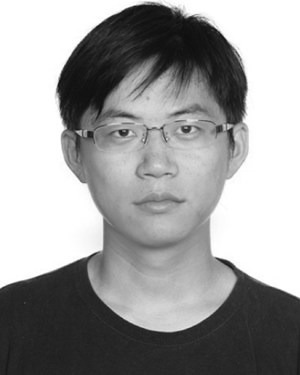 Fei Yang (fei yang 杨 非)合作论文数3
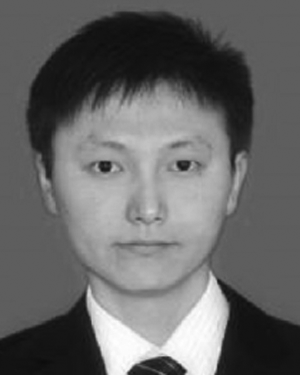 Xueshuo Xie合作论文数Nankai Univ, Coll Comp Sci, Tianjin, Peoples R China2
 Shuang PENG (彭爽)合作论文数2Aimin Pan合作论文数1Chengkun Du合作论文数1Zhi Ma合作论文数1Mengmeng Liu合作论文数1
 Yi Zhang (张毅)合作论文数The Second Clinical College of Wuhan University1Sun Ning合作论文数1Chen Sheng合作论文数3Lenovo Research AI Lab1
 Kai Wang (王锴)合作论文数School of Computing, National University of Singapore;High Performance Computing for Artificial Intelligence Lab, National University of Singapore1




