A variety of electronic products are in daily use to serve a variety of needs. Electronic products require different types of cable harnesses for production. Nowadays, user preferences vary and change quickly. Therefore, a variety of small-volume products are made, and producing various kinds of complex harnesses to satisfy people’s needs is difficult. In robotic automation, the wiring harness assembly process in the manufacturing of deformable objects is challenging. Because of the characteristics of a deformable object, the manufacturing task cannot be standardized. However, relying solely on image sensors is not advisable, due to the challenges involved in recognizing complex cables with image sensors. Additionally, even when cable recognition is possible, it requires too much time. To address these issues, this paper introduces a strategic algorithm for the wiring harness assembly process. The algorithm minimizes the dependence on image sensors by enabling the use of a robotic dual-arm system. The proposed method includes techniques such as cable estimation, frictional models, and trajectory planning in the algorithms. On the basis of these methods, for a provided assembly board, the algorithm outputs a systematic process for wiring harness assembly. Experimental results validate the algorithm, demonstrating its good performance.
This paper proposes a generalized method for designing tendon-driven serial-chained manipulators with an arbitrary number of tendon redundancy. First, a special class of tendon-driven structures is defined by introducing the controllable block triangular form (CBTF) of a null space matrix and its complementary CBTF of a structure matrix, satisfying physical constraints related to the minimal connection of tendons and to the placement of actuators. Then it is shown that any general design of tendon-driven serial manipulators can be reduced to the design of such a special class of tendon-driven structures. Two associated design problems are derived and solved. The first design problem is about finding a complementary CBTF structure matrix for a given CBTF null space matrix using algebraic relations, whereas the second one seeks the both matrices that optimize the wanted structural characteristics based on the result of the first design problem. Numerical design examples are provided to show the validity of the proposed method.
Stair climbing is necessary to improve the convenience of electric wheelchairs. An important issue in developing a climbable wheelchair is stability and speed during climbing. In this work, tri-wheel and supporting leg were adopted in the stair climbing method for high speed and stable posture. Based on the mechanical and static analyses of the climbing mechanism, the design method of the wheel cluster system was expressed as equations. These equations were proposed considering the design parameters that ensure the continuity and stability of the climbing motion. Moreover, the collision information between the stairs and the cluster system during the climbing motion was included in those equations. A validation test of the stair climbing mechanism was performed by manufacturing a prototype of 750 ( W ) x 800( D ) x 1,000( H ) mm 3 and 120 kg . The experimental verification proved that the electric wheelchair can stably go up and down the stairs under extreme conditions (stair width = 300 mm , stair height = 180 mm ) at a speed of 10 steps/min.
This article proposes a novel differential kinematics of elastic tendons for tendon-driven manipulators where tendons transmit actuator force/torque to remote links via a train of pulleys. The local variability of tension and longitudinal speed in each tendon is carefully investigated in terms of the rest lengths of the virtually partitioned tendon segments along the tendon. A significant attention is paid to building a proper friction-tension mechanic model between the pulleys and tendons to identify the no-slip points that are important to be used as kinematic constraints. The kinematic relations of tendon are obtained for two possible types of tendon-pulley transmission, i.e., free-free ended and fixed-free ended types, and then a complete kinematics of tendon is formulated by augmenting all the kinematic relations existing in the entire system. Simulation and experimental results are provided to validate the proposed kinematics of tendon by comparing with a previous simple spring model where the tension was determined by the relative positions of consecutive pulleys.
In this work, structural synthesis of lower-mobility cable-driven parallel mechanisms (CDPMs) is conducted to clearly identify all feasible structures of the lower-mobility CDPMs with n-degrees-of-freedom, which are driven by n +1 cables fixed on the ground. Through the synthesis, geometric information of various and some new promising structures of unconstrained and constrained lower-mobility CDPMs such as actuation cable wrenches, cable position vector, and required constraint wrenches, are successfully extracted. Then a promising 3T1R type CDPM structure is selected to develop as a haptic device. Its position analysis is conducted and its input-to-output force model is derived. Also, its feasible workspace and its input-to-output force transmission characteristics are examined. Then a prototype haptic device is implemented which is controlled by Raspberry Pi microprocessors. Through a virtual wall following operation by the operator, its operational capability as a haptic device is verified.
In this paper, a new mechanical design for the human-like shoulder complex is proposed by using traditional mechanical elements such as links, plates, joints and tendons. The characteristics of the musculoskeletal structure of the human shoulder complex is realized into the design so that the mechanical scapula can reproduce elevation, depression, protraction, retraction, and two rotations. A rigorous kinematic and dynamic modeling for the proposed design is provided. Then, the validity of the proposed design and its modeling is verified by comparing the movements between the human shoulder complex and its mechanical counterpart.
A numerically efficient force distribution method for actuator saturation avoidance is proposed, which is applicable to two different types of the mechanisms with two degrees of actuator redundancy, parallel mechanism (PM) and cable-driven parallel mechanism (CDPM). The proposed method searches the optimal force solutions based on their geometric interpretation. Each actuator force with two degrees of actuator redundancy is expressed as a plane equation with respect to two intermediate variables. Thus, the optimal forces are found by searching for both the intersections between force planes and the common intersection points among those force planes. The proposed method for each of PM and CDPM is described. Then for two different exemplary mechanisms, the 2 T 2 R -type 4 -DOF CDPM with six actuation cables and for the 2 T 1 R -type planar 3- DOF PM with five active joints, comparative simulations moving along the spiral trajectory are conducted, employing three different methods, the proposed method and the other two typical off-line methods, the interior point method and the linear matrix inequality method. It is confirmed from those simulation results that the computational efficiency of the proposed method in finding their desired optimal force solutions is superior to the ones of the other two typical offline optimal searching methods and also sufficiently fast enough in real time applications.
This paper addresses a numerical method to solve the time-optimal control of a two-mass spring system with a continuous path constraint. A time optimal problem is first formulated in continuous domain and then it is transcribed into a finite dimensional approximate one. The pseudo-spectral method is used to numerically solve the optimal solution. The validity is confirmed via numerical simulation.
In this paper, a new kinematic calibration method that takes into consideration the effect of joint compliance in robot manipulators is proposed. A modified product-of-exponential (POE) kinematic model is formulated in such a way that it accommodates static joint deflection by gravitational force. A novel nonlinear cost function is constructed by combining the modified POE kinematic model and the end point measurements of the deflected circular trajectory, so that the kinematic screw and joint compliance are simultaneously identified after minimizing the cost function. An in-depth discussion of how to select a good reference configuration for better parameter identification is also given. Simulation and experimental results are provided to demonstrate the effectiveness of the proposed kinematic calibration method for an industrial 6-DOF (degree-of-freedom) robot manipulator and a custom 9-DOF robot manipulator.
This paper propose a novel method for designing N + α open-ended serial tendon-driven mechanism (STDM). The design method starts from assigning a set of desired null space bases and from these the structure matrix is optimized so that the mechanism's actuation capability is maximized. An illustrative synthesis example is provided.
In this paper, a new kinematic parameter calibration method is proposed for robot manipulators having elastic joints. Kinematic screw and compliance parameters are identified through the proposed calibration procedure, so that an enhanced kinematic accuracy is achieved. Traditional circular point analysis is modified to cope with new product-of-exponential (POE) kinematic model that accounts for joint deflection. Simulation result is provided to validate the proposed kinematic calibration method.
Demands for human-robot collaboration in production line has increased and the problem of safety in robot becomes more and more important. This paper presents a manipulator with counterbalancing mechanism to secure safety of a human worker in human-robot collaboration environment by reducing a needed power to drive a manipulator. A counterbalancing torque to cancel out a gravitational torque was generated by a restoring force of spring. Also a control algorithm to minimize the effect of spring on tracking performance was proposed. Experimental results were suggested to verify the performance of the proposed method.
This paper presents a new antagonistic tendon-driven joint (TDJ) which has an advantage of enhanced stiffness characteristics. Detailed mathematical analyses on the stiffness of typical TDJs are worked out to compare the stiffness among them. Prototypes of the proposed TDJ design are introduced in the form of packaged modular structure that merges two TDJs generating a combined roll-pitch motion or similar ones. Numerical examples are given to confirm the superior stiffness of the proposed TDJ design.
This paper addresses the kinematic analysis of tendon driven manipulator for handling heavy weight. Contrary to elementary N, N + 1 or 2N type tendon manipulators, this paper propose a specific N + 2 type robot manipulator for handling heavy weight. Necessary kinematics and statics issues are discussed. A more extended N + a type can be designed if more freedom for load distribution to tendons is sought. Numerical examples are given to confirm the validity of the analysis.
This paper provides an approach for dynamic analysis of tensegrity systems subject to arbitrary joint constraints. Advantages of non-minimal dynamics including the simplicity of formulation and scalability are enjoyed. Due to the generality of the formulation, we can create a software module that can carry out dynamic simulation of numerous tensegrity systems. To illustrate the effectiveness of the proposed dynamics formulation, we show simulation results for a deployable tensegrity structure and a multi-stage tensegrity prism under various types of joint constraints such as pin, revolute, and planar types.
This paper provides a numerical correction algorithm for implementation of the dynamics of tensegrity systems described by non-minimal coordinates. This correction algorithm corrects any numerical error that would violate the fixed-length bar constraints. A recursive form of the correction algorithm is proposed, and simulation results support the validity of the proposed scheme. (C) 2014 Elsevier Ltd. All rights reserved.
Tendon driven robot mechanisms have many advantages such as allowing miniaturization and light-weight designs and/or enhancing flexibility in the design of structures. When designing or analyzing tendon driven mechanisms, it is important to determine how the tendons should be connected and whether the designed mechanism is easily controllable. Graph representation is useful to view and analyze such tendon driven mechanisms that are complicatedly interconnected between mechanical elements. In this paper, we propose a method of generalized graph representation that provides us with an intuitive analysis tool not only for tendon driven manipulators, but also various other kinds of mechanical systems which are combined with tendons. This method leads us to easily obtain structure matrix - which is the one of the most important steps in analyzing tendon driven mechanisms.
We propose an approach for the exact dynamic inversion of singularly perturbed second-order linear systems through asymptotic expansion in a singular parameter. We show that the inversion solution, corresponding to the invariant slow manifold, can be expressed as a converging infinite series under desired output constraints composed of exponential support functions in the complex domain. We provide systematic mathematical procedures to obtain the closed-form invariant slow manifold, along with required admissible boundary conditions. Numerical examples are given to validate the proposed approach.
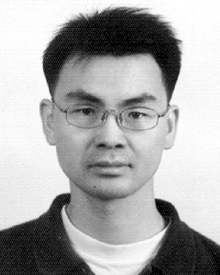 Joono Cheong合作论文数19
 Bongki Kang合作论文数Korea Univ, Dept Control & Instrumentat Engn, Sejong 312700, South Korea3
 Jongwoo Park合作论文数Korea Inst Machinery & Mat, Dept Robot & Mechatron, Daejeon 34103, South Korea3
 Hyun-hwan Jeong合作论文数3
 Byung-Ju Yi合作论文数School of Electrical Engineering and Computer Science, Hanyang University, Ansan, Korea3
 Dongil Park合作论文数3
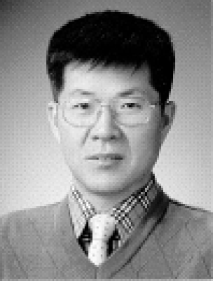 Whee Kuk Kim合作论文数3
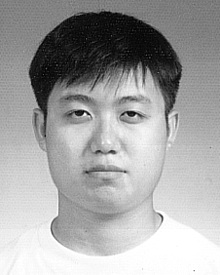 Hyunmin Do合作论文数3
 Son Young-Su合作论文数3
 Chanhun Park合作论文数Dept Robot & Mechatron, Korea Inst Machinery & Mat3
 Munyu Kim合作论文数2Doo-Hyeong Kim合作论文数2Jinho Kyung合作论文数1
 Hyunuk Seo合作论文数1Hyunmok Jung合作论文数1
 Da-Woon Jeong合作论文数Korea Inst Ind Technol, Korea Russia Innovat Ctr1
 Hwi-Su Kim合作论文数Korea Inst Machinery & Mat, Dept Robot & Mechatron, Daejeon 34103, South Korea1
 Song Sung-Hyuk合作论文数1
 Byung-In Kim合作论文数Department of Industrial and Management Engineering, Pohang University of Science and Technology (POSTECH),1
 Jeongdo Ahn合作论文数1Min Gun Kim合作论文数1
 Byung-Kil Han合作论文数1
 Seung-Ik Lee合作论文数1




