Deep unfolding networks (DUNs), which offer strong interpretability, have gradually attracted increasing attention in seismic data reconstruction. Most existing DUN approaches are limited to unfolding in the time-space (t-x) domain, making it difficult to fully exploit the multiscale features of seismic signals, thereby decreasing reconstruction performance and often leading to the loss of fine details. To overcome the above limitation, a dual-domain optimization framework is proposed, in which the traditional iterative process is replaced by neural networks, yielding a dual-domain deep unfolding network (D3U-Net) based on implicit regularization. The proposed method combines prior information from both the t-x domain and the wavelet domain, guiding the network to simultaneously capture spatial structural information and frequency characteristics at each stage, thus achieving cooperative reconstruction in both domains and enhancing detail recovery. Meanwhile, an implicit regularization mechanism is introduced, where a learnable neural network substitutes the conventional proximal mapping operator and does not require manual specification of the weights of the regularization term, simplifying the tuning process and endowing the network with greater flexibility and adaptability. Experiments conducted on synthetic data, the BP2004 dataset, and field marine seismic data demonstrate that D3U-Net achieves superior reconstruction accuracy and stability under both regular and random seismic-trace missing scenarios compared with current state-of-the-art methods, confirming overall advantages in reconstruction fidelity, generalization capability, and interpretability.
A novel seabed-controlled source electromagnetic (CSEM) detection system is adopted to enhance signal strength and improve the detection of small-scale high-conductivity hydrothermal sulfides. The system integrates a seated-bottom transmitting coil and borehole receiving system for refined detection with minimal signal attenuation. Due to spatial constraints and limited power in the seabed environment, increasing the transmitting coil size and power capacity is not feasible. Additionally, the highly inductive transmitting coil causes reactive power and suppression of multifrequency excitation currents. To address these issues, a multifrequency resonance matching (MFRM) network is introduced, enabling dynamic impedance matching for inductive loads under broadband frequency conditions. This solution boosts the transmitting current strength without requiring higher voltage or power capacity. This article presents the system composition, topology, and impedance performance analysis, along with a control strategy for effective signal transmission. Laboratory and seawater tank experiments validate the feasibility, demonstrating over 104 % improvement in the main frequency current amplitude and a higher signal-to-noise ratio (SNR) compared to the system without impedance matching.
The marine vibrators (MVibs) have become indispensable in marine industrial exploration due to its controllable energy output, high repeatability, and environmental compatibility. MVib-based blended acquisition improves exploration efficiency by reducing sampling duration and operational costs, but it introduces significant challenges in source separation due to blending noise. Since the subsequent processing method of MVibs require precorrelation data, this article presents a deblending framework for precorrelation MVib data by integrating a prior network into the inversion framework. To address the scarcity of labeled MVib data for deep learning, a data augmentation strategy is proposed in which natural images are converted into seismic-like data using band-pass filtering to train the prior network. This approach enhances model generalization and alleviates the limitations of MVib datasets. The proposed framework is validated through multi-MVib simulations and large scale open sea trials. Experimental results demonstrate that the method effectively suppresses blending noise while preserving key signal features, outperforming conventional deblending techniques and demonstrating strong practical value in real-world marine exploration.
Due to limitations in exploration costs and surface conditions, actual seismic data are often sparsely sampled and exhibit irregular coverage, which weakens the effects of migration imaging and wavefield inversion, thereby reducing the accuracy and reliability of geological interpretation. Deep learning, particularly generative adversarial networks (GANs), has shown considerable promise in seismic data reconstruction. However, existing GAN-based methods often suffer from limitations such as restricted feature extraction, blurring and artifacts. Additionally, 2D networks struggle to capture the spatiotemporal correlations of 3D seismic data, leading to inter-layer inconsistencies and the loss of critical tectonic features, which ultimately limits overall reconstruction quality. To address complex missing-data patterns in seismic datasets, this study proposes a 3D generative adversarial network integrating a Global Grouped Coordinate Attention (GGCA-GAN). The proposed network employs group-based feature modeling and, by jointly training on natural images and real seismic data, achieves high-resolution 3D seismic reconstruction with moderate robustness to noise. This method further reduces computational overhead by enhancing global spatial feature extraction in both the generator and discriminator via grouped processing. In addition, to address the scarcity of training data under limited observation conditions, natural image datasets are incorporated into the network training process. Their structural features are used to construct cross-domain priors, which, when combined with measured seismic data, enhance the network’s ability to generalize to complex seismic signals. The effectiveness of the proposed method is validated on publicly available datasets.
Abstract Full waveform inversion (FWI) is a powerful technique for building high-resolution subsurface models, but it is fundamentally ill-posed. Traditional FWI cannot quantify uncertainties arising from noise, modeling errors, the intrinsic high nonlinearity, and other sources. In Bayesian inference, Markov chain Monte Carlo (MCMC) methods facilitate direct sampling from the posterior distribution to resolve these concerns. However, MCMC approaches are slow to converge and inefficient for exploration in high-dimensional spaces due to the complex posterior distribution in FWI. In this study, we develop an uncertainty quantification framework for Bayesian FWI based on underdamped Langevin dynamics, which adds momentum and inertia to sample trajectories, allowing for more efficient posterior exploration. We implement two splitting schemes, Strang splitting and OBABO splitting (named after the sequence of operator applications in underdamped Langevin dynamics), to discretize the stochastic differential equations (SDE). These splitting methods divide the Langevin dynamics into simpler components, each of which can be solved more accurately, and can then be recombined. This reduces discretization errors and improves stability, allowing more efficient sampling. We validate the proposed approach through numerical experiments on two examples. The results show that our methods can effectively explore high-probability regions of the posterior distribution, enabling reliable estimation of posterior means, variances, and marginal probability densities for uncertainty quantification. The Strang splitting scheme exhibits a slightly faster convergence rate and lower computational overhead. Overall, at an acceptable computational cost, our methods achieve rapid convergence, provide robust uncertainty quantification, and yield posterior statistics that are largely insensitive to the choice of initial model.
Seismic traveltime is a crucial seismic attribute that directly influences the computational accuracy and efficiency of various seismic processing and interpretation methods. The Fast Marching Method (FMM) is an accurate and stable finite-difference approach for calculating seismic traveltime. However, when applied to three-dimensional models, its computational efficiency becomes a major limitation. To address this issue, this paper proposes an efficient traveltime computation algorithm that integrates coarse-grid interpolation with the FMM. The proposed method first computes the global traveltime field on a coarse grid using FMM, then refines the results to a fine grid across the entire domain via cubic spline interpolation. Both theoretical analysis and numerical experiments demonstrate that the proposed approach preserves the unconditional stability of the FMM while significantly reducing memory consumption and computational time by combining coarse-grid computation with interpolation-based refinement.
Marine vibrators (MVibs) show great potential for marine seismic exploration due to their environmental friendliness, controllable source signatures, and high signal fidelity. However, in practical acquisition, MVib data often exhibit insufficient resolution as a result of stratigraphic absorption and the attenuation of both low- and high-frequency components. To address this limitation, we propose MVibDiff, a conditional diffusion-based method for resolution enhancement of MVib data. First, we propose a conditional diffusion-based reconstruction framework, where low-resolution seismic records serve as conditional inputs and a denoising diffusion implicit model (DDIM) gradually reconstructs high-resolution seismic representations. Second, within this framework, we design a multiscale noise prediction network that integrates ResNet blocks (REBs) with seismic feature refinement attention (SFRA) and multiscale SFRA (MSFRA) modules to recover fine-scale reflection details and model long-range structural dependencies in seismic sections. Finally, we introduce a joint optimization objective that combines a simplified mean-squared error loss with a variational lower bound, together with a pyramid-based weighted aggregation strategy, to ensure structurally consistent reconstruction of large-scale seismic sections. Experimental results on both synthetic and field datasets demonstrate that the proposed method consistently outperforms baseline approaches, while field applications further confirm its robustness and effectiveness under complex geological conditions.
Based on the observational data from 60 short-period stations deployed in the Jishishan M6.2 earthquake epicenter and adjacent regions (Gansu Province, 2023), this study inverted the near-surface S-wave velocity structure through teleseismic receiver function analysis by using the amplitude of direct P-wave. The results reveal that the epicentral area (Liugou Township and surroundings) exhibits markedly low S-wave velocities of 400-600 m/s, with a mean value of (500 ± 50) m/s. In contrast, intermountain basins—Guanting Basin and Dahejia Basin—demonstrate significantly elevated velocities, exceeding the epicentral zone by 100–300 m/s, with values concentrated at 600–900 m/s. Notably, localized areas such as Jintian Village and Caotan Village maintain stable S-wave velocities of (700 ± 30) m/s.The western margin tectonic belt of Jishishan displays distinctive velocity diff erentiation: A pronounced velocity gradient zone along the 35.8°N latitude boundary separates northern areas (<550 m/s) from southern regions (>750 m/s). These findings demonstrate significant spatial heterogeneity in shallow S-wave velocity structures, primarily controlled by three factors: (1) topographic-geomorphic units, (2) stratigraphic lithological contrasts, and (3) anthropogenic modifications. The persistent low-velocity anomalies (<600 m/s) in the epicentral zone and northern Yellow River T2 terrace likely correlate with Quaternary unconsolidated sediments, enhanced groundwater circulation, and bedrock weathering.These results provide critical geophysical constraints for understanding both the seismogenic environment of the Jishishan earthquake and its damage distribution patterns. Furthermore, they establish a foundational framework for regional seismic intensity evaluation, site amplification analysis, and secondary hazard risk assessment.
Marine vibrators (MVibs) are increasingly used in seismic surveys due to their precise waveform control, flexible signal design, environmental friendliness, and enhanced low-frequency output. However, their long-duration pilot sweeps introduce challenges not present with traditional airguns-most notably, the Doppler effect. The simulation or correction of phase distortion can be achieved using frequency-wavenumber (F-K) domain dephasing operator equation based on the instantaneous frequency function, while they require sufficient spatial sampling to get a reliable effect. Besides, as a typical coherent noise source, the removal of surface-related multiples greatly determines seismic imaging quality. Although the surface-related multiple elimination (SRME) scheme can suppress the interference, moderate phase, timing, and amplitude errors, clutter in predicted signal components is detrimental. We propose a Bayesian primary-multiple separation and Doppler-shift correction iterative framework that assumes the predictions from SRME-type techniques are approximately independent in the shearlet domain and robustly corrects and separates them. In our approach, the energy mismatch between separated and predicted components is effectively controlled. Synthetic and field data examples have shown that its key advancements include: 1) the F-K domain phase distortion operator based on the instantaneous frequency function cleverly matches with the shearlet dictionary to simulate source motion in the sparsity-promoting inversion, reducing computational costs by 35.02%; 2) the introduction of linear moveout (LMO) overcomes the sensitivity of Doppler-shift correction to spatial aliasing and achieves a 18.0742-dB signal-to-noise ratio (SNR) improvement in phase correction; and 3) an improved threshold function is proposed to optimize primary-multiple separation, aiming at the shortcomings of the traditional ones. It outperforms the hard and soft threshold functions regarding average SNR, with improvements of 0.97% and 6.21%, respectively. Our approach only requires about ten iterations to attain the converged solution.
As an alternative seismic source, marine vibrators (MVibs) have many advantages over airgun arrays in terms of marine acquisition, such as environmental friendliness, good waveform control level, repeatability, and rich low-frequency energy output. However, they create a series of unique processing and imaging difficulties: the Doppler shift and the time-dependent source-receiver offsets specific to ocean bottom node (OBN) acquisition, which go against the assumption of stationary geometry in standard seismic processing and imaging techniques. Not considering geometry motion effects in seismic imaging not only brings phase change and mispositioning into the imaged structure but also leads to reflectivity errors and apparent poor illumination. We develop a least-squares reverse time migration (LSRTM) method that considers geometry motion effects. First, we propose a highly productive Born forward strategy for simulating moving sources scattered wavefield, which is accomplished by combining the Born approximation theory with the sweep segmentation and compression approach that models moving sources. Then, the proposed moving sources Born forward operator and a time-variant spatial convolution operator describing receiver motion are deployed in a least-squares misfit function to achieve accurate imaging of Doppler-shifted MVib data acquired by different acquisition devices (i.e., OBN or towed-streamer). We reveal the new misfit function gradient based on the adjoint-state method. Our approach effectively avoids any spatial aliasing issues encountered by Doppler-shift correction, granting assurance for imaging accuracy. Optimization methods are deployable when the inversion problem is highly nonlinear and ill-posed. Synthetic and field data examples demonstrate that our approach can construct an accurate estimate of reflectivity models even when the geometry is in intense motion.
Thickness measurement plays an important role in the monitoring of pipeline corrosion damage. However, the requirement for prior knowledge of the shear wave velocity in the pipeline material for popular ultrasonic thickness measurement limits its widespread application. This paper proposes a method that utilizes cylindrical shear horizontal (SH) guided waves to estimate pipeline thickness without prior knowledge of shear wave velocity. The inversion formulas are derived from the dispersion of higher-order modes with the high-frequency approximation. The waveform of the example problems is simulated using the real-axis integral method. The data points on the dispersion curves are processed in the frequency domain using the wave-number method. These extracted data are then substituted into the derived formulas. The results verify that employing higher-order SH guided waves for the evaluation of thickness and shear wave velocity yields less than 1% error. This method can be applied to both metallic and non-metallic pipelines, thus opening new possibilities for health monitoring of pipeline structures.
In the safety evaluation of engineering sites, the average shear velocity in the upper 30 m (Vs30) is widely adopted for engineering sites classification for decades. However, it often suffers from challenges such as estimating the seismic response of certain sites as deep and thick soil deposits. In order not to be limited to surface effects, but to fully take into account the real impedance contrast between soil and bedrock, a dual-source (active and passive sources) surface wave joint analysis method with multiple modes dispersion curves is proposed to determine deeper shear wave velocity profiles. Firstly, an improved frequency-wavenumber method is developed to extract the multiple modes dispersion curves of active sources data, which utilizes the exponential moving average algorithm with deviation correction to weight the moving average of the amplitude values of the active source dispersion spectrum normalized along the frequency direction. While ensuring the computational efficiency, it better balances the dispersive energy of different modes surface wave. Secondly, the frequency-Bessel transform method is utilized to extract the dispersion curves of passive sources data, which proves the effectiveness for higher mode surface wave. Finally, the multiple modes dual-source dispersion curves were used to construct the shear wave velocity profile in the central depression. The shear wave velocity profile reveals the thickness and layering of sediments in the study area. The effective interpretation depth is over 80 m with some areas reaching nearly 120 m. These results indicate the effectiveness of the proposed method for the characterization ability of the deeper shear wave velocity profile as well as the potential for thick soil sites classification applications.
Marine vibrators have gained preference in seismic acquisition recently due to their superior waveform control, repeatability, and reduced environmental impact. Such sources excite for several seconds, while the source vessel is moving, thereby creating the Doppler effect. Phase corrections for the Doppler shift can be achieved through deconvolution techniques. They assume using extensions of the standard convolutional model to model geometry motion. However, such operations generate aliasing artifacts under coarse spatial sampling. Additionally, due to incomplete and uneven coverage of acquisition systems and dead traces, real seismic data always have some missing traces, which affects the performance of multichannel algorithms such as multiple separations, wave-equation-based imaging, inversion, and Doppler-shift correction. To remedy these issues, a new derivation of the weighted projection onto convex sets (WPOCS) reconstruction and Doppler-shift correction method is presented from the iterative shrinkage-thresholding (IST) algorithm, under the sparsity constraint. It interpolates, corrects for the Doppler shift, and denoises irregularly sampled marine vibrator data simultaneously in a sparse inversion framework that promotes sparsity of the data in a 3-D curvelet domain. To prevent alias in the transform domain thus achieving arbitrary undersampling rate, an improved jittered undersampling method is proposed, leading to high-fidelity wavefield reconstruction and precise Doppler-shift correction during the sparsity-promoting process. Moreover, a weighted trace reinsertion strategy is defined to facilitate denoising noisy seismic volumes. Finally, aiming at the shortcomings of the traditional threshold functions, we propose an improved threshold function to better implement noise attenuation and wavefield reconstruction. Synthetic and field data examples verify our approach's effectiveness.
Reverse time migration (RTM) is a well-established imaging technique that uses the two-way wave equation to achieve high-resolution imaging of complex subsurface media. However, when using RTM for reverse time extrapolation, a source wavefield needs to be stored for cross-correlation with the backward wavefield. This requirement results in a significant storage burden on computer memory. This paper introduces a wavefield reconstruction method that combines sparse representation to compress a substantial amount of crucial information in the source wavefield. The method uses the K-SVD algorithm to train an adaptive dictionary, learned from a training dataset consisting of wavefield image patches. For each timestep, the source wavefield is divided into image patches, which are then transformed into a series of sparse coefficients using the trained dictionary via the batch-orthogonal matching pursuit algorithm, known for its accelerated sparse coding process. This novel method essentially attempts to transform the wavefield domain into the sparse domain to reduce the storage burden. We used several evaluation metrics to explore the impact of parameters on performance. We conducted numerical experiments using acoustic RTM and compared two RTM methods using checkpointing techniques with two strategies from our proposed method. Additionally, we extended the application of our method to elastic RTM. The conducted tests demonstrate that the method proposed in this paper can efficiently compress wavefield data, while considering both computational efficiency and reconstruction accuracy.
Marine vibrators have been favored by seismic acquisition in recent years because of their greater waveform control, repeatability, and lower environmental damage. However, it presents a processing challenge not found with airguns: the Doppler effect. The current industry standard method for source motion correction is based on spatiotemporal filtering or frequency–wavenumber (F-K) domain division. However, both correction methods generate spatial aliasing when the shot interval is coarse. The passage presents a deconvolution–interpolation method implemented in the F-K domain to correct moving marine vibrator data. By deploying a linear composite operator within the sparse inversion framework, including a mask function, an F-K domain convolution operator, a sampling matrix, and a dictionary mapping seismic data to a basis function, the method achieves interpolation, correction, and noise attenuation simultaneously of noisy Doppler-shifted marine vibrator data under coarse shot interval in the F-K domain. The power function threshold model is proposed to be deployed in the fast iterative soft-thresholding algorithm (FISTA) for inversion, thus leading to a substantial saving of iterations. Furthermore, the mask function preserves the effective spectrum during beyond-alias interpolation and denoising. Finally, the amount of observed data involved during the inversion process can be halved by utilizing the conjugate symmetry of the real signal Fourier transform. We demonstrate the impact of the Doppler effect and its correction under coarse shot interval on seismic data and structural imaging, while considering the interference of noise. Synthetic and field data examples verify the effectiveness of our method in mitigating the aforementioned disturbances.
Large-scale geologic structures with strong contrasts present difficulties for seismic imaging and inversion. Previously, direct envelope inversion (DEI) with ultralow frequency has been proposed to retrieve strong-contrast velocity models. However, the envelope signals lose the instantaneous phase of the original wavefield, resulting in erroneous seismic inversion results. To solve this problem, the instantaneous phase of the wavefield is encoded into envelopes for DEI. In this way, a polarized envelope is created to contain both abundant low frequencies and the instantaneous phase information of the original seismic waveform. Furthermore, to improve the resolution of deep regions underneath the strong reflections, we propose a phase-amplitude-based polarized direct envelope inversion (PA-PDEI) misfit in the time-frequency domain that uses an amplitude factor to emphasize the phase information. This makes it possible to adjust the amplitude influence and boost the low-amplitude seismic signals for deep targets. Tests on a model with a salt body and on field data show that combining the PA-PDEI with the phase-amplitude-based full-waveform inversion (PA-FWI) make it possible to reliably reconstruct velocity models, especially for deep regions, despite large and strong perturbations.
Due to the strong nonstationary characteristics of seismic signals, energy criteria-based methods are not robust for detecting moving targets, especially in data with low SNRs. To address this problem, we propose a new method for detecting ground moving target based on fractal dimension (FD) theory named FD-based support vector machine (FD-SVM). In this method, seismic signals are first measured by fractals, which can effectively extract seismic nonlinear features. These fractal features are then fed into an SVM to distinguish moving targets from noise. Two data sets are used to evaluate the proposed method. One is a set of seismic signals induced by wheeled and tracked vehicles. The other is a set of seismic signals generated by human footsteps. Experimental results demonstrate that the proposed FD-SVM algorithm achieves promising results on both data sets. Compared with the benchmark methods, the FD-SVM algorithm achieves a better precision rate, recall rate, and F1 score.
Suppressing random noise in seismic data is a significant problem in seismic data processing. Often, there is serious aliasing between the effective signal and random noise, affecting the identification of weak signals, and even resulting in great difficulties in the suppression of conventional seismic signals. We propose an improved attention-guided convolutional neural network (ADNet) to eliminate seismic interference noise. After a sufficient amount of training, the network removes noise by transferring seismic data features learned from a synthetic dataset to tests with complex field data. Our workflow consists of four parts. First, in the model, we improve the feature enhancement module (FEM) and attention module (AM), increase the convergence speed, and enhance the expressive ability. Second, we use 2-D synthetic data to verify the ability of the model to suppress noise in seismic records. Third, we use 2-D real seismic data to further verify the denoising effect of the improved ADNet. Fourth, we convert the 3-D simulated seismic data and field data into 2-D data for processing and reorganize the 2-D denoising results into 3-D data. By comparing the noise suppression outcomes of several classic denoising methods, simulations and actual experiments show that the improved ADNet effectively maintains the signal amplitude, reduces the network depth, and better suppresses seismic noise. Hence, we believe that our model can be widely applied in the field of seismic data processing.
针对传统数控铣削表面粗糙度预测模型泛化性差、精度较低等问题,提出了一种基于多源异构数据的数控铣削表面粗糙度预测方法.获取变工艺条件下数控铣削的工艺参数、刀具直径及工件材料等静态数据和振动信号、力信号及功率信号等动态数据;采用粒子群优化算法(PSO)优化卷积神经网络(CNN)的网络结构参数得到PSO-CNN;运用PSO-CNN自适应提取动态数据特征并对静态数据特征进行人工提取,再通过浅层神经网络融合动、静态数据等多源异构数据的特征,建立变工艺下的表面粗糙度预测模型;通过不同模型的预测性能对比试验,验证了该方法的优越性,并以两个工件加工过程为例,验证了该方法的有效性.
Surface monitoring of microseismic monitoring events is generally challenging because microseismic data have a low signal-to-noise ratio (SNR). Traditional event-detection methods struggle to detect weak microseismic events. A variance fractal dimension (VFD) method for automatic microseismic event detection via multitrace energy envelope stacking (MTEES) is introduced. In the first stage, we propose a processing microseismic data method based on the MTEES method. It increases the energy of weak microseismic data to avoid missed and false microseismic detection. Furthermore, it can greatly improve computational efficiency to satisfy real-time processing requirements. In the second stage, the VFD algorithm is applied to the data processed in the first stage to improve the feasibility and validity of microseismic event detection. A simulation test with perforation data shows the reliability of the new method in the automatic detection of microseismic events. In addition, we demonstrate that analogous results can be obtained when perforation data are not available by introducing a novel approach based on synthetic correction time. The new approach is particularly useful when perforation data are not recorded, representing a significant advantage over previous approaches. We describe the application of the novel method to a real microseismic data example from monitoring hydraulic fracture treatments in Shanxi Province, China, with and without perforation data. The new method yields improvement in microseismic event detection for microseismic monitoring. Therefore, we find a wide range of applications requiring analysis of microseismic data.
 Jun Lin (林君)合作论文数College of Instrument & Electrical Engineering, Jilin University14
 Zubin Chen (陈祖斌)合作论文数College of Instrumentation & Electrical Engineering, Jilin University9
 Feng Sun (孙锋)合作论文数College of Instrumentation & Electrical Engineering, Jilin University8
 Shuang Yan合作论文数5
 Xingguo Huang (黄兴国)合作论文数College of Instrumentation and Electrical Engineering, Jilin University4
 Liguo Han (韩立国)合作论文数地质地球物理综合解释实验室4
 Li Na合作论文数3Jin JIA (贾晋)合作论文数3
 Xuefeng Xing (邢雪峰)合作论文数College of Instrumentation & Electrical Engineering, Jilin University3
 Xiangbo Gong (巩向博)合作论文数College of Geoexploration Science and Technology, Jilin University3Heming Zhao合作论文数2Shixue Lv合作论文数2
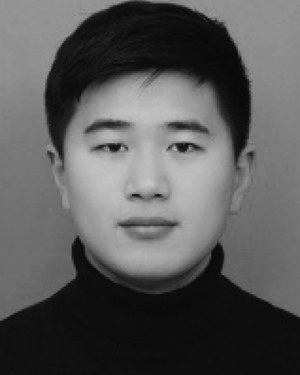 Xikun Zhao合作论文数2
 Chenqing Tan合作论文数2Xiao-zhe WEN (文晓哲)合作论文数2Xiaoshan WU (吴小珊)合作论文数2
 Congbo Li (李聪波)合作论文数College of Mechanical and Vehicle Engineering, Chongqing University2
 Xiaohua Zhou (周晓华)合作论文数College of Instrumentation & Electrical Engineering, Jilin University2
 Hongyuan Yang (杨泓渊)合作论文数College of Instrumentation & Electrical Engineering, Jilin University2
 Chunyang Pei (裴春阳)合作论文数1
 Ronghao Fu合作论文数1Shixue Lyu合作论文数1
 Fang Ye合作论文数1Xiaopu Zhang合作论文数1CUI Jiabin (崔佳斌)合作论文数1
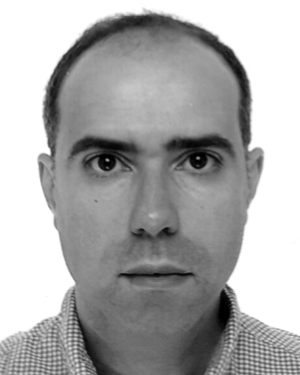 Nuno V. da Silva合作论文数Dept Earth Sci & Engn, Imperial Coll London1Huan Liu合作论文数1Yadongyang Zhu合作论文数1
 Qinge Xiao合作论文数Chongqing Univ, State Key Lab Mech Transmiss, Chongqing, Peoples R China1
 Kangcheng Bin (宾康成)合作论文数1Linglin LUO (罗铃霖)合作论文数1Wenyuan Du (杜文元)合作论文数1
 Li Han合作论文数1
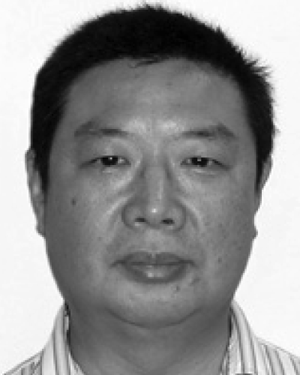 Xu Liu (刘旭)合作论文数1ZHAO De (赵德)合作论文数1Heshan Yang (杨河山)合作论文数1JianRong Tan (谭建蓉)合作论文数1HongChuan Zhu (祝洪川)合作论文数1
 Jinxia Liu (刘金霞)合作论文数College of Physics, Jilin University1
 Yongzhong Xu (许永忠)合作论文数School of Resources and Geosciences, China University of Mining and Technology1
 Hui Sun (孙辉)合作论文数Faculty of Geosciences and Engineering, Southwest Jiaotong University1
 Qunli An (安群力)合作论文数School of Aerospace Engineering, Huazhong University of Science and Technology1Z. Hang Yahong合作论文数1L. V. Qingtian合作论文数1Guanyu Zhang (张冠宇)合作论文数College of Instrumentation & Electrical Engineering, Jilin University1
 Jianhai Zhang (张建海)合作论文数School of Mechanical And Aerospace Engineering, Jilin University1
 Xu Yang (杨旭)合作论文数School of Mechanical and Aerospace Engineering, Jilin University1
 Fengjiao Zhang (张凤蛟)合作论文数College of Geoexploration Science and Technology, Jilin University1
 Jing Chen (陈静)合作论文数College of Automotive Engineering, Jilin university1




