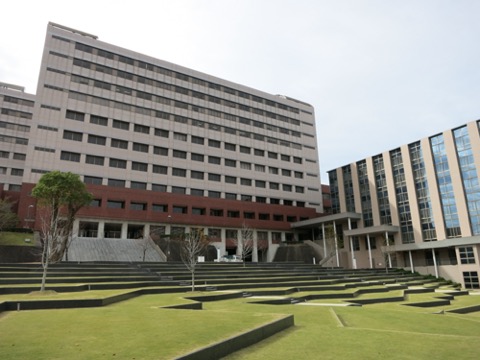
Kyushu Sangyo University (九州産業大学, Kyūshū Sangyō Daigaku) was founded in 1960 in Fukuoka City, and currently has twenty departments and six graduate schools. It is a private university..

In this paper, we prove an n-point boundary rigidity theorem on bounded symmetric domains in & Copf;(n) and on complex Hilbert balls, respectively. Next, we prove several Burns-Krantz boundary rigidity theorems on complex Hilbert balls. Finally, we give examples which show that boundary rigidity theorems do not hold for holomorphic mappings from the unit polydisk Delta(n)to Delta(N), where N > n >= 1. The obtained results provide the improvements and extensions of the corresponding known results. (c) 2026 Elsevier Inc. All rights are reserved, including those for text and data mining, AI training, and similar technologies.
Recent measurements of B(E2) values in even-even Te isotopes have revealed a smooth evolution of quadrupole collectivity, with only a slight asymmetry across the middle of the shell. These findings confirm that the only nucleus exhibiting an "anomalous" B4/2 ratio (B4/2 G 1) in even-even Te isotopes is 114Te. To further investigate this anomaly, lifetime measurements were carried out in the odd-mass isotope 115Te (N = 63), focusing on the 15/2- and 19/2- negative-parity levels in the nu h11/2 band, which are the analog states of the 2+ and 4+ levels in neighboring even-even nuclei. The extracted B(E2) values for 115Te indicate a "normal" behavior, with a B4/2 ratio greater than unity, further restricting the extent of the anomalous region in Te isotopes with B4/2 G 1 to the lower mass region with A G 114. The results have been interpreted using multiple theoretical frameworks: the shell model with the realistic pairing plus multipole terms with monopole interaction, large-scale configuration-interaction shell-model calculations, and the interacting boson-fermion model with triaxial deformation. The models give a fair reproduction of the experimental data, but fail to capture the detailed trend in the case of the B4/2 values.
We apply the complex scaling method to black-hole perturbations in four-dimensional Schwarzschild–de Sitter (dS) spacetimes. The method converts the outgoing-wave boundary-value problem into a non-Hermitian spectral problem and enables quasinormal-mode poles and the rotated continuum to be treated in a common framework. We focus in particular on the continuum level density, which characterizes the continuum response beyond isolated quasinormal-mode frequencies. Using Regge–Wheeler-type perturbation equations for scalar, electromagnetic, and gravitational fields, we investigate how a nonzero cosmological constant modifies the pole and continuum sectors. We also discuss a possible extension to string-inspired coupled-channel systems, and illustrate that higher-dimensional dS black holes can be treated within the same framework, at least in tensor- and vector-type sectors. Our results indicate that complex scaling offers a useful spectral framework for analyzing both quasinormal modes and continuum response in black-hole physics.
We improve our previously proposed two Higgs doublet model of six-dimensional SU(4) gauge theory compactified on an orbifold T^2/Z_2 by introducing the brane localized gauge kinetic terms. Since two Higgs doublets are identified with massless zero modes in extra spatial components of the six-dimensional gauge field, the Higgs sector in our model is constrained by the six-dimensional gauge symmetry. As a result, our Higgs potential at tree-level is automatically CP conserving and Z_2 symmetric, which are assumed by hand in the ordinary two Higgs doublet models. The scalar masses breaking the Z_2 symmetry softly are generated at one-loop. We show that the Standard Model Higgs mass can be obtained by tuning the size of the brane localized gauge kinetic terms as well as the electroweak symmetry breaking is realized. Other physical Higgs masses are predicted.
At a black-hole exceptional point (EP), two quasinormal modes coalesce and their separate residues become ill-conditioned. Rather than postulating a near-degenerate modal fit, we derive the response constructively from the complex-scaled Regge–Wheeler–Zerilli resolvent, treating the modes as one isolated rank-two Riesz cluster. Its zeroth and first contour moments determine an exact pair resolvent on both sides of, and at, the EP, without labeling the individual modes or constructing a normalized Jordan chain. At a second-order EP, these moments determine the simple- and double-pole Laurent operators. Although the modal decomposition is singular, fixed-real-frequency transmission and the greybody factor remain real-analytic through the EP, provided that the cluster remains isolated, the complementary resolvent is regular, and no pole reaches the physical axis. Source–observer matrix elements of the Laurent operators define finite, normalization-independent amplitudes and fix both the constant and linear-in-time terms in the causal ringdown. Their equality with the coefficients from the Jost double-zero expansion shows that they are operator-defined coefficients of the specified physical response, rather than fitting parameters. Thus two cluster moments provide mode-label-free data from which both scattering and driven responses follow.





