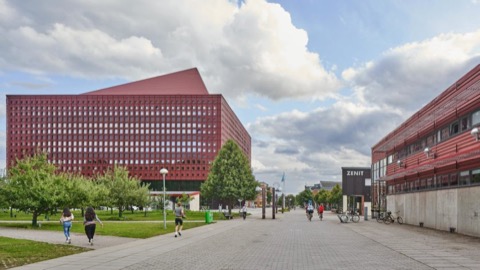

Urban development depends on construction activity to improve sustainability, yet the logistics required to move materials, equipment, waste, and workers remains insufficiently integrated into urban planning. This paper examines how construction logistics can be integrated into municipal urban planning by analysing how actor groups perceive its impacts and coordinate value creation across fragmented urban systems. The study applies a qualitative interactive research design based on a Swedish construction logistics project. Data were collected between August 2022 and March 2024 through eight semi-structured group interviews, joint workshops, actor-specific validation workshops, and a final synthesis workshop with developers, main contractors, suppliers, and trade organizations. The analysis combines iterative thematic coding with value configuration theory. The findings show that suppliers emphasize efficiency and climate savings, main contractors focus on project efficiency and safety, developers stress sustainability, accessibility and accountability, while trade organizations highlight knowledge-building and sector coordination. These differences create misalignment because societal benefits are often separated from project-level costs. Four conditions are identified as central: clearer procurement requirements, stronger logistics knowledge, scalable logistics service designs, and systematic follow-up of time, cost, and emission effects. The paper concludes that municipalities should use procurement, planning requirements and follow-up mechanisms to enforce construction logistics values in urban planning.
Internet-based cognitive behaviour therapy (ICBT) is now a well-established treatment modality supported by numerous controlled trials. Platforms for delivering these interventions have become critical infrastructure for both research and clinical practice, yet platform descriptions remain rare in the literature. In this article, we provide an updated description of the Iterapi platform, originally reported by Vlaescu et al., 2016. Over the past decade, Iterapi has been used in more than 100 published research studies, spanning over 35 clinical conditions (including depression, anxiety disorders, insomnia, tinnitus, loneliness, and climate anxiety) across at least 20 countries on five continents. We describe the platform's core architecture and functionality, including treatment modules, questionnaire systems, communication tools, and automation features. We also report on significant developments since 2016, including enhanced security and regulatory compliance (GDPR, data protection impact assessments), new features for ecological momentary assessment, electronic identification and incorporation of artificial intelligence. Finally, we outline future directions including mobile application development, digital phenotyping, just-in-time adaptive interventions, and the role of emerging regulatory frameworks. This update is intended as a practical resource for researchers and clinicians considering platform-based delivery of internet interventions.
BACKGROUND:Mental health conditions such as depression, anxiety, and post-traumatic stress disorder (PTSD) are highly prevalent among forcibly displaced populations. Prevalence rates of common mental health conditions have been studied in refugee groups. However, research is sparse regarding the heterogeneity of psychiatric symptoms and quality of life (QoL) profiles among individuals with recent displacement experiences. METHODS:The current study employed Latent Profile Analysis (LPA) to identify profiles of psychopathology and QoL in a sample of 510 recently arrived refugees in Sweden. The associations of profile membership with socio-demographic factors were thereafter investigated. RESULTS:Three distinct profiles were identified: a severe psychopathology/low QoL profile (36.27%), a PTSD-dominant/preserved QoL profile (33.14%) and a mild psychopathology/high QoL profile (30.59%). Nationality and residence status were moderately associated with profile membership. Individuals with Afghan nationality were over-represented, and those with Syrian nationality under-represented, in the severe psychopathology/low QoL profile. This association is likely explained by residence status: 82% of individuals in the severe psychopathology/low QoL profile lacked a residence permit, with only 3.6% of Afghans having received a residence permit, compared to 59.1% of Syrians. CONCLUSIONS:The results underscore the heterogeneity of psychopathological symptoms and QoL in individuals with recent displacement experiences, as well as a significant influence of contextual factors like residence status on their mental health and QoL. These findings may have implications for informing psychological treatments and migration policies.
Spatial ability has been identified as an essential cognitive ability for educational performance broadly in science, technology, engineering, and mathematics (STEM) education. Further, children with higher levels of this ability are more likely to choose STEM educational pathways. It is theorised that a benefit of spatial ability lies in affording young people further capacity to think and reason effectively in diverse problem-solving contexts, which translates into desirable educational outcomes. However, substantial evidence has identified a gender gap favouring boys particularly in the mental rotation spatial factor, and there is less evidence for any similar gender gaps for other spatial factors, particularly in adolescence. Resolving this knowledge gap would offer a knowledge base on which to design educational interventions, particularly in terms of what spatial factors to target and when. In response to this, this paper reports on three large scale studies from the US, Ireland, and Austria in which mental rotation and visualisation performance data were collected across adolescence. Single-paper meta-analyses, for both mental-rotation and visualisation tasks, reveal medium and small gender differences respectively favouring boys, with these gender differences already apparent from the beginning of adolescence. Age was a significant moderator for both, indicating that the gender difference continues to grow during adolescence, and instrument type moderated mental rotation effect size magnitude but the effect size for visualisation was robust across instruments. The results support the introduction of interventions to reduce or prevent these gender gaps in childhood, otherwise early in adolescence, and further research into the potential sources of gender differences in spatial ability and of educational consequences of the visualisation factor specifically beyond mental rotation.
The loss of biodiversity due to habitat destruction has been identified as a critical global issue. There is an urgent need for landscape-based guidelines for critical levels of habitat amount in conservation work. The aims were to identify habitat amount thresholds for species associated with old oaks and semi-natural grasslands, and to map functional areas and areas with habitat mismatch to guide conservation and restoration planning. We used spatial data on the distribution of old oaks (Quercus robur) and semi-natural grasslands in southern Sweden, combined with an extensive dataset of occurrence records for species associated with these habitats. Presence and absence of 102 species in grid cells in relation to habitat amount were analysed using binomial GLMs weighted by survey effort. A total of 86 species showed a significant positive relationship between occurrence and habitat amount and these relationships were used to identify habitat thresholds. Species-specific threshold values within each habitat type ranged from low to high, showing considerable variation in habitat requirements. The mapping of functional areas showed clear patterns in the study area with large differences between regions. However, there were also large regions showing a habitat mismatch, i.e., occurrence of species in areas with habitat amounts below the estimated thresholds suggesting potential extinction debts. Our analysis shows that by prioritising habitat restoration sites it is possible to make them fully functional in the future, offering tools for cost-effective nature conservation. The approach here, using extensive, partly citizen science data and relatively simple models to provide conservation practitioners and planners with decision support maps, can be a useful tool to tackle biodiversity loss. However, threshold values should be interpreted as minimum targets, and complementary consideration of habitat connectivity and climate change is recommended.





