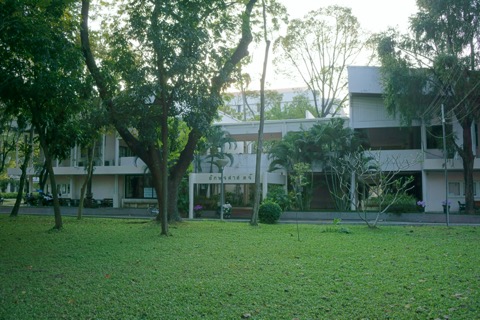
Silpakorn University (SU.) (Thai: มหาวิทยาลัยศิลปากร; RTGS: Mahawitthayalai Sinlapakon; also known as The University of Fine Arts of Thailand) is a national university in Thailand. The university was founded in Bangkok in 1943 by Tuscan–born art professor Corrado Feroci, who took the Thai name Silpa Bhirasri when he became a Thai citizen. It began as a fine arts university and now includes many other faculties as well. In 2016, it has 25,210 students.

Pharmaceutical nanoparticle involves complex and highly nonlinear interactions between formulation variables and process parameters that are difficult to describe using conventional statistical models. Artificial intelligence (AI) offers an advanced approach to overcoming these limitations and enhancing formulation optimization and quality control. This study aimed to develop an AI-driven framework integrating hybrid machine learning (HML) and a reinforcement learning–enhanced genetic algorithm (GA-RL) to optimize resveratrol-loaded polymeric nanoparticles (RES-PNPs) for cancer treatment. A dataset of RES-PNPs was used to train ML, including linear regression, k-nearest neighbors, support vector machines, and artificial neural networks. HML was constructed to predict particle size (PS), polydispersity index (PDI), zeta potential (ZP), and percentage encapsulation efficiency (
Polyvinyl alcohol (PVA) composite films are a promising biodegradable material for various applications, particularly in packaging. These films are typically prepared using an aqueous solution and casting method. Microcrystalline cellulose derived from hemp waste was incorporated as an additive to enhance its mechanical properties. The alkali treatment, bleaching treatment, and acid hydrolysis were used to synthesize the microcrystalline cellulose from hemp waste (CHW). The size of CHW was about 13 +/- 1 mu m and 64% crystallinity. PVA/CHW composites were prepared using the casting method, with the CHW contents being 1, 3, 5, and 7 phr. The mechanical properties were illustrated, with PVA/CHW 3 phr showing the highest tensile strength. Moreover, the PVA/CHW composites showed good compatibility, as observed by SEM images. Thus, alkyl ketene dimers (AKD) wax was coated by a rod-coater to improve the hydrophobicity. The film coated with AKD showed a significant increase in the water contact angle. Nevertheless, AKD coating reduced the light transmittance of the film in both the UV and the visible ranges. Lastly, the PVA/CHW composites improved the resulting mechanical properties. The hydrophobicity of the film was developed by AKD to produce biodegradable materials that can be used as a food packaging film.
Cultural heritage plays a pivotal role in shaping identity, fostering social cohesion, and advancing sustainable development. However, a vast number of non-designated historic buildings face ongoing risks of degradation or disappearance due to their unacknowledged value. Addressing this issue, this study investigates pathways for their sustainable reuse. Employing a multi-criteria decision-making framework, we developed a post-occupancy evaluation model comprising four dimensions: historical value preservation, adaptive reuse efficacy, regional development impact, and management service quality. The model was empirically applied to three cases of Meizhou Hakka architecture, in which such buildings were repurposed as guesthouses. The findings reveal that, unlike officially protected heritage buildings, the successful reuse of non-designated historic buildings depends not primarily on the strict preservation of historical value, but rather on superior adaptive reuse efficacy-namely, contemporary performance metrics such as functional adaptation rationality, spatial utilization efficiency, environmental comfort, and structural safety and reliability. Quantitative weighting results indicate that historical value preservation functions as a fundamental baseline, while empirical analysis demonstrates that adaptive reuse efficacy is the decisive determinant of successful regeneration. Achieving sustainability requires establishing a dynamic conservation model based on community symbiosis, wherein a building's vitality is continually sustained through interaction with its social and cultural context. This study provides both a scientific tool and practical guidance for the assessment and management of non-designated historic buildings. It also underscores the necessity of a broader paradigm shift, contributing both theoretical and practical insights to the advancement of more inclusive and sustainable human settlements.
Kinetics of tagatose formation from galactose in arginine solution at various temperatures and the effect of ethanol concentration on tagatose yield were investigated. A solution containing 5
Fe-Cu skarns of the Loei Fold Belt have been poorly investigated in terms of lead isotopic signatures. We report the first MC-ICP-MS dataset from the belt, based on 15 ore samples from the Khao Thap Kwai deposit (Lop Buri, Thailand). Ores signatures display internally coherent yet dispersed signatures (206Pb/204Pb = 17.794-18.335, 207Pb/204Pb = 15.495-15.601, and 208Pb/204Pb = 37.628-38.256). The data plot between mantle and upper-crust evolutionary fields and overlaps the orogenic growth curve; binary mixing between hydrous mantle-derived arc melts and upper-crustal reservoirs provides a parsimonious explanation. Regionally, Khao Thap Kwai field partly overlaps the Chatree epithermal system but shows distinctly lower 208Pb/204Pb ratios, whereas ore deposits of the Truong Son Belt are more radiogenic, highlighting the utility of Pb isotopes for discriminating metallogenic provinces in western Indochina.





