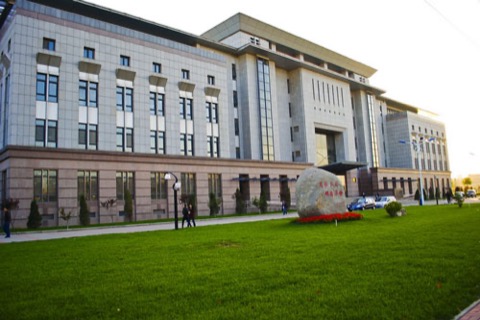
The Tianjin University of Commerce (TUC; Chinese: 天津商业大学) is a municipal public university in Tianjin, China. The university is sponsored by the Tianjin Municipal People's Government. The university was established in 1980. After two decades of construction and development, it has become an advanced university with undergraduate and postgraduate programs specialising in economics, administration, engineering, law, liberal arts and science.The university is located by the Ziya River in Tianjin and covers an area of 600,000 m2 including 500,000 m2 of teaching and dormitory space. The campus is clean and tidy with first-rate facilities providing excellent conditions for working, studying and researching.

To explore the feasibility of early, non-destructive freshness grading for kiwifruit and grapes under the present experimental conditions, this study investigated Kyoho grapes (non-climacteric) and Xuxiang kiwifruit (climacteric) stored at 5 °C for 15 days, while additional storage temperatures of 10 and 15 °C were used to support kinetic and Arrhenius-based quality modeling. Firmness, weight loss, respiration rate, and color parameters were measured on days 0, 3, 6, 9, 12, and 15. In parallel, eight volatile organic compounds (VOCs) selected on the basis of stable detection, dynamic change during storage, metabolic relevance, and correlation with freshness-related indicators were quantified by GC–MS using an internal standard method. Based on the integrated changes in multiple quality indicators, a five-level freshness grading scheme was established, and four machine-learning classifiers were developed using the concentrations of the eight VOCs. The results showed that pronounced changes in characteristic VOCs occurred approximately 3–6 days earlier than the observable declines in firmness and darkening in color. On the independent test set, SVM achieved the best performance for grapes (accuracy: 93.00
Unplanned failures of aircraft engines pose severe threats to flight safety and result in substantial economic losses, making accurate prognostic maintenance critical for the aviation industry. To address the challenges in degradation modeling and improve reliability, this study proposes a novel deep temporal modeling framework that features architectural decoupling and dynamic regularization for the remaining useful life (RUL) prediction of turbofan engines. Specifically, a bidirectional long short-term memory is employed as a streamlined encoder to strictly capture bidirectional temporal contexts, while a multi-head attention mechanism is dedicated to feature re-weighting, thereby enhancing the representation of critical degradation segments. Subsequently, an LSTM-based predictor is used to model degradation trends and estimate RUL. Furthermore, to bolster the model's robustness against time-varying industrial noise, an adaptive Gaussian noise perturbation strategy is introduced. Experimental results on the C-MAPSS turbofan engine dataset demonstrate that the proposed method outperforms several representative baselines in terms of prediction accuracy; furthermore, extended validation on the XJTU-SY rolling bearing dataset confirms its superior generalization performance, validating its potential for effective engineering applications.
The antioxidant, anti-inflammatory and anti-nociceptive mechanisms of action of flavonoids in Trollius chinensis Bunge (TCB) were systematically analyzed. By this means, the TCB extracts, prepared by ethanol/water (8:2, v/v, 24 h) at room temperature, displayed significant antioxidant activity by capturing superoxide anion (O2·), hydroxyl radical (·OH), DPPH and ABTS free radicals, reducing ferricyanide power and chelating ferrous irons. The anti-inflammatory activity of the TCB extracts was evaluated by carrageenan-induced paw edema, xylene-induced ear edema and acetic acid-induced vascular permeability. The anti-nociceptive activity of the TCB extracts was evaluated by the acetic acid-induced writhing, the formalin-induced paw licking, the hot plate test and the tail immersion test. All results revealed that TCB is a good source of functional food materials which concurrently had the antioxidant, anti-inflammatory and anti-nociceptive effects. This study will provide valuable information for the further development of TCB as functional foods or in pharmaceutical industries in the near future.
Background, Objectives, and Materials To overcome the poor texture and volume of gluten-free whole millet cakes caused by a lack of gluten network, this study evaluated the impact of 0.15% CMC, XG, and SA on a 6:4 native-to-extruded millet flour blend. The underlying stabilization mechanisms were analyzed using Micro-CT, texture analysis, RVA, DSC, TGA, and FTIR.Findings Micro-CT imaging demonstrated that CMC and XG effectively stabilized air cells and prevented structural collapse, whereas SA led to coarser cavities due to excessive batter viscosity. Texture analysis showed that CMC provided the most balanced improvement, decreasing hardness by 23% and increasing springiness by 45%. RVA and DSC results indicated that hydrocolloids increased batter viscosity and delayed starch gelatinization by competing for water. While TGA confirmed enhanced thermal stability attributed to stronger starch-hydrocolloid interactions. Furthermore, FTIR analysis revealed that hydrocolloids promoted the transformation of protein alpha-helices and beta-turns into beta-sheets, strengthening the batter network. CMC uniquely facilitated the formation of random coils and inhibited starch retrogradation, contributing to a softer, fluffier crumb.Conclusion The incorporation of hydrocolloids significantly enhances the quality of gluten-free whole millet cakes by modulating starch-protein-hydrocolloid interactions. Among the tested additives, 0.15% CMC emerged as the optimal improver for achieving superior texture, volume, and crumb uniformity.Significance and Novelty This study establishes a theoretical framework for utilizing CMC to overcome structural limitations in gluten-free goods by correlating molecular conformational changes with microstructural stability.
High-pressure homogenization (HPH), a representative non-thermal technology, shows promise for juice processing. This study systematically compared the effects of high-pressure homogenization (150 MPa/10 min) and thermal pasteurization (TP, 85 °C/10 min) on tomato juice quality through microbial assessment, physicochemical characterization, and untargeted metabolomics. Results demonstrated that HPH achieved a 3-log reduction in microbial load while substantially preserving quality attributes. HPH-treated juice retained 83.66





