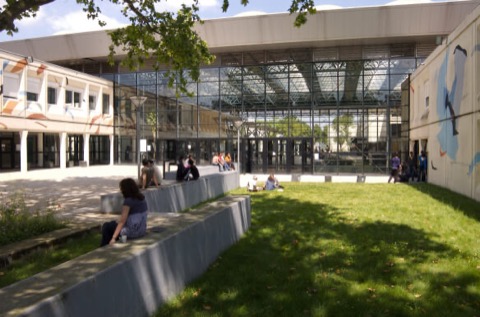
位于巴黎北郊的巴黎第十三大学(又称巴黎北方大学,北巴黎大学)是从原巴黎索邦大学衍生出来的十三所大学之一。于2020年更名为 Université Sorbonne Paris Nord。

This paper investigates integrality properties of perfect matching polytopes, focusing on box-total dual integrality and integer decomposition properties.We begin by characterizing the graphs whose perfect matching polytope is a slice of the nonnegative orthant, identifying these as the solid graphs introduced by de Carvalho et al. (2002) [17]. As a result, perfect matching polytopes of solid graphs admit a compact description. Moreover, we observe that 0,1 polytopes that are slices of the nonnegative orthant have the integer Carathéodory property. Thus, perfect matching polytopes of solid graphs have the integer Carathéodory property. This in particular unveils a new positive case of the generalized Berge-Fulkeron conjecture.We also establish that deciding the box-total dual integrality of a perfect matching polytope can be done in polynomial time. Additionally, we characterize the conditions under which perfect matching polytopes of two fundamental graph classes, namely near-bricks and bicritical graphs, are box-totally dual integral.
This study presents a computational model that integrates bone remodeling dynamics with damage accumulation, focusing on both physiological and pathological conditions. Building upon Komarova’s classical model of osteoclast and osteoblast interactions, this work introduces fatigue-induced damage using a stress-life (S-N) approach. By simulating bone responses under sinusoidal and random mechanical loads, the model captures the cyclical nature of bone turnover. The results show that under normal physiological conditions, bone is able to repair microdamage and maintain structural integrity. However, in pathological scenarios such as osteoporosis and tumors, the remodeling cycle is disrupted, leading to an increase in damage accumulation and eventual structural failure. Through numerical simulations, the study also demonstrates the significant impact of fatigue on bone health, showing that repetitive mechanical loads, even below critical stress levels, can result in bone degradation over time. By capturing the accumulation of microdamage and its repair, the model offers potential applications in personalized medicine to assess fracture risks in varying stress and health scenarios. This approach provides a framework for understanding how different stress patterns contribute to bone damage and offers insights into the progression of bone diseases. The model could be extended using metabolic and age-related characteristics and serves as a potential tool for personalized medicine, helping to predict bone failure risks in individuals when they are submitted to repetitive mechanical loads.
In video surveillance, distortions such as blurred focus, haze, motion blur, and uneven illumination, as well as their simultaneous combinations, adversely affect video quality and hinder the effectiveness of various high-level tasks, such as object detection and identification, visual tracking, abnormal event detection, and scene understanding. Existing deep learning methods struggle with generalization and handling of coexisting distortions in real-world scenarios. To address these challenges, we propose a new architecture that combines a vision transformer scheme and attention mechanisms modules for identifying and classifying multiple distortions in surveillance videos. Specifically, we adapt and fine-tune a pretrained ViT-B/16 model, incorporating specialized classifier heads to handle both single and multiple distortions in the VSQuAD dataset. Our method leverages a vision transformer for its robust feature extraction capabilities and attention mechanisms, enabling it to distinguish subtle and globally dispersed distortion patterns. To enhance the model’s robustness against class imbalance, we employ weighted cross-entropy loss, data augmentation, and adaptive learning rate scheduling. The method achieves 95.8
The frozen Erdos-R & eacute;nyi random graph is a variant of the standard dynamical ErdosR & eacute;nyi random graph that prevents the creation of the giant component by freezing the evolution of connected components with a unique cycle. The formation of multicyclic components is forbidden, and the growth of components with a unique cycle is slowed down, depending on a parameter p is an element of [0, 1] that quantifies the slowdown. At the time when all connected components of the graph have a (necessary unique) cycle, the graph is entirely frozen and the process stops. In this paper we study the fluid limit of the main statistics of this process, that is their functional convergence as the number of vertices of the graph becomes large and after a proper rescaling, to the solution of a system of differential equations. Our proofs are based on an adaption of Wormald's differential equation method. We also obtain, as a main application, a precise description of the asymptotic behavior of the first time when the graph is entirely frozen.
We define extensions of CTL and TCTL with strategic operators, called Strategic CTL (SCTL) and Strategic TCTL (STCTL), respectively. For each of the above logics we give a synchronous and asynchronous semantics, i.e., STCTL is interpreted over networks of extended Timed Automata (TA) that either make synchronous moves or synchronise via joint actions. We consider several semantics regarding information: imperfect (i) and perfect (I), and recall: imperfect (r) and perfect (R). We prove that SCTL is more expressive than ATL for all semantics, and this holds for the timed versions as well. Moreover, the model checking problem for SCTL[ir] is of the same complexity as for ATL[ir], the model checking problem for STCTL[ir] is of the same complexity as for TCTL, while for STCTL[iR] it is undecidable as for ATL[iR]. The above results suggest to use SCTL[ir] and STCTL[ir] in practical applications. Therefore, we use the tool IMITATOR to support model checking of STCTL[ir].





