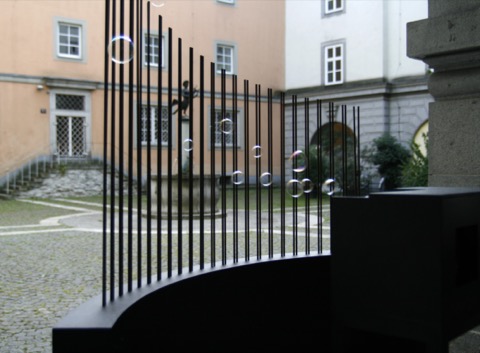

The mouth is the most primal musical instrument and a central interface for wind performance, yet it remains largely overlooked in the design of contemporary electronic instruments. Given its exceptional sensory acuity and fine motor control, this neglect represents a loss of expressive potential and a hindrance to musicians with motor disabilities. This paper documents a participatory workshop on electronic mouth-only instruments, co-led by an expert with tetraplegia. Grounded in Tangible Musical Interface design, our approach emphasises sensorimotor interactions to reconnect digital sound creation with embodied experience. To support the playful exploration of this design space, we developed a modular toolset combining electronic input and feedback modalities for the mouth, along with methods for custom-built accessibility devices.
The constant flood of alarms triggered by operational technology (OT) used in critical infrastructures (CRITIS) such as energy or traffic systems poses a serious challenge to their safe and efficient operation. Operators must quickly recognize truly critical situations and make life-saving decisions. This task is made more difficult by typical characteristics of CRITIS, including the high heterogeneity of OT systems, their wide geographical distribution, decentralized nature, and continuous, partly unpredictable evolution. As a result, operators often have only an isolated view of individual OT components, without understanding their interdependencies, which prevents effective alarm reduction. This paper tackles the problem of alarm flood reduction based on interdependencies in CRITIS, as studied in our research project iReduce. We present a research roadmap that outlines a two-step approach to identify and represent OT interdependencies. This is supported by a domain-adaptable OT knowledge base for semantic representation and by provenance mechanisms to handle system evolution. We also report on the current implementation status and first evaluation results, focusing on the exploration of OT interdependencies as a key step towards intelligent alarm reduction.
AI systems operate within ecologies where their effects unfold among non-human organisms, at timescales and through semiotic processes humans cannot access. Yet evaluation paradigms presuppose an anthropocentric horizon that renders these effects invisible by construction. This paper develops the Transsemiotic Turing Approach to investigate what becomes visible when that horizon is provisionally suspended, while remaining accountable to the paradox that its instruments are themselves anthropogenic. The framework inverts Turing's test, asking not whether machines register as intelligent for human judges but whether AI outputs acquire significance for non-human interpreters. This motivates the concept of transsemiotic exchange as a coupling between entities whose sign systems share no common code. Distinguishing normative selectivity (grounded in biological imperatives) from parametric selectivity (oriented by a reward function) keeps the criteria from being trivially satisfied on either side. The distinction anchors four diagnostic conditions, of which transduction is the material precondition, followed by selectivity, appropriation, and persistence. Three artistic-research installations (2022–2024) materialise the framework, coupling microbial communities, human participants, and reinforcement-learning agents that generate synthetic voice articulations conditioned by pH and optical density measurements. The contribution is conceptual and practice-led, the diagnostic criteria derive from biosemiotic theory and the generative principles from arts-based research. Rather than verifying significance directly, the approach diagnoses conditions under which evidence for transsemiotic exchange becomes producible. Read as practice-led observations, the installations motivate the hypotheses that AI functions as temporal infrastructure mediating between computational milliseconds and biological days, and that the richest transsemiotic configurations resist diagnostic clarity.
This article revisits the concept of the instrument's inherent score, exploring how musical instruments can embody a form of notation that both shapes and inspires performance. Building on earlier research (Tom & aacute;s 2016; Tom & aacute;s and Kaltenbrunner 2014), the study examines the historical and theoretical foundations of this idea, tracing its roots to experimental music practices of the 1960s and 1970s, particularly within the Sonic Arts Union collective. Composers such as Alvin Lucier, Gordon Mumma and Nicolas Collins have described how electronic instruments embody compositional elements, effectively functioning as scores. The paper argues that the instrument's score emerges from the material and symbolic affordances of the instrument, mediating the performer's engagement with its sonic and physical properties. This concept has influenced contemporary digital instrument design, where the boundary between composition and instrument becomes blurred. The study also engages with theoretical frameworks from Vil & eacute;m Flusser and Friedrich Kittler, situating the instrument's score within broader discourses on technology and embodiment. Finally, the paper explores the challenges of notating such scores, drawing parallels with choreographic practices, and concludes by emphasising the body's central role in interpreting and enacting these inscriptions during performance.





