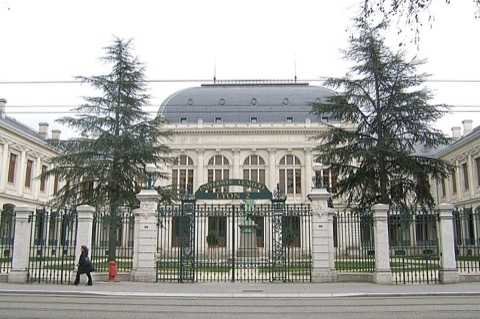
里昂大学(Université de Lyon)位于法国著名的历史文化名城—里昂,是法国最悠久的综合性大学之一,法国“卓越大学计划”高校,欧洲顶尖大学联盟—“科英布拉集团”成员高校。里昂大学培养出了“格氏试剂”之父维克多·格林尼亚等多位诺贝尔奖获得者以及一大批杰出人才,在自然科学、生命科学、社会学、人文和法学等领域声名卓著。里昂大学包括11个学院和法国国家科研中心(里昂地区),拥有17个博士生院,这些机构承担了里昂大学主要的教学和科研任务。 里昂大学是法国和欧洲最具声望的大学之一。在2020U.S. News世界大学排名中,位列世界第139名、法国第5名 。其中,数学位居世界第30位,机械工程位列世界32位,物理学位列世界44位,空间科学位列世界49位,微生物学位列世界51位,化学位列世界70位,生物学和生物化学位列世界76位,计算机科学位列世界81位,土木工程位列世界84位,地球科学位列世界90位,神经系统科学与行为学位列世界95位,植物与动物科学位列世界97位。此外,工程学、材料科学、临床医学、农业科学等均位居世界前列 。 里昂大学于2017年2月27日入选法国 “卓越大学计划” (IDEX) ,单独获得法国政府8亿欧元的经费支持。根据该计划要求,里昂大学旗下所属机构于2020年1月再次全面整合为共同体(La communauté d'universités et établissements,ComUE),下属所有大学学位均由里昂大学统一颁发。

Gas hydrates are solid compounds that form under high-pressure and low-temperature conditions, posing a major threat to oil and gas operations because of their tendency to agglomerate and block pipelines. One mitigation strategy is to allow hydrates to form under controlled conditions, enabling their transport as a slurry within the liquid phase. However, limited research on how such particles affect key multiphase flow parameters has been conducted. This study investigates the influence of particle concentration on slug flow characteristics, a common flow regime in oil and gas production. Experiments using air–water and air–oil systems with model polyethylene particles mimicking hydrate density were performed in a flow loop. The test section was composed of 50-mm ID, 34-m long horizontal pipe. Four particle concentrations were tested: 0%, 5%, 10% and 20% v/v. Except under flow conditions near the stratified–slug transition line, which lead to long elongated bubbles and low slug frequencies, particles were effectively dispersed and transported in both the film and slug regions. The presence of particles had a weak effect on the slug flow topology – structure lengths, flow frequency, bubble velocity and phase fraction remained almost unchanged. This was attributed to the minimal impact of the particles on the thermophysical properties of the mixture. In contrast, particles significantly increased the pressure drops in the oil system because of a higher mixture density and a particle size comparable to the viscous sublayer, what affects the apparent viscosity. An empirical correlation for pressure drop prediction was proposed, achieving deviations of about 5% compared to experimental data.
Fluctuation theorems, such as the Jarzynski equality and the Crooks relation, are effective tools connecting non-equilibrium work statistics and equilibrium free energy differences. However, detailed hands-on, reproducible protocols for implementing and analyzing these relations in real experiments remain scarce. This tutorial provides an end-to-end workflow for measuring, validating, and applying fluctuation theorems using a single-beam optical tweezers setup. It introduces the foundational ideas and consolidates practical calibration (PSD-based trap stiffness and position sensitivity), protocol design (forward/reverse finite-time drives over multiple amplitudes and durations), and robust estimators for free-energy difference and dissipated work, highlighting finite-sampling and rare-event effects. We demonstrate the procedures using an extensive set of measured trajectories under different conditions and provide openly accessible datasets and Python code, enabling new researchers or educators to reproduce the results with minimal effort. Beyond pedagogical validation, we discuss how these recipes translate to broader soft-matter and mesoscopic contexts. By combining user-friendly instruments with clear and transparent analysis, this work promotes the education and reliable adoption of stochastic thermodynamic methods in the curricula of physics and chemistry, as well as among emerging research teams.
The preparation of thermal states of matter is a crucial task in quantum simulation. In this work, we prove that a recently introduced, efficiently implementable dissipative evolution thermalizes to the Gibbs state in time scaling polynomially with system size at high enough temperatures for any Hamiltonian that satisfies a Lieb-Robinson bound, such as local Hamiltonians on a lattice. Furthermore, we show the efficient adiabatic preparation of the associated purifications or "thermofield double" states. To the best of our knowledge, these are the first results rigorously establishing the efficient preparation of high-temperature Gibbs states and their purifications. In the low-temperature regime, we show that implementing this family of dissipative evolutions for inverse temperatures polynomial in the system's size is computationally equivalent to standard quantum computations. On a technical level, for high temperatures, our proof makes use of the mapping of the generator of the evolution into a Hamiltonian, and then connecting its convergence to that of the infinite temperature limit. For low temperature, we instead perform a perturbation at zero temperature and resort to circuit-to-Hamiltonian mappings akin to the proof of universality of quantum adiabatic computing. Taken together, our results show that a family of quasi-local dissipative evolutions efficiently prepares a large class of quantum many-body states of interest, and has the potential to mirror the success of classical Monte Carlo methods for quantum many-body systems.
Oxidative and carbonyl stresses (COS), which damage brain cells through the accumulation of toxic reactive carbonyl species (RCS), are key players in the etiology of Alzheimer's disease (AD). Our group developed lipophenols, i.e. COS-targeting hybrid molecules combining polyunsaturated fatty acids (PUFAs) and alkyl-(poly)phenols. Among them, quercetin-3-O-docosahexaenoate-7-O-isopropyl (Quercetin-3-O-DHA-7-O-iPr or "Q-iP-DHA") afforded neuroprotection against acrolein-induced toxicity, reduced carbonyl stress, and lowered amyloid-beta secretion in neuroblastoma cells. To evaluate Q-iP-DHA in vivo, it was formulated into lipid nanocapsules (to allow solubilization) then administered intranasally to J20 transgenic mice, a model of AD. This approach was chosen to optimize blood-brain barrier (BBB) penetration. This delivery led to improvements in well-being, organizational skills and spatial memory. In addition, Q-iP-DHA treatment reduced hippocampal amyloid plaque numbers, normalized expression of the Receptor for Advanced Glycation End-products (RAGE), and decreased microglial activation, indicating anti-inflammatory effects. Overall, our preclinical findings suggest that intranasal administration of nanoformulated Q-iP-DHA may represent a promising multitarget therapeutic approach against AD.
The development of numerical simulation software enables the modeling of complex physical phenomena that are difficult to detect in printed parts within the fused deposition modeling (FDM). However, simulating all possible combinations of process parameters, across factors and levels, remains time-consuming and computationally expensive. The use of numerical design of experiments (NDoE) is a relevant approach, as it enables the optimization and establishment of correlations between printing parameters and the associated physical phenomena. In this study, the influence of different printing temperatures (melting temperature, build-plate temperature, and ambient temperature) on polymer diffusion kinetics, filament coalescence (neck formation), and the resulting porosity is investigated numerically. The analysis is based on a two-dimensional numerical model that incorporates heat transfer and Schneider’s equations for crystallization simulation using multi-physics software. From these results, it is possible to evaluate filament coalescence, the degree of inter-filament healing, and interfacial porosity. Each parameter is analyzed separately to determine its individual influence on the phenomenon being investigated, and then the thermal interactions between these parameters are evaluated to better understand their combined effect on the physical mechanisms. The results indicate that higher build-plate temperatures, as well as prolonged exposure to processing ambient temperature, enhance inter-filament diffusion and reduce residual porosity. Moreover, changing the printing orientation from 0° to 90° leads to a significant increase in the degree of healing, rising from 0.55 to 0.71. In contrast, increasing the deposition temperature has only a limited effect on the initiation and development of these phenomena.





