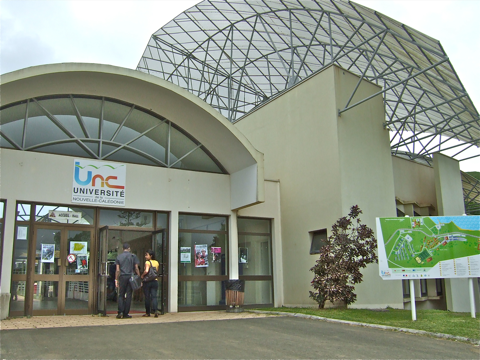
The University of New Caledonia UNC (Université de la Nouvelle-Calédonie) is a French university which is part of the Academy of New Caledonia located in Nouméa.The university goes back to 1987 when the Université Française du Pacifique (French University of the Pacific) was created, with two centres, one in French Polynesia and the other in New Caledonia. In 1997, the decision was made to split the two parts into separate universities and so in 1999 the Université de la Nouvelle Calédonie and the Université de la Polynésie Française were created.UNC hosts around 3,000 local and international students with a staff of about 100 professors and researchers and 100 administrative employees each year. The President of UNC is Gaël Lagadec, who succeeded Jean-Marc Boyer.

Coral reefs are vital social-ecological systems, but highly vulnerable to global change and local stressors. While conveying the urgency of existential threats is paramount, bleak outlooks can become self-reinforcing, limiting capacities to act. To counter this, experts working on coral reefs in diverse geographies imagined coral reef futures through a structured visioning process. The resulting visions offer alternatives aspiring to desirability, sustainability, and equity for coral reefs. These broaden the conversation on coral reef futures, enabling discussions beyond siloed conservation, traditional management tools, or pure techno-fixes. Concepts such as earth stewardship, biocultural revitalization, and anticipatory governance emerged as essential to sustaining human well-being and enabling the viability of future coral reef ecosystems before, during, and beyond social-ecological shocks. By fostering forward-thinking dialog, these visions and narratives constitute key stepping stones to reimagining desirable relationships between people and coral reefs and speak to both anticipatory and adaptive pathways toward desired change.
We prove that when the Aubry set for a Lipschitz continuous potential is a subshift of finite type, then the pressure function converges exponentially fast to its asymptote as the temperature goes to 0. The speed of convergence turns out to be the unique eigenvalue for the matrix whose entries are the costs between the different irreducible pieces of the Aubry set. For a special case of Walters potential, we show that perturbations of that potential that go faster to zero than the pressure do not change the selection, neither for the subaction nor for the limit measure, a zero temperature.
Marine heatwaves (MHWs) are intensifying with climate change, endangering ecosystems such as coral reefs. Yet their regional characteristics and drivers remain poorly understood in many parts of the Pacific. Here we provide a comprehensive assessment of MHWs in the central South Pacific and across the five archipelagos of French Polynesia (FP; representing more than 5 million km2 of maritime area, a region as vast as Europe), using sea surface temperature observations and an ocean reanalysis to investigate underlying mechanisms. MHW characteristics vary widely across the region: its northern and southern parts (the Marquesas and Austral archipelagos, respectively) experience the highest number of MHW days and the strongest cumulative intensities, especially during the warm season (November–April). In contrast, its central part (the Society, Tuamotu, and Gambier Islands) exhibits more moderate MHW characteristics. Heat budget analyses highlight the seasonally and regionally diverse mechanisms shaping MHWs. In central FP during the warm season (austral summer), most MHWs are driven by air–sea heat fluxes, while in the northern part, those driven by oceanic horizontal advection dominate. During the cold season (austral winter), more MHWs driven by horizontal advection are observed in the whole region since the thicker seasonal mixed layer reduces the proportion of MHWs driven by air–sea fluxes. El Niño–Southern Oscillation (ENSO) strongly modulates MHW occurrences: El Niño favors MHW occurrences in northeastern FP, while La Niña increases MHW occurrence in the southwest with different spatial extent depending on ENSO flavors (Central or Eastern Pacific ENSO events). This modulation arises from reduced wind-evaporation cooling with reduced wind speed, shoaled mixed layers, and enhanced horizontal heat advection, occurring primarily to the northeast of French Polynesia during El Niño and to the southwest during La Niña. These results greatly improve our understanding of MHW characteristics, dynamics and variability in this ecologically-fragile region.
Mangrove ecosystems are dynamic ecotones that play a key role in organic carbon and trace metals (TM) cycling along tropical coastlines. Tidal pumping is a key process that allows dissolved organic matter (DOM) and dissolved trace metals export towards adjacent ecosystems. While this process is well characterized, DOM-TM relationships and variability within mangrove soils remain poorly studied. In the present study, we investigated the vertical distribution of DOM and TM in a Rhizophora stylosa mangrove stand in New Caledonia over 12-h tidal cycles during both spring and neap tides. DOM quantity and quality were assessed through UV-visible absorbance, fluorescence spectroscopy, total and dissolved organic carbon analysis, and physicochemical measurements. Dissolved TM were quantified using ICP-MS. Our results show a vertical gradient in DOM, with deeper layers concentrated in aromatic and humified compounds, attributed to vertical migration through potential convection process. This gradient (DOM and salinity) is accentuated during neap tide due to lower hydrodynamics. Dissolved TM exhibited distinct vertical trends with depth: Cr and Mn followed DOM trends, suggesting either common vertical transport mechanisms or complexation with humic substances. In contrast, Mo and Ni decreased with depth, suggesting stronger control by physicochemical or mineralogical conditions, and potential precipitation within pyrite in the most anoxic layers. This study highlights the combined effect of vertical soil gradients and tidal fluctuations on DOM-TM interactions, contributing to a better understanding of the role of mangroves as biogeochemical filters and as both sources and sinks of trace elements at the land-ocean interface.
Rock outcrops are geological formations that harbor a highly specialized biota adapted to harsh environmental conditions that differ from their surrounding landscapes. They are globally distributed, especially in old, highly weathered landscapes, and can function as habitat islands containing high levels of endemism and distinct evolutionary lineages. Despite their ecoevolutionary importance, rock outcrops remain largely overlooked in global conservation policy, ecosystem typologies, and biodiversity monitoring frameworks. Extractive activities directly remove the geological substrate that underpins these habitats, and climate change intensifies drought, heatwaves, and hydrological instability. Rising global demand for energy-transition metals required for decarbonization is expected to further accelerate these pressures, particularly in biodiverse regions of the Global South where governance is weaker. Given that rock outcrop ecosystems are ecologically and evolutionarily significant, we devised a policy-relevant conservation roadmap structured around prevention, mitigation, restoration, and governance issues. Priority actions include recognizing rock outcrops as unique ecosystems in global classifications and ecosystem typologies, integrating them into biodiversity monitoring frameworks, and improving the identification of key biodiversity areas and the International Union for Conservation of Nature (IUCN) Red List of Ecosystems assessments. We call for stronger environmental impact assessments, cumulative-impact evaluations for mining and quarrying projects, and the designation of mining and quarrying exclusion sites of high irreplaceability. Coordinated international policy, improved ecological data, and meaningful engagement with local and Indigenous communities are essential to safeguard these ancient ecosystems before further, irreversible losses occur.





