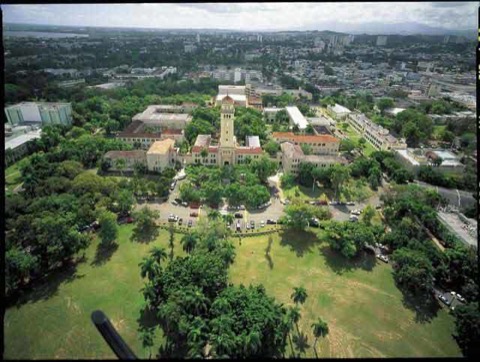
The University of Puerto Rico, Río Piedras Campus (Spanish: Universidad de Puerto Rico, Recinto de Río Piedras, La IUPI, UPR-RP, UPRRP), is a public research university in Río Piedras, Puerto Rico. It is the largest campus of the University of Puerto Rico system in terms of student population and it was Puerto Rico's first public university campus.The university serves more than 18,000 students, of which 20% are graduate students, and grants an average of over 3,000 degrees a year. Its academic offerings range from the bachelor to the doctoral degree, through 70 undergraduate programs and 19 graduate degrees with 71 specializations in the basic disciplines and professional fields. UPR‐RP has consistently granted the largest number of doctorate degrees to Hispanics under the American flag.

Current sustainability discourse promotes sustainable yard practices as a means for residents to contribute to urban environmental health and soil conservation. Social-ecological research suggests that yard practices are shaped by multiscale social drivers, including social contagion, whereby visible expressions of individuality in front yard design are copied by nearby neighbors. This study evaluated residential areas within the R & iacute;o Piedras Watershed (RPWS) in the San Juan metropolitan area to assess evidence of social contagion in front yard configuration and vegetation structure, and to examine whether these variables were associated with socio-demographic and economic characteristics when spatial effects were considered. A total of 6858 front yards across six highly urbanized sites were analyzed using Google Earth Street View imagery. Housing lot sizes were quantified, and yards were classified into eight landscape configurations based on green and gray cover elements. Woody vegetation structures, including trees, shrubs, and palms, were also quantified to generate estimates of functional diversity and a front yard quality index. Significant differences in yard characteristics were observed among sites. Spatial analyses revealed significant clustering at distances of 65-80 m, particularly for front yard configuration, while clustering of woody vegetation density was weaker. Local clustering patterns and the distribution of outliers varied across sites. Spatial lag models indicated that lot area positively influenced yard configuration and quality, and the density and diversity of woody vegetation. While socio-economic variables were not significant predictors of yard quality, their effects cannot be discarded. Overall, results are consistent with social contagion processes but also highlight neighborhood design as a key driver of clustering, alongside widespread conversion of green to paved front yards, with implications for soil and green infrastructure loss as well as environmental and human health in the RPWS.
In our field, there are few opportunities to examine (and demonstrate) the properties of existing measures. A recent survey of 993 US adults conducted by the National Endowment for Financial Education (NEFE) provides such an opportunity. In this study, we examine the factorial validity, reliability, and measurement invariance of the Brief Money Management Scale. Our central question is whether money management is a distinct construct for people living at or near the poverty line as compared to people living above that line (i.e., < 100
Objective: Previous research has shown the impact of disasters on the formal labor market at the county and city levels, but there is little research evaluating informal labor markets after three consecutive natural events affecting marginalized communities. We selected Puerto Rico, a territory impacted by three disasters, for a case study. Method: Official surveys do not usually obtain data from marginalized communities. We conducted a survey and found that the post-disaster dynamics differ among marginalized communities. Findings: Proximity to the center of the disaster, demography, and whether the setting is rural or urban can modify a community's post-disaster labor market. In the case of the informal labor market, our findings contradict the official statistics and challenge the widespread stereotype that most adults in impoverished communities do not work when aid is received. Despite the aid received during the pandemic lockdown and the lower educational attainment in these communities than in the broader Puerto Rican population, both the case study communities exhibited relatively high labor attachment.
Much dropout research has found that being diagnosed with specific learning disabilities increases the risk of dropping out of school. While previous studies have found mixed results for the impact of low socioeconomic status on dropouts among students with specific learning disabilities, they are not conclusive because of sample selection bias. We hypothesized that specific learning disabilities, in combination with poverty, can have the greatest impact on dropouts. We tested our hypothesis in Puerto Rico, where the percentage of the adult population without a high school diploma is double the proportion in the United States. We used individual data from all students in the Puerto Rico public education system during the period 2015 to 2021 and estimated a panel logistic regression with random effects. The mediating effect of poverty was statistically significant, and its associations with attrition were invariant to model specification. This research offers some recommendations to reduce school dropout.JEL Codes: I2, I21, I30
PurposeThe purpose of this study is to examine how institutional distance impacts unrealized cross-border mergers and acquisitions (CBMAs) deals of firms from China and Russia after they have been rumored. Prior research on CBMAs has acknowledged that only a small percentage of all evaluated target firms are acquired. Using institutional distance theory, the authors contribute to the research literature by examining the institutional distance relating to the regulative, normative and cognitive institutional distance between China and Russia and their respective host countries to identify the determinants of unrealized CBMA deals after they have been rumored.Design/methodology/approachThe authors test hypotheses using data on CBMA rumors by examining a sample of CBMA deals by Chinese and Russian multinational enterprises from January 2003 to December 2019.FindingsFor Russia and China, rumored deals are less likely to remain unrealized in host countries with higher business and investment freedom than in the acquiring country (China or Russia). Rumored deals are less likely to be unrealized in host countries with lower corruption levels than in the acquiring country. Greater cultural distance between the home and host countries increases the likelihood of unrealized deals.Originality/valueThe authors make a unique contribution to the literature, as no prior studies have investigated the influence of institutional distance on unrealized rumored CBMA deals, particularly in the comparison of Chinese and Russian multinational enterprises.





