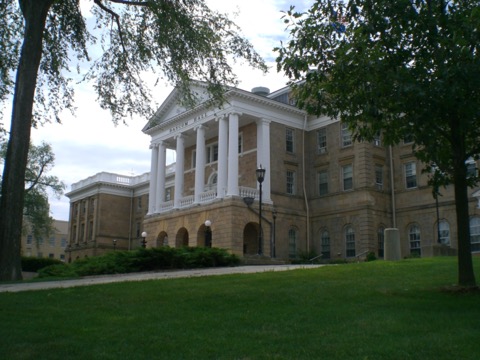
The University of Wisconsin System is a university system of public universities in the U.S. state of Wisconsin. It is one of the largest public higher-education systems in the country, enrolling more than 174,000 students each year and employing approximately 39,000 faculty and staff statewide. The University of Wisconsin System is composed of two doctoral research universities, eleven comprehensive universities, and thirteen freshman-sophomore branch campuses.

Many eutrophication studies focus on the external supply of critical nutrients like nitrogen and phosphorus, but hydrology and geomorphology can enhance or dampen the effects of excessive nutrient supply. We studied six backwater lakes in the Upper Mississippi River that varied in water residence time and water depth. Eutrophication in these systems is responsible for negative impacts such as cyanobacterial blooms and toxicity, and floating plant and algal mats that disrupt recreational water uses. Increasing backwater residence time was associated with more nitrate removal and a greater likelihood of nitrogen limitation, as well as greater accumulations of duckweed. Backwaters with greater depth and lower nitrogen concentration had less likelihood of filamentous algal accumulations. The median water residence time of backwaters with low duckweed (11.7 days) and no filamentous algae (16.9 days) approached the 12-day target to maintain overwintering conditions in backwaters for fisheries survival, supporting that water residence times in this range would likely improve both winter and summer water quality. Mean depth in backwaters with low duckweed and no filamentous algae was similar to 1.3 m, while shallower backwaters were more likely to produce duckweed and filamentous algae mats. This indicates that deeper backwaters might reduce the likelihood of eutrophication impacts. Natural resource management at the local level may not always be able to answer global and regional threats, but habitat restoration of hydrology and geomorphology can possibly alleviate or reduce large-scale threats at the local level.
Purpose E-commerce consumers value both forward and reverse logistics services and triple-bottom-line sustainability (cost, CSR and environmental performance). Unfortunately, these aspects of e-commerce can be at odds with one another. Therefore, a major challenge for e-commerce retailers lies in balancing the importance of forward and reverse logistics services with concerns about triple-bottom-line sustainability. To help e-commerce retailers better understand this challenge, our study delves into US consumers' tradeoff preferences related to delivery, returns and sustainability performances. Design/methodology/approach Policy capturing is a method employed by researchers to assess how individual decision-makers use available information when making evaluative tradeoffs between factors. We employ a policy-capturing method with 364 participants. Findings We find different consumers' tradeoff preferences in different groups in the USA. We observed that environmental concerns are paramount for younger respondents, but cost is more important for older respondents. Also, delivery performance is regarded as more significant than returns performance. Research limitations/implications Our findings imply that the demographic background of consumers plays a role in their purchasing behaviors. E-commerce retailers need to consider the psychological attitudes and age of the consumers. Practical implications Environmental performance seems to matter more to younger respondents relative to their older counterparts, so e-commerce retailers will need to adjust their strategies accordingly. We see some examples of e-commerce retailers trying to use this shift in attitudes to their advantage. Originality/value While literature has demonstrated that triple-bottom-line sustainability and logistics service are key consumer considerations in e-commerce, it has not yet been established how consumers evaluate these disparate and sometimes orthogonal factors in tandem. Our research aims to fill this gap.
Hexokinase (HK) catalyses the phosphorylation of glucose to glucose 6-phosphate, marking the first step of glucose metabolism. Most cancer cells co-express two homologous HK isoforms, HK1 and HK2, which can each bind the outer mitochondrial membrane (OMM). CRISPR screens performed across hundreds of cancer cell lines indicate that both isoforms are dispensable for growth in conventional culture media. By contrast, HK2 deletion impaired cell growth in human plasma-like medium. Here we show that this conditional HK2 dependence can be traced to the subcellular distribution of HK1. Notably, OMM-detached (cytosolic) rather than OMM-docked HK supports cell growth and aerobic glycolysis (the Warburg effect), an enigmatic phenotype of most proliferating cells. We show that under conditions promoting increased translocation of HK1 to the OMM, HK2 is required for cytosolic HK activity to sustain this phenotype, thereby driving sufficient glycolytic ATP production. Our results reveal a basis for conditional HK2 essentiality and suggest that demand for compartmentalized ATP synthesis explains why cells engage in aerobic glycolysis. Hexokinase detachment from the outer mitochondrial membrane is shown to support aerobic glycolysis in cancer cells. Differential localization of the HK1 isoform to the outer mitochondrial membrane, compared to the HK2 isoform, explains the conditional essentiality of HK2 in cancer cells cultured in physiologic media.
Kernza intermediate wheatgrass (Thinopyrum intermedium [Host] Barkworth & D.R. Dewey) is a novel dual-use perennial grain and forage crop with environmental and economic benefits for farmers. Perennial crop byproducts, such as Kernza straw, have been suggested as an alternative forage source in livestock systems. However, there is limited information on cattle performance offered Kernza straw. Therefore, our study assessed the performance of mature beef cows fed Kernza straw mixed with a haylage composed of alfalfa (Medicago sativa L.) and cool-season grasses. Grasses included orchardgrass (Dactylis glomerata L.), meadow fescue (Festuca pratensis L.) and Kentucky bluegrass (Poa pratensis L.). Two feeding trials conducted in two different years were performed with 36 pregnant Angus cows (Bos taurus) in six pens of six animals each in a completely randomized design with three replications. Dietary treatments included: (i) a 100% grass-alfalfa haylage (control), and (ii) a 50% Kernza straw - 50% grass-alfalfa haylage. Average daily gain was lower in the Kernza straw cows than in the control group (0.41 vs 0.92 kg day-1) in Trial 1 (P = 0.02) with no differences in Trial 2 (P = 0.13). Daily dry matter intake did not change in Trial 1 (P = 0.08), while for the cows offered Kernza straw it was reduced from 12.9 to 11.3 kg cow-1 day-1 in Trial 2 (P < 0.01). There were no changes in body condition among cows fed different diets in both trials (P > 0.05). Therefore, 50% Kernza straw can be successfully used in beef cow diets at least for 60 days without negative impacts on animal performance and potential economic and environmental benefits.
Objective: Accurate and timely classification of brain tumors from MRI slices is critical for effective diagnosis and treatment. This study introduces PBSNet, a lightweight deep learning model designed to achieve high classification precision from individual 2D slices while maintaining computational efficiency. Methods: We propose PBSNet (Parallel Branch Spatial Network), a convolutional neural network featuring a novel Parallel Branch Integration Module (PBIM) for enhanced intra-slice spatial feature extraction. PBSNet employs parallel 2D convolutional branches within the PBIM to simultaneously capture various spatial features of each slice. These features are subsequently integrated using a 3D convolution operating across the parallel branch dimension, designed to efficiently model complex patterns within individual slices and reduce computational complexity compared to standard 3D CNNs. Results: Evaluated on a dataset of 7023 individual MRI slices, PBSNet achieved a test accuracy of 98.63% and macro precision, recall, and F1 scores ranging from 97% to 100%. The model demonstrated a low test loss of 0.069 and a rapid training time of 367.2 s. With approximately 2.72 million parameters, PBSNet is compact and highly effective for slice-based classification. Conclusion: PBSNet integrates multi-pathway spatial analysis into an efficient architecture with a relatively low parameter count. By effectively processing individual MRI slices using parallel branches for feature extraction and integration, it offers a promising approach for applications where computational resources are limited, although inference speed requires further validation. This method provides a robust foundation for computer-aided diagnosis in neurooncology, enabling precise and resource-efficient brain tumor classification from 2D MRI data. Unlike conventional multi-branch CNNs that replicate parallel paths without specialized integration, PBSNet introduces a cross-branch 3D convolutional fusion module designed specifically for slice-level MRI analysis, enabling efficient intra-slice spatial diversity capture with minimal parameter overhead.





