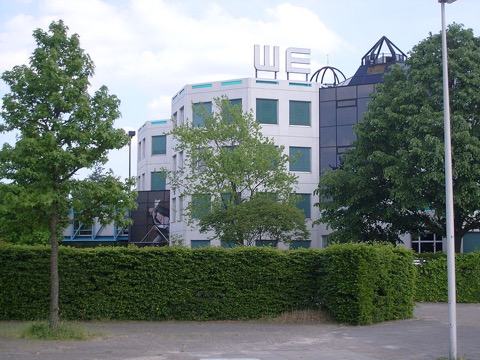
WE, also known as WE Fashion, is originally a Dutch fashion chain which sells clothing, shoes, bags and other accessories. WE has approximately 240 shops and 3,000 employees in the Netherlands, Belgium, Germany, France, Luxembourg, Austria and Switzerland. WE is part of the European fashion conglomerate Logo International, which also owns the brands O'Neill and Van Gils. WE is a company with a vertical organisation that designs its collections in-house. Advertising, marketing and store concepts are also developed internally. WE has a sales training programme called WE University.

The Przewalski´s horse (Extinct in the Wild in 1996) is currently listed as Endangered. The first individuals were reintroduced to the Great Gobi B Strictly Protected Area (GGBSPA) in Mongolia in 1997. We observed selected horse groups in the GGBSPA during two seasons in one year (2019) and used ecological niche models to (1) model habitat selection for feeding and resting with generalised linear mixed models; (2) identify the influence of origin (Wild-born vs. Reintroduced); and (3) discuss the potential influence of human presence on the habitat used by the horses for these behaviours. We used three types of satellite-derived predictors: (i) topography (ALOS); (ii) vegetation indexes (Landsat); and (iii) land cover (Copernicus). We assessed the spatial similarity between Reintroduced vs. Wild-born models using pairwise comparisons of the two response variables (feeding and resting). We found significant differences and an apparent shift between the areas preferred for feeding and resting by Wild-born and Reintroduced horses, both over the selected periods and between the groups of different origins. For Wild-born horses, the probability of feeding increased with increasing vegetation quality, while Reintroduced horses tended to feed in worse areas in Late Spring. Surprisingly, an opposite trend was observed in Autumn. On the contrary, no clear pattern emerged from the full model that combined both seasons. Our research provides valuable insights that can inform the refinement of conservation practices, offering practical approaches for enhanced management of the species. We propose that habitat suitability, anthropogenic pressure, and reintroduced group size should be considered key factors for the successful reintroduction of Przewalski´s horses. Additionally, our results caution against simple sample-size maximisation and show that stratified, well-defined datasets might prevent dilution of key drivers in habitat-use models for reintroduced ungulates.
In Germany, continuing education for emergency medical personnel remains largely defined by mandatory hours and formal requirements rather than by meaningful learning outcomes. This paper argues for a paradigm shift toward a goal-oriented and competence-based model of professional development. Drawing on educational theory and international frameworks such as Continuous Professional Development (CPD), the authors analyze the heterogeneity of current training systems and emphasize the need for structured, reflective, and learner-centered approaches. Professional competence is conceptualized as a dynamic combination of technical expertise, social and methodological skills, and self-awareness-elements that must be continually cultivated in response to evolving clinical, technological, and organizational demands. Reframing continuing education as a core element of lifelong learning not only enhances patient safety and teamwork but also strengthens the professional identity of emergency service personnel.
Work-nonwork balance remains a consistently pertinent topic due to its beneficial impact on both employees and employers. We provide evidence that work-nonwork balance is not just an organizational issue but is partly determined by personality. Nevertheless, the organizational context plays a pivotal role in implementing and firmly anchoring interventions. This study investigates the negative relationship of neuroticism and work-nonwork balance and the extent to which self-efficacy, as a personal cognitive resource, mediates this relationship. To examine this relationship, we conducted a quantitative online survey involving 190 employed adults from various organizations in Germany. We assessed the constructs of work-nonwork balance, neuroticism, and self-efficacy. Using regression analysis and mediation analysis, we demonstrate that neuroticism has a significantly negative impact on work-nonwork balance, and this relationship is partially mediated by self-efficacy. This article discusses the study's limitations, such as its cross-sectional nature, and offers theoretical and practical implications regarding the development, maintenance, and improvement of individual self-efficacy.
Forest restoration is a crucial natural climate solution, yet its long-term carbon benefits remain uncertain. Globally, three main strategies are adopted: natural regeneration (NR), assisted natural regeneration (ANR), and active restoration (AR). We integrated 36 years of aboveground carbon (AGC) dynamics derived from lidar, Landsat, and forest monitoring plots across East Africa and applied a a quasi-experimental framework to quantify the additionality of active interventions (including AR and ANR) for AGC change over time. We found active interventions commonly exhibit early-stage setbacks in AGC accumulation relative to NR, reflecting site preparation and seedling establishment. However, their impact strengthens over time, becoming pronounced > 9 years after restoration. Long-term AGC gains attributable to ANR and AR range from 0.88 to 3.31 Mg C ha-1 yr-1, with AR performing best in environmentally constrained dry and montane systems and ANR in productive forests facing land-use competition. Optimizing restoration across 14.45 million hectares in East Africa—2.1% of global potential restoration areas—could enhance carbon removal by 2.18 ± 0.36 Gt C by 2050, although less than one-quarter would be realized by 2030. Restoration benefits are therefore strongly time-dependent, and sustained commitment is essential to realize their climate mitigation potential and enhance restoration efficiency.
This study presents an extension to the theory for analytically analyzing the eigenfunctions and frequency equation of a taut cable with an intermediate point support. The equations of motion for the free vibration of the two-span cable, along with the corresponding boundary and continuity conditions, are established to define the eigenvalue problem and derive simple analytical expressions for the modal properties. Examination of the obtained spectrum reveals “localized modes”—in which only one span exhibits significant vibration amplitudes—“global modes”—in which the vibration of the cable extends across both spans—and “degenerate modes”—where there is more than one independent eigenfunction for a natural frequency. In a numerical example, the analytical results are confirmed by a comparison with finite element solutions obtained with computation endowed with commercial software (ABAQUS).





