In the case of a variable period (wavelength) of a perturbed interface, the instability and stability of Richtmyer–Meshkov vortices in perfect gas and incompressible perfect fluid, respectively, are investigated numerically and analytically. Taking into account available experiments, the instability of the interface between the argon and xenon in the case of a relatively small period is modeled. An estimate of the magnitude of the critical period is given. The nonlinear (for arbitrary initial conditions) stability of the corresponding steady-state vortex flow of perfect fluid in a strip (vertical periodic channel) in the case of a fairly large period is shown.
Possible approaches to modeling two-dimensional coherent hydrodynamic structures based on the statistical mechanics of local vortices are considered. The exact definitions of coherent structures are given and the mechanisms of their formation are shown. The bases of the kinetic theory of Onsager vortices are given and the possibility of applying the classical molecular-kinetic theory for the explanation of the origin of vortex meso-structures in the shear flows is considered.
This paper presents the numerical simulation of the circumfluence of a recovery apparatus with brake engines and a detachable heat protection shield carried out by the use of the conservative numerical method of cluster architecture. The simulation results of the action of reactive jets of brake engines on the landing surface and the recovery apparatus, as well as the basic aerodynamic characteristics, are considered.
The existing approaches to analyzing the dynamics of coherent vortex structures are considered from the viewpoint of the calculus of variations for Poisson systems. For turbulent hydrodynamic flows with large-scale vortices, a simulation technique in the form of statistical mechanics of the Euler equation in a “coarse-grained” representation is substantiated.
The evolution of an initial perturbation in an axisymmetric subsonic normal inviscid gas flow through a pipe is directly simulated. The basic (unperturbed) flow has a zero radial velocity component, while its axial velocity component (along the axis of symmetry) increases or decreases linearly with the radius. The perturbation is specified as a swirl (rotation about the axis) with a positive or negative velocity vanishing on the central axis and the lateral surface. Irrespective of its direction, the swirl gives rise to a steady-state vortex carried by the flow. It shape is spherical (contiguous to the rotation axis) or circular (sliding along the impermeable lateral surface).
Памяти Сергея Петровича Капицы, Андреев А.Ф., Белоцерковский О.М., Богомолов Г.Д., Быков В.П., Каган Ю.М., Карлов Н.В., Луганский Л.Б., Питаевский Л.П., Прозорова Л.А., Рыжов Ю.А., Фортов В.Е., Ципенюк Ю.М.
A spectral representation of kinetic energy for a vortex cascade of instability in a compressible inviscid shear flow is considered, and the Rayleigh-Taylor instability is studied. A comparative analysis is given to the spectral decompositions of kinetic energy for both problems. The classical Kolmogorov −5/3 power law is proved to hold for developed turbulent flows.
The possibility of describing vortex structures in quasi-one-dimensional plane flows by applying kinetic equations and bifurcation theory is examined. The Lyapunov-Schmidt method is used to obtain a system of Riccati-type generalized bifurcation equations. An analysis of its properties leads to conditions for the existence of vortex structures.
The countercurrent flow in a gas centrifuge is simulated. Mechanical and thermal methods for its excitation are discussed; thermal restructuring, the thermal control of the velocity field, and a shift in the inversion point are analyzed; and the formation of overtone flows in the rarefaction zone is studied.
Dorodnicyn’s classical work concerning the method of integral relations is given in his original presentation. Developments of the method provided by Dorodnicyn’s students are outlined. Belotserkovskii’s 1956 paper concerning a technique for computing the detached shock wave in flow over a cylinder is presented in full (with comments and numerical results). A technique for the study of flow characteristics for space vehicles of particular shapes is described. The breakthrough character of techniques proposed more than 50 years ago is demonstrated, and their (still important) philosophy is assessed.
Vortex cascades of instabilities forming a core are studied. Large-scale linear waves in a fluctuating medium are described.
A possible approach to the simulation of turbulent flows is proposed that is based on statistics of vortices of various types in a plane. It is shown that coherent (large-scale) fluid structures can be identified with solutions of the Joyce-Montgomery equations, and the possibility that these solutions bifurcate is explored. The formalism of turbulent dynamics description is based on kinetic equations for point vortices with a nontrivial internal structure.
 Alexei M Oparin合作论文数15V. M. Chechetkin合作论文数11
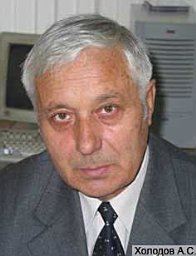 A. S. Kholodov合作论文数Moscow9
 Oleg Troshkin合作论文数9V. G. Grudnitskii合作论文数7
 V. A. Gushchin合作论文数All-Russian Scientific-Research and Design-Technological Institute for the Utilization of Equipment and Petroleum Products in Agriculture (VIITiN) USSR7
 Victor V Denisenko合作论文数Research Laboratory of Design Automation, Taganrog, Russia7S. V. Fortova合作论文数7ю м давыдов合作论文数6
 Nikolay Fimin合作论文数6V.E. Yanitskii合作论文数6I. V. Eriklintsev合作论文数6v e ianitskii合作论文数5с а козлов合作论文数Институт автоматизации проектирования РАН5Victor Antonovich Sadovnichii合作论文数5
 Andrey Konyukhov合作论文数Prokhorov General Physics Institute, Russian Academy of Sciences5E. I. Oparina合作论文数4M. M. Golomazov合作论文数4Valeriy Demchenko合作论文数4Alexey V Babakov合作论文数4Yu. M. Davydov合作论文数4Yu. I. Zhuravlev合作论文数4l b luganskii合作论文数3AS GLAZUNOV合作论文数3Владимир Е. Фортов合作论文数3G. D. Bogomolov合作论文数3Ilya Andreevich Shishmarev合作论文数3Boris Nikolaevich Chetverushkin合作论文数Institute of Mathematical Modeling, Russian Academy of Sciences3
 Igor Lomov合作论文数3M. K. Kerimov合作论文数3A. Bulekbaev合作论文数3I. V. Mingalev合作论文数2VN RYGALIN合作论文数2Im Davydov合作论文数2людмила андреевна прозорова合作论文数2М. С. Белоцерковская合作论文数2юрий моисеевич каган合作论文数2M. S. Belotserkovskaya合作论文数2Yu.P. Popov合作论文数2Im Khalatnikov合作论文数2Iv Gaishun合作论文数2Tk Shemyakina合作论文数2AV VINOGRADOV合作论文数2
 O. V. Mingalev合作论文数2So Belotserkovskii合作论文数2Sv Emel'Yanov合作论文数2MP KIRPICHNIKOV合作论文数2Vs Mingalev合作论文数2S. K. Korovin合作论文数2




