The formation of cosmic structures in the late Universe was considered using the Vlasov kinetic approach. The crucial point is the use of the gravitational potential with repulsive term of the cosmological constant, which provides a solution to the Hubble tension, that is, the Hubble parameter for the late Universe has to differ from its global cosmological value. This also provides a mechanism of formation of stationary semi-periodic gravitating structures of voids and walls, so that the cosmological constant has the role of the scaling. It can therefore be compared with the observational data for given regions. The considered mechanism of the structure formation in the late cosmological epoch then succeeds the epoch described by the evolution of primordial density fluctuations.
We consider a method for obtaining equations of the Hamiltonian dynamics for system of interacting massive charged particles using the general relativistic Einstein–Hilbert action. In the general relativistic case, Vlasov-type equations are derived in the nonrelativistic and weakly relativistic limits. Expressions are proposed for corrections to the Poisson equation, which can contribute to the effective action of dark matter and dark energy. In this case, an efficient approach to synchronizing the proper times of different particles of a many-particle system is proposed. Based on the obtained expressions for the action, we analyze the possibility of a composite structure of the cosmological term in the Einstein equations. Reduced Euler equations leading to the Milne–McCrea cosmological model are derived using a hydrodynamic substitution and are solved in the self-similar class.
The criteria for the formation of stationary pseudo-periodic structures in a system of gravitating particles, described by the Vlasov–Poisson system of equations. Conditions studied branching solutions of a nonlinear integral equation for a generalized gravitational potential, leading to the emergence of coherent complex states of relative equilibrium in non-stationary systems of massive particles.
The criteria for the formation of non-stationary pseudo-periodic structures in a system of gravitating particles, described by the Vlasov--Poisson system of equations. Conditions of branching of solutions of a nonlinear integral equation for a generalized gravitational potential, leading to the emergence of coherent complex states of relative equilibrium in non-stationary systems of massive particles, is studied.
We consider a principal problem, that of the possible dominating role of self-consistent gravitational interaction in the formation of cosmic structures: voids and their walls in the local Universe. It is in the context of the Hubble tension as a possible indication of the difference in the descriptions of the late (local) and early (global) Universe. The kinetic Vlasov treatment enables us to consider the evolution of gravitating structures where the fundamental role has the modified gravitational potential with a cosmological constant, leading to the prediction of a local flow with a Hubble parameter that is nonidentical to that of the global Hubble flow. The Poisson equation for a potential with an additional repulsive term, including an integral equation formulation, is analyzed, and we predict the appearance of multiply connected two-dimensional gravitating structures and voids in the local Universe. The obvious consequence of the developed mechanism is that the cosmological constant poses a natural scaling for the voids, along with the physical parameters of their local environment, which can be traced in observational surveys.
We study structure formation in the late Universe within the Vlasov kinetic self-consistent field approach. Our work is principally focused on the use of the modified gravitational potential with a repulsive term of the cosmological constant, which is directly linked to observations that enable characterizations of the Hubble tension as the result of local and global flows. We formulate the criteria for the formation of the semi-periodic gravitating structures, along with the predictions of their quantitative scales associated with observable parameters. Our principal conclusion is that filament formation in the Local (late) Universe can proceed as a deterministic process that is distinct from the structures at larger scales that result from the essentially stochastic dynamics of density perturbations.
The paper proposes and implements a method of obtaining a closed set of Vlasov–Maxwell–Einstein equations (and its weakly relativistic and nonrelativistic analogues) based on variation of the generalized Hilbert–Einstein–Pauli action. This technique also makes it possible to obtain the exact form of the energy-momentum tensor in terms of particle distribution functions. Using a hydrodynamic substitution in the Vlasov equation, the Euler–Lamb equations are obtained, which can be transformed to the form of Hamilton–Jacobi equations. Exact solutions of cosmological type of the hydrodynamic system are demonstrated, and their physical consequences are analyzed (including a generalization of the Milne–McCrea model).
The authors propose a general scheme of derivation from the general relativistic Einstein-Hilbert action for a system of gravitationally interacting charged particles, Hamilton’s dynamics equations and field equations. In accordance with the proposed methodology, new forms of equations of Vlasov type are obtained in the general relativistic case, nonrelativistic and weakly relativistic limits. Expressions are established for the resulting corrections in the equation Poisson, which can contribute to the action of dark matter and dark energy. An effective approach to synchronizing the proper times of different particles of a many-particle system is proposed based on invariance of the form of action. Authors derived (using hydrodynamic substitution) and solved the Euler-type equations leading to the cosmological Friedmann and Milne-McCrea models.
This preprint describes the system of Vlasov–Poisson equations in the self-consistent gravitational potential of cosmological genesis, and shows a case that leads to the formation of coherent pseudochaotically distributed ”walls” of the cosmological structure.
The emergence of one- and two-dimensional configurations—Zeldovich pancakes—progenitors of the observed filaments and clusters and groups of galaxies is predicted by means of a developed kinetic approach in analyzing the evolution of initial density perturbations. The self-consistent gravitational interaction described by Vlasov–Poisson set of equations with branching conditions is shown to predict two-dimensional structures as of layers of increased density and voids between them, i.e., the cellular macro-structure of the Universe. The modified potential of weak-field General Relativity is involved, which enables one to explain the Hubble tension, revealing the conceptual discrepancy in the local galactic flows and the cosmological expansion. This demonstrates the possible essential role of self-consistent gravity in the formation of the cosmic web.
The principle of the least action and the Vlasov kinetic formalism is used to derive the closed set of equations defining the systems of gravitating particles. The hydrodynamic approximation is shown to enable one to reduce the Vlasov equation to the Euler–Courant equations, including in the Hamilton–Jacobi form. Exact solutions of those equations for non-relativistic cosmological models of Milne–McCrea form with Gurzadyan’s potential are obtained, which, particularly, enables to address the Hubble tension problem.
A three-dimensional numerical model describing the interaction of a plasma with an electromagnetic field based on the Vlasov–Maxwell equations is used to compute relativistic colliding jets of a dense neutral electron–proton plasma in a vacuum. The influence exerted by the initial velocity of plasma particles and their concentration on the interaction of the jets is investigated.
The model problem of heat transfer from a nonuniformly heated pipe wall to the basic flow is considered, or, in other words, the initial stages of fluid temperature and pressure relaxation in a heated pipe are addressed. The computations are based on computer codes using various combinations of the Navier–Stokes equations, a modified Burnett equation, and the kinetic BGK equation.
We derive from the principle of least action (a slight generalization of the classical one) the right-hand sides of Maxwell and Einstein equations for a system on charged particles in the framework of the Vlasov–Maxwell–Einstein system of equations. The reduced Euler equations are derived using hydrodynamic substitution and are solved within the self-similar class, as a consequence of the Vlasov system of equations. The properties of the generalized non-relativistic Friedmann–Milne–McCrea model are analyzed in context of Gurzadyan’s theorem on the general function satisfying the equivalency of sphere’s and point mass’s gravity.
Рассматривается модельная задача о переносе тепла от неравномерно нагреваемых стенок трубы
A new universal method is proposed for obtaining Vlasov–type equations for systems of interacting massive charged particles from the general-relativistic Einstein–Hilbert action. At the same time, a new effective approach to synchronizing the proper times of various particles of a many–particle system has been introduced. A new form of the energy–momentum tensor for matter (and the right-hand side of Einstein’s equations) is obtained.
 V. M. Chechetkin合作论文数34в а чуянов合作论文数16
 Valery Chuyanov合作论文数15V. V. Vedenyapin合作论文数13Valery Mihailovich Chechetkin合作论文数11S. L. Ginzburg合作论文数8O. M. Belotserkovskii合作论文数Moscow6Yu. N. Orlov合作论文数6Vladimir V. Dyachenko合作论文数Physico-Technical Institute5г п чуркина合作论文数4В. В. Веденяпин合作论文数4
 M. A. Negmatov合作论文数4AL SUDARIKOV合作论文数3I. V. Melikhov合作论文数3V. V. Kazantseva合作论文数3В. М. Чечеткин合作论文数3в ф дьяченко合作论文数2v m suslin合作论文数2Yu. A. Volkov合作论文数2
 Gregory V. Vereshchagin合作论文数Natl Acad Sci Belarus, ICRANet Minsk2I. A. Siutsou合作论文数2E. A. Zabrodina合作论文数2S. Z. Adzhiev合作论文数2O. V. Nikolaeva合作论文数2
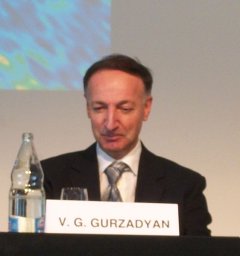 Vahe Gurzadyan合作论文数Yerevan Physics Institute;Yerevan State University2V. G. Novikov合作论文数2V. F. D’yachenko合作论文数1National Research Center “Kurchatov Institute”合作论文数1Ya. G. Batishcheva合作论文数1Sapienza Università di Roma合作论文数1
 Remo J. Ruffini合作论文数University La Sapienza1
 Remo Ruffini合作论文数1S. Yu. Gus’Kov合作论文数1V. V. Paleichik合作论文数1Alexei M Oparin合作论文数1Vladislav B Rozanov合作论文数1S. A. Bel’Kov合作论文数1




