Hypergraph neural networks (HGNNs) have shown great potential in modeling higher-order relationships among multiple entities. However, most existing HGNNs primarily emphasize low-pass filtering while neglecting the role of high-frequency information. In this work, we present a theoretical investigation into the spectral behavior of HGNNs and prove that combining both low-pass and high-pass components leads to more expressive and effective models. Notably, our analysis highlights that high-pass signals play a crucial role in capturing local discriminative structures within hypergraphs. Guided by these insights, we propose a novel sheaflet-based HNNs that integrates cellular sheaf theory and framelet transforms to preserve higher-order dependencies while enabling multi-scale spectral decomposition. This framework explicitly emphasizes high-pass components, aligning with our theoretical findings. Extensive experiments on benchmark datasets demonstrate the superiority of our approach over existing methods, validating the importance of high-frequency information in hypergraph learning.
In this paper, we focus on analyzing the excess risk of an unpaired data generation model, called CycleGAN. Unlike classical GANs, CycleGAN not only transforms data between two unpaired distributions but also ensures the mappings are consistent, which is encouraged by the cycle-consistency term unique to CycleGAN. The increasing complexity of model structure and the addition of the cycle-consistency term in CycleGAN present new challenges for error analysis. By considering the impact of both the model architecture and training procedure, the risk is decomposed into two terms: approximation error and estimation error. These two error terms are analyzed separately. Each component is rigorously analyzed; the approximation error through constructing approximations of the optimal transport maps, and the estimation error through establishing an upper bound using Rademacher complexity. Our analysis not only isolates these errors but also explores the trade-offs between them, which provides theoretical insights of how CycleGAN’s architecture and training procedures influence its performance.
Graph convolutional networks (GCNs) have emerged as powerful models for graph learning tasks, exhibiting promising performance in various domains. While their empirical success is evident, there is a growing need to understand their essential ability from a theoretical perspective. Existing theoretical research has primarily focused on the analysis of single-layer GCNs, while a comprehensive theoretical exploration of the stability and generalization of deep GCNs remains limited. In this paper, we bridge this gap by delving into the stability and generalization properties of deep GCNs, aiming to provide valuable insights by characterizing rigorously the associated upper bounds. Our theoretical results reveal that the stability and generalization of deep GCNs are influenced by certain key factors, such as the maximum absolute eigenvalue of the graph filter operators and the depth of the network. Our theoretical studies contribute to a deeper understanding of the stability and generalization properties of deep GCNs, potentially paving the way for developing more reliable and well-performing models.
In recent years, there has been growing interest in the field of functional neural networks. They have been proposed and studied with the aim of approximating continuous functionals defined on sets of functions on Euclidean domains. In this paper, we consider functionals defined on sets of functions on spheres. The approximation ability of deep ReLU neural networks is analyzed using an encoder-decoder framework on the unit sphere. An encoder is introduced first to accommodate the infinite-dimensional nature of the functional’s domain. It utilizes spherical harmonics to help us extract the latent finite-dimensional information of functions, which in turn facilitates in the next step of approximation analysis using fully connected neural networks. Moreover, real-world objects are frequently sampled discretely and are often corrupted by noise. Therefore, encoders with discrete inputs and those with discrete and random noise inputs are constructed, respectively. The approximation rates with different encoder structures are provided therein.
In this article, we are concerned with the generalization performance of nonparametric estimation for pairwise learning. Most of the existing work requires the hypothesis space to be convex or a VC-class, and the loss to be convex. However, these restrictive assumptions limit the applicability of the results in studying many popular methods, especially kernel methods and neural networks. We significantly relax these restrictive assumptions and establish a sharp oracle inequality of the empirical minimizer with a general hypothesis space for the Lipschitz continuous pairwise losses. As an example, we apply our general results to study pairwise least squares regression and derive an excess population risk bound that matches the minimax lower bound for the pointwise least squares regression. The key novelty lies in constructing a structured deep ReLU neural network to approximate the true predictor, and in designing a targeted hypothesis space composed of networks with this structure and controllable complexity. Experiments validate the effectiveness of the proposed method. This example demonstrates that the obtained general results indeed help us to explore the generalization performance on a variety of problems that cannot be handled by existing approaches.
Deep neural networks have emerged as powerful tools for learning operators defined over infinite-dimensional function spaces. However, existing theories frequently encounter difficulties related to dimensionality and limited interpretability. This work investigates how sparsity can help address these challenges in functional learning, a central ingredient in operator learning. We propose a framework that employs convolutional architectures to extract sparse features from a finite number of samples, together with deep fully connected networks to effectively approximate nonlinear functionals. Using universal discretization methods, we show that sparse approximators enable stable recovery from discrete samples. In addition, both the deterministic and the random sampling schemes are sufficient for our analysis. These findings lead to improved approximation rates and reduced sample sizes in various function spaces, including those with fast frequency decay and mixed smoothness. They also provide new theoretical insights into how sparsity can alleviate the curse of dimensionality in functional learning.
Motivated by challenges in conditional generative modeling, where the target conditional density takes the form of a ratio f1 over f2, this paper develops a theoretical framework for approximating such ratio-type functionals. Here, f1 and f2 are kernel-based marginal densities that capture structured interactions, a setting central to diffusion-based generative models. We provide a concise proof for approximating these ratio-type functionals using deep neural networks with the SignReLU activation function, leveraging the activation's piecewise structure. Under standard regularity assumptions, we establish L^p(Omega) approximation bounds and convergence rates. Specializing to Denoising Diffusion Probabilistic Models (DDPMs), we construct a SignReLU-based neural estimator for the reverse process and derive bounds on the excess Kullback-Leibler (KL) risk between the generated and true data distributions. Our analysis decomposes this excess risk into approximation and estimation error components. These results provide generalization guarantees for finite-sample training of diffusion-based generative models.
In this work, we explore the intersection of sparse coding theory and deep learning to enhance our understanding of feature extraction capabilities in advanced neural network architectures. We begin by introducing a novel class of Deep Sparse Coding (DSC) models and establish a thorough theoretical analysis of their uniqueness and stability properties. By applying iterative algorithms to these DSC models, we derive convergence rates for convolutional neural networks (CNNs) in their ability to extract sparse features. This provides a strong theoretical foundation for the use of CNNs in sparse feature-learning tasks. We additionally extend this convergence analysis to more general neural network architectures, including those with diverse activation functions, as well as self-attention and transformer-based models. This broadens the applicability of our findings to a wide range of deep learning methods for the extraction of deep-sparse features. Inspired by the strong connection between sparse coding and CNNs, we also explore training strategies to encourage neural networks to learn sparser features. Through numerical experiments, we demonstrate the effectiveness of these approaches, providing valuable insight for the design of efficient and interpretable deep learning models.
To overcome the shortcomings of classical support vector machines in classifying matrix-type data and outliers, we aim at studying kernel support matrix machines with ramp loss. For this purpose, a class of proximal stationary points is introduced. First, the relationship between the proximal stationary point, the Karush-Kuhn-Tucker point, and the locally optimal solution to the proposed model is built. Second, to solve the kernel support matrix machines with ramp loss, an alternating direction method of multipliers algorithm is developed. Any limit point of the sequence generated by this algorithm is shown to be a proximal stationary point. Finally, through extensive numerical simulations, we showcase the superiority of the proposed model with convolutional neural tangent kernels over existing state-of-the-art methods for matrix input data.
Hypergraphs provide a flexible framework for modeling high-order (complex) interactions among multiple entities, extending beyond traditional pairwise correlations in graph structures. However, deep hypergraph neural networks (HGNNs) often face the challenge of oversmoothing with increasing depth, similar to issues in graph neural networks (GNNs). While oversmoothing in GNNs has been extensively studied, its implications in relation to hypergraphs are less explored. This paper addresses this gap by first theoretically exploring the reasons behind oversmoothing in deep HGNNs. Our novel insights suggest that a spectral-based hypergraph convolution, equipped with both low-pass and high-pass filters, can potentially mitigate these effects. Motivated by these findings, we introduce FrameHGNN, a framework that utilizes framelet-based hypergraph convolutions integrating tight framelet transforms with both low-pass and high-pass components, as well as the commonly used strategies in designing deep GNN architecture: initial residual and identity mappings. The experiment results on diverse benchmark datasets demonstrate that FrameHGNN outperforms several state-of-the-art models, effectively reducing oversmoothing while improving predictive accuracy. Our contributions not only advance the theoretical understanding of deep hypergraph learning but also provide a practical spectral-based approach for HGNNs, emphasizing the design of multifrequency channels.
We study approximation and learning capacities of convolutional neural networks (CNNs) with one-side zero-padding and multiple channels. Our first result proves a new approximation bound for CNNs with certain constraint on the weights. Our second result gives new analysis on the covering number of feed-forward neural networks with CNNs as special cases. The analysis carefully takes into account the size of the weights and hence gives better bounds than the existing literature in some situations. Using these two results, we are able to derive rates of convergence for estimators based on CNNs in many learning problems. In particular, we establish minimax optimal convergence rates of the least squares based on CNNs for learning smooth functions in the nonparametric regression setting. For binary classification, we derive convergence rates for CNN classifiers with hinge loss and logistic loss. It is also shown that the obtained rates for classification are minimax optimal in some common settings.
In this report, we introduce Gemini Embedding, a state-of-the-art embedding model leveraging the power of Gemini, Google's most capable large language model. Capitalizing on Gemini's inherent multilingual and code understanding capabilities, Gemini Embedding produces highly generalizable embeddings for text spanning numerous languages and textual modalities. The representations generated by Gemini Embedding can be precomputed and applied to a variety of downstream tasks including classification, similarity, clustering, ranking, and retrieval. Evaluated on the Massive Multilingual Text Embedding Benchmark (MMTEB), which includes over one hundred tasks across 250+ languages, Gemini Embedding substantially outperforms prior state-of-the-art models, demonstrating considerable improvements in embedding quality. Achieving state-of-the-art performance across MMTEB's multilingual, English, and code benchmarks, our unified model demonstrates strong capabilities across a broad selection of tasks and surpasses specialized domain-specific models.
In this paper, we explore the approximation theory of functions defined on graphs. Our study builds upon the approximation results derived from the K-functional. We establish a theoretical framework to assess the lower bounds of approximation for target functions using Graph Convolutional Networks (GCNs) and examine the over-smoothing phenomenon commonly observed in these networks. Initially, we introduce the concept of a K-functional on graphs, establishing its equivalence to the modulus of smoothness. We then analyze a typical type of GCN to demonstrate how the high-frequency energy of the output decays, an indicator of over-smoothing. This analysis provides theoretical insights into the nature of over-smoothing within GCNs. Furthermore, we establish a lower bound for the approximation of target functions by GCNs, which is governed by the modulus of smoothness of these functions. This finding offers a new perspective on the approximation capabilities of GCNs. In our numerical experiments, we analyze several widely applied GCNs and observe the phenomenon of energy decay. These observations corroborate our theoretical results on exponential decay order.
Deep learning based on deep neural networks has been very successful in many practical applications, but it lacks enough theoretical understanding due to the network architectures and structures. In this paper we establish some analysis for linear feature extraction by a deep multi-channel convolutional neural networks (CNNs), which demonstrates the power of deep learning over traditional linear transformations, like Fourier, wavelets, redundant dictionary coding methods. Moreover, we give an exact construction presenting how linear features extraction can be conducted efficiently with multi-channel CNNs. It can be applied to lower the essential dimension for approximating a high dimensional function. Rates of function approximation by such deep networks implemented with channels and followed by fully-connected layers are investigated as well. Harmonic analysis for factorizing linear features into multi-resolution convolutions plays an essential role in our work. Nevertheless, a dedicate vectorization of matrices is constructed, which bridges 1D CNN and 2D CNN and allows us to have corresponding 2D analysis.
Deep neural networks (DNNs) have garnered significant attention in various fields of science and technology in recent years. Activation functions define how neurons in DNNs process incoming signals for them. They are essential for learning non-linear transformations and for performing diverse computations among successive neuron layers. In the last few years, researchers have investigated the approximation ability of DNNs to explain their power and success. In this paper, we explore the approximation ability of DNNs using a different activation function, called SignReLU. Our theoretical results demonstrate that SignReLU networks outperform rational and ReLU networks in terms of approximation performance. Numerical experiments are conducted comparing SignReLU with the existing activations such as ReLU, Leaky ReLU, and ELU, which illustrate the competitive practical performance of SignReLU.
In this article, we develop a general theoretical framework for constructing Haar-type tight framelets on any compact set with a hierarchical partition. In particular, we construct a novel area-regular hierarchical partition on the two spheres and establish its corresponding spherical Haar tight framelets with directionality. We conclude by evaluating and illustrate the effectiveness of our area-regular spherical Haar tight framelets in several denoising experiments. Furthermore, we propose a convolutional neural network (CNN) model for spherical signal denoising, which employs fast framelet decomposition and reconstruction algorithms. Experiment results show that our proposed CNN model outperforms threshold methods and processes strong generalization and robustness.
Motivated by kernel methods in machine learning theory, we study the uniform approximation of functions from reproducing kernel Hilbert spaces by Bernstein operators. Rates of approximation are provided in terms of the function norm in the reproducing kernel Hilbert space. A case study of contracting properties of the Bernstein operators is also presented.
The nature of heterophilous graphs is significantly different from that of homophilous graphs, which causes difficulties in early graph neural network (GNN) models and suggests aggregations beyond the one-hop neighborhood. In this article, we develop a new way to implement multiscale extraction via constructing Haar-type graph framelets with desired properties of permutation equivariance, efficiency, and sparsity, for deep learning tasks on graphs. We further design a graph framelet neural network model permutation equivariant graph framelet augmented network (PEGFAN) based on our constructed graph framelets. The experiments are conducted on a synthetic dataset and nine benchmark datasets to compare the performance with other state-of-the-art models. The result shows that our model can achieve the best performance on certain datasets of heterophilous graphs (including the majority of heterophilous datasets with relatively larger sizes and denser connections) and competitive performance on the remaining.
Deep learning based on deep convolutional neural networks (CNNs) is extremely efficient in solving classification problems in speech recognition, computer vision, and many other fields. But there is no enough theoretical understanding about this topic, especially the generalization ability of the induced CNN algorithms. In this article, we develop some generalization analysis of a deep CNN algorithm for binary classification with data on spheres. An essential property of the classification problem is the lack of continuity or high smoothness of the target function associated with a convex loss function such as the hinge loss. This motivates us to consider the approximation of functions in the $L_{p}$ space with $1\leq p \leq \infty $ . We provide rates of $L_{p}$ -approximation when the approximated function lies in a Sobolev space and then present generalization bounds and learning rates for the excess misclassification error of the deep CNN classification algorithm. Our novel analysis is based on efficient cubature formulae on spheres and other tools from spherical analysis and approximation theory.
This paper proposes a distributed weighted regularized least squares algorithm (DWRLS) with radial basis functions to tackle spherical data that are stored across numerous local servers and cannot be shared with each other. Via developing a novel integral operator approach based on spherical quadrature rules, we succeed in deriving optimal approximation rates for DWRLS and theoretically demonstrate that DWRLS performs similarly as running a weighted regularized least squares algorithm on the whole data stored on a large enough machine. This interesting finding implies that distributed learning is capable of sufficiently exploiting potential values of distributively stored spherical data, even though local servers cannot access the whole data.
 Dingxuan Zhou (周定軒)合作论文数School of Mathematics and Statistics, University of Sydney;Faculty of Science, University of Sydney14
 Jianfei Li合作论文数7
 Shuo Huang合作论文数6
 Ming Li (李明)合作论文数Zhejiang Key Laboratory of Intelligent Education Technology and Application, Zhejiang Normal University;Department of Computer Science, Zhejiang Normal University5
 Xiaosheng Zhuang (庄晓生)合作论文数Department of Mathematics, College of Science, City University of Hong Kong4
 Junyu Zhou合作论文数2
 Guangrui Yang合作论文数2Yan Ge合作论文数2
 Feng Dai (戴峰)合作论文数College of Architecture & Environment, Sichuan University2
 Pietro Liò合作论文数Department of Computer Science and Technology, University of Cambridge;Cambridge Centre for AI in Medicine, University of Cambridge2Yongchun Gu合作论文数1Yujie Fang合作论文数1
 Gustavo Hernandez Abrego合作论文数Google1Ruigang Zheng合作论文数1Le-Yin Wei合作论文数1
 Yongbin Gong合作论文数1Blair Chen合作论文数1Martin Buhmann合作论文数1
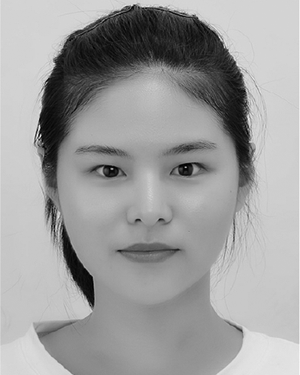 Chaoyan Huang合作论文数1
 Yunfei Yang (杨云斐)合作论文数School of Mathematics (Zhuhai), Sun Yat-Sen University1Sizai Hou合作论文数1
 Daniel Salz合作论文数Google1
 Puyu Wang合作论文数Department of Computer Science, RPTU Kaiserslautern-Landau1
 Tom Duerig合作论文数Google1
 Feiyang Chen合作论文数Zhejiang University1
 Rongrong Lin合作论文数Sun Yat Sen Univ, Sch Math & Computat Sci, Guangzhou 510275, Guangdong, Peoples R China1
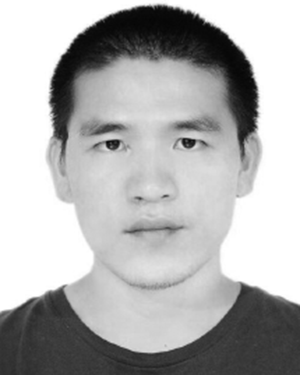 Chunhua Deng合作论文数Rutgers University1
 Daniel Cer合作论文数Google1
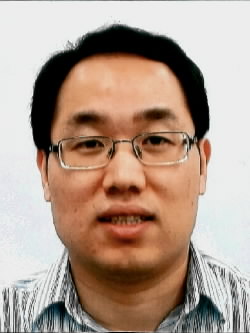 Kelin Xia合作论文数Division of Mathematical Sciences, School of Physical and Mathematical Sciences, College of Science, Nanyang Technological University1
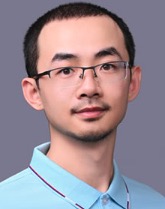 Siyu Liao (廖思宇)合作论文数School of Integrated Circuits, Sun Yat-Sen University1
 Iftekhar Naim合作论文数1
 Jinhyuk Lee合作论文数Computer Science and Engineering, Korea University1
 Fedor Moiseev合作论文数Google Inc.1
 Zhe Li合作论文数Department of Ophthalmology, Stanford University1
 Kaifeng Chen合作论文数xAI1
 Lu Bai (白璐)合作论文数School of Artificial Intelligence, Beijing Normal University1
 Christian Krattenthaler合作论文数Fakultat fur Mathematik, Universität Wien1
 Raymond Chan (陳漢夫)合作论文数Department of Mathematics, City University of Hong Kong1
 Zhe Dong合作论文数Microsoft AI1
 Bo Yuan合作论文数The New Jersey Institute of Food, Nutrition & Health, The State University of New Jersey1
 Gitta Kutyniok合作论文数Department of Mathematics, Faculty of Mathematics Informatics and Statistics, Ludwig-Maximilians Universität München1
 Jingang Yi合作论文数Department of Mechanical and Aerospace Engineering, School of Engineering, Rutgers, The State University of New Jersey1
 Yuan Xu合作论文数Department of Mathematics, University of Oregon1
 Shao-Bo Lin (林绍波)合作论文数School of Management, Xi'an Jiaotong University1
 Ke Chen合作论文数Peng Cheng Laboratory1
 Yulan Liu合作论文数Amazon com1
 Qingying Xue (薛庆营)合作论文数School of Mathematical Sciences, Beijing Normal University1Zhiying Fang合作论文数Shenzhen Polytechnic1
 Tieyong Zeng (曾鐵勇)合作论文数Department of Mathematics, Chinese University of Hong Kong;Center for Mathematical Artificial Intelligence, Chinese University of Hong Kong1




