With the rapid growth of encrypted network traffic, effective traffic classification has become essential for network security and quality of service management. Current machine learning and deep learning approaches for traffic classification face three critical challenges: computational inefficiency of Transformer architectures, inadequate traffic representations with loss of crucial byte-level features while retaining detrimental biases, and poor handling of long-tail distributions in real-world data. We propose NetMamba+, a framework that addresses these challenges through three key innovations: (1) an efficient architecture considering Mamba and Flash Attention mechanisms, (2) a multimodal traffic representation scheme that preserves essential traffic information while eliminating biases, and (3) a label distribution-aware fine-tuning strategy. Evaluation experiments on massive datasets encompassing four main classification tasks showcase NetMamba+'s superior classification performance compared to state-of-the-art baselines, with improvements of up to 6.44% in F1 score. Moreover, NetMamba+ demonstrates excellent efficiency, achieving 1.7x higher inference throughput than the best baseline while maintaining comparably low memory usage. Furthermore, NetMamba+ exhibits superior few-shot learning abilities, achieving better classification performance with fewer labeled data. Additionally, we implement an online traffic classification system that demonstrates robust real-world performance with a throughput of 261.87 Mb/s. As the first framework to adapt Mamba architecture for network traffic classification, NetMamba+ opens new possibilities for efficient and accurate traffic analysis in complex network environments.
Graph unlearning methods focus on removing specific information from graph neural networks (GNNs) to protect privacy. Existing graph unlearning methods often assume that all training data can be accessed. However, in machine learning as a service (MLaaS) scenarios, data owners, model developers, and service providers are responsible for providing data, training models, and deploying models, respectively. Service providers typically cannot have access to training data. Thus, graph unlearning can only be performed by model developers. In this paper, we introduce an innovative subgraph-based certified graph un learning (SCGU) method for MLaaS scenarios, enabling service providers to directly modify model parameters to achieve graph unlearning while minimizing privacy exposure. Specifically, we first define the influenced subgraph, which is only closely related to the unlearning target. Based on the influence function principle and the message-passing mechanism of GNNs, we then localize the computation of the gradient difference to the influenced subgraph. Moreover, by introducing an indicator, L-CODEC, to evaluate each parameter's importance to the unlearning target and to select the most important subset, we compute only the Hessian matrix of these parameters via finite differences, thereby efficiently localizing all parameter-estimation computation within the influenced subgraph. Once an unlearning request is received, the service provider only requires the influenced subgraph to calculate relevant variables, thereby directly modifying the model parameters to achieve graph unlearning. We evaluate the model utility, unlearning efficiency, and efficacy of our SCGU across multiple datasets (i.e., Cora, Citeseer, Pubmed, Coauthor-CS, and Coauthor-Physics) and GNN-based architectures (i.e., GCN, GIN, GAT, and SGC). The running efficiency experiments indicate that our SCGU is at least 4 times faster than retraining-based methods. The experimental results on SGC demonstrate that our SCGU achieves a closer parameter approximation to the retrained model, reducing the distance to it by 3%-5% compared to baseline methods. In addition, our SCGU outperforms other baseline methods, except for retraining, across most scenarios in terms of model utility and unlearning efficacy.
Driven by the filterless optical networks which are widely discussed in real deployments, we propose some opportunities and challenges in the optical satellite network. Meanwhile, the routing and spectrum assignment are expected to be exploited .
To meet the expected secure increase in optical satellite network, the quantum key distribution(QKD) approaches are exploited.
Teeth localization, segmentation, and labeling in 2D images have great potential in modern dentistry to enhance dental diagnostics, treatment planning, and population-based studies on oral health. However, general instance segmentation frameworks are incompetent due to 1) the subtle differences between some teeth' shapes (e.g., maxillary first premolar and second premolar), 2) the teeth's position and shape variation across subjects, and 3) the presence of abnormalities in the dentition (e.g., caries and edentulism). To address these problems, we propose a ViT-based framework named TeethSEG, which consists of stacked Multi-Scale Aggregation (MSA) blocks and an Anthropic Prior Knowledge (APK) layer. Specifically, to compose the two modules, we design 1) a unique permutation-based upscaler to ensure high efficiency while establishing clear segmentation boundaries with 2) multi-head self/cross-gating layers to emphasize particular semantics meanwhile maintaining the divergence between token embeddings. Besides, we collect 3) the first open-sourced intraoral image dataset IO150K, which comprises over 150k intraoral photos, and all photos are annotated by orthodontists using a human-machine hybrid algorithm. Experiments on IO150K demonstrate that our TeethSEG outperforms the state-of-the-art segmentation models on dental image segmentation.
The non-consensual exploitation of facial manipulation has emerged as a pressing societal concern. In tandem with the identification of such fake content, recent research endeavors have advocated countering manipulation techniques through proactive interventions, specifically the incorporation of adversarial noise to impede the manipulation in advance. Nevertheless, with insufficient consideration of robustness, we show that current methods falter in providing protection after simple perturbations, e.g., blur. In addition, traditional optimization-based methods face limitations in scalability as they struggle to accommodate the substantial expansion of data volume, a consequence of the time-intensive iterative pipeline. To solve these challenges, we propose a learning-based model, Adversarial Robust Safeguard (ARS), to generate desirable protection noise in a single forward process, concurrently exhibiting a heightened resistance against prevalent perturbations. Specifically, our method involves a two-way protection design, characterized by a basic protection component responsible for generating efficacious noise features, coupled with robust protection for further enhancement. In robust protection, we first fuse image features with spatially duplicated noise embedding, thereby accounting for inherent information redundancy. Subsequently, a combination comprising a differentiable perturbation module and an adversarial network is devised to simulate potential information degradation during the training process. To evaluate it, we conduct experiments on four manipulation methods and compare recent works comprehensively. The results of our method exhibit good visual effects with pronounced robustness against varied perturbations at different levels.
Significant progress in video question answering (VideoQA) have been made thanks to thriving large image-language pretraining frameworks. Although image-language models can efficiently represent both video and language branches, they typically employ goal-free vision perception and do not interact vision with language well during the answer generation, thus omitting crucial visual cues. In this paper, we are inspired by the human recognition and learning pattern and propose VideoDistill, a framework with language-aware (i.e., goal-driven) behavior in both vision perception and answer generation. VideoDistill generates answers only from question-related visual embeddings and follows a thinking-observing-answering approach that closely resembles human behavior, distinguishing it from previous research. Specifically, we develop a language-aware gating mechanism to replace the standard cross-attention, avoiding language's direct fusion into visual representations. We incorporate this mechanism into two key components of the entire framework. The first component is a differentiable sparse sampling module, which selects frames containing the necessary dynamics and semantics relevant to the questions. The second component is a vision refinement module that merges existing spatial-temporal attention layers to ensure extracting multi-grained visual semantics associated with the questions. We conduct evaluations on various challenging video question-answering benchmarks, and VideoDistill achieves state-of-the-art performance in both general and long-form VideoQA datasets. In Addition, we verify that VideoDistill can effectively alleviate the utilization of language shortcut solutions in the EgoTaskQA dataset.
Existing methods to fine-tune LLMs, like Adapter, Prefix-tuning, and LoRA, which introduce extra modules or additional input sequences to inject new skills or knowledge, may compromise the innate abilities of LLMs. In this paper, we propose LLaMA-Excitor, a lightweight method that stimulates the LLMs' potential to better follow instructions by gradually paying more attention to worthwhile information. Specifically, LLaMA-Excitor does not directly change the intermediate hidden state during the self-attention calculation. We designed the Excitor block as a bypass module that reconstructs Keys and changes the importance of Values in self-attention using learnable prompts. LLaMA-Excitor ensures a self-adaptive allocation of additional attention to input instructions, thus effectively preserving LLMs' pre-trained knowledge when fine-tuning LLMs on low-quality instruction-following datasets. Furthermore, we unify the modeling of multi-modal and language-only tuning, extending LLaMA-Excitor to a powerful visual instruction follower without the need for complex multi-modal alignment. Our approach is evaluated in language-only and multi-modal scenarios. Compared with the original LLaMA-7B, LLaMA-Excitor is the only PEFT method that maintains basic capabilities and achieves +3.12% relative improvement on the MMLU benchmark. In the visual instruction tuning, we achieve a new state-of-the-art image captioning performance on MSCOCO (157.5 CIDEr), and a comparable performance on ScienceQA (88.39%) to cutting-edge models with more parameters and extensive vision-language pertaining. The code will be available at https://zoubo9034.github.io/Excitor/.
Artificial Intelligence of Things (AIoT) applications have advanced rapidly. However, most of them are inherently vulnerable to security threats and may be the source of spoofing attacks, and meanwhile, in AIoT systems, the transfer of real-time data from terminals and the cloud strains network bandwidth. To defend against attacks, save network forwarding resources, and relieve authentication pressure on the receiver end, it is essential to verify the source identity of AIoT terminals on the forwarding path. In this article, we propose PDIV, a probabilistic and distributed identity validation solution for AIoT applications. In the framework of PDIV, honest forwarders can verify the authenticity of the source identity of packets with a certain probability and filter spoofed packets to prevent them from spreading, reduce end-to-end network latency, and increase throughput as much as possible. Additionally, PDIV, a blockchain-based system that uses Merkle Patricia Trie (MPT) on the blockchain, makes it practical and efficient to realize distributed storage and verification of identity information. Moreover, we theorize about the tradeoff between PDIV network performance and detection effectiveness, as well as how PDIV enables defenses against different attacks, such as spoofing and Distributed Denial-of-Service attacks. Furthermore, we implement PDIV on network simulator version 3 (NS3) and evaluate its performance. The simulation results demonstrate that PDIV can prevent the spread of spoofed packets effectively and PDIV works better than currently available blockchain-based public-key infrastructure (PKI) approaches in terms of network latency.
Network traffic classification is a crucial research area aiming to enhance service quality, streamline network management, and bolster cybersecurity. To address the growing complexity of transmission encryption techniques, various machine learning and deep learning methods have been proposed. However, existing approaches face two main challenges. Firstly, they struggle with model inefficiency due to the quadratic complexity of the widely used Transformer architecture. Secondly, they suffer from inadequate traffic representation because of discarding important byte information while retaining unwanted biases. To address these challenges, we propose NetMamba, an efficient linear-time state space model equipped with a comprehensive traffic representation scheme. We adopt a specially selected and improved unidirectional Mamba architecture for the networking field, instead of the Transformer, to address efficiency issues. In addition, we design a traffic representation scheme to extract valid information from massive traffic data while removing biased information. Evaluation experiments on six public datasets encompassing three main classification tasks showcase NetMamba's superior classification performance compared to state-of-the-art baselines. It achieves an accuracy rate of nearly 99% (some over 99%) in all tasks. Additionally, NetMamba demonstrates excellent efficiency, improving inference speed by up to 60 times while maintaining comparably low memory usage. Furthermore, NetMamba exhibits superior few-shot learning abilities, achieving better classification performance with fewer labeled data. To the best of our knowledge, NetMamba is the first model to tailor the Mamba architecture for networking.
Significant advancements in video question answering (VideoQA) have been made thanks to thriving large image-language pretraining frameworks. Although these image-language models can efficiently represent both video and language branches, they typically employ a goal-free vision perception process and do not interact vision with language well during the answer generation, thus omitting crucial visual cues. In this paper, we are inspired by the human recognition and learning pattern and propose VideoDistill, a framework with language-aware (i.e., goal-driven) behavior in both vision perception and answer generation process. VideoDistill generates answers only from question-related visual embeddings and follows a thinking-observing-answering approach that closely resembles human behavior, distinguishing it from previous research. Specifically, we develop a language-aware gating mechanism to replace the standard cross-attention, avoiding language's direct fusion into visual representations. We incorporate this mechanism into two key components of the entire framework. The first component is a differentiable sparse sampling module, which selects frames containing the necessary dynamics and semantics relevant to the questions. The second component is a vision refinement module that merges existing spatial-temporal attention layers to ensure the extraction of multi-grained visual semantics associated with the questions. We conduct experimental evaluations on various challenging video question-answering benchmarks, and VideoDistill achieves state-of-the-art performance in both general and long-form VideoQA datasets. In Addition, we verify that VideoDistill can effectively alleviate the utilization of language shortcut solutions in the EgoTaskQA dataset.
Wireless networks are vulnerable to many attacks due to its dynamic environments. Unrestricted forwarding of packets from untrusted sources in wireless networks has caused many serious security threats and a great waste of network resources. This paper presents RepuFilter, a probabilistic packet filtering scheme based on trust evaluation, which enables a shared data plane to provide security services for wireless networks. RepuFilter proposes a dynamic trust evaluation model based on the transitivity of trust evaluation between network users, and applies the model to packet filtering. In the framework of RepuFilter, forwarders verify packets with a certain probability, and discard packets from untrusted sources, to prevent the packets from being spread, and reduce inspection expenses as much as possible. We implement RepuFilter and evaluate its performance based on Network Simulator Version 3 (NS3). Simulation results prove that RepuFilter can resist the spread of untrusted packets more effectively than the classic and latest trust models and RepuFilter can meet current network performance requirements,
The tremendous progress of vision-to-language retrieval over these years is fueled by contrastive vision-language pretraining (VLP), such as CLIP. Although, contrastive methods do not exhibit the same level of performance on other downstream tasks (e.g., video question answering and natural language grounding). One possible reason is they ignore the misalignment between vision and language, especially the absence of spatial information in language. To mitigate this issue, We start from a new perspective and propose a contrastive VLP framework with spatial reconstruction on text (SpaceCLIP). Specifically, we introduce a unique reconstruction method to assign text representations into the same spatial structure with images or videos and a pretraining objective, SpatialNCE, to reduce the computational overhead and ensure performance on downstream tasks. Empirically, we show SpaceCLIP outperforms other methods with performance gains ranging from 2.1% up to 9.0% on MSRVTT and EgoCLIP multiple-choice questions answering, 2.5% up to 11.0% on EPIC-KITCHENS-100 and MSRVTT multi-instance retrieval, and 0.31% up to 7.2% on Ego4D natural language query benchmark.
Abuses of forgery techniques have created a considerable problem of misinformation on social media. Although scholars devote many efforts to face forgery detection (a.k.a DeepFake detection) and achieve some results, two issues still hinder the practical application. 1) Most detectors do not generalize well to unseen datasets. 2) In a supervised manner, most previous works require a considerable amount of manually labeled data. To address these problems, we propose a simple contrastive pertaining framework for DeepFake detection (DFCP), which works in a finetuning-after-pretraining manner, and requires only a few labels (5%). Specifically, we design a two-stream framework to simultaneously learn high-frequency texture features and high-level semantics information during pretraining. In addition, a video-based frame sampling strategy is proposed to mitigate potential noise data in the instance-discriminative contrastive learning to achieve better performance. Experimental results on several downstream datasets show the state-of-the-art performance of the proposed DFCP, which works at frame-level (w/o temporal reasoning) with high efficiency but outperforms video-level methods.
Internet of Things (IoT) devices have achieved rapid development but most of them are vulnerable to spoofing attacks and spoofing-related attacks. It is crucial to verify source identity at the near-source end to defend against attacks, save network forwarding resources, and relieve the authentication pressure on the receiver end. In this paper, we propose Smart-PKI, a blockchain-based distributed identity validation scheme for IoT Devices. In the architecture of Smart-PKI, near-source forwarders can verify the authenticity of the source identity of packets and can filter spoofed packets. Besides, we apply Merkle Patricia Trie (MPT) to the Smart-PKI blockchain to enable lightweight blockchain copy storage and efficient retrieval and verification of identity information on forwarders. Meanwhile, Smart-PKI proposes an identity restoration mechanism and enables solutions for the attacks caused by public and private key compromise. Furthermore, we implement Smart-PKI on Network Simulator Version 3 (NS3) and evaluate its performance against reflection denial-of-service (DDoS) attacks. The simulation results demonstrate the effectiveness and efficiency of Smart-PKI and it outperforms existing blockchain-based PKI solutions for IoT devices in terms of network latency for verifying certificates.
The emergence of photo-realistic deepfakes on a large scale has become a significant societal concern, which has garnered considerable attention from the research community. Several recent studies have identified the critical issue of “temporal inconsistency” resulting from the frame reassembling process of deepfake generation techniques. However, due to the lack of task-specific design, the spatio-temporal modeling of current methods remains insufficient in three critical aspects: 1) inapparent temporal changes are prone to be undermined compared to abundant spatial cues; 2) minor inconsistent regions are often concealed by motions with greater amplitude during downsampling; 3) capturing both transient inconsistencies and persistent motions simultaneously remains a significant challenge. In this paper, we propose a novel Dual-Modality Co-Learning framework tailored for these characteristics, which achieves more effectual deepfake detection with complementary information from RGB and optical flow modalities. In particular, we designed a Multi-Scale Motion Regularization module to encourage the network to equally prioritize both the significant spatial cues and the subtle temporal facial motion cues. Additionally, we developed a Multi-Span Cross-Attention module to effectively integrate the information from both RGB and optical flow modalities and improve the detection accuracy with multi-span predictions. Extensive experiments validate the effectiveness our ideas and demonstrate the superior performance of our approach.
The issue of detecting deepfakes has garnered significant attention in the research community, with the goal of identifying facial manipulations for abuse prevention. Although recent studies have focused on developing generalized models that can detect various types of deepfakes, their performance is not always be reliable and stable, which poses limitations in real-world applications. Instead of learning a forgery detector, in this paper, we propose a novel framework - Integrity Encryptor, aiming to protect portraits in a proactive strategy. Our methodology involves covertly encoding messages that are closely associated with key facial attributes into authentic images prior to their public release. Unlike authentic images, where the hidden messages can be extracted with precision, manipulating the facial attributes through deepfake techniques can disrupt the decoding process. Consequently, the modified facial attributes serve as a mean of detecting manipulated images through a comparison of the decoded messages. Our encryption approach is characterized by its brevity and efficiency, and the resulting method exhibits a good robustness against typical image processing traces, such as image degradation and noise. When compared to baselines that struggle to detect deepfakes in a black-box setting, our method utilizing conditional encryption showcases superior performance when presented with a range of different types of forgeries. In experiments conducted on our protected data, our approach outperforms existing state-of-the-art methods by a significant margin.
In order to effectively solve the problem of high reliability of computing units in harsh environments, a design method for PHYTIUM computing units based on OpenVPX is proposed. Firstly, the characteristics of the OpenVPX bus specification are analyzed, Secondly, the functional modules of the PHYTIUM computing unit are divided, and the design process of each module circuit is given, including the parameter calculation process. Thirdly, the PCB layout and routing rules of the computing unit are given. Finally, the feasibility and effectiveness of the design are proved through analysis and experimental verification.
With current advancements in deep learning technology, it is becoming easier to create high-quality face forgery videos, causing concerns about the misuse of deepfake technology. In recent years, research on deepfake detection has become a popular topic. Many detection methods have been proposed, most of which focus on exploiting image artifacts or frequency domain features for detection. In this work, we propose using real images of the same identity as a reference to improve detection performance. Specifically, a real image of the same identity is used as a reference image and input into the model together with the image to be tested to learn the distinguishable identity representation, which is achieved by contrastive learning. Our method achieves superior performance on both FaceForensics++ and Celeb-DF with relatively little training data, and also achieves very competitive results on cross-manipulation and cross-dataset evaluations, demonstrating the effectiveness of our solution.
Today's large datacenters house a massive number of machines, each of which is being closely monitored with multivariate time series (e.g., CPU idle, memory utilization) to ensure service quality. Detecting outlier machine instances with multivariate time series is crucial for service management. However, it is a challenging task due to the multiple classes and various shapes, high dimensionality, and lack of labels of multivariate time series. In this article, we propose DOMI, a novel unsupervised model that combines Gaussian mixture VAE with 1D-CNN, to detect outlier machine instances. Its core idea is to capture the normal patterns of machine instances by learning their latent representations that consider the shape characteristics, reconstruct input data by the learned representations, and apply reconstruction probabilities to determine outliers. Moreover, DOMI interprets the detected outlier instance based on the reconstruction probability changes of univariate time series. Extensive experiments have been conducted on the dataset collected from 1821 machines with a 1.5-month-period, which are deployed in ByteDance, a top global content service provider. DOMI achieves the best F1-Score of 0.94 and AUC score of 0.99, significantly outperforming the best performing baseline method by 0.08 and 0.03, respectively. Moreover, its interpretation accuracy is up to 0.93.
 Dan Pei (裴丹)合作论文数Department of Computer Science and Technology, Tsinghua University44
 Chengbin Quan (全成斌)合作论文数Department of Computer Science and Technology, Tsinghua University26
 Xiaoping Zhang (张小平)合作论文数Department of Computer Science and Technology, Tsinghua University23
 Jianping Wu (吴建平)合作论文数Department of Computer Science and Technology, Tsinghua University15
 Guo Chen (陈果)合作论文数College of Computer Science and Electronic Engineering, Hunan University;National Supercomputing Center in Changsha, Hunan University;Institute of African Studies, Hunan University15
 Kaixin Sui合作论文数BizSeer13
 Hongtao Guan (关洪涛)合作论文数Institute of Computing Technology, Chinese Academy of Sciences11
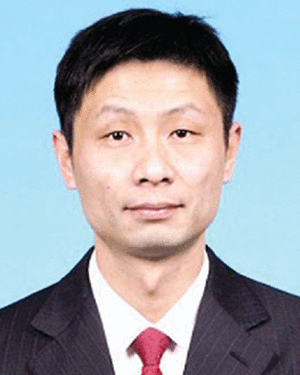 Yong Lu合作论文数School of Electronic Information Engineering, Foshan University10
 Fuchun Sun (孙富春)合作论文数Department of Computer Science and Technology, Tsinghua University10
 Zhihan Li (李之涵)合作论文数Kuaishou Technology9
 Dapeng Liu合作论文数Department of Information Systems and Business Analytics, Hankamer School of Business, Baylor University9
 Xiaohui Nie合作论文数Tsinghua Univ, Beijing, Peoples R China8
 Zhenhua Liu (刘振华)合作论文数8
 Yong Cui (崔勇)合作论文数Institute of Computer Networks, Department of Computer Science and Technology, School of Information Science and Technology, Tsinghua University7
 Bo Zou合作论文数6Ya Su (苏亚)合作论文数Huawei Technologies Co., Ltd.6Jiazhi (Jax) Guan (官佳智)合作论文数6
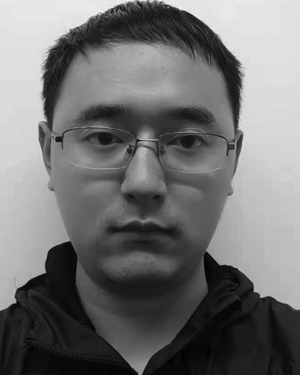 Wenxiao Chen (陈文潇)合作论文数Huawei6Haowen Xu (许昊文)合作论文数NetMan Lab, Tsinghua University6
 Yuan Meng合作论文数6Zhiyuan Lv合作论文数5
 Minghua Ma (马明华)合作论文数Microsoft5
 Changhua Pei (裴昶华)合作论文数Computer Network Information Center, Chinese Academy of Sciences;University of Chinese Academy of Sciences5
 Chao Yang (杨超)合作论文数5Tielei Zhang合作论文数5
 Jiyang Zhang合作论文数4
 Xiaowei Jing合作论文数4
 Mei Feng合作论文数4YANG Guanghui (杨光辉)合作论文数4
 Yuanwei Lu合作论文数4
 Xiaoliang Wang (王晓亮)合作论文数School of Computer Science, Nanjing University4Yongqian Sun (孙永谦)合作论文数4Lei Xu (徐蕾)合作论文数4Deng Lirui合作论文数4
 Li Zimu合作论文数4
 Hang Zhou合作论文数Department of Computer Vision Technology, Baidu Inc.4Zu-Hui Yue合作论文数4
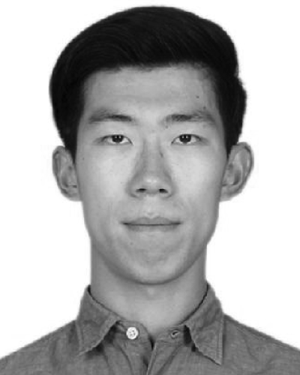 Han Bao合作论文数3
 Xianping Qu合作论文数Baidu Inc, Beijing, Peoples R China3Ruming Tang合作论文数3Ruisheng Wang (王瑞生)合作论文数Ming Hsieh Dept Elect Engn, Univ So Calif3
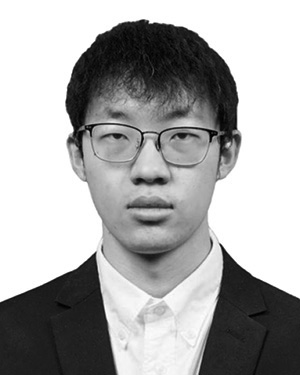 Gaoyuan Wang合作论文数3
 Rong Liu合作论文数Department of Information Systems and Business Analytics, College of Business, Florida International University3Ting Zhou (周婷)合作论文数3
 Hui Xie合作论文数3
 Yu Qiao (乔宇)合作论文数Multimedia Laboratory, Shenzhen Institutes of Advanced Technology, Chinese Academy of Sciences;Shanghai AI Laboratory;Shenzhen University of Advanced Technology3
 Jianhua Li (李建华)合作论文数School of Cyber Science and Engineering, Shanghai Jiao Tong University;Zhang Jiang Institute for Advanced Study, Shanghai Jiao Tong University3
 Errui Ding合作论文数Department of Computer Vision Technology, Baidu Inc.3
 Shaoqing Wang合作论文数3