Multi-view clustering seeks to leverage complementary information from heterogeneous data sources, yet existing methods often overlook two critical aspects: per-cluster view relevance and fine-grained intra-view structures. We propose a novel Dual Mixture-of-Experts (Dual MoE) framework for multi-view K-means that simultaneously addresses these challenges. First, our cluster-view adaptive weighting dynamically calibrates each view's importance at the cluster level, enabling the model to emphasize informative views while suppressing noise. Second, our region-wise sparse partitioning decomposes each view into localized subregions, capturing nuanced intra-view patterns via specialized centroids. We derive high-probability excess clustering risk bounds, revealing that balanced view-cluster weights minimize generalization error and motivate our entropy-regularized square-weight mapping. A linear-time alternating optimization algorithm ensures scalability to large datasets. Empirical evaluations on ten public benchmarks demonstrate that Dual MoE consistently outperforms state-of-the-art methods, achieving an average rank of 1.1-1.2 across standard accuracy, NMI, and ARI metrics. Ablation studies further confirm the complementary benefits of our dual expert mechanisms. The implementation is available at https://github.com/sroytik/DMoE-MVKM.
Time series anomaly detection (TSAD) serves for and across diverse domains. A core challenge is learning discriminative representations that encapsulate multi-scale temporal patterns while effectively separating anomalies. To tackle this, we introduce TF-ConvAD, a Temporal-Frequency Convolutional network for Anomaly Detection. The model first separates input time series into seasonal and trend parts. Subsequently, a dual-branch reconstruction mechanism is presented, which explicitly amplifies the discrepancy between normal and abnormal points by contrasting local-to-global and global-to-local consistency. It then applies Temporal-Frequency Convolutional Blocks (TFCBs) that combine multi-scale temporal convolutions with spectral convolution to simultaneously capture short-scale variations and long-scale periodicities. A broad suite of empirical evaluations conducted across five established benchmark corpora demonstrates that TF-ConvAD achieves competitive or better performance versus state-of-the-art methods.
Outlier interpretation methods, based on outlying aspect mining, have been extensively utilized in diverse applications due to their effectiveness and interpretability. The primary objective of these methods is to identify an outlying feature subspace where a detected outlier deviates most significantly from the inliers. However, this subspace is typically not personalized and incomplete. In this article, we propose a novel convertible outlying aspect mining method named Mining convErtible ouTlying Aspect (META) to interpret the detected outlier. META not only identifies a personalized outlying feature subspace (i.e., where) that differentiates the detected outlier from inliers, but also quantifies the outlying direction and degree within this subspace (i.e., how), thereby offering actionable interpretative insights, rather than corrective actions, for understanding the outlier. Specifically, META defines a convertible outlying aspect with a convertible cost to convert the detected outlier into a converted instance, and employs a pretrained adversary to evaluate whether the instance is an inlier or not. Subsequently, we formulate an objective function that minimizes the convertible cost, ensures the successful conversion of the instance into an inlier, and minimizes the size of the outlying feature subspace. META leverages this objective function to learn an optimal convertible outlying aspect for the detected outlier. The optimal convertible outlying aspect provides the outlying feature subspace, outlying direction, outlying degree, and converted instance. Empirical results from experiments conducted on both real-world and synthetic datasets demonstrate that META outperforms state-of-the-art (SOTA) baselines.
Most of the existing anomaly data detection models are implemented by supervised or unsupervised algorithms. However, these algorithms have a strong dependence on whether the samples are fully labeled or not. Semi-supervised learning is an effective approach for detecting anomalous data. In anomalous data detection models based on semi-supervised learning, unlabeled data are usually assumed to be normal data. However, when the unlabeled dataset contains a small amount of abnormal data, the performance of a semi-supervised learning abnormal data detection model can be greatly degraded. A co-training semi-supervised anomaly data detection model based on random forest is introduced to overcome degradation and maintain stable detection performance. The claimed random forest based co-training anomaly data detection has three stages: (1) In the data preprocessing stage, the data are divided into two sub-view datasets using a feature importance ranking algorithm based on extremely randomized trees; (2) In the co-training stage, it labels the unlabeled samples with pseudo-labels using two random forest classifiers until all the two sub-view data are labeled; (3) In the third stage, to further improve the accuracy of pseudo labeling, a soft voting mechanism is used to synthesize a final classifier model and improve the generalization ability of the classifier. The proposed random forest-based co-training mechanism, leveraging iterative pseudo-labeling with dual classifiers and soft voting, effectively addresses performance degradation caused by limited anomalies in unlabeled data, achieving superior F1 and AUC scores over six state-of-the-art models across 11 benchmark datasets.
Ensemble clustering aims to derive a more robust consensus result from a set of base clustering results. Recently, anchor-based clustering methods have improved computational efficiency by learning the relationships between anchors and samples, thereby avoiding the expensive computation of pairwise sample similarities. However, these methods typically rely on a static anchor selection strategy and require post-processing to obtain the final clustering assignments. This often leads to inflexible anchors and a low-quality anchor similarity matrix, ultimately degrading clustering accuracy. To address this issue, we propose a novel ensemble clustering method named $\mathbf{D}$ynamic ancho $\mathbf{R}$-based One-step hyp$\mathbf{E}$ rgr$\mathbf{A}$ph ense $\mathbf{M}$ ble clustering (DREAM). Specifically, DREAM first transforms the base clustering results into a hypergraph. It then introduces a novel hypergraph enhancement strategy to improve the reliability of the initial hypergraph. Next, DREAM introduces a mapping matrix to filter redundant information in the hypergraph, and reconstructs the hypergraph via matrix factorization to obtain the anchor similarity matrix. Subsequently, DREAM introduces an alignment mechanism that refines the anchor similarity matrix by generating local consensus information. The alignment is achieved by maximizing the element-wise consistency between the anchor similarity matrix and the local consensus information. This yields a high-quality anchor similarity matrix that can be directly projected into the label space, enabling one-step generation of clustering results without any additional post-processing. Extensive experimental results demonstrate the superior performance of the proposed DREAM method.
Outlier interpretation aims to explain why a data point is identified as anomalous (an outlier) compared to the majority of ``normal'' data points (inliers). Existing methods based on feature subspace mining, which seek to find a subset of features that maximally separate a query outlier from inliers, suffer from two critical limitations: (i) They struggle to distinguish a query outlier from inliers when the outlier's features closely resemble those of inliers in the original space. (ii) They fail to highlight the unique characteristics of a query outlier compared to other outliers.To address these issues, we propose TMQ, a novel framework that simultaneously learns an interpretable latent space to separate the query outlier from inliers and highlight its unique characteristics relative to other outliers. Specifically, in order to take into account the differences among the query outlier, other outliers, and inliers, TMQ first designs a quadruplet generation module to transform the original dataset into a set of quadruplets to facilitate the learning of the latent space. Then, TMQ constructs a latent space learning module based on a quadruplet-based global-local Transformer block to map the set of quadruplets from the original space to a latent space. This latent space is iteratively optimized by an outlying measure module that maximizes distances among the query outlier, other outliers, and inliers. Finally, an interpretation acquisition module extract specific interpretability for the query outlier from the learned latent space. Extensive experiments demonstrate that TMQ outperforms nine existing baseline methods across twelve real-world datasets, achieving superior performance on thirteen evaluation metrics. The source code of TMQ is available at https://github.com/GAOI-Source-Code/tmq.
Semi-supervised anomaly detection methods have demonstrated significant performance improvements over unsupervised anomaly detection methods. In real-world scenarios, the definition of anomalies often relies more on prior domain knowledge than on differences in distributions. In this paper, we propose CLEAR: Contrastive Learning EnhAnced semi-supeRvised anomaly detection. Firstly, CLEAR adopts a semi-supervised contrastive learning strategy to learn an enhanced representation with prior domain knowledge. CLEAR then processes potential nonlinear patterns within the representations using a kernelized mapper, and further analyzes the distribution of samples across each dimension to compute the final anomaly scores. Extensive experiments conducted on a real-world shopping orders dataset from JD.com as well as 12 real-world benchmark datasets, demonstrate that CLEAR significantly outperforms current semi-supervised anomaly detection methods.
Ensemble clustering aims to derive a consensus partition from multiple base clustering results. Anchor-based methods construct compact similarity representations via anchors, substantially improving computational efficiency. However, when outliers contaminate the data, reconstructing the base clustering results often yields biased anchors. These biased anchors degrade the quality of the anchor similarity matrix and lead to a decline in clustering accuracy. To address this issue, we propose a novel method called large-scale robust enhanced ensemble clustering via outlier decoupling (RANGE). Specifically, RANGE first converts the base clustering results into an initial bipartite graph. To enhance the reliability of this bipartite graph, RANGE designs a high-order fuzzy enhancement strategy (HFES) specifically for initial bipartite graphs. Next, a mapping matrix further filters redundant information from the enhanced bipartite graph. RANGE then reconstructs the mapped bipartite graph via matrix factorization. An anchor matrix is introduced to further enhance computational efficiency. To improve robustness, RANGE incorporates a decoupling term that separates the clean clustering structure and the outlier-contaminated structure in the anchor space. With this decoupling mechanism, RANGE is capable of performing robust ensemble clustering. Moreover, by applying outlier detectors to the decoupled outlier structure, RANGE can be extended to the outlier-detection task. Consequently, RANGE forms a cross-task general framework, and both tasks retain linear time complexity. Extensive cross-domain experiments indicate that RANGE delivers superior performance in both clustering validity and outlier detection. The code is available in the supplementary material.
Ensemble clustering integrates a set of base clustering results to obtain more accurate consensus results. Most existing methods transform base clustering results into a co-association (CA) matrix, which describes the frequency with which samples belong to the same cluster. However, these methods still exhibit insufficient learning of sample similarity relationships, overlooking the capture of a more comprehensive similarity relationship from multiple perspectives. To address this issue, we propose a method called tOpological-aware Multiple kErnel Learning for Ensemble clusTering (OMELET). Specifically, OMELET uses multiple kernel functions to remeasure the similarity between samples from multiple perspectives. To fully exploit the sample similarity relationships in different kernel spaces, OMELET employs multiple kernel learning to learn a consensus kernel and obtain the similarity matrix between samples. To eliminate noise from the similarity matrix captured in the fused kernel space, OMELET leverages topological similarity propagated among highly similar neighbors to reshape the similarity graph. Finally, OMELET captures a topological affinity matrix that represents the sample similarity relationships. Moreover, to enable OMELET to scale on large datasets, we derive a variant called OMELET-SV, which leverages anchors to construct an anchor-based kernel matrix, thereby improving computational efficiency. Extensive experimental results demonstrate the outstanding performance of OMELET compared to 18 representative methods.
This study aimed to develop and validate a clinically motivated artificial intelligence framework for preoperative risk assessment of the second mesiobuccal (MB2) canal in maxillary first molars using panoramic radiographs. A total of 388 panoramic radiographs were retrospectively collected. Stage 1 used YOLOv5 to localize maxillary first molars and crop tooth-level regions of interest. Stage 2 applied Panoramic-based MB2 Prediction Network (PanMB2-Net) (ResNet50 with gray-guided attention, receptive field block, contrastive regularization, and Sobel edge loss) for MB2 classification. Data were split 80/20 at the image level for training/validation. Detection was assessed by localization accuracy; classification via accuracy, precision, recall, and F1-score. Ablation studies and class activation heatmaps were used for validation and visualization. PanMB2-Net achieved 72.9
Anomaly interpretation plays a critical role in understanding abnormal behaviors within high-stakes decision systems. Counterfactual Explanation (CE), an emerging technique, offers promise by generating hypothetical scenarios that transition anomalies to normal states through minimal perturbations. However, when applied specifically to anomaly interpretation, existing CE methods suffer from three critical limitations: (i) Distance-minimizing CE methods produce counterfactual instances clustered near anomalies, failing to reach core normal regions; (ii) Gradient-based CE methods suffer geometric instability near complex boundaries where anomalies reside; (iii) CE methods trained solely on normal instances generate out-of-distribution counterfactual instances from anomalies. To address these issues, we propose GLEAN (Generating pLausible countErfactual instances for Anomaly iNterpretation with generative adversarial networks), a novel framework leveraging generative adversarial networks to generate plausible and in-distribution counterfactual explanations specifically for anomaly interpretation. Technically, GLEAN employs adversarial perturbation to transform anomalies into plausible counterfactual instances within the normal instance distribution, guided by normal instance prototypes to ensure interpretability and reduce sensitivity to the decision boundary. The framework establishes an adversarial equilibrium where a generator minimizes feature perturbations, the distance between generated counterfactual instances and query anomalies, and the similarity between generated counterfactual instances and inlier prototypes, while a density-based discriminator to ensure that generated counterfactual instances adhere to the normal data distribution. GLEAN outputs the most plausible and in-distribution counterfactual instances as explanations for the anomalies identified. Empirical results show that GLEAN achieves state-of-the-art performance across four key metrics of Density, Distance, Proximity and Sparsity, outperforming 15 baseline methods on ten real-world datasets. Our datasets and source code are publicly available at https://github.com/KDDElab/GLEAN.
Multi-view outlier detection is essential for analyzing complex data, yet many existing approaches rely on shallow fusion schemes or remain sensitive to noise. We propose a Bilateral Graph Filtering Framework with Alternating Optimization for Robust Multi-View Outlier Detection(BGFMOD), which detects attribute outliers via high-frequency residuals and identifies class outliers through cross-view structural inconsistencies. An alternating optimization strategy efficiently addresses the non-convexity of bilateral filtering while preserving spectral orthogonality. Experiments on multiple benchmark datasets show that BGFMOD achieves superior AUC performance and strong robustness across diverse multi-view scenarios. The complete code is available at https://github.com/Jinzhao11/BGFMOD
Drug repositioning is a cost-effective strategy that seeks new therapeutic uses for existing drugs and fundamentally depends on identifying potential drug-disease associations. Drug repositioning entails inherent complexity: one must model not only cross-type relationships (drug-disease) but also intra-type relationships (drug-drug and disease-disease), while accounting for the modulatory effects of auxiliary biomedical entities (e.g., targets, pathways). However, existing methods overlook the discrepancy in information granularity among multi-level relationships. To address this problem, we propose AURORA, an adaptive multi-granularity graph learning framework with consistency regularization for drug repositioning. Specifically, AURORA integrates fine-grained representations from a biomedical heterogeneous graph and coarse-grained features derived from drug and disease hypergraphs. Then, AURORA employs a bidirectional attention mechanism to adaptively fuse representations from different granularity graphs, while a consistency regularization term aligns embeddings across granularities. Finally, the optimized drug and disease embeddings are fed into a gradient boosting predictor to produce drug-disease association likelihood scores. Extensive experiments demonstrate that AURORA outperforms state-of-the-art methods in predicting unknown drug-disease associations. Additionally, we conduct case studies to show the capability of AURORA to predict candidate drugs for complex diseases. The source code is available at https://github.com/ZhangYid/AURORA.
Drug-drug interaction (DDI) prediction is always a focal point in order to furnish more effective and safer therapy in cases of multiple or complex diseases. We consider this problem from both a functional and a structural solution as drug direct-indirect association information and drug structure information are important and unignorable during this process. Therefore, we propose a method called MVIC (short for multi-view information collaborative fusion for drug-drug interaction prediction) which incorporates drug direct-indirect association and molecular structure information for DDI prediction. MVIC extracts information from two views, i.e., the network view and the molecular structure view. For the former, we construct a drug information network, which then undergoes meta-path-specific representation learning and a designed transformer-like semantic fusion module to obtain the corresponding representations. For the latter, we encode the molecular structure via graph neural network (GNN). In the end, we introduce a multi-view collaborative information fusion module for predicting DDIs. The experiments prove that our method outperforms baselines across all four metrics on three datasets. We also conduct a case study to show the capability of MVIC to predict new prospective DDIs. Our source code is available at https://github.com/scu-kdde/Bioinfo-MVIC-2025 .
To enhance the ability to detect anomalous activities in online manner, streaming anomaly detection often faces the challenge of adapting to changing data trends. Although existing methods for streaming anomaly detection exhibit significant performance, most of them are limited by their inability to fully account for long-term memory of global data distribution, the lack of rapid adaptation to local data distribution changes, and the low generalizability of manually defined thresholds. To address these challenges, we propose an adaptive anomaly detection framework designed for streaming data, named AdpStream. Specifically, AdpStream first utilizes a feature extraction module to encode streaming data, capturing correlations among variables to generate embeddings for each data record. Secondly, a global memory module is used to store embeddings from long historical windows, preserving diverse global patterns of normal data with dynamic update strategy. The local adapter module calculates reconstruction loss for each record and determines its anomaly probability using local information. Finally, the anomaly criterion module assesses anomaly levels by combining the reconstruction error of the current record with its similarity to data in the global memory. Extensive experiments on 10 real-world datasets are conducted to demonstrate the superior performance of AdpStream. The source code is available at: https://anonymous.4open.science/r/AdpStream-2C2B .
Anomaly detection has been intensively studied in recent years, yet answering the reason why an instance is detected to be an outlier, i.e., outlier interpretation, remains challenging. To this end, existing model-agnostic methods mainly explain outliers by mining the feature subspace. However, most of them solely use normal instances to explain the query outlier. This single-perspective consideration often leads to a lack of specificity, as it fails to capture the nuanced distinctions needed to explain why the query outlier is different from other outliers. Furthermore, outliers similar to or different from the query outlier may share the same subspace for interpretation, resulting in explanations that lack targeted insights. To address these limitations, we propose a novel model-agnostic outlier interpretation method named PML (Perspective-based Multi-task Learning for outlier interpretation). Specifically, PML samples and transforms datasets into quintuplets and learns representations of quintuplets. Furthermore, PML introduces a multi-task learning strategy to learn the feature subspace from both normal and abnormal perspectives. Finally, PML uses the optimal feature subspace to explain why the query outlier is anomalous. Through extensive experiments, we demonstrate the effectiveness of PML. The source code is available at https://github.com/scu-kdde/OAM-PML-2025.
Real-world time series inherently intertwine global periodic structures with localized non-stationary variations. Existing approaches process these heterogeneous dynamics within a single computational domain, incurring fundamental limitations: time-domain models suffer from periodic misalignment over long horizons, while frequency-domain models over-smooth transient spikes. We argue that the optimal computational domain is not a property of the model, but of the data itself. Based on this principle, we propose RouteTS, a unified forecasting framework that partitions the frequency spectrum via amplitude routing and delegates components to their mathematically optimal domains. Dominant frequencies are processed by a complex-valued linear predictor in the frequency domain to preserve periodic structure, while residual spectral energy is reverted to the time domain and modeled by a lightweight MLP for local variations. Extensive experiments demonstrate that RouteTS achieves competitive prediction accuracy across diverse real-world datasets, with routing decisions guided by the underlying spectral signature. Furthermore, the lightweight design of RouteTS provides significant computational efficiency advantages, offering a principled solution to the longstanding dilemma between global periodicity and local transience.
Outlier interpretation explains anomalous behaviors by identifying why a query outlier deviates from normal patterns (inliers). Existing methods based on feature subspace mining aim to identify a subspace that maximally separates a query outlier from inliers. However, when applied to real-valued industrial inspection data, such as measurements from electronic components, textured surfaces, and precision-engineered, these methods face two main limitations: (i) they struggle to capture complex higherorder feature interactions commonly present in such real-valued datasets, and (ii) they rely on nearest-neighbor selection without considering the underlying density distribution of inlier instances. To address these, we propose SPELT for industrial outlier interpretation. SPELT first constructs density-aware hypergraphs via kernel density estimation and density-stratified hyperedges to model higher-order relationships. It then designs a hypergraph projection module to project features into a latent space through dual pathways: nonlinear transformations and dynamic hypergraph convolution that propagates global density structures via hypergraph diffusion, collectively generating discriminative embeddings in this latent space. These embeddings are optimized by a density-aware loss enforcing geometric separation and density alignment. Finally, SPELT utilizes a subspace mining module to identify interpretable subspaces by fusing linear weights and hypergraph-derived weights from hypergraph projection module, leveraging the optimized latent embeddings to identify minimal subsets that best explain outliers’ deviations. Experiments on 12 realworld industrial datasets show that SPELT consistently outperforms existing baselines, yielding significant performance gains across 5 key evaluation metrics
Forecasting non-stationary time series remains challenging because both statistical distributions and spectral patterns evolve over time. Existing frequency-domain normalization methods mainly rely on global Fourier analysis to remove dominant frequency components, which overlooks local spectral variations and the cumulative effect of weak but persistent high-frequency signals. To handle these issues, we propose Frequency Energy Adaptive Normalization (FEAN), a plug-and-play time-frequency normalization framework. FEAN partitions the lookback window into patches and computes a high-frequency energy ratio via discrete wavelet transform to measure local non-stationarity. This ratio is then used to adaptively fuse patch-level and instance-level statistics for reversible normalization. In addition, a lightweight predictor estimates future statistics and energy ratios for denormalization. Experiments on eight standard benchmarks and two multimedia datasets show that FEAN consistently improves multiple forecasting backbones and achieves competitive or superior performance against state-of-the-art normalization methods, especially on strongly non-stationary series.
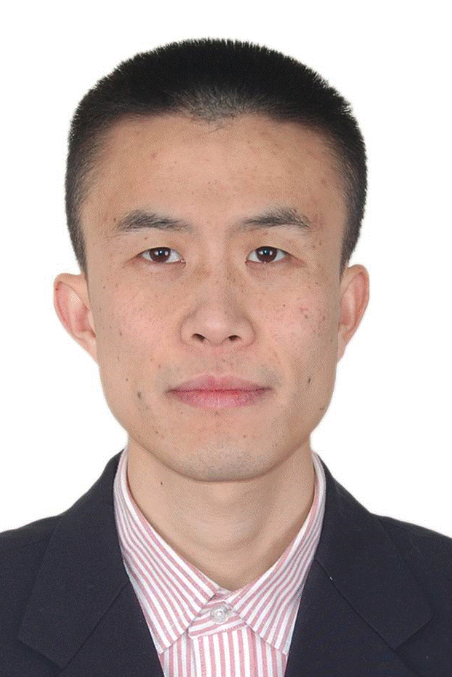
 Changjie Tang (唐常杰)合作论文数College of Computer Science, Sichuan University70
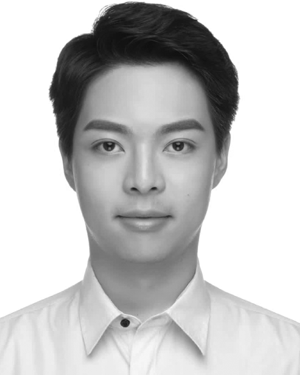
 Jie Zuo (左劼)合作论文数College of Computer Science, Sichuan University37
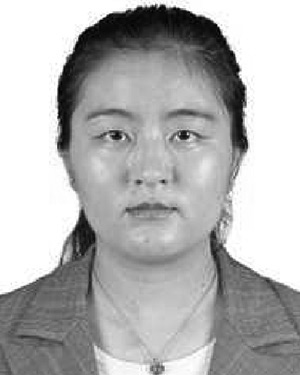
 Chengxin He合作论文数Sichuan University, Chengdu, China28
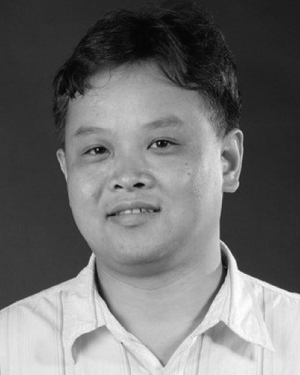
 Xinye Wang合作论文数24
 Huiru (Jane) Zheng合作论文数School of Computing, Ulster University17
 Guozhu Dong合作论文数Department of Computer Science and Engineering, Wright State University;Kno.E.Sis Center of Excellence, Wright State University;University of Melbourne17
 Yidan Zhang合作论文数Sichuan University, Chengdu, China13
 Jyrki Nummenmaa合作论文数Faculty of Information Technology and Communication Sciences, Tampere University12
 Liang Du (杜亮)合作论文数School of Computer and Information Technology, Shanxi University11
 Song Deng合作论文数11Zhenyang Yu (余祯阳)合作论文数10
 Ruiqi Qin合作论文数Sichuan Univ, Sch Comp Sci, Chengdu, Sichuan, Peoples R China10
 Chuan Li (李川)合作论文数College of Computer Science, Sichuan University10
 Jesse Li-Ling合作论文数9Guicai Xie合作论文数9Pan Qin (秦攀)合作论文数8Tianqing Zhang (张天庆)合作论文数College of Computer Science, Sichuan University8
 Ning Yang (杨宁)合作论文数College of Computer Science, Sichuan University8
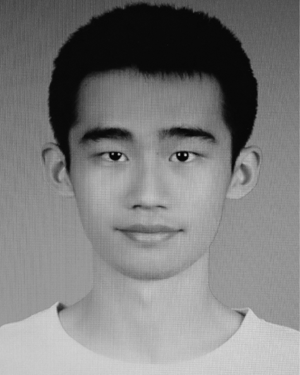 Zihao Chen合作论文数7
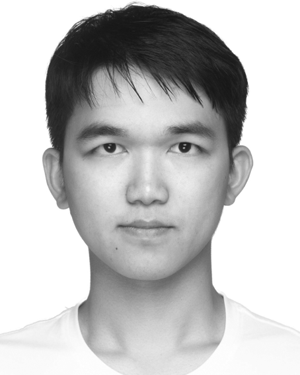 Weipeng Jiang合作论文数7Yuening Qu合作论文数7
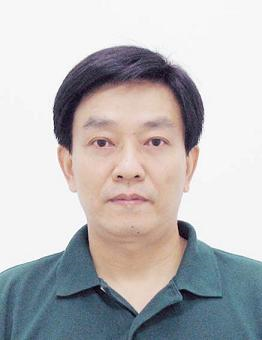 Jun Zhu (朱俊)合作论文数College of Physics, Sichuan University7
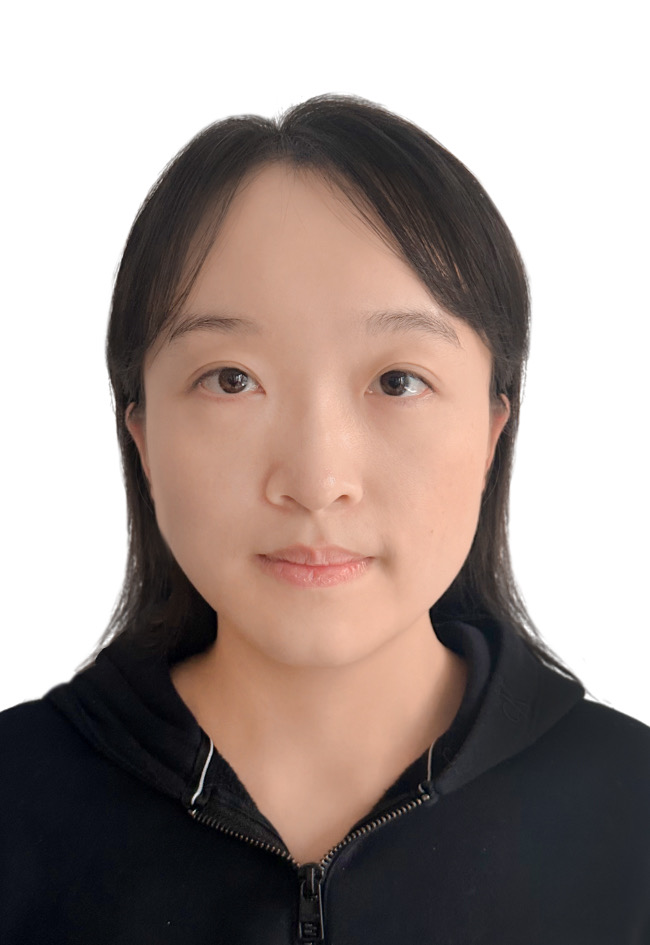 Tingting Wang合作论文数School of Computing Technologies, RMIT University7Kaikuo Xu合作论文数7
 Zhaohang Luo (罗钊航)合作论文数Nuclear Power Institute of China;Paris Elite Institute of Technology, Shanghai Jiao Tong University6
 Hao Yang合作论文数6Dagang Wei (魏大刚)合作论文数6Jie Gong (巩杰)合作论文数6
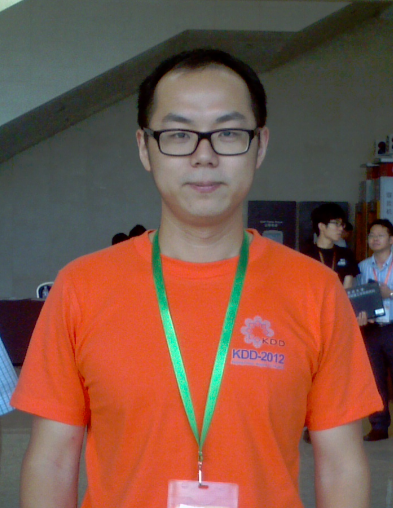 Liang Tang合作论文数Google6
 Yexi Jiang合作论文数Roblox6Longhai Li合作论文数5
 Yue Wang (王悦)合作论文数School of Information, Central University of Finance and Economics5
 Peng Zhou (周芃)合作论文数School of Computer Science and Technology, Anhui University5Yixiao Zhong (钟义啸)合作论文数5Jing Peng合作论文数School of Electronics Engineering and Computer Science; Peking University; Beijing 100871, China
5Yintian Liu合作论文数5Shan Xiao合作论文数4Jiaxuan Xu合作论文数4Runze Ma合作论文数4Tinghai Pang合作论文数Sichuan Univ, Sch Comp Sci, Chengdu, Sichuan, Peoples R China4Geng Deng合作论文数4
Peng Zhou (周芃)合作论文数School of Computer Science and Technology, Anhui University5Yixiao Zhong (钟义啸)合作论文数5Jing Peng合作论文数School of Electronics Engineering and Computer Science; Peking University; Beijing 100871, China
5Yintian Liu合作论文数5Shan Xiao合作论文数4Jiaxuan Xu合作论文数4Runze Ma合作论文数4Tinghai Pang合作论文数Sichuan Univ, Sch Comp Sci, Chengdu, Sichuan, Peoples R China4Geng Deng合作论文数4 Jiaoling Zheng (郑皎凌)合作论文数Big Data Research Institute, Chengdu University of Information Technology4
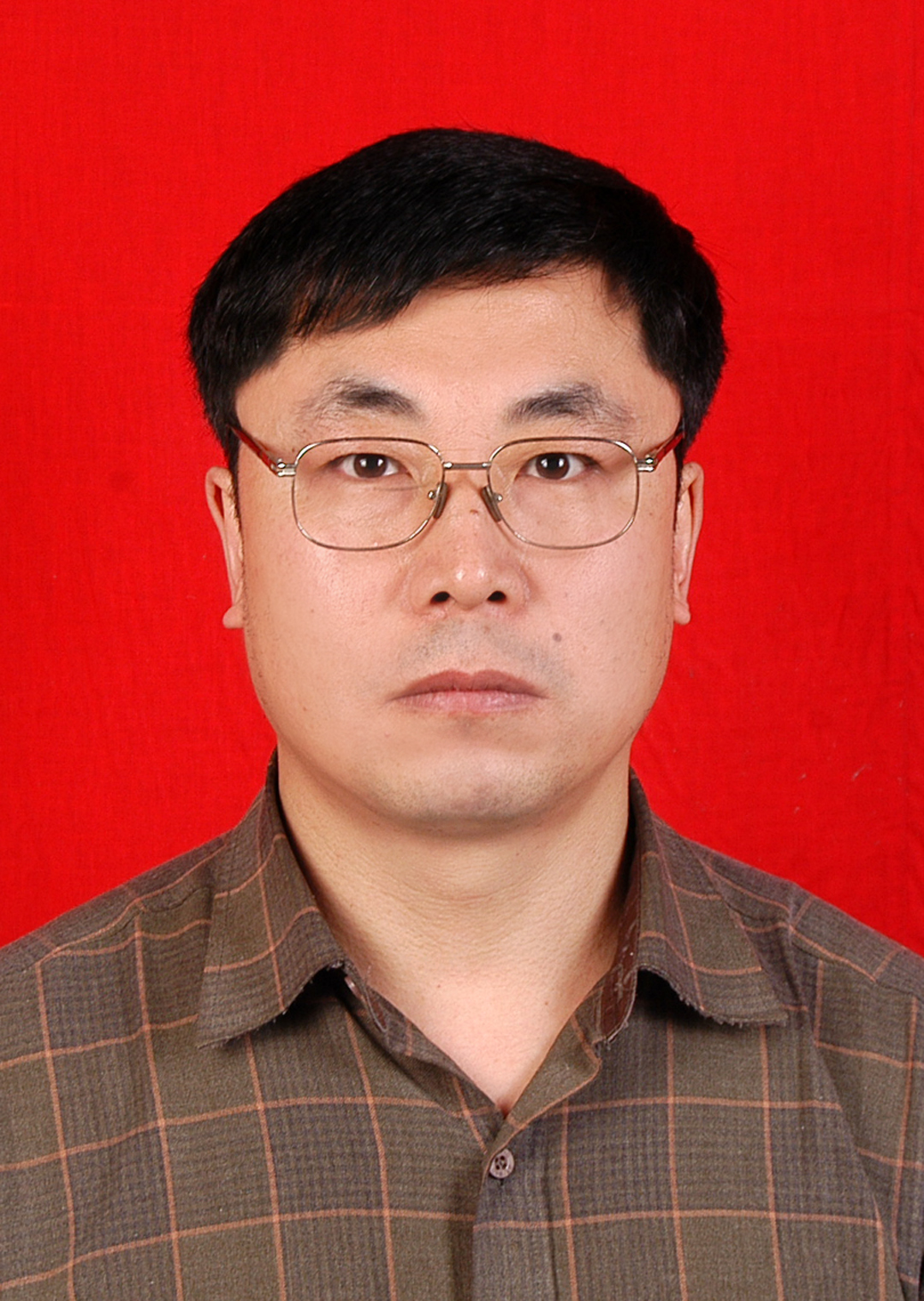 Zhonghua Yu (于中华)合作论文数College of Computer Science, Sichuan University4
 Mingjie Tang (唐明洁)合作论文数College of Computer Science, Sichuan University;Intelligence and Database System Lab, Department of Computer Science, Sichuan University4
 Haiying Wang合作论文数School of Computing and Mathematics, University of Ulster4
 An-long Chen (陈安龙)合作论文数School of Information and Software Engineering, University of Electronic Science and Technology of China4
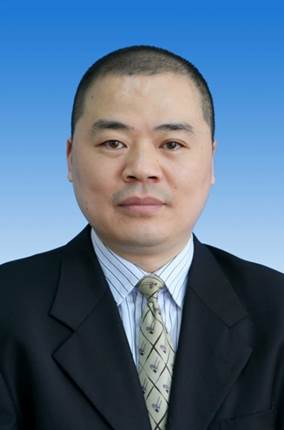 Taiyong Li (李太勇)合作论文数School of Computing and Artificial Intelligence, Southwestern University of Finance and Economics4
 Jiang Wu (吴江)合作论文数SWUFE-UD Institute of Data Science Atswufe, Southwestern University of Finance and Economics4




