The process of hydrolysis of amide groups of polyacrylamide in the presence of a dispersion of nanosized copper particles obtained via the reduction of copper cations with sodium tetraborate has been studied. Quantum-chemical simulations have shown an increase in the effective positive charge on the carbon atom in the amide group upon formation of the complex with copper. Energy of interaction of units of polyacrylamide and polyacrylic acid macromolecules with a unit area of copper nanoparticles has been calculated. The significant difference in the energies leads to replacement of the hydrolyzed amide groups of the polymer from the surface of copper particles by the unreacted amide groups. The degree of hydrolysis of polyacrylamide in the presence of copper particles has been 89%, being 22% in the absence of the particles.
In this work, the initiation mechanism of the propylene cation polymerization monomer in the presence of an aluminum chloride - water catalyst in a heptane solvent with a stoichiometric composition of 1:1:1:3 was studied. Quantum-chemical modelling was performed using the ab initio RHF method, which best calculates the energy characteristics of the reaction - the activation energy and enthalpy values, according to the reaction coordinate RH(11)-C(1) with optimization for all geometric parameters by the gradient method built into the Firefly program based on the GAMESS source code. The total charge for all interaction models was 0, and the multiplicity (M) was 1, since all the electrons in the models were paired, and therefore the total spin is S=0 (therefore M=2S+1=1). The reaction is conditionally divided into three stages of interaction: the first is the coordination stage, the second is the stage of formation of the active center (AC) or the stage of breaking the π-bond of the monomer, and the third is the formation of the final structure of the interaction of the complex catalyst AlCl3 - H2O with propylene. It is shown that the value of the activation energy is 111 kJ/mol, and the thermal effect is 77 kJ/mol. The reaction is endothermic. During the reaction, the simultaneous breaking of O(10)-H(11) bonds and the transformation of C(1)=C(2) π-bond (double) into σ-bond (single) and the formation of a new bond - C(1)-H(11) and the counterion [AlCl3 - OH]-, as a result of which the active center is formed, which is a polarized intermediate [AlCl3 - OH]- ... C+3H6 (counterion - carbation). The change of charges on atoms, the behavior of reaction fragments, breaks and the formation of new bonds indicate that it follows a pattern of coordinated interactions.
For the first time, a quantum-chemical study of the reaction of protonation of the monomer of cationic polymerization of p-methylstyrene in the presence of a complex catalyst boron fluoride – water in toluene with a stoichiometric composition of 1:1:2 was carried out by the ab initio method with the reaction coordinate RC1-H20. I t is shown that the value of the activation energy is 123 kJ/mol, and the thermal effect of the reaction is 86 kJ/mol. It has been proved that the interaction of the studied catalytic complex with p-methylstyrene in toluene of stoichiometric composition 1:1:2 is a coordinated process.
For the first time, a quantum-chemical study of the reaction of protonation of the monomer of cationic polymerization of p -methylstyrene in the presence of a complex catalyst boron fluoride – water in toluene with a stoichiometric composition of 1:1:2 was carried out by the ab initio method with the reaction coordinate R C1-H20 . I t is shown that the value of the activation energy is 123 kJ/mol, and the thermal effect of the reaction is 86 kJ/mol. It has been proved that the interaction of the studied catalytic complex with p -methylstyrene in toluene of stoichiometric composition 1:1:2 is a coordinated process.
For the first time, a quantum-chemical study of the reaction of protonation of the monomer of cationic polymerization of p-methylstyrene in the presence of a complex catalyst boron fluoride – water in toluene with a stoichiometric composition of 1:1:2 was carried out by the ab initio method with the reaction coordinate RC1-H20. I t is shown that the value of the activation energy is 123 kJ/mol, and the thermal effect of the reaction is 86 kJ/mol. It has been proved that the interaction of the studied catalytic complex with p-methylstyrene in toluene of stoichiometric composition 1:1:2 is a coordinated process.
Using the classical semi-empirical quantum-chemical method МNDO, for the first time the calculation of graphene oxide molecules was performed within the framework of the Nakajima-Matsuo and Lerf-Klinovsky models. The acidic strength of these models and the Hartree energy are theoretically estimated. It was found that the studied graphene oxides belong to dielectrics and to the class of intermediate Bronsted acids (pKa = 9-14).
In this work, we performed a quantum-chemical calculation of some epoxy molecules: 1,2-epoxy-butene, 1,2-epoxy-2-methylpropane, 1,2 epoxyethane by the density functional theory DFT. An optimized geometric and electronic structure of these compounds is obtained. It was found that the studied epoxides belong to the class of very weak СH-acids (pKa = 28-30).
The DFT method was used to perform a quantum-chemical calculation of graphene isomers from 7 hexagons. The energy of the forbidden zone of these models is estimated theoretically. It is shown that the energy of the forbidden band depends very significantly on the structure of the configuration of the isomers of the studied graphene.
The ab initio 3.21G method was used to study the initiation mechanism of 2-methylpentene-1 under the action of a complex catalyst AlClCH - HO in heptane of stoichiometric composition 1:1:1:1. The energetics of this reaction is estimated, the values of its energy barrier and enthalpy are obtained.
For the first time, the geometric and electronic structure of graphene oxide was calculated within the framework of the Hoffman and Ress models by the quantum-chemical method MNDO. Optimized structures of this compound are obtained. The acidic strength (pKa = 28 and pKa = 14) was theoretically estimated in the Hoffman and Ress model, respectively.
 A. I. Rakhimov合作论文数36
 V. A. Babkin合作论文数Favorskii Institute of Chemistry, Russian Academy of Sciences36д с андреев合作论文数27а в игнатов合作论文数20Gennadii E Zaikov合作论文数11V. S. Belousova合作论文数9
 Roman G. Fedunov合作论文数V.V. Voevodsky Institute of Chemical Kinetics and Combustion, Siberian Branch of the Russian Academy of Sciences8FOMICHEV V T合作论文数7
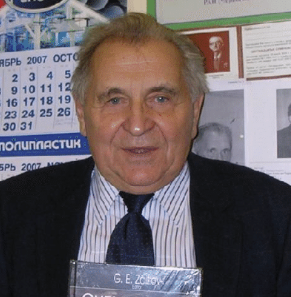 G. E. Zaikov合作论文数N. M. Emanuel Institute of Biochemical Physics7V. V. Vovko合作论文数6и ю каменева合作论文数6M. I. Artsis合作论文数6N. A. Shreibert合作论文数5R. O. Boldyrev合作论文数5V. U. Dmitriev合作论文数4E. V. Kozlovskii合作论文数3А.Р. Титова合作论文数3г е заиков合作论文数3
 Dmitrii Fedorovich Pyreu合作论文数3И. А. Короткова合作论文数2M. B. Navrotskii合作论文数2о в стоянов合作论文数2S. N. Rusanova合作论文数2
 Ivan A. Novakov合作论文数Department of Technology of High-Molecular Compounds and Fibrous Materials, Volgograd State Technical University2
 Aleksandr Efremov合作论文数Ivanovo State University of Chemical Technology Ivanovo2G. A. Savin合作论文数2I. Yu. Kameneva合作论文数1A. E. Mikhailyuk合作论文数1Л Ф Стоянова合作论文数1T. S. Krivonogikh合作论文数1F. S. Radchenko合作论文数1н а рахимова合作论文数1в в трифонов合作论文数1oleg v kulikov合作论文数1yu v popov合作论文数1валерий тарасович фомичев合作论文数1I. A. Kirillov合作论文数1N. G. Lebedev合作论文数Volgograd State University1O. V. Stoyanov合作论文数1S. V. Kudashev合作论文数1O. V. Vostrikova合作论文数1Irina V. Terekhova合作论文数1N. K. Tsenev合作论文数1A. S. Ozerin合作论文数1
 Oleg Ponomarev合作论文数1




