The evolution of ore-forming fluids in gold precipitation is a key aspect in understanding the genesis of orogenic gold deposits. Traditional fluid inclusion analyses are often limited in revealing the fluid property changes during mineralization, leading to significant debates on the mineralization temperature and fluid sources. In this study, we selected the Liba gold deposit in the West Qinling orogen and employed scanning electron microscope–cathodoluminescence (SEM-CL) and laser ablation–inductively coupled plasma mass spectrometry (LA-ICPMS) to analyze the microstructure and trace element characteristics of quartz veins, revealing the multi-stage evolution of ore-forming fluids and the mineralization mechanisms. SEM-CL imaging identified five distinct quartz stages. The pre-mineralization (Qz0) and early-stage mineralization (Qz1) fluids were predominantly magmatic–metamorphic in origin, as indicated by relatively high δ18O and δD values. During the primary metallogenic (Qz2a, Qz2b) and late-stage mineralization (Qz3), temperatures progressively decreased, and the gradual mixing of meteoric water and formation water was observed, which promoted gold precipitation. And the content of trace elements in post-mineralization quartz (Qz4) is significantly lower and similar to that in the Qz0 stage. Through the analysis of quartz trace elements (e.g., Al/Ti, Ge/Al ratios) and isotope data (δ18O = 8.25‰ to 12.67‰, δD = −119.1‰ to −79.8‰), the results indicate that the Liba gold deposit is a medium- to low-temperature orogenic gold deposit. Furthermore, the gold enrichment process was primarily driven by a hydrothermal system, with variations in the fluid composition during mineralization contributing to the concentration of gold.
In porphyry systems, the physicochemical properties of ore-related intrusions critically influence both metallogenic fertility and the resulting metal assemblages. Biotite is a widespread magmatic mineral capable of recording subtle changes in physicochemical parameters throughout the evolution of porphyry systems. Throughout the years, several biotite thermobarometers have been proposed; however, the most appropriate combination for application to porphyry systems remains uncertain. In the Julong Cu–polymetallic district, where magmatic biotite is pervasive in the ore-related intrusive suite, we integrate available temperature, pressure, and oxygen fugacity data to assess which combination of biotite-based thermobarometers best captures the physicochemical condition of the magma. Our results demonstrate that the structural formula recalculation method of Li et al. (2020), when combined with the thermometer of Li and Zhang (2022) and the barometer of Uchida et al. (2007), yields the most accurate reconstruction of magmatic conditions in porphyry systems. In the Julong district, this integrated approach reveals that the earliest granodiorite crystallized at depths of ~3.2–6.3 km, under strongly oxidizing conditions (~NNO+3 to HM) and in the presence of elevated volatile concentrations. A slightly younger monzogranite formed at ~4.4 km depth, recording lower oxygen fugacity conditions (~NNO+2 to NNO+4). Its elevated F concentration and lower oxygen fugacity suggest a genetic link to the fractional crystallization of magmatic phases, especially magnetite. On the other hand, the ore-related monzogranite porphyry (~NNO+3 to HM) shares the oxidized signature of the granodiorite and was emplaced at ~3.4 km depth. Its low log(fH2O/fHCl) value reflects elevated HCl activity, conducive to the efficient magmatic transport of Cu and Mo.
Liba gold deposit, located in the western Qinling metallogenic belt, is a super-large gold deposit. The source of ore-forming materials and the mechanism of gold enrichment and precipitation are still controversial. Through detailed field investigation and microscopic observation, this paper studies the occurrence characteristics of pyrite and arsenopyrite in mining areas, and delineates the geological-mineralization processes as the sedimentary (-metamorphic) period, pre-mineralization/early mineralization stage, main mineralization stage, and late mineralization stage. In-situ geochemical studies of major, trace elements and sulfur isotopes of pyrite in different stages show that pyrite (PyO) in the sedimentary stage is a typical sedimentary genesis, pyrite (Py2) in the main metallogenic stage and pyrite (Py3) in the late metallogenic stage are generally characterized by hydrothermal genesis, while pyrite (Pyl) in the pre-metallogenic and early metallogenic stage has the characteristics of composite genesis of sedimentation and hydrothermal. There is a good positive correlation between Au and As contents in pyrite, which indicates that gold mostly exists in pyrite and arsenopyrite in the form of solid solution. Au, Sb, Pb and Tl in pre-mineralization and early mineralization stage pyrite (Pyl) are predominantly incorporated into the crystal lattice through isomorphic substitution, but tend to separate from the crystal lattice of pyrite in the main stage of mineralization and in the late stage of mineralization. Sb, Pb and other elements exist in pyrite in the form of inclusions such as galena, while Au may be finely dispersed in pyrite or exist in other sulfides. The 8"S value of pyrite in Liba gold mine is 2.54%-12. 1%, which reflects that sulfur mainly comes from magmatic hydrothermal solution generated by water-rock reaction with surrounding rock strata. The geological thermometer estimation results of arsenopyrite show that the ore-forming temperature and sulfur fugacity of ore-forming fluids tend to decrease from early stage to late stage, reflecting sulfur depletion in the fluid system caused by arsenopyrite precipitation.
Qingshan Au-Pb deposit, located in Tanjianshan ore concentration area, northern Qaidam basin, is a paragenetic or associated Au-Pb orogenic deposit that is very rare in the world. The ore of the deposit mainly exists in the schist of the Paleoproterozoic Darken Daban Group, whose distribution is controlled by the NW-trending fault. There are two types of ores, i.e., the altered rock type and the quartz vein type. Sulfides, including pyrite, limonite, galena, chalcopyrite, sphalerite and so on, are well developed in the ores. Among them, the pyrite is the main gold-bearing mineral in the deposit, whose geochemical characteristics not only indicate the existent state of gold but also reveal the properties of ore-forming fluid and the genesis of deposit. Samples of different types of ores and country rocks together with pyrite in them at different depths in boreholes ZK2103 and ZK3701 were selected to analyze their whole rock compositions and ore-forming elements. The chondrite-normalized REE distribution model curves of the measured samples are right-lean-shaped with obvious Eu negative anomaly, but no Ce anomaly, showing that the ore-forming fluid is from metamorphic without any seawater. The ores are relatively enriched Au, Ag, Cu, Pb, Zn, As, Co, Bi, Sb, W, Ni, Sr, Cd and V elements, but depleted in Sn, Mo and Cr elements. The S/Fe values of pyrite in the ore and country rocks are less than 2.0, showing they are depleted in S but enriched in Fe. The Au/Ag value of pyrite is greater than 0.5, and the results of Co-Ni diagram all show that the pyrite is of hydrothermal origin. The gold mainly exists in the form of nanoparticles, with a small amount of gold existing in the form of solid solution. Gold was mainly transported in the form of Au(HS)2-. However, the mixing of fluids destroys the stability of Au(HS)2-, that is most likely the reason for gold precipitation. The sulfur content in the ore-forming fluid is high, as a result, a certain amount of Cu, Pb and Zn will be migrated with sulfur. After the gold precipitates, the reduction of temperature and pressure in the fluid leads to the Pb precipitation. Due to the limited ability of the fluid to transport Pb and Zn, the lead ore of Qingshan deposit developed in small scale. The results of S and Pb isotopes show that the ore-forming material comes from the strata, however, contents of Pb and Zn in the strata of Jinlonggou and Qinglonggou mining areas is low, so there is no lead ore formed in this area.
The Sangong Cu-Ni sulfide mineralized mafic-ultramafic intrusion is located on the southern margin of the Bogeda-Harlik belt, eastern Tianshan, China. The intrusion is a well-differentiated complex and is comprised of leucogabbro, gabbro, olivine gabbro, Pl-bearing peridotite, and Pl-bearing pyroxenite. The Pl-bearing pyroxenite hosts both irregularly disseminated sulfide and round droplet sulfide. The intrusive rocks have a wide range of SiO2 (42.1 wt.
在大量典型矿床剖析的基础上,以矿物学、岩石学、矿床学、构造地质学、地球化学等基础理论为指导,以大量实地观察和实验数据为支撑,通过总结矿山深部和外围找矿实践和典型矿床研究成果,按照成矿作用内因和外因相结合的辩证思维,成矿作用时间、空间、物质能量相统一的综合思维,以及元素地球化学分类和找矿预测矿床分类的比较思维,提出成矿地质体、成矿构造和成矿结构面、成矿作用特征标志等概念.成矿地质体是形成矿床主要矿产、决定主成矿阶段空间位置的成矿地质作用的实物载体,划分为沉积作用、火山作用、岩浆作用、变质作用和大型变形作用形成的 5 类成矿地质体.成矿结构面是赋存矿体的各类界面,包括构造界面、岩性界面、物理化学转换界面;成矿作用特征标志是能够直接指示矿体赋存位置和对找矿预测具有特殊意义的标志.依据成矿地质作用对中国主要矿床类型进行梳理划分,归纳总结了主要矿床类型的地质特征,构建了反映矿体赋存位置的成矿地质体-成矿结构面-成矿作用特征标志"三位一体"找矿预测地质模型.在此基础上,提出勘查区找矿预测的工作方法,对矿床学研究、找矿预测、矿产勘查工作具有重要的指导意义.
位于东昆仑造山带东段的浪木日铜镍钴多金属矿床,在新近勘查工作中又圈出独立的铂矿体,对该矿床成矿特征的进一步研究有助于指导勘查找矿.通过矿床地质特征分析,结合含矿橄辉岩主微量元素、Sr‐Nd同位素及其中橄榄石、云母主量元素测试,以及黑云母花岗岩锆石U‐Pb年代学及岩石地球化学特征研究,探讨了浪木日矿床成矿特征、成矿时代及矿床成因.含矿橄辉岩中橄榄石属贵橄榄石(Fo值为86.72~88.39),云母为金云母,其均为幔源岩浆作用产物;含矿橄辉岩稀土元素具右倾型的配分模式,富集Cs、Rb、U等元素,ε Nd (t)值为0.66~2.66,暗示其形成过程中经历了地壳混染.获得黑云母花岗岩U-Pb年龄为414.5±8.8 Ma,其具弧岩浆地球化学特征,( 87 Sr/ 86 Sr) i (0.718 609~0.719 177)、ε Nd (t)值(1.28~5.36)显示其为壳幔岩浆混合作用产物.本研究认为浪木日铜多金属矿床具叠加成矿特征,在450~439 Ma形成与橄辉岩有关的铜镍钴铂钯矿体的基础上,叠加了415 Ma的与黑云母花岗岩有关的热液脉型铜矿化;本矿床以早期与橄辉岩有关的硫化物成矿为主,岩浆演化过程中的地壳混染及岩浆期后热液活动对成矿具积极贡献.本矿区基性-超基性杂岩体底部及顶部、黑云母花岗岩与之接触部位均为有利找矿空间.
The Qingshan gold deposit is located in the Tanjianshan ore collection area, which is in the northern margin of Qaidam Basin and is one of the most important gold and polymetallic metallogenic belts in China. Based on the field investigation and optical microscopic observations, mineralization at the Qingshan deposit can be divided into three stages: (1) quartz-pyrite stage, (2) quartz-sulfide-gold stage, (3) quartz-calcite stage. Pyrite from the stage 1 (Py1), stage 2 (Py2) and stage 3 (Py3) are selected for LA-ICP-MS trace element analyses. Pyrite from the stage 1 (Py1), stage 2 (Py2) are selected for in situ sulfur isotopes analysis. Pyrite from the stage 1 (Py1), stage 2 (Py2) and stage 3 (Py3), galena from the stage 1 (Gn1) and stage 2 (Gn2) are selected for in situ lead isotopes analysis. The result shows that Py1 is relatively rich in Co, Ni, Zn and Ag contents and lacking in Sb contents. Py2 is relatively rich in Cu, As, Sb, Au, Pb and Ag contents and lacking in Co, Ni and Bi contents. Py3 is relatively rich in Co, Ni and Bi contents and lacking in Zn, As, Au and Pb contents. The Au/As ratio shows that invisible gold occurs in the form of solid solution (Au+). The values of Au/Ag and Co/Ni ratio show that the pyrites in the Qingshan deposit are hydrothermal origin. The S isotope values of pyrite range from -4.33 to 4.97%o (mean: 3.71%o, n = 31). The Pb isotope compositions with 206Pb/204Pb, 207Pb/204Pb, and 208Pb/204Pb values ranging from 18.002 to 18.791, 15.567 to 15.584, and 38.410 to 38.485, respectively. The results of in situ S-Pb isotopic indicate that sulfur and metals of the Qingshan deposit were mainly derived from the upper crust and orogenic belts. The Qingshan gold deposit is classified as an orogenic gold deposit, and was closely related to a large-scale ductile shear zone, which formed during the process of subduction between the Qaidam block and the Qilian block in the Variscan period. The mixing of fluids destroyed the stability of Au(HS)2- and is most likely the reason for gold precipitation.
牛苦头矽卡岩型铅锌矿床是祁漫塔格成矿带最重要的铅锌多金属矿床之一.前人对牛苦头矿床的成岩成矿年代学、成矿岩体性质、矽卡岩矿物成因、流体包裹体、成矿系统以及矿床成因进行了研究,但对于成矿类型与成矿环境存在不同的认识.牛苦头矿区中典型矿物(磁黄铁矿、黄铁矿、黄铜矿、磁铁矿、闪锌矿及方铅矿)电子探针分析结果表明,黄铁矿与磁黄铁矿均富Co贫Ni,且磁黄铁矿以单斜磁黄铁矿为主,磁黄铁矿多与黄铜矿共生,代表了一种中温特征的矿床;黄铜矿、闪锌矿与方铅矿硫含量较高,且闪锌矿以铁闪锌矿为主,Zn/Cd值较低,代表中高温矽卡岩型矿床成因;且早期磁铁矿较晚期磁铁矿更富集MnO、TiO2、Al2O3,均指示矽卡岩型以及岩浆热液型成因.综合各矿物标型特征认为,牛苦头铅锌矿床为具矽卡岩型和热液型特征的中温矿床.
The Qimantagh area of East Kunlun orogeninc belt is an important skarn–type polymetallic mineralization belt in Qinghai, and the Niukutou deposit is located in the central–western part of this area, which is one of the middle–large Pb–Zn skarn deposits in Qimantagh area. In view of the controversy about the diagenetic and metallogenic age and the source of the metal ore–forming materials of Niukutou ore district, the zircon and pyrite chronology has been studied by LA–ICP–MS and thermal surface ionization mass spectrometry Re–Os isotope testing technology in this paper. The results show that the ages of the ore-forming granite bodies at the bottom of the 10 line drill hole in the M1 ore block of Niukutou ore district are (362.2±2.7) Ma and (361.8±3.4) Ma respectively, and the Re–Os isochron age of the pyrite closely associated with the sphalerite in the main mineralization stage is (359.2±6.3) Ma. This shows that the diagenesis and mineralization age of the skarn Pb–Zn polymetallic deposit in Niukutou ore district are coupled at (362.2±2.7)~(359.2±6.3) Ma, which further indicates that the skarn Pb–Zn polymetallic deposit was formed in the late Devonian of Variscan. The initial 187OS/188Os of pyrite is 0.13±0.24, which indicates that the metal ore–forming materials of Niukutou Pb–Zn deposit are of crust mantle mixed source, and formed under the extensional background of collision–post collision in the tectonic magmatic cycle from Early Paleozoic to early Late Paleozoic at Late Devonian.
The Niukutou Pb-Zn deposit is typical of skarn deposits in the Qimantagh metallogenic belt (QMB) in the East Kunlun Mountains. In this study, based on detailed petrographical observations, electron microprobe analyses (EMPAs), and laser-ablation–inductively coupled plasma–mass spectrometry (LA-ICP-MS) analyses, we report the major and trace element compositions of the typical skarn mineral assemblages (garnet, pyroxene, ilvaite, epidote, and chlorite) in this deposit. Three hydrothermal mineralization stages with different mineral assemblages of the prograde metamorphic phase were determined, which were distributed from the inside to the outside of the ore-forming rock mass. Grt1+Px1 (Stage 1), Grt2+Px2 (Stage 2), and Px3 (Stage 3) were distinguished in the Niukutou deposit. Furthermore, the ilvaites in the retrograde metamorphic phase can be divided into three stages, namely Ilv1, Ilv2, and Ilv3. The ore-forming fluid in Stage 1 exhibited high ∑REE, U, and Nd concentrations and δEu, δCe, and LREE/HREE values, which were likely derived from a magmatic–hydrothermal source and formed at high temperatures, high fO2 values, and mildly acidic pH conditions, and probably experienced diffusive metasomatism in a closed system with low water/rock ratios. In Stages 2 and 3, the ore-forming exhibited lower ∑REE, U, and Nd concentrations and δEu, δCe, and LREE/HREE values, with high Mn content that had likely experienced infiltrative metasomatism in an open system with high water/rock ratios. From Ilv1 to Ilv3, the δEu and U contents decreased, whereas the Mn content increased, indicating that the oxygen fugacity of mineralization was in decline. The ore-forming fluid evolution of the Niukutou deposit can be characterized as follows: from Stage 1 to Stage 3, the hydrothermal fluid migrated from the deep plutons to the shallow skarn and marble; the environment altered from the high fO2 and temperature conditions to low fO2 and temperature values, and the pH and Mn contents increased. The fluids contained considerable metal ore-forming materials that were favorable for the enrichment and precipitation of the Fe content. In the retrograde metamorphic phase, with the decrease in oxygen fugacity (from Ilv1 to Ilv3), the temperature and oxygen fugacity of the theore-forming fluid environment decreased, ultimately becoming conducive to the dissolution and precipitation of Pb and Zn elements.
辽宁五龙金矿是辽东地区大型岩浆热液型矿床之一,成矿作用主要与中生代火成岩有关,为了进一步理清五龙地区中生代火成岩成因,笔者等对五龙金矿区大量花岗斑岩脉、闪长岩脉、三股流岩体和其中的各类脉岩进行了单颗粒锆石LA-ICPMS U-Pb测年和岩石主、微量元素地球化学研究.结果表明,五龙地区岩浆岩形成时代主要有晚侏罗世和早白垩世,矿区内近南北向展布的花岗斑岩脉形成于晚侏罗世(154.3±0.9~155.6±1.1 Ma),指示矿区在晚侏罗世受到区域最大主应力方向为近南北向;三股流岩体成岩最新年龄(116.8±0.8~117.3±0.7 Ma)基本位于前人报道的年龄范围(111~129 Ma);地球化学数据表明各类岩浆岩属于高钾钙碱性—钾玄岩系列,具有相同源区特征,形成于活动大陆边缘俯冲伸展环境下的弧岩浆,并且具有壳幔混合及进一步演化特征;结合不同深度标高成矿元素丰度特征,指示闪长岩与成矿作用密切相关,并且越往深部成矿潜力越大,对该地区找矿预测具有重要指导意义.
牛苦头铅锌多金属矿床位于东昆仑造山带祁漫塔格地区中西段,目前已探明铅和锌金属量(推断及以上)115×104t,为祁漫塔格地区最具成矿潜力的矽卡岩型铅锌矿床之一.本次研究通过野外工作,对牛苦头M1、M4磁异常区典型矿体的样式及产状研究,总结出牛苦头矿区共有五种矿化(体)类型,其中矽卡岩型矿体和贯入式矿体是牛苦头矿山的主要矿体.结合牛苦头矿区成矿类型及矿化样式,对牛苦头铅锌多金属矿床成因模式进行了进一步的探讨,认为矽卡岩型矿体产于远离成矿岩体的大理岩与碎屑之前的硅钙面,而贯入式矿体产于靠近岩体的层间断裂之中.两类矿体的识别对于牛苦头铅锌多金属矿床成因模式的研究以及成矿规律的总结具有重要意义.
近年来,人们在大兴安岭南部发现了多处与白垩纪花岗岩相关的锡多金属矿床,但并非所有该时期的花岗岩都与锡矿伴生.为了解花岗岩伴生锡矿的形成条件,本文对内蒙古北大山岩体中的含锡石(磨盘山)与不含锡石(窟窿山)花岗岩开展了锡石U-Pb年龄、锆石U-Pb年龄、全岩地球化学及矿物地球化学分析测试,并进行岩石学、年代学和岩浆演化物理化学条件的对比.结果表明,窟窿山石英正长斑岩和磨盘山黑云母花岗岩的锆石U-Pb加权平均年龄分别为140.2±0.7 Ma和139.9±0.7 Ma,磨盘山黑云母花岗岩锡石U-Pb加权平均年龄为134.9±1.4 Ma,时代均属于早白垩世.全岩地球化学分析结果表明,这些岩石具有高硅(SiO2=64.96%~76.71%),富碱(Na2O+K2O=8.28%~9.03%),过铝质(Al2O3=12.42%~15.88%)的特点.相对富集Th、Pb、Hf等元素,亏损Nb、Ta、Ti、Sr、P等元素.轻稀土相对重稀土明显富集,Eu异常明显.窟窿山石英正长斑岩与磨盘山黑云母花岗岩在哈克图解上,随着SiO2含量增加,TiO2、FeOT、Al2O3、CaO、Na2O、P2O5含量逐渐降低,呈现较好的负相关关系,暗示二者具有同源性.但窟窿山样品的DI值为89,Sn含量为2×10⁻⁶;磨盘山样品具有较高的DI值(96~98),Sn含量高(15×10-6~36×10-6).从矿物学特征反演的物理化学条件推测,窟窿山岩体经历了温度降低、氧逸度升高的过程,而磨盘山岩体在降温过程中氧逸度进一步降低.另外,在流体卤素含量上,黑云母的IV(F)、IV(Cl)指示磨盘山花岗岩(IV(F)=0.95~1.15,IV(Cl)=-3.66~-3.54)相较于窟窿山石英正长斑岩(IV(F)=1.24~1.28,IV(Cl)=-2.96~-2.52)具有更高富集程度的Cl和F含量.综上,低氧逸度、高演化程度和高的F、Cl丰度是影响北大山地区花岗岩是否含锡的重要原因.
牛苦头矽卡岩型铅锌多金属矿床位于东昆仑造山带祁漫塔格地区中西段,是祁漫塔格地区近年来发现最大的矽卡岩型铅锌矿床之一.本文通过牛苦头M1磁异常区采坑周边及矿权西侧开展等值反磁通瞬变电磁法(以下简称"OCTEM")以及野外地质调查编录,共识别出8条NE向、北西陡倾断层,圈定了8条低阻异常,综合研究认为I号异常东侧为已知矿体或矿化体所致,西侧可能为揭露矿体或矿化体向西的延伸.II号异常应为第四系下伏地层中的低阻层,异常内局部区域可能为断层引起的低阻.本文认为NE向构造为M1磁异常区主要导矿构造,矿体的形成受NE向构造控制明显.I号异常和II号异常可能为已知矿体西延导致,为矿致异常.根据低阻带延伸方向,本文认为M1采坑西南侧32-18线以及16-6线仍具有较大找矿潜力.
东天山黄山东和黄山西镁铁-超镁铁岩是区域早二叠世大规模幔源岩浆作用的产物,赋存有两个大型岩浆铜镍硫化物矿床.黄山东和黄山西矿床的主要矿体均赋存于超镁铁岩中,其含矿超镁铁岩的成因机制研究对揭示区域铜镍硫化物成矿作用机制具有重要意义.本文对黄山东和黄山西含矿超镁铁岩进行了详细的电子背散射图像研究,发现其斜长石斑晶存在显著的不平衡结构,并系统进行了电子探针成分剖面分析.结果显示斜长石具有剧烈变化的成分环带,其中黄山东超镁铁岩斜长石An值介于48.6~75.6,黄山西含矿超镁铁岩斜长石An值介于44.9~79.2,表明两个矿床含矿超镁铁岩的母岩浆在侵位过程中发生过显著的成分变化.结合黄山东和黄山西镁铁-超镁铁杂岩体地质特征,本文认为高分异镁铁质岩浆的加入导致了低分异超镁铁质岩浆成分发生显著变化,致使岩浆硫化物熔离,以及黄山东和黄山西大型铜镍硫化物矿床的形成.
The Wulong deposit is a large gold deposit in the Liaodong peninsula (North China Craton). Silicic and pyrite alterations are well-developed in the deposit and closely related to mineralization. The least altered and silicified microdiorite samples were selected for major and trace element analyses to reveal the elemental migration/enrichment. Pyrites of stage 1 (Py1) were selected for backscattered electron (BSE) imaging and LA-ICP-MS trace element analyses to reveal their possible metallogenic link. Mass balance calculation showed that Al2O3, CaO, Fe2O3, K2O, SiO2, Ag, As, Cu, and Pb were brought in, whereas MgO, Na2O, FeO, Cr, Zn, and Ni were leached out during silicification. LA-ICP-MS trace element analyses show that Py1 has higher Au and Zn contents than Py2 and Py3, Py2 has higher Au and Cu contents than Py1 and Py3, and Py3 has higher Pb, Cu, and As contents than Py1 and Py2. During the process of silicification and pyritization, the depleted H+ concentration and HS− concentration in the ore-forming fluids led to instability of the Au(HS)2− complexes and led to gold precipitation. The depleted sulfur and the reduced temperature during the precipitated of bismuthinite also led to instability of the Au(HS)2− complexes and gold precipitation.
Three generations of garnets are distinguished in the Yamansu volcanic-hosted skarn iron deposit in NW China, and their detailed textures and geochemical characteristics are presented to reveal the mechanisms controlling the distribution of trace elements in the garnets and to discuss the physicochemical conditions and evolution of the ore-forming fluid. First-generation garnets (Grt1) show well-preserved core-rim growth zonation and have considerable variations in composition (And25-99Gro0-73). Second-generation garnets (Grt2) show complex core-mantle-rim zonation textures with high andradite components (And54-99Gro0-44). Third-generation garnets (Grt3) occur in veins and exhibit nearly monotonic textures and geochemical components (And48-51Gro46-49). Garnet crystals in different generations have variable trace element compositions, such as REEs, U, and Y. We speculate that Grt1 cores were derived from a magmatic-hydrothermal fluid and crystallized in a closed system with low water/rock (W/R) ratios, low oxygen fugacity, and neutral pH, with the distribution of trace elements in Grt1 cores being largely controlled by crystal chemistry. However, during the crystallization of Grt1 rims and Grt2 cores, the hydrothermal fluid system is interpreted to have been open with high W/R ratios and with internal complexes (Cl complex) and external fluid (seawater-like) integrally controlling the fluid properties. The incorporation of trace elements into the Grt1 rims and Grt2 cores was controlled by not only crystal chemistry but also crystal-liquid equilibrium. The Grt2 mantles and rims are interpreted to have formed in a closed system as a result of crack-seal fluid flow. The inferred stable conditions associated with low W/R ratios, a reducing environment, and nearly neutral pH favored Fe reduction in the hydrothermal fluid and provided a material basis for later deposition of iron ores. Grt3 likely formed under near-equilibrium chemical conditions, with low W/R ratios during periods of slow fluid influx determined by episodic supply of hydrothermal fluids, and their distributions were largely controlled by crystal chemistry. The special environment of multistage hydrothermal fluid in the Yamansu deposit was the key factor controlling the multiple enrichment and precipitation of trace elements into garnet.
尾亚矿床是东天山地区规模最大的钒钛磁铁矿矿床,其含矿岩体中新发现了夕卡岩捕虏体.尾亚夕卡岩捕虏体具有核-边二元结构,其核部为外夕卡岩,其边部为内夕卡岩.尾亚外夕卡岩以它形结构和含有镁橄榄石为特征,内夕卡岩则以半自形粒状结构和含有高钙契尔马克分子单斜辉石为特征.尾亚夕卡岩捕虏体的发现表明其含矿岩体母岩浆在运移和就位过程中同化混染了碳酸盐岩地层.碳酸盐岩同化混染作用改变了尾亚含矿岩体Sr-Nd-O同位素组成,导致了斜长石的大量结晶堆积,以及尾亚钒钛磁铁矿矿床的形成.
 Lingli Long (龙灵利)合作论文数Beijing Institute of Geology for Mineral Resources56
 Jingbin Wang (王京彬)合作论文数Beijing Institute of Geology for Mineral Resources Co., Ltd.43
 Dedong Li合作论文数北京矿产地质研究院有限责任公司31
 Lijuan Wang (王莉娟)合作论文数Beijing Institute of Geology for Mineral Resources28Yu Shi (石煜)合作论文数19Zhen Liao (廖震)合作论文数17
 Zhiyuan Sun合作论文数15HongJing Jie (解洪晶)合作论文数14
 Xinyou Zhu (祝新友)合作论文数Beijing Institute of Geology for Mineral Resources Co., LTD14Zhichao Zhang合作论文数13LuTong Zhao (赵路通)合作论文数13GuoChao Zhou (周国超)合作论文数13Pingzhi Tang (唐萍芝)合作论文数11
 HuiQiong Zhang (张会琼)合作论文数Beijing Institute of Mineral Geology, Beijing 100012, China10
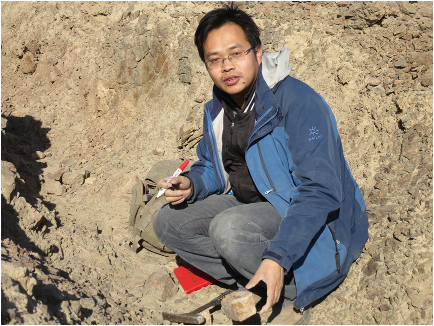 Qigui Mao (毛启贵)合作论文数Beijing Institute Of Geology For Mineral Resources10Hongjing Xie合作论文数9LiJuan Wang (王莉娟)合作论文数9
 Shulai Wang (王书来)合作论文数Beijing Institute of Geology for Mineral Resources Co.,Ltd9
 Boran Guo合作论文数8Tao Zou (邹滔)合作论文数1) Zhongse Zijin Geological Exploration (Beijing) Co., LTD., Beijing 100012, China;
2) Beijing Institute of Mineral Geology Co., LTD., Beijing 100012, China7KeXin PU (蒲克信)合作论文数6
Boran Guo合作论文数8Tao Zou (邹滔)合作论文数1) Zhongse Zijin Geological Exploration (Beijing) Co., LTD., Beijing 100012, China;
2) Beijing Institute of Mineral Geology Co., LTD., Beijing 100012, China7KeXin PU (蒲克信)合作论文数6 Chun-Kit Lai合作论文数Fac Sci, Univ Brunei Darussalam6
 Xiao-Hua Deng合作论文数6YiHan GAO (高一菡)合作论文数5Shenghui Li合作论文数5Xin-yu WANG (王新雨)合作论文数5Jin-rong WU (吴锦荣)合作论文数5JiaDuo Li (李加多)合作论文数5TongHui Fang (方同辉)合作论文数5Mingjie Yu (于明杰)合作论文数School of Geography, South China Normal University5Cai Ma (马财)合作论文数4Ya-wei CAI (蔡亚伟)合作论文数4ShunTing Li (李顺庭)合作论文数4HaiKui Tong (童海奎)合作论文数4Rufu Ding (丁汝福)合作论文数北京矿产地质研究所4Gao Liming合作论文数3Xinyu Wang合作论文数3JinZhu Qiu (邱金柱)合作论文数3JunSheng Wang (王军升)合作论文数3JiNiu Deng (邓吉牛)合作论文数3
 Qingdong Zeng (曾庆栋)合作论文数Key Laboratory of Mineral Resource, Institute of Geology and Geophysics, Chinese Academy of Sciences3
 Jianming Liu (刘建明)合作论文数桂林电子科大计算机科学与工程学院3
 Lingli Zhou合作论文数Faculty of Science, Geology and Geochemistry, Vrije Universiteit Amsterdam;Department of Earth Sciences, Vrije Universiteit Amsterdam;University College Dublin;Institute of Geochemistry, Chinese Academy of Sciences3
 Heping Zhu合作论文数United States Department of Agriculture3wang lijuan (莉娟 王)合作论文数2Haicheng Qiu合作论文数2Guanbin Wu合作论文数2Quan-xin QIN (秦全新)合作论文数2




