Bacteria are widely distributed in the biosphere, with roles ranging from beneficial microorganisms to deadly pathogens. Accurate bacterial counting is thus crucial for safeguarding human health and establishing effective medical support systems. An atomic force microscopy (AFM) is capable of generating ultra-high-resolution images, enabling researchers to quantify the number of microscopic bacteria. However, traditional manual methods are time-consuming and labor-intensive, making precise bacterial counting difficult to implement. To address the above issues, a deep learning-based approach is introduced in this paper to achieve automated bacterial counting based on AFM images. Specifically, a novel deep neural network, named as pyramid agregation MPCount, is proposed based on density map estimation to count sixteen bacterial species, including Achromobacter xylosoxidans, Burkholderia cenocepacia, Escherichia coli, etc. The proposed model achieves the minimum quantification error via training and testing on a dataset containing 588 AFM bacterial images. Experimental results demonstrate that the proposed method is efficient in identifying and counting bacteria, serving as a reference scheme for rapid and accurate microbial counting in medical systems.
Shape memory alloy (SMA) is widely used in many fields due to the excellent properties. However, in spaceconstrained microscale applications, it faces the significant challenge to control SMA wires since traditional macroscopic models heavily rely on temperature parameters, which are difficult to accurately estimate or measure without augmenting structural complexity. To address the issue, this study builds a reproducible intrinsic model considering stress, strain and resistance of the SMA wires. Specifically, a characteristic measurement platform is first set up to collect displacement-resistance data of the SMA wire with the diameter of $76 \mu \mathrm{m}$ under different loads (141 g, $179 \mathrm{g}, 225 \mathrm{g})$. On this basis, a long short-term memory (LSTM) neural network is established as a practical displacementresistance prediction model, which captures the nonlinearity and temporal dependence of the SMA phase transition data without relying on temperature parameters. Experiments verify that the model achieves the good fitting performance, particularly, the model still meets the requirements of microscale applications under the load condition with obvious R-phase effect.
Bacterial classification commonly relies on the specialized knowledge and the laborious procedure. To address the issue, a spatial-spectral feature fusion attention residual network (SFFA-Net) is designed to achieve automated bacterial classification in this paper. Specifically, a bacterial image dataset generated by the atomic force microscopy is first established for high-precision network training. Subsequently, the SFFA-Net is built via designing a residual network to perform feature extraction and encode the discriminative representations of the specimens. On this basis, the twin-branch feature extraction module is designed to extract two-dimensional and three-dimensional features, respectively. Subsequently, the improved squeeze and excitation attention blocks are introduced to focus on the key areas of the feature maps to improve the classification accuracy. Besides, an auxiliary classifier is designed to further enhance the model performance by bringing in additional supervision signals. The superiority of the proposed method is verified through comparative experiments.
To eliminate distortion caused by vertical drift and illusory slopes in atomic force microscopy (AFM) imaging, a lifting-wavelet-based iterative thresholding correction method is proposed in this paper. This method achieves high-quality AFM imaging via line-by-line corrections for each distorted profile along the fast axis. The key to this line-by-line correction is to accurately simulate the profile distortion of each scanning row. Therefore, a data preprocessing approach is first developed to roughly filter out most of the height data that impairs the accuracy of distortion modeling. This process is implemented through an internal double-screening mechanism. A line-fitting method is adopted to preliminarily screen out the obvious specimens. Lifting wavelet analysis is then carried out to identify the base parts that are mistakenly filtered out as specimens so as to preserve most of the base profiles and provide a good basis for further distortion modeling. Next, an iterative thresholding algorithm is developed to precisely simulate the profile distortion. By utilizing the roughly screened base profile, the optimal threshold, which is used to screen out the pure bases suitable for distortion modeling, is determined through iteration with a specified error rule. On this basis, the profile distortion is accurately modeled through line fitting on the finely screened base data, and the correction is implemented by subtracting the modeling result from the distorted profile. Finally, the effectiveness of the proposed method is verified through experiments and applications.
Scaling a large crawling robot to the centimeter-level size is a major technical challenge, which mainly includes the research on mechanical structure design, independent battery life, maneuverability, and perception. For most miniature crawling robots, it is difficult to synchronously balance the aspects of simple structure, good maneuverability, and visual perception. Aiming at such problems, this article designs a composite-cam- driven miniature hexapod crawling robot, named NKhex, with the abilities of visual perception and target tracking. The size of the microrobot is centimeter-level, and only two micromotors are used as drivers. The tripod gait motion of the robot can be realized with the six outriggers through the composite cam transmission mechanism. The robot is equipped with a miniature camera and has the functions of visual perception and object recognition via training neural networks, based on which it can achieve trajectory tracking and moving target tracking through closed-loop control. Besides, the robot is able to crawl and turn quickly in narrow space and outdoor environment, thus presenting potential applications in emergency rescue and data collection in dangerous areas. Sufficient experiments are carried out to verify the motion performance and perception ability of the robot.
Although the piezoelectric actuator (PEA) has the advantages of high displacement resolution and fast response speed, the positioning performance is weakened by the hysteresis nonlinearity and the unknown disturbance. To address this issue, a compound control strategy based on a well-designed temporal convolutional network (TCN) is proposed in this paper to achieve accurate trajectory tracking of the PEA. Specifically, the feedforward compensation is implemented via a TCN-based hysteresis inverse model, and the response speed and the tracking accuracy of the system is thus improved due to the powerful time series feature extraction capability of the TCN. Moreover, to reduce the damage of the modeling error and the unknown disturbance to the tracking performance, a single neuron adaptive proportional-integral-derivative controller is designed to improve the tracking accuracy and the robustness through adaptive adjustment of the control parameters, thus achieving accurate tracking of the desired trajectory. Numerous simulations and comparative experiments are conducted to fully validate the effectiveness of the proposed approach.
To expand the current limited research of three-dimensional (3D) cooperative dual boom cranes (CDBCs), this paper proposes a dynamic model of CDBCs in 3D space for the first time, which provides a foundation for precise motion control. Based on geometric constraint analysis and the Lagrangian modeling method, the proposed model accurately describes the dynamic characteristics of practical systems. Moreover, coordinated boom motion trajectories are designed for preliminary control realization of 3D CDBCs, which facilitates engineering applications. Finally, simulations and hardware experiments are implemented under different working conditions, which verifies the effectiveness of the proposed model and trajectories.
Morphology analysis based on atomic force microscopy (AFM) imaging contributes to understanding the characteristics of specimens more deeply. The preliminary and crucial step of implementing morphology analysis is to precisely segment the target area from the complex background. In this study, an automated AFM image segmentation strategy based on a well-designed U-shaped neural network is proposed to achieve accurate and robust segmentation for AFM images of different samples, thus realizing morphology analysis in micro-nano scale. Specifically, the centralized information interaction strategy cooperated with a two-path attention module is introduced to realize efficient cross-scale information interaction, which can fundamentally avoid the negative effects induced by spatial interpolation. Besides, the global information flows are adopted to guide the global information extracted by atrous spatial pyramid pooling to each level of the top-down pathway, which ensures that the high-level semantic information is not diluted during the top-down transmission process, thus locating the target area more precisely. Moreover, an AFM image dataset is constructed to train the network, which will be available online for free to facilitate other data-based AFM research. The segmentation results demonstrate that the proposed strategy has better performance on multiple AFM images compared with traditional Otsu method, fully convolutional network and U-Net. The application of the proposed method is carried out to exhibit the effectiveness in automated morphology analysis. Note to Practitioners —Despite the growing demand of AFM-based morphology analysis in many fields, the automated analysis is still lacking limited by accuracy and robustness of AFM image segmentation. Since manual segmentation, sometimes tedious and time-consuming, heavily depends on the personal judgment, it is thus necessary to develop automated segmentation methods. Although traditional automated segmentation algorithms have good performance on certain types of images, they may be difficult to apply in different scenarios, especially for micro-nano images, due to the limited robustness. Therefore, this paper proposes an automated image segmentation algorithm based on an improved U-shaped neural network to achieve accurate morphology analysis for AFM images. The proposed automated morphology analysis workflow will be a practical tool to help reduce human workload and subjective errors, as well as enhancing the accuracy and robustness of the analysis process. In addition, the constructed AFM image dataset can greatly facilitate the research on data-based AFM image analysis of other practitioners. Moreover, practitioners can benefit from our algorithm to improve the accuracy and robustness of image segmentation in other practical applications.
In this paper, considering the emergency braking problem for double pendulum crane systems, we propose a swing suppression guaranteed braking method with safety limits consideration, whose performance is also theoretically proved. Since the workspace for double pendulum cranes may be complex, while the transported payload may be large, it is of great significance to design proper emergency braking methods to make the entire double pendulum crane brake quickly and avoid possible accidents. By carefully analyzing the crane dynamics and taking into account the important swing suppression objective, coupling enhanced terms are designed based on the coupling behavior between the trolley motion and the swing angles. Then the coupling enhanced terms are combined with crane mechanical energy function, which further introduces swing angle-related feedback terms and achieves better swing suppression performance. Furthermore, safety limits are also taken into consideration by designing a special barrier function-like term, which can restrict the payload and hook horizontal positions in permitted domains. Based on all these terms, the swing suppression guaranteed braking method is designed with rigorous mathematical analysis proposed to shown its proper performance. To the best of our knowledge, it is the first emergency braking method for double pendulum cranes. Experimental tests are also implemented by using a hardware crane testbed, which further verify the effectiveness of the proposed method.
The piezoelectric actuator (PEA) is widely used to realize high precise motion of the micro-systems. However, the inherent nonlinear property such as hysteresis, creep, thermal drift and vibration impairs the overall performance and leads to the system instability. In this paper, a practical nonlinear model predictive control (PNMPC) approach based on an echo state network is proposed for the displacement tracking of PEAs. The proposed method has the advantage of omitting the common building process of an inversion model for hysteresis compensation, which avoids the problem of model inversion and the inversion imprecision. Specifically, an echo state network (ESN) is adopted to model the nonlinear dynamics of the PEA system. On this basis, the PNMPC method is designed via utilizing the linearized ESN model, which reduces the computational complexity of the optimization problem caused by nonlinear model predictive control. Finally, the tracking performance of the proposed controller is verified through experimental results.
Considering that the hysteresis described by the classical Prandtl-Ishlinskii (CPI) model is usually symmetric, this paper presents a modified generalized Prandtl-Ishlinskii (MGPI) model for pneumatic artificial muscles (PAMs), which can describe dynamic hysteresis nonlinearities by considering different loads and frequencies. Currently, it is still a challenging issue to achieve tracking control of PAMs because of their inherent characteristics such as dynamic hysteresis nonlinearities, output saturation, and creep. Unlike the commonly used rate-dependent PI model which linearly changes the weights or thresholds with the input rate, the proposed model changes the shape of envelope functions in GPI play operators. The MGPI model, in particular, has the advantage of directly describing the output-to-input relationship with fewer to-be-identified parameters, which reduces the computational burdens in real-time applications. To validate the efficacy and accuracy of the proposed model, a self-built PAM experiment platform is performed, and the obtained experimental results show that the proposed method achieves satisfactory tracking performance.
To lessen the positioning error of the piezoelectric actuator (PEA) caused by hysteresis nonlinearity and unknown external disturbance, a neural network based adaptive controller is designed to realize the accurate trajectory tracking of the PEA. Specifically, a more universal model, consisting of a hysteresis submodel and a dynamics submodel, is first built for the PEA without the requirement of parameter identification. On this basis, a sliding mode adaptive controller capable of handling unknown parameters of the dynamics submodel is designed to weaken the damage of external disturbance to the system stability. Furthermore, to deal with the hysteresis submodel with unknown structure and parameters, a neural network based self‐tuning control scheme is developed to enable the PEA to accurately track the desired trajectory. Moreover, Lyapunov stability analysis is performed to strictly prove that the tracking error of the system can asymptotically converge to zero. Finally, the performance of the designed controller is verified via sufficient comparative simulations and experiments.
>Dear editor,The inherent hysteresis of a piezoelectric actuator(PEA) results in intricate nonlinearity between the output displacement and input voltage, which restricts positioning accuracy of the actuator [1, 2]. Hysteresis behavior appears as a coupling of nonlinearity, frequency-dependence and memory characteristic, which makes it difficult to comprehensively characterize hysteresis [3]. To eliminate the effect of hysteresis on the positioning accuracy of PEAs,
Crane systems are commonly used transportation tools in industry to transport heavy cargoes to corresponding target positions. If the cargo shape is large which could not be regarded as a mass point or the hook mass also needs to be taken into account, the cranes would perform as double pendulum systems, whose dynamics are more complex than those of single pendulum systems. Since the working environment for crane systems can be very complex in practice, unavoidable emergency situations may occur, which are very dangerous. To avoid possible accidents, effective emergency braking methods are urgently needed, especially for double pendulum cranes with large cargoes. Considering this fact, this paper presents a coupling enhanced braking strategy for double pendulum cranes, which stops the trolley fast and achieves double pendulum vibration elimination objectives simultaneously. Specifically, an elaborately designed variable consisting of the trolley movement, the hook’s swing, and the payload’s swing, is utilized as feedback, which enhances the system couplings and improves the vibration elimination ability. Some constraint items are also introduced to restrict the payload in a safety domain and further avoid possible collisions. The effectiveness is rigorously analyzed and proved by mathematical analysis. Some experiments are executed to show the performance of the designed strategy.
To shorten the scanning time by focusing on the local scanning for such specimens as cells, this article proposes an advanced scanning strategy based on autonomous exploration, so as to detect the specimen in real time and achieve fast imaging for an atomic force microscopy. More specifically, fast raster scanning is first performed to locate the initial boundary point of the specimen. On this basis, a boundary tracking algorithm is proposed to construct the internal boundary of the specimen online through the autonomous exploration of the probe. Afterward, the boundary is expanded according to the internal boundary tracking direction, based on which a convex hull of the specimen is further constructed for the local scanning. Furthermore, the local slow scanning is performed for the specimen according to the generated scanning trajectory. Subsequently, unscanned areas in the sample can also be scanned by this autonomous method. Experimental results verify that the proposed method can achieve fast scanning while ensuring high-quality imaging.
To improve the scanning speed of an atomic force microscopy (AFM), a smooth scanning pattern is elaborately devised via trajectory shaping in this paper, so as to achieve fast imaging without hardware modification. Specifically, in the proposed scanning method, the piezoelectric actuator tracks a well-designed smooth periodic signal in x-direction, and simultaneously tracks a step signal in y-direction. The advantage of the proposed method is that it does not require additional data reprocessing to construct the morphology of the sample surface, while significantly increasing the scanning bandwidth restricted by the raster scanning method. Particularly, to directly utilize the height data collected by scanning to produce the sample morphology, the forward process in the common raster scanning mode is retained in the proposed method, the tracking signal in the forward process is thus set to a ramp function in x-direction. In addition, to ensure the continuity and smoothness of the entire tracking signal in x-direction, a segment of a sine curve is uniquely determined as the backward tracking signal by position and acceleration constraints, so as to ensure that the forward and backward curves are continuous and acceleration-continuous at the intersection point. Moreover, the frequency spectrum analysis of the designed smooth signal is carried out to exhibit the depressed amplitudes of high-frequency components, which demonstrates that the proposed method is able to reduce the resonance in AFM high-speed scanning, so as to improve the capacity of rapidly generating high-quality images. Finally, convincing comparison experiments are implemented to verify the imaging performance of the designed scanning algorithm.
Adaptive control is widely used in nonlinear systems, and is under active research. Although the conventional adaptive control guarantees the asymptotic stability, it may yield limited performance in real experiments due to many factors, such as noise and hardware limitations. In this paper, a proportional-integral adaptive controller with a proportional-integral-derivative update law is proposed to attenuate the effect of measurement noise and improve the performance of the closed-loop system. Two more improvements, dividing differential signals into two smoother signals and facilitating additional estimations to weight different components of the same signal, are used in addition to the proportional-integral-derivative-type update law. The stability is proved theoretically and the performance is verified by simulation tests.
In this study, a novel digital compound compensation method is proposed to compensate for the hysteresis nonlinearity and the drift disturbance of a piezoelectric nanopositioning system with a large range. The overall hysteresis behaviors can be divided into the static amplitude-dependent behavior and the dynamic rate-dependent behavior, where the static hysteresis is compensated for by a novel discrete feedforward controller, while the dynamic hysteresis and the drift disturbance are compensated for by a novel discrete composite feedback controller composed of a drift observer-based state feedback controller and a repetitive learning controller. Compared with traditional control strategies, the proposed compound control strategy, including feedforward and feedback components, can eliminate system errors more effectively when tracking large range signals with obvious hysteresis. Moreover, the proposed online drift observer is superior over a traditional offline drift compensator both in response speed and compensation accuracy. Sufficient simulation tests and convincing tracking experiments, with large range periodic signals up to 90 μm, are carried out. And comparisons with the two classical control algorithms are performed. The tracking results show that the mean absolute error of the proposed control method is minor compared with the other two algorithms, which validates that the proposed strategy can efficiently compensate for the hysteresis nonlinearity and the drift disturbance.
In this study, a novel method combining pulse coupled neural network (PCNN) and social network search (SNS) is proposed to achieve accurate image segmentation for an atomic force microscopy (AFM). The proposed method utilizes the biological visual characteristics of PCNN and the solution space search ability of SNS to determine the optimal key parameters, which can address the issue of incorrect image segmentation caused by different topographic heights of specimens in an AFM image. In the tests, the performance of the proposed method is compared with the traditional PCNN method and the Otsu method, which demonstrates that the proposed method can automatically segment the AFM image with higher accuracy and robustness.
 Yongchun Fang (方勇纯)合作论文数College of Artificial Intelligence, Nankai University36
 Zhi Fan合作论文数18
 Cunhuan Liu合作论文数15Xiao Ren合作论文数11
 He Chen (陈鹤)合作论文数School of Artificial Intelligence, Hebei University of Technology5Yingao Chang合作论文数3Han Lu合作论文数3
 Huawang Liu (刘华旺)合作论文数Institute of Robotics & Automatic Information System, NanKai University3
 Ning Sun (孙宁)合作论文数Institute of Robotics and Automatic Information Systems, College of Artificial Intelligence, Nankai University;Underactuated Robots Lab, College of Artificial Intelligence, Nankai University3Ningning Qi合作论文数2
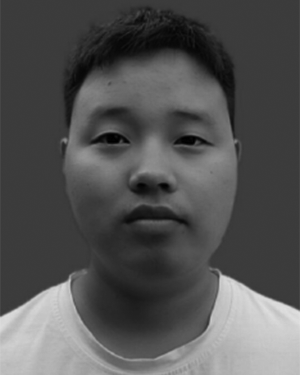 Mengyuan Li合作论文数2
 Qingxiang Wu (吴庆祥)合作论文数Institute of Robotics and Information Automation, College of Artificial Intelligence, Nankai University2
 Tong Yang合作论文数Nankai Univ, Coll Artificial Intelligence, Inst Robot & Automat Informat Syst, Tianjin 300350, Peoples R China2Wenbin Yan合作论文数1Jiayu Guo合作论文数1
 Fan Xu (徐璠)合作论文数School of Automation and Intelligent Sensing, Shanghai Jiao Tong University1
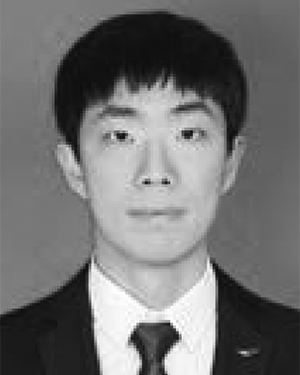 Xinlin Zhang合作论文数1Xiaozhe Yuan合作论文数1
 Zhuoqing Liu合作论文数1
 Gendi Liu合作论文数1
 Zhi-Ang Liu合作论文数College of Computer Science, Nankai University1YiFei Ren (任毅菲)合作论文数山西省农业科学院畜牧兽医研究所1Lv Qing合作论文数1
 Keping Liu合作论文数1
 Chao Wang (王超)合作论文数College of Life Sciences, Nankai University1
 Xin Ma (马昕)合作论文数School of Control Science and Engineering, Shandong University1Dong Sun (孫東)合作论文数1
 Xuebo Zhang (张雪波)合作论文数College of Artificial Intelligence, Nankai University1




